
Review · FRANCE HISTORY TOURS
Private Walking Guided Tour of Historic Bayeux English or French
Bayeux is compact, but its story is not. In two hours, this private walk links the Aure River’s medieval workshops, the Norman cathedral, the famous 11th-century embroidery, and the town’s role in the liberation of France in 1944. Guides such as Christele, Marie-Noelle, and Marie bring a local point of view, with history, architecture, language, and everyday details woven into the route.
I like the private format, since you can ask questions, slow down, or shift the focus toward art, military history, architecture, or local life. I also like the guide’s flexibility: past groups have adapted the route around rain, strong wind, anniversary security restrictions, and the temporary closure of the embroidery museum.
The main drawback is practical rather than historical. You will stand for much of the two hours, toilets are scarce, and the museum itself is closed until October 2027. The cathedral interior is not guaranteed within the two-hour visit, so plan this walk as an outdoor introduction rather than a complete museum tour.
Key points to know before booking
- More than 20 short stops can cover medieval trades, local expressions, architecture, famous figures, and wartime history.
- The private group limit is four people, making the $119.83 group price reasonable for couples, families, or friends traveling together.
- The Bayeux embroidery museum is closed until October 2027, but the guide explains its scenes, production, and historical importance outside.
- The route can change to suit your group, including age, mobility, interests, and the agreed meeting point.
- Foot pickup may be possible, but this means meeting the guide on foot at another location, not a car transfer.
- Bring a phone number, water, and a plan for toilet stops, since the walk includes many standing pauses and few facilities.
Why a private Bayeux walk works so well
Bayeux rewards a guide who can connect small details. A stone building, a bend in the river, or a tree in a square can open a door onto several centuries. On your own, you may photograph these sights without seeing how they fit together.
This tour keeps the group small, with a maximum of four people. That matters in an old town where lanes can be narrow and where stopping to look at architectural details can slow a larger group. You can ask about a Norman ruler, a French expression, a church feature, or the life of ordinary residents without waiting for a scheduled question period.
The guides are bilingual in English and French. The English delivery has earned particular praise for being clear enough to follow in difficult conditions, including strong wind. Christele is also noted for using recaps that pull the story together, which helps when the route jumps from medieval Bayeux to the Second World War.
The tone is friendly and alert rather than formal. You will hear local anecdotes, architectural observations, and historical explanation in the same walk. Marie-Noelle may point out acquaintances or shop owners along the way, giving the experience a more local feel than a standard lecture delivered to a passing group.
More History Walking Tours in France
- Paris: Dark History and Ghostly Guided Walking Tour
★ 4.7 · 1,000 reviews - Vieux Lyon Cultural & Historical Walking Guided Tour (English)
★ 5.0 · 942 reviews - Strasbourg: Guided Historical Neighborhoods Walking Tour
★ 4.9 · 275 reviews
Starting beside the tourist office
The usual meeting point is the Bayeux Tourist Office at 3 Rue Saint-Jean. If your accommodation is on the provider’s suggested pickup list, the guide may meet you there on foot. You can also request another walking meeting point, but it must be confirmed in advance and may alter the route.
The opening minutes at the tourist office set the tone. The guide introduces the town through more than dates and names, using linguistic expressions, old habits, local characters, and visible features around you. This is useful on your first day in Bayeux because it gives you a framework for the rest of your stay.
I would book this walk early in a Bayeux visit, not at the end. The guide can suggest museums, places to eat, and other sights afterward. One private group received particularly useful restaurant and museum suggestions, while another used the tour to understand places they had already seen but not yet placed in context.
Rue des Teinturiers and the Aure River
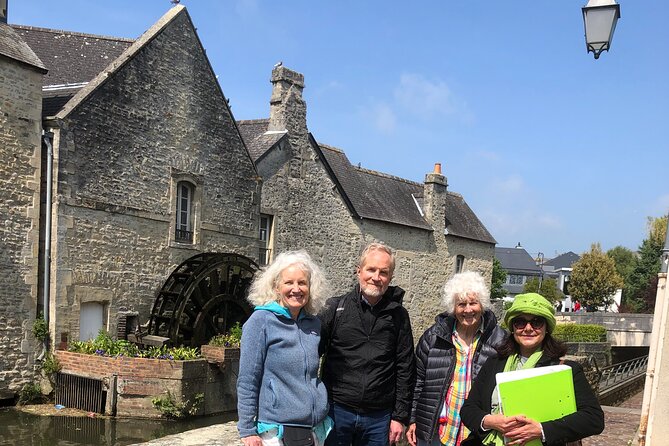
The stop on Rue des Teinturiers introduces the working side of medieval Bayeux. Here, the discussion turns to tanning and dyeing, with the Aure River at the center of those trades.
This is one of the tour’s best choices because it moves beyond grand buildings. Rivers were practical tools, not just pretty scenery. They supplied water for industries and shaped where people worked and lived. A guide can help you picture the mess, smells, labor, and economic activity that once filled these streets.
You will not enter a museum or reconstructed workshop here. Instead, the value comes from reading the street itself. If you want stories about everyday people rather than rulers and battles, ask directly. The tour is designed to adapt to questions, and the provider has indicated that ordinary life is a subject guides are happy to expand upon.
Allée des Augustines and the story behind the embroidery
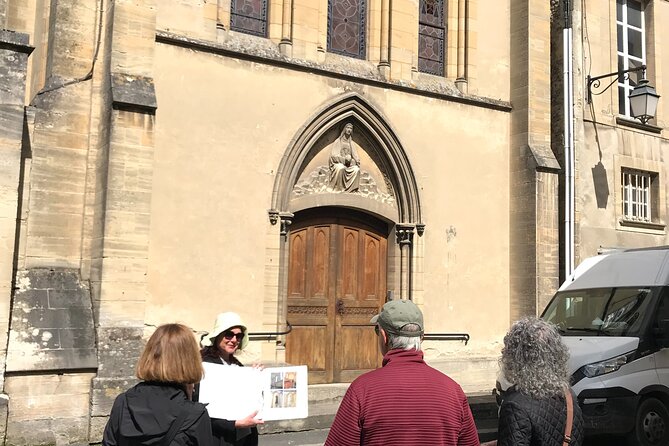
At Allée des Augustines, the guide explains the influence of the Augustine sisters on Bayeux. One sister also left her mark in what is now Canada, adding a wider connection to the town’s religious and social history.
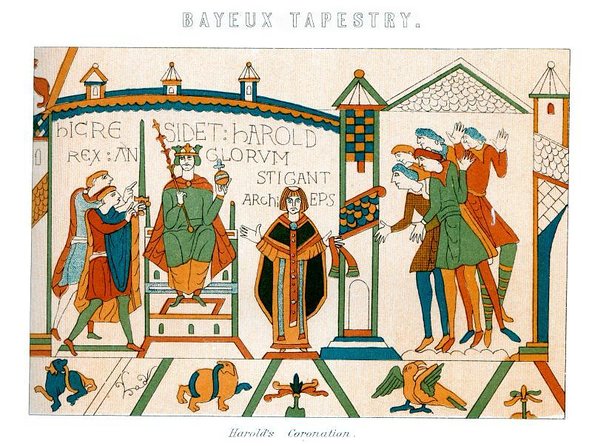
The alley also offers a chance to locate the famous Bayeux embroidery. The guide explains the Battle of Hastings, William the Conqueror’s accession to the English throne, and the people shown in the scenes. You will hear about the embroidery as an object, a historical source, and a piece of visual storytelling.
This is helpful if you plan to see the actual work later, though that is not possible at the moment because the museum is closed for a new building until October 2027. The guide can still explain how the work was made, why it matters, and what its scenes reveal about power, warfare, ships, clothing, and medieval storytelling.
Do not expect to view the embroidery during the walk. You are learning about it outdoors, near its museum, rather than entering an exhibit.
More Private History Tours in France
- Paris City of Fashion History Private Guided Walking Tour
★ 5.0 · 221 reviews - History of Paris City Center w/ Notre Dame Semi-Private 12ppl Max
★ 5.0 · 194 reviews - Strasbourg: Private Walking Tour of the Historical Center
★ 4.2 · 107 reviews - Private Guided History tour of Lourdes
★ 5.0 · 64 reviews
The closed embroidery museum and a useful substitute
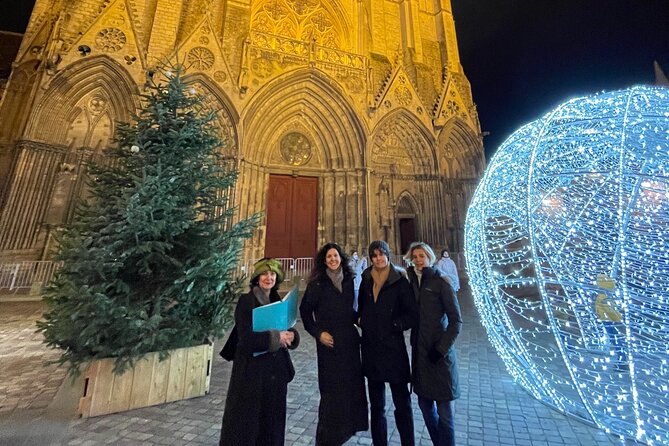
The stop outside the Musée de la Tapisserie de Bayeux lasts about 15 minutes. The museum’s closure is a major point to understand before paying for this tour. If seeing the original embroidery is your chief reason for visiting Bayeux, this walk cannot replace the museum, and the museum is not included.
Still, the outdoor explanation has value. The guide can walk you through the events and characters shown on the work, discuss its construction, and explain its place in Norman and English history. That preparation will help you make better use of the museum once it reopens.
The temporary closure has also made the private format more useful for some groups. Rather than simply skipping the subject, the guide can give you a careful explanation and then adjust the rest of the walk. In one rainy visit, the group spent more time inside the cathedral instead of adding an outdoor cemetery visit.
Roman remains and new glass on Rue Léonard Lambert Leforestier
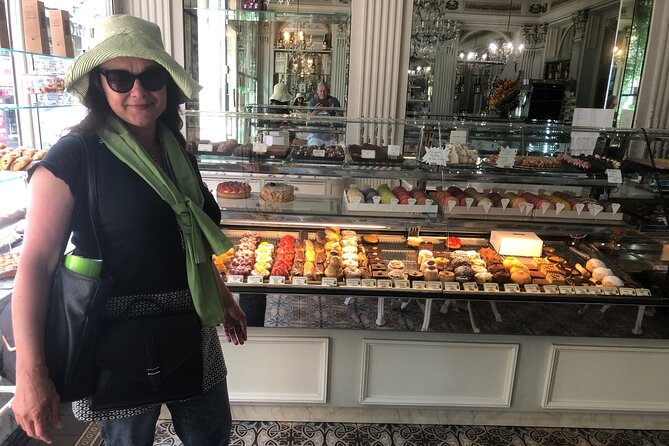
This street shifts the story back to Bayeux’s earliest roots. The guide explains the town’s origins in Celtic times and points out remains of the Roman castrum.
The stop also includes new dichroic glass, an unexpected modern detail in a route filled with older stone and timber. That contrast is valuable. Bayeux is not simply a preserved medieval display. It is a living town where new art and old structures share the same streets.
This part of the walk is brief, but it gives you a useful timeline. Bayeux did not begin with William the Conqueror or the Norman period. Its story reaches from Celtic settlement through Roman occupation, medieval religion and trade, revolutionary France, and the liberation of 1944.
Notre-Dame Cathedral, from building phases to details
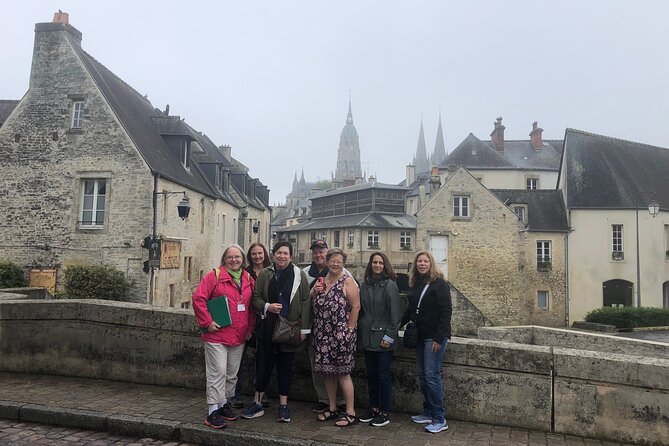
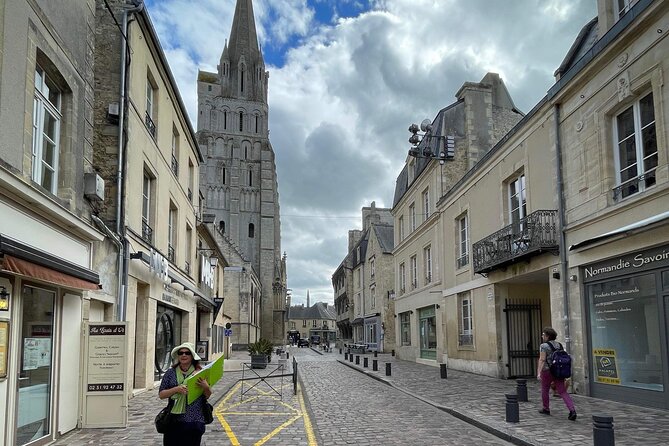
The cathedral stop lasts about 20 minutes, the longest pause on the listed route. The guide explains the different stages of construction and points out architectural features that are easy to miss when you walk through alone.
You may be able to enter the cathedral during the two-hour service if authorization is available that day. This is not guaranteed, so treat the interior as a possible addition rather than a promised part of the tour. If your main aim is a detailed cathedral visit, allow separate time afterward.
For most people, the explanation outside is still worthwhile. A cathedral built over different periods can look like one unified structure until someone shows you changes in style, materials, or design. An art historian’s eye is especially useful here. One group praised the way the guide connected architecture with the wider story of Bayeux rather than treating the building as an isolated monument.
The Liberty Tree and the French Revolution
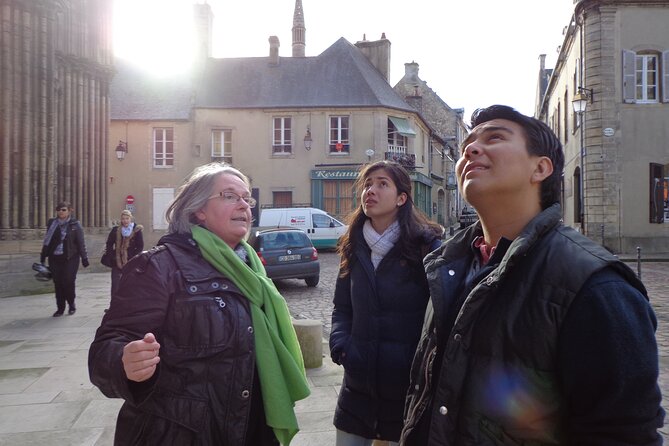
The Arbre de la Liberté is a sycamore more than 200 years old. The guide explains why it carries the name Liberty Tree and connects it to the French Revolution.
This is a small stop with a large civic theme. It shows how political ideals were marked in public spaces and how a living tree can become part of a town’s memory. The stop also breaks up the sequence of medieval and Norman subjects, giving you a clearer sense of how Bayeux changed through later French history.
You will pause here for about 10 minutes. If you have mobility concerns, tell the provider in advance. The route can be adjusted for age and mobility, and public benches may be used where available.
Place Charles de Gaulle and Bayeux in 1944
The final listed stop is Place Charles de Gaulle, where the guide discusses the liberation of Bayeux on June 7 and General de Gaulle’s first visit to the square.
This section matters because Bayeux’s wartime story is not only about nearby beaches and cemeteries. The town has its own place in the liberation of France, and the guide explains why that history remains important to local people.
A British cemetery visit is not part of this two-hour walk, though the subject may come up. In poor weather, a guide can explain the cemetery’s importance without taking you there. If you want a dedicated cemetery visit, reserve separate time and ask the guide for suggestions.
The route usually ends near À La Reine Mathilde at 47 Rue Saint-Martin, close to the main street and cathedral. The ending may change if you arrange a different walking pickup point.
What the $119.83 group price really buys
At $119.83 for up to four people, the price is easier to justify if you fill the group. Four people pay roughly $30 each for a two-hour private walk. For two people, the per-person cost is higher, but you gain more control over questions, pace, and subject matter.
You are paying for interpretation, not admission. The tour includes no museums, and it does not provide car transportation. Pickup, when available, is a walking meeting arrangement. That keeps the cost focused on the guide rather than transport.
The value is strongest for people who want context. If you only want a quick orientation and a few photographs, a free walk with a map may be enough. If you want to understand why a river mattered, how the cathedral developed, and how medieval and 1944 Bayeux connect, the private guide earns the fee.
The two-hour length is also sensible. Bayeux is walkable, but standing and listening can tire you. The provider recommends planning ahead for toilets and bringing a folding stool if standing is difficult, especially for people with back problems or during pregnancy. You can also raise specific constraints when booking so the route can be prepared around them.
Who will enjoy this most
I would choose this walk for:
- First-time visitors who want a clear introduction before exploring alone.
- Couples and families who can share the private group price.
- History fans interested in Norman England, the French Revolution, or the 1944 liberation.
- People who enjoy architecture and want help reading a cathedral or old street.
- Solo visitors who prefer a personal guide instead of joining a large group.
- Anyone who wants recommendations for museums, restaurants, and later sightseeing.
I would be more cautious if the Bayeux embroidery is your only priority. The museum is closed until October 2027, and the walk cannot show you the original. I would also reconsider if you need frequent restroom stops or cannot comfortably stand through several short talks, unless the provider confirms an adjustment first.
The tour is offered in English or French, and service animals are allowed. Most people can participate, but mobility needs should be stated ahead of time. Recording or filming the guide is not permitted.
Booking timing and cancellation
This experience is often reserved well ahead, with an average booking lead time of about 96 days. That suggests you should reserve early for a particular date, especially if your Normandy schedule is tight.
You receive confirmation at booking. Free cancellation is available until 24 hours before the start time. Cancellations or changes made inside that window are not refunded or accepted, based on local time.
Include your mobile number when booking and save the provider’s number in your phone. This matters if you arrange a walking pickup or run into a last-minute problem. If an agent books for you, the final participant’s number must be provided, not the agent’s.
Should you book the Bayeux private walk?
Book it if you want Bayeux to make sense rather than simply look old. The guide connects the Aure River, medieval trades, the Augustine sisters, the Roman remains, the cathedral, the Revolution, and the 1944 liberation in a compact route. Christele, Marie-Noelle, and Marie are all associated with a warm, local style, and the format gives you room to ask for more detail.
The strongest reasons to book are the private group of four, the flexible route, and the clear explanations of history and architecture. The main limits are the closed embroidery museum, the possible lack of cathedral access, and the amount of standing.
For a first morning in Bayeux, I consider it a smart use of two hours. You leave with a map in your head, better questions for the rest of your stay, and a much clearer sense of why this small Norman town matters.
FAQ
How long is the private Bayeux walking tour?
The tour lasts approximately two hours. The provider can adapt the duration, stops, and commentary to the group in some circumstances.
How many people can join the private tour?
The private tour is limited to four people. Larger groups should contact the provider directly.
Is the tour available in English?
Yes. The tour can be conducted in English or French, and the experience is currently offered in English.
Does the tour include the Bayeux embroidery museum?
No. The tour does not include museum admission, and the Musée de la Tapisserie de Bayeux is closed until October 2027. The guide explains the embroidery outside the museum.
Is pickup included?
Foot pickup may be available from some accommodations or another agreed location. It is not vehicle pickup. If pickup is not arranged, the usual meeting point is the Bayeux Tourist Office at 3 Rue Saint-Jean.
Can the cathedral interior be visited during the tour?
The cathedral interior can be included within the two-hour service only if authorization is available that day. It is not guaranteed, so you should allow separate time if an interior visit is important to you.
More WWII and D-Day Tours in France
- Historic Bayeux Daily Group City Tour In English 2 hrs (Apr-Sept)
★ 5.0 · 220 reviews - Vienna: World War II Historical Walking Tour
★ 4.8 · 1,772 reviews - Zagreb: City & History Walking Tour & WW2 Tunnels
★ 4.9 · 1,202 reviews - Pearl Harbor History Remembered Tour from Ko Olina
★ 5.0 · 1,009 reviews
Newest history tours we have reviewed in France
- Small-Group Full-Day Tour of Côte de Nuits, Côte de Beaune Vineyards and Beaune Historical District★ 5.0 · 364 reviews
- Private Bordeaux History Tour with a glass of Bordeaux wine.★ 5.0 · 28 reviews
- Bordeaux Historic and Gourmet Food Walking Tour★ 4.5 · 82 reviews
- Bordeaux’ Best Boulangeries & History Tour★ 5.0 · 126 reviews
- Historical Center, Bordeaux Food Tour★ 5.0 · 33 reviews
- 2-Hour Walking Tour of the City’s Iconic Sights and History★ 4.0 · 207 reviews
- Historic Bayeux Daily Group City Tour In English 2 hrs (Apr-Sept)★ 5.0 · 220 reviews
- Enchanting Historical Walking Tour in Avignon★ 5.0 · 53 reviews
WWII & D-Day Tours, compared.
Zagreb: City & History Walking Tour & WW2 Tunnels
Read our review →
Pearl Harbor History Remembered Tour from Ko Olina
Read our review →
Hiroshima Peace (Heiwa) Walking Tour at World Heritage Sites
Read our review →

Pearl Harbor & USS Arizona Small-Group Tour [Early Access]
Read our review →
Anne Frank and the Jewish History of Amsterdam Private Tour
Read our review →
Browse the lists this tour appears in