Review · ATHENS HISTORY TOURS
Acropolis of Athens, Ancient Agora and the Agora Museum Tour
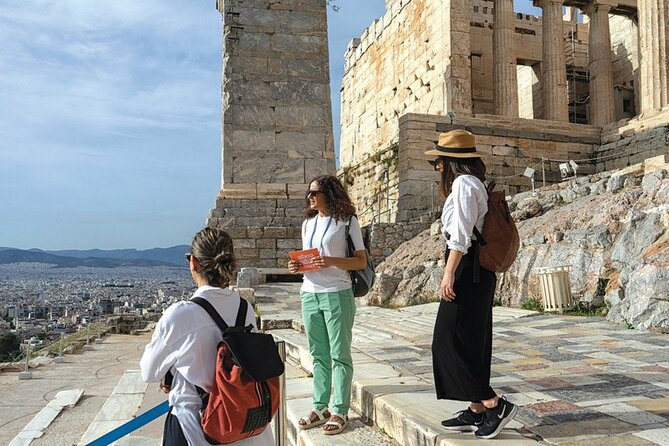
The best thing about this tour is the way it links two very different parts of ancient Athens. At the Acropolis, you see the Parthenon, Temple of Nike, Dionysus Theater, and Herod Atticus Odeon. At the Ancient Agora, you see where civic life, trade, debate, and daily business took place. The guide helps turn broken columns into a working city.
I like the licensed local guides, who explain not only what you are looking at but why it mattered. Guides such as Pam, Tina, Helen, Hermes, Eli, and Stavros have been praised for clear storytelling and thoughtful answers. I also like the sensible pace, with time for photographs and pauses in the shade. The main drawback is the physical demand: steep paths, slippery stone, strong sun, and roughly four hours on foot.
Key points to know before booking
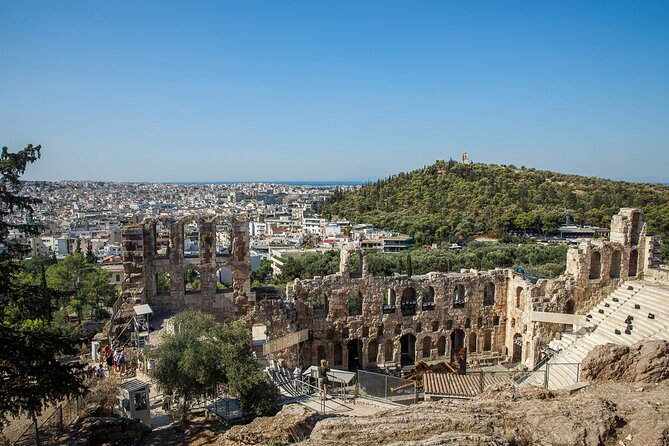
- Two major ancient sites in one morning: Start at the Acropolis, then continue to the Ancient Agora and its museum.
- The guide adds real context: Expect explanations of democracy, city-state life, religion, architecture, and the influence of ancient Greece on modern society.
- Entrance fees need careful attention: The tour price is $67.58 per person, but admission fees may be separate depending on the option you choose.
- The schedule is strict: Meet at Dionysiou Areopagitou 3 at 10:30 am. Late arrivals may be unable to join, with no refund.
- Prepare for heat and rough ground: Bring plenty of water, sun protection, and sturdy shoes. Strollers are not allowed on the Acropolis site.
- The group can reach 24 people: That is small enough to follow a guide, though not the same as a private tour.
The Acropolis at 10:30 am
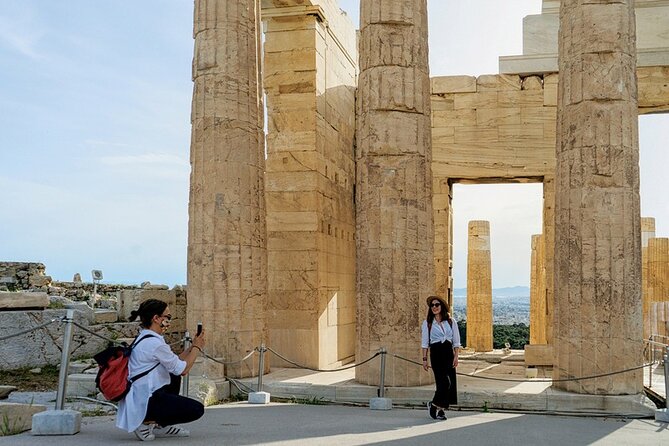
You meet at Dionysiou Areopagitou 3, near the lower Acropolis approach and the Fresko Yoghurt area mentioned in the meeting instructions. This is a useful starting point because the tour goes directly into the Acropolis visit rather than spending the first part of the morning on transport or hotel pickups.
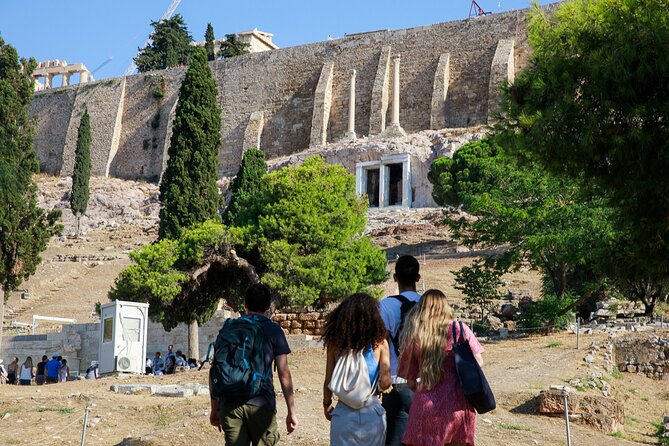
The Acropolis is not a single building. It is a hilltop collection of monuments, each with a different role and story. The tour covers the Parthenon, the Temple of Nike, the Dionysus Theater, the Herod Atticus Odeon, and other important features of the site.
Your guide’s job here is especially useful. Without context, you may see a grand temple, a few columns, and a fine view of Athens. With explanation, you begin to understand how religion, public ceremony, theater, politics, and civic identity came together on this rocky hill.
The walking is not gentle in every place. You climb ramps and steps, and some ancient stones are worn smooth. Several people who enjoyed the tour still described it as sporty. Wear shoes with a firm grip rather than sandals with thin soles. A walking stick or stroller is not specifically supplied, and baby strollers are not allowed on the archaeological site. A baby pouch is the practical choice for families with very young children.
More Ancient History Tours in Athens
- Athens: Ancient Greek Theater Performance
★ 4.7 · 2,481 reviews - Historical Delphi One Day Tour with Arachova Stop & Expert Guide
★ 4.5 · 1,247 reviews - From Athens: Ancient Corinth Day Trip with Canal & VR Guide
★ 4.6 · 1,073 reviews
The Parthenon and the view across Athens
The Parthenon receives about 30 minutes within the Acropolis portion of the visit, although the full Acropolis experience lasts longer. This is enough time to hear the main explanation, look closely at the structure, and take photographs without being rushed from one viewpoint to the next.
The Parthenon was dedicated to Athena, the city’s patron goddess, and its design has influenced Western architecture for centuries. The guide brings attention to the building’s scale, its position on the hill, and the way the monument relates to the rest of the Acropolis.
You should also allow yourself a few quiet moments. The views are a major part of the experience. From the hilltop, Athens spreads in every direction, and the city’s modern streets make the ancient site easier to understand. This is one of those places where photographs help, but they do not replace simply looking around.
Security can slow the visit. All visitors pass through airport-style checks, and during busy periods the wait may reach 30 minutes or more. The tour uses skip-the-ticket-line service, which helps with ticket queues, but it does not guarantee instant passage through security.
Theater, temples, and the lower slopes
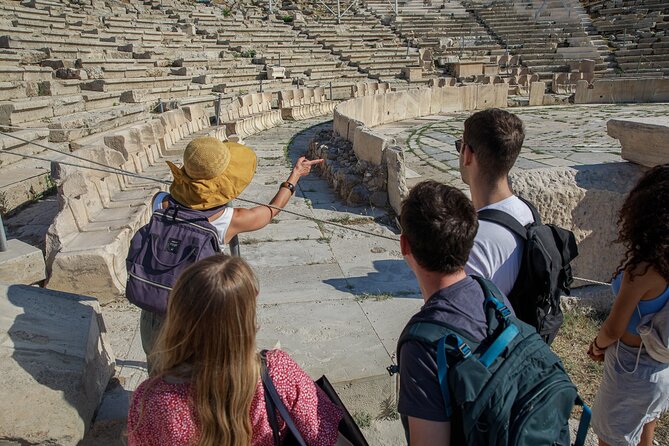
The Dionysus Theater is one of the most valuable stops for anyone interested in theater or public life. This was not merely a scenic ruin. It was a large public setting connected with performances and festivals honoring Dionysus.
The Herod Atticus Odeon offers a different lesson. It shows how later buildings were added to the Acropolis area and how the site remained important over many centuries. Your guide may use these structures to explain how the hill changed from a religious center into a layered archaeological site.
The tour also passes through the Dionysiou Areopagitou area, a pedestrian route at the foot of the Acropolis. This gives you a chance to reset before the Agora section, but the day does not end there. The second site adds another hour of walking and explanation, so save some energy.
The guides are often praised for finding shade when possible and adjusting the pace for people struggling with heat or climbs. That is helpful, but shade is limited on ancient sites. In May, the sun can feel strong, and summer conditions may be much harder. Bring more water than you think you need. Some participants prepared two liters each, which is sensible on a hot day.
Walking down to the Ancient Agora
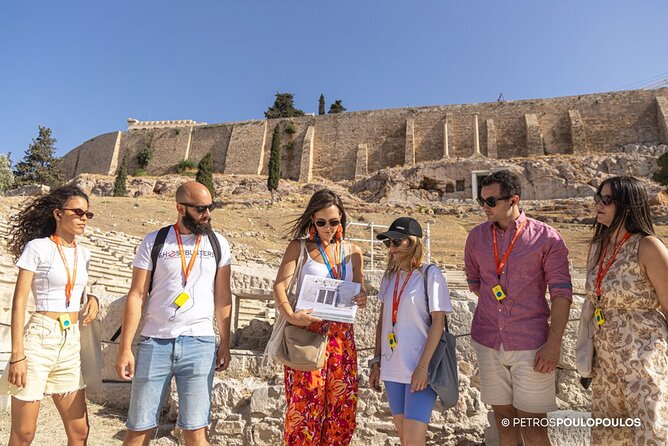
The tour continues to the Ancient Agora at about 1 pm. This shift from hilltop monument to open civic center is what gives the experience its shape.
The Agora was the working heart of ancient Athens. It was tied to public meetings, trade, administration, social life, and political debate. The Acropolis shows the city’s religious and symbolic power. The Agora helps you picture ordinary civic business and the way the city functioned day by day.
This is where guides such as Eli and Stavros have been especially effective, explaining how the ancient city-state worked and how ideas linked to democracy and education still affect modern life. Those connections are useful because the Agora can otherwise feel like a broad field of foundations. A guide helps you identify what different spaces were used for and why their locations mattered.
The Ancient Agora is also less visually overwhelming than the Acropolis. That can be a relief after the crowds and steep climbs. It gives you room to look across the site and imagine streets, workshops, gathering areas, and public buildings that are no longer intact.
The downside is timing. After an hour at the Acropolis and its monuments, then a walk through the city, you may be tired by the time you reach the Agora. One good guide can keep the pace steady, but you should not expect a leisurely, stop-and-start outing.
More Ancient History Tours in Greece
- Acropolis, Parthenon & Athens Old City Heritage Walking Tour
★ 4.5 · 876 reviews - Private Biblical Tour Ancient Corinth & Isthmus Canal from Athens
★ 5.0 · 762 reviews - Athens: Ancient Corinth & Nafplio Full Day Trip with Swim
★ 4.8 · 531 reviews - Athens Skip the Line: Open Air Ancient Greek Theatre Performance
★ 4.5 · 520 reviews
The Museum of the Ancient Agora
The museum receives about 30 minutes and is housed in the Stoa of Attalos, a reconstructed building within the Agora area. The museum helps explain the objects and public life connected with the site.
This part is shorter and more focused than the outdoor visit. You see artifacts that give shape to the people who used the Agora, rather than only the buildings they left behind. The museum works best after the guide has explained the site outside, since you can connect objects with places you have just seen.
Not everyone will value this half-hour equally. Some people find it a useful final chapter, while others feel ready to stop after the Acropolis and Agora. If you have already spent a long day sightseeing, the museum may feel like one extra layer rather than a highlight.
Museum access can also depend on current operating conditions. One past visit found the museum closed for renovation. It is sensible to confirm the status close to your tour date if the museum is important to you.
What the guides add
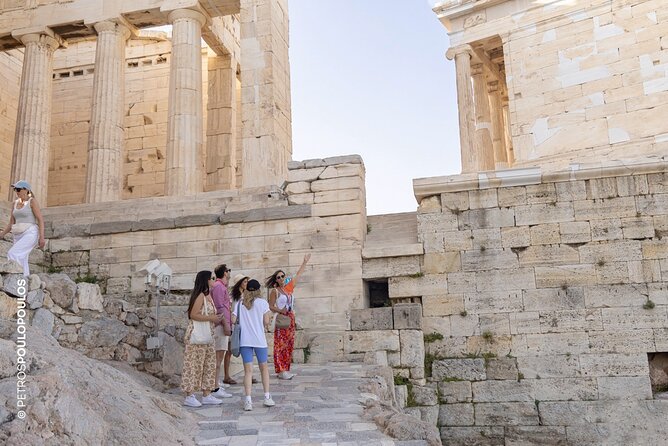
The strongest part of this experience is the human explanation. Guides including Pam, Gina, Tina, Helen, Amaryllis, Sissy, Eli, Hermes, Daphne, Angeliki, Stavros, Nikos, and Costos have been singled out for different strengths, from historical detail and storytelling to patience, humor, and practical care in hot weather.
Some guides have archaeological training. Others focus on connecting the sites with modern civic life. The best explanations do more than name a temple. They help you understand how people worshipped, debated, performed, traded, and organized their city.
You should still pay attention. The group may gather in shade or around a monument, and distractions are easy when there are crowds, views, and photographs. One guide’s information can be missed if you drift too far from the group. Keep an eye on the meeting point and listen for instructions before moving between stops.
Pickpocket awareness is also sensible around crowded approaches and busy archaeological entrances. Keep your phone and wallet secure, especially while taking photographs.
Price, tickets, and the real value
The listed price is $67.58 per person. That amount pays for the guided experience, but entrance fees are not always included. The exact arrangement depends on the option you select, so read the ticket wording carefully before paying.
This distinction matters. Some people arrive thinking the tour price covers both sites, only to discover that admission must be arranged separately. If you choose the option without tickets, follow the voucher instructions closely and purchase the required site tickets before the tour. You cannot join without a valid entrance ticket at the start, and the tour fee is not refunded if you fail to meet that requirement.
The tour can be good value if you want clear explanations at both sites and prefer not to manage entry timing alone. It is less attractive if you only want to walk through quickly, take photographs, and read signs independently.
A multi-site archaeological ticket may also be available through the local operator, including places such as the Acropolis, Ancient Agora, Roman Agora, Hadrian’s Library, and Keramikos. Check the current ticket terms and prices before choosing, since admission arrangements can change.
Timing, weather, and group size

The tour lasts about four hours and starts at 10:30 am. The Acropolis comes first, with the Agora scheduled for roughly 1 pm. That order is important because both sites require timed entry planning.
Do not arrive late. Acropolis entry times are strict, and the group cannot wait for people who miss the start. The tour runs in rain or sunshine, so dress for the forecast. In hot weather, use a hat, sunscreen, light clothing, and sturdy shoes. In rain, the stone can become even more slippery.
The group may include up to 24 people. That is a reasonable size for a walking tour, but you should not expect the personal attention of a private guide. The operator provides a local guide, an Athens guide magazine, and an Athens map. Hotel pickup and drop-off are not included, so plan your route to the meeting point in advance.
Most people can participate, but the climbs and uneven surfaces make this a poor choice for anyone who cannot manage sustained walking. The stroller restriction is particularly important for families.
Who should book this tour
I would choose this tour for a first visit to Athens, especially if you want the Acropolis explained rather than simply photographed. It suits couples, families with older children, and adults who enjoy history but do not want to build their own route through two large archaeological sites.
It is also a good fit if you want the wider story. The Acropolis gives you monumental religion and symbolism. The Agora gives you the machinery of city life. Together, they make a stronger introduction than either site alone.
I would be cautious if you dislike group tours, have limited stamina, or want a slow photographic visit. The four-hour schedule is full, and the combination of heat, hills, crowds, and stone surfaces can wear you down. If you book, plan a quiet break afterward rather than another demanding attraction.
Should you book the Acropolis and Agora tour?
Book it if you want the ancient sites to make sense, not just look impressive. The guides are the main reason to choose it, and the strongest sessions connect architecture with democracy, theater, religion, and daily life.
Before booking, confirm the ticket option, buy required admission in advance, and arrive early at Dionysiou Areopagitou 3. Bring serious sun protection, plenty of water, and shoes that can handle polished stone. With those details sorted, this is a well-focused way to experience the two most important ancient sites in central Athens.
FAQ
How much does the tour cost?
The listed price is $67.58 per person. Entrance fees may be separate, depending on the option selected.
How long does the tour last?
The experience lasts approximately four hours.
What time does the tour start?
It starts at 10:30 am.
Where does the tour meet?
The meeting point is Dionysiou Areopagitou 3, Athens 117 42, Greece.
Where does the tour end?
The tour ends at the Ancient Agora of Athens, Athens 105 55, Greece.
Which sites are included in the route?
The route covers the Acropolis, Parthenon, Temple of Nike, Dionysus Theater, Herod Atticus Odeon, Ancient Agora, and Museum of the Ancient Agora.
Are admission tickets included?
Admission tickets are not included in every option. Check the option details and follow the voucher instructions if you select the option without tickets.
What happens if I arrive late?
The Acropolis has strict entry times, so the group cannot wait for late arrivals. No refund is provided for missing the tour because of lateness.
Are baby strollers allowed?
Baby strollers are not allowed on the Acropolis archaeological site. There is no cloakroom at the side entrance used by the tour, so a baby pouch is recommended.
Does the tour operate in bad weather?
Yes. The tour operates in all weather conditions, including rain. Dress appropriately for the forecast.
How many people can join the tour?
The group can include a maximum of 24 people.
Can I cancel for a refund?
You can cancel at least 24 hours before the start time for a full refund. Cancellations or changes made less than 24 hours before the start time are not refunded.
More Museum and Gallery History Tours in Athens
- New York City: American Museum of Natural History Ticket
★ 4.5 · 15,447 reviews - Paris: Louvre Museum Entry with History of Mona Lisa
★ 3.9 · 2,823 reviews - Venice’s Best: Basilica, Doge’s Palace, Gondola & History Gallery
★ 4.5 · 2,478 reviews - American Museum of Natural History Admission Ticket
★ 4.0 · 1,931 reviews
More Museum and Gallery History Tours in Greece
- Ancient Athens tour: Acropolis, Parthenon and Acropolis Museum
★ 5.0 · 256 reviews - Athens: Kotsanas Ancient Greek Technology Museum Guided Tour
★ 5.0 · 29 reviews - Ancient Olympia: Archaeological Site and Museum Entry Ticket
★ 4.3 · 555 reviews - Heraklion Highlights: Knossos, Museum & Historic City Drive
★ 5.0 · 64 reviews
Newest history tours we have reviewed in Athens
- Athens: The History of Greek Mythology Private Tour★ 4.7 · 53 reviews
- Athens: Women in Ancient Greece★ 5.0 · 98 reviews
- Athens: Ancient Corinth & Nafplion Guided Premium Tour★ 4.7 · 237 reviews
- Athens: Be an Ancient Sculptor: Craft Your Greek Masterpiece★ 5.0 · 26 reviews
- Athens: Roman Agora & Ancient Agora E-ticket & 2 Audio Tours★ 4.1 · 107 reviews
- Athens: Ancient Greek Theatre Murder Mystery Experience★ 4.8 · 298 reviews
- Athens: Corinth Canal and Ancient Olympia Private Trip★ 4.6 · 21 reviews
- Athens: Kotsanas Ancient Greek Technology Museum Guided Tour★ 5.0 · 29 reviews
Ancient History Tours, compared.
Colosseum: Underground and Ancient Rome Tour
Read our review →
Colosseum & Ancient Rome with Arena Floor Option I Max 6 People
Read our review →
Colosseum, Ancient Rome Tour or AudioGuided Tour
Read our review →
Colosseum Underground & Ancient Rome Guided Tour
Read our review →

Taormina: Ancient Theater Skip-the-Line Ticket & Audio Guide
Read our review →
Discover the Ancient Ruins of Pompeii: Day Trip from Rome
Read our review →