Review · ATHENS HISTORY TOURS
Ancient Athens tour: Acropolis, Parthenon and Acropolis Museum
The best part of this four-hour Athens tour is the link between the Acropolis ruins and the Acropolis Museum. You see the Parthenon and its neighbors in place, then examine the surviving sculptures and architectural details indoors, where the story makes far more sense.
I like the early 9:00 am start, which helps you face less heat, and I like the licensed guides, including archaeologists such as John and Efie. The main consideration is cost: the advertised price is $72.59, but entrance tickets may add €30 for the Acropolis and €20 for the museum unless you choose the ticket-inclusive option.
Key points to know before you book
- The museum completes the Acropolis visit: The gallery explains details you cannot fully see on the hill.
- A 9:00 am start helps with heat and crowds: Athens can be punishing later in the day.
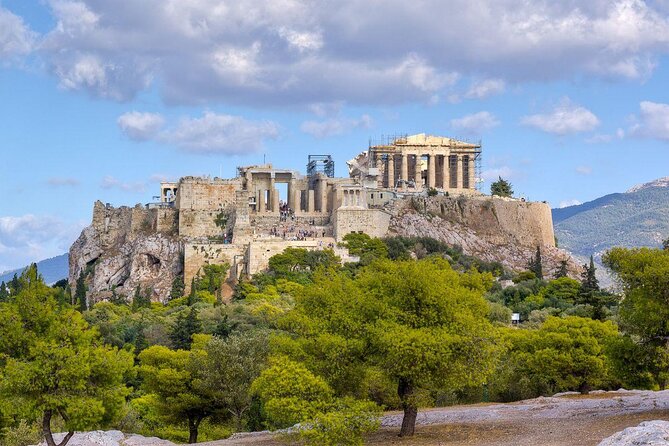
- You visit the essential monuments: The route includes the Parthenon, Propylaea, Erechtheion, Dionysus Theater, and Herod Atticus Odeon.
- The guide makes the difference: Guides such as Alexia, Lydia, Selena, Giannas, and Bernardos have been praised for clear explanations and lively storytelling.
- Expect a real uphill walk: Slippery stone and uneven ground call for sensible shoes and moderate fitness.
- Check the ticket option carefully: Tickets are not automatically included in every booking.
Why the Acropolis and museum work so well together
You can visit the Acropolis on your own, of course. You can also wander through the museum alone. But doing both with a guide gives you a better sense of how the pieces fit together.
On the hill, you see grand columns, broken foundations, and famous silhouettes. The scale is powerful, but some details are hard to read from a distance. At the museum, you get close to carved figures, decorative fragments, and objects found on the Acropolis and its slopes. That second look helps turn impressive stones into human work made for a specific religious and civic world.
The tour spends about two hours around the Acropolis and its monuments, followed by about an hour inside the museum. The schedule leaves room for explanations and photographs, though you should not expect a long period of unstructured wandering on the hill. This is a guided overview, not a full-day archaeological study.
The group can include up to 20 people. That is small enough to remain manageable, but it is not a private tour. Several guides use listening devices or earpieces so you can hear without standing shoulder to shoulder. One useful tip from past departures is to bring your own wired headphones if you have them, since hearing can still be difficult in crowded areas.
More Ancient History Tours in Athens
- Athens: Ancient Greek Theater Performance
★ 4.7 · 2,481 reviews - Historical Delphi One Day Tour with Arachova Stop & Expert Guide
★ 4.5 · 1,247 reviews - From Athens: Ancient Corinth Day Trip with Canal & VR Guide
★ 4.6 · 1,073 reviews
Starting at Porinou 5 at 9:00 am
The meeting point is Porinou 5, Athens 117 42, near public transportation. The tour returns to this meeting point at the end, though the museum portion can give you a natural place to continue exploring afterward if your plans allow.
The early start is one of the tour’s practical strengths. Athens gets hot, and the Acropolis offers limited shade. Starting at 9:00 am gives you a better chance of walking up before the strongest heat, and it can help you avoid some of the later crowds.
You still need sun protection. Bring water, sunscreen, and a hat if you use one. Bottled drinking water is provided, which is helpful, but you should not rely on a single bottle for four hours in the Greek sun.
The meeting point is also convenient if you want to explore the Plaka afterward. One guide recommended Plaka for lunch, and the neighborhood is within walking distance of the Acropolis. That makes this tour easy to pair with an afternoon meal and more sightseeing.
Walking up the Acropolis
The Acropolis visit is the physical core of the experience. You walk uphill over ancient stone, with uneven and sometimes slippery patches. A moderate level of fitness is required, and sensible walking shoes matter more here than stylish footwear.
The approach is not a quiet stroll. You may be moving through large crowds, stopping in tight spaces, and adjusting your position so the whole group can hear. A good guide earns their fee by finding sensible stopping points, keeping the group together, and making room for photos without losing the thread of the story.
Several guides have been praised for doing exactly that. Giannas was noted for making the uphill route easier to manage, while Zeta was praised for moving efficiently through crowds. Lydia and Alexia were both described as attentive to shade, water, and the group’s comfort.
The tour format also helps you avoid a common Acropolis problem: seeing everything but understanding very little. Without context, the hill can become a parade of famous names. With a guide, you get explanations of how the buildings relate to religion, public life, mythology, and the changing fortunes of Athens.
The Parthenon, the tour’s grand centerpiece
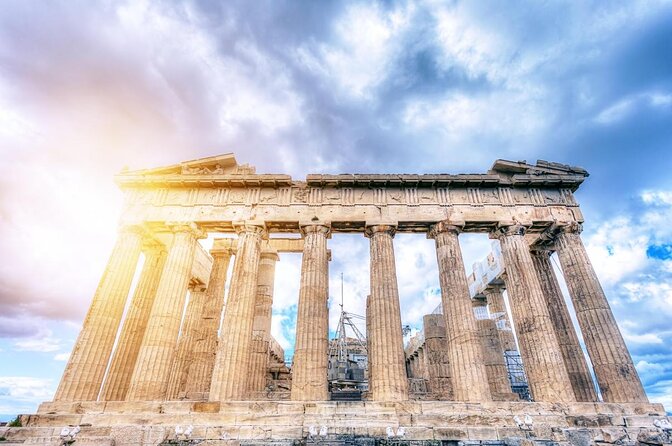
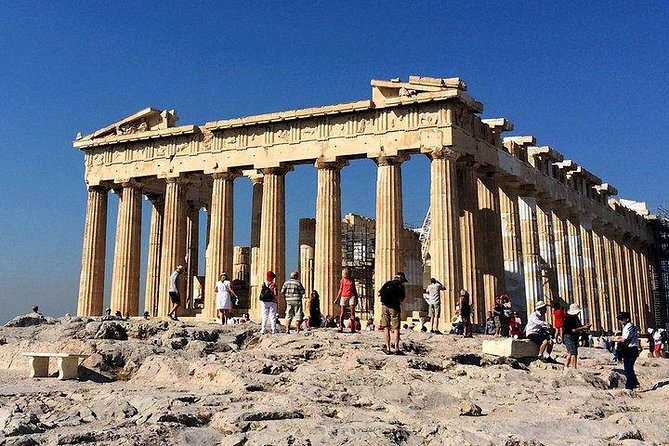
The Parthenon is the stop most people imagine before arriving in Athens. Dedicated to Athena, the city’s patron goddess, it dominates the summit and remains the visual anchor of the Acropolis.
The formal stop here is listed at about 10 minutes, but that does not mean the whole Acropolis experience is limited to ten minutes. Your guide discusses the Parthenon as part of the larger walk, points out architectural features, and finds places where you can take in the building from different angles.
You will see damage, scaffolding, missing sculpture, and incomplete surfaces. That is part of the site, not a flaw in the tour. The guide helps you picture the original decoration and explains why the surviving structure still matters.
Do not expect to walk inside the Parthenon. The value is in seeing its design, position, and details from the permitted viewing areas. Photography is a major part of the stop, but the best experience comes when you pause long enough to look beyond the familiar outline.
More Ancient History Tours in Greece
- Acropolis, Parthenon & Athens Old City Heritage Walking Tour
★ 4.5 · 876 reviews - Private Biblical Tour Ancient Corinth & Isthmus Canal from Athens
★ 5.0 · 762 reviews - Athens: Ancient Corinth & Nafplio Full Day Trip with Swim
★ 4.8 · 531 reviews - Athens Skip the Line: Open Air Ancient Greek Theatre Performance
★ 4.5 · 520 reviews
Dionysus Theater and the birth of public drama
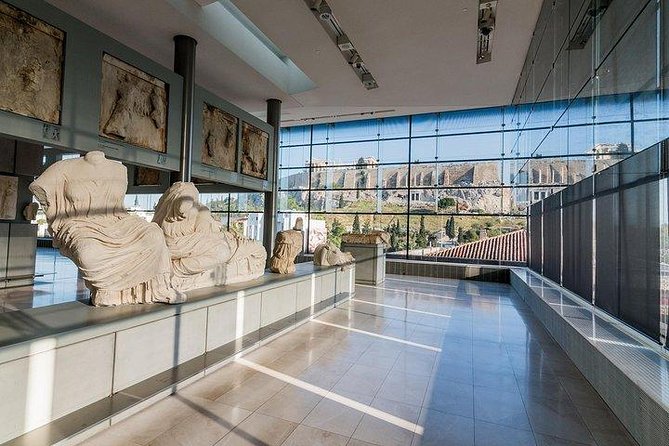
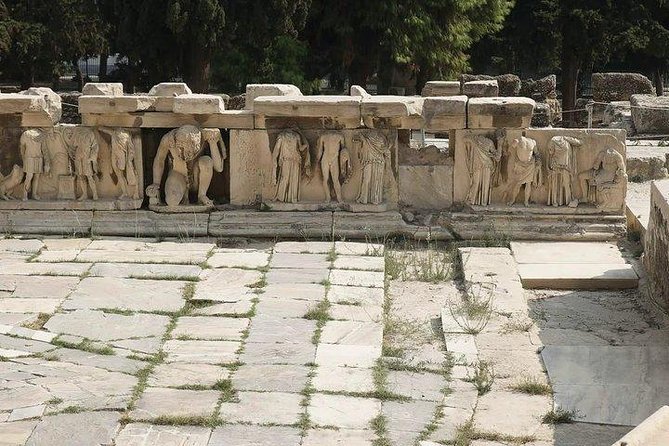
The Theatre of Dionysus sits on the southern slope of the Acropolis. It is one of the ancient world’s most important theaters and gives you a different view of Athens than the temples above.
The theater connects the Acropolis to performance, civic life, and public gatherings. A short stop here helps explain that the hill was not only a sacred precinct. It was tied to the wider life of the city, including drama and festivals.
The itinerary lists the Dionysus Theater twice, but the useful point is that this is one sightseeing stop within the Acropolis route, not two separate theater visits. Expect roughly ten minutes of focused explanation, with a chance to look over the seating area and imagine the scale of an ancient performance.
Herod Atticus Odeon and the Propylaea
The Herod Atticus Odeon is a Roman-era theater built on the southern slope. Unlike many ancient structures that survive only as ruins, it still operates for performances. You may not enter during this tour, but seeing the stage and curved seating from the Acropolis route adds another layer to the site.
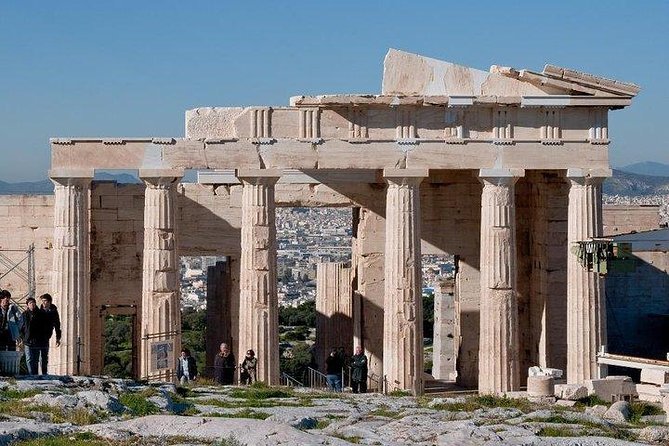
The Propylaea served as the monumental gateway to the Acropolis. It is a powerful reminder that reaching the sacred summit was designed as an experience in itself. The route through the gates, the rising ground, and the framed views all helped create a sense of arrival.
The Propylaea can be crowded, so your guide’s ability to choose a good place to stop matters. This is also one of the spots where a listening device can help. You want to hear the explanation without having to press into the group.
The Erechtheion and its famous Caryatids
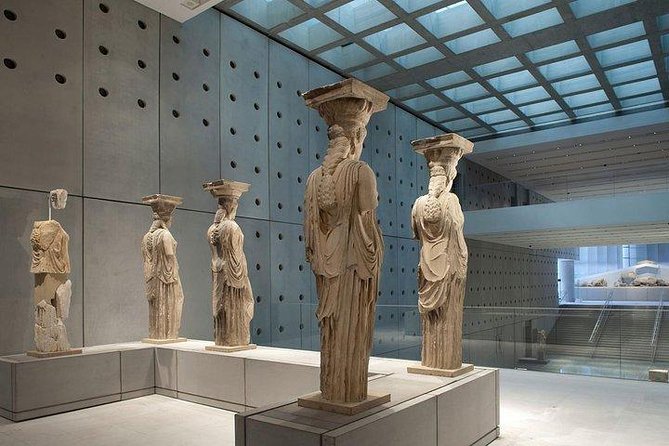
The Erechtheion is one of the most memorable structures on the Acropolis, partly because of its unusual design and partly because of the Caryatids, the sculpted female figures used as architectural supports.
The figures you see on the building are carefully preserved copies. The original Caryatids are displayed in the Acropolis Museum, apart from the one held by the British Museum. This is one of the clearest reasons to include the museum rather than stopping at the hill.
At the Erechtheion, take time to compare the building’s uneven layout with the more orderly appearance of the Parthenon. The contrast helps you understand that the Acropolis was not built as one single project with one simple plan. Different sacred traditions and older sites shaped its form.
The Acropolis Museum brings the stones to life
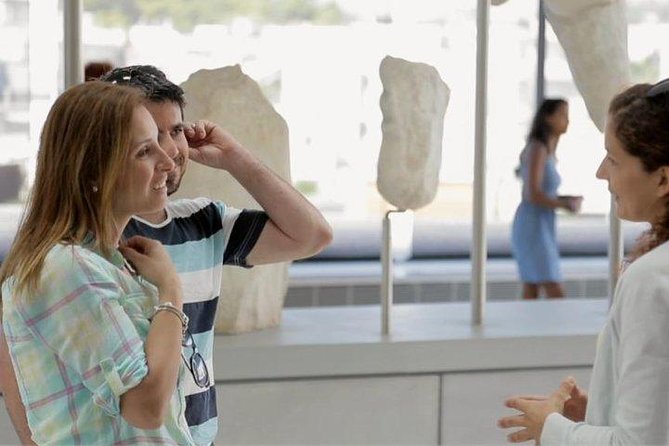
The museum visit lasts about an hour with the guide. That is enough for a well-planned introduction, though not enough to inspect every gallery at a leisurely pace.
The museum focuses on objects found on the Acropolis and its surrounding slopes, covering periods from the Greek Bronze Age through Roman and Byzantine Athens. It also sits above remains of Roman and early Byzantine buildings, so the building itself connects modern Athens with earlier layers of the city.
The museum is especially useful after the hill because it gives you close views of details that are difficult to see outdoors. You can examine sculpture, architectural decoration, and the Caryatids in a controlled setting away from the sun.
Several guides encourage people to remain in the museum after the formal tour ends. That is good advice if your schedule permits. The guided hour gives you a framework, then you can continue at your own speed instead of trying to absorb every object while keeping up with a group.
The museum is not a consolation prize for the ruins. It is an essential part of the visit. If you book the experience, I would make the museum ticket part of your plan rather than treating it as an optional extra.
What the guides add
The strongest feature of this experience is the quality of the guiding. The company uses licensed guides, and some departures are led by archaeologists. John, Efie, and other guides have been praised for combining formal knowledge with clear explanations and an easy manner.
The names that come up repeatedly include Alexia, Lydia, Selena, Giannas, Bernardos, Michael G, Aphrodite, Simon, Demos, Zeta, and George. You cannot select a particular guide from the information provided, but the range of positive comments suggests that the experience is not built around one individual.
The best guides do more than recite dates. They explain mythology, point out small design details, connect monuments to political events, and use humor without turning the site into a comedy routine. Bernardos was praised for storytelling, while Alexia was noted for warmth and energy. Selena was particularly good at making a group of about 15 feel engaged.
That style matters at the Acropolis. The site is crowded, bright, and visually overwhelming. A guide who can organize the information into short, memorable stories makes the visit easier to follow.
Price, tickets, and overall value
The listed price is $72.59 per person. That covers the guided experience, but you need to check your selected option because entrance fees may be separate.
The stated entrance costs are €30 per person for the Acropolis and €20 per person for the Acropolis Museum. If tickets are not included in your booking, you may buy them in cash from the guide at the meeting point, or arrive with tickets already purchased. People under 25 need a physical passport or ID to confirm eligibility for a reduced price.
That ticket detail can change the value calculation. At the base price, the tour is reasonably priced for four hours with a licensed guide, but the total rises sharply if you add both entrance fees. A ticket-inclusive booking may be easier and may reduce uncertainty at the meeting point, even if its listed price is higher.
I would compare the full cost, not just the headline figure. The guide, crowd management, historical context, and museum connection are the main reasons to pay for the tour. If you are happy reading signs and planning your own route, a self-guided visit may cost less. If you want the site explained clearly and efficiently, the extra cost is easier to justify.
Who should book this tour
You are a good fit for this tour if you want to see the essential Acropolis monuments and the museum in one morning. It suits first-time visitors, cruise passengers with limited time, and anyone who prefers historical explanation to wandering without a plan.
It also works well for people who want help with the crowds. The group size can reach 20, so you will not get the intimacy of a private guide, but the format remains small enough for organized movement and questions.
Families and older visitors should take the terrain seriously. The walk is not extreme, but the uphill route, slippery stone, heat, and standing time can be tiring. Plan around your own fitness and wear shoes with a good grip.
You may prefer another format if you want several hours alone at the monuments. One person found the four-hour schedule packed and wished for more independent time on the Acropolis. The tour does allow photographs and does not need to feel rushed, but its purpose is guided interpretation, not unlimited free exploration.
My booking advice
I would book this tour if the Acropolis is a priority and you want the Parthenon explained rather than simply photographed. Choose the option that clearly includes the entrance tickets if you value a simple morning and do not want to handle cash at the meeting point.
Book the 9:00 am departure, bring sunscreen and sturdy shoes, and keep drinking water. If you have wired headphones, pack them in case the listening system is hard to hear in a crowded area.
The strongest reason to choose this experience is the pairing of the hill with the museum. The ruins give you the setting, while the museum supplies the close-up details. If you have only one morning in Athens, this is a sensible way to spend it.
Cancellation is free up to 24 hours before the start time. Changes or cancellations made less than 24 hours ahead are not accepted for a refund.
FAQ
How long does the Ancient Athens tour last?
The tour lasts approximately four hours. About two hours are scheduled for the Acropolis area and about one hour for the Acropolis Museum, with the remaining time used for movement and explanations.
What time does the tour start?
The tour starts at 9:00 am.
Where does the tour meet?
The meeting point is Porinou 5, Athina 117 42, Greece. The activity ends back at the meeting point.
Are Acropolis and museum entrance tickets included?
Tickets are excluded unless you select the option that includes entrance tickets. The listed prices are €30 per person for the Acropolis and €20 per person for the Acropolis Museum.
Is the tour offered in English?
Yes. The tour is offered in English.
How large is the group?
The tour can have a maximum of 20 travelers.
Is the tour physically demanding?
You should have a moderate level of physical fitness. The route includes an uphill walk over uneven and potentially slippery stone, and the Greek sun can make the visit tiring.
More Museum and Gallery History Tours in Athens
- New York City: American Museum of Natural History Ticket
★ 4.5 · 15,447 reviews - Paris: Louvre Museum Entry with History of Mona Lisa
★ 3.9 · 2,823 reviews - Venice’s Best: Basilica, Doge’s Palace, Gondola & History Gallery
★ 4.5 · 2,478 reviews - American Museum of Natural History Admission Ticket
★ 4.0 · 1,931 reviews
More Museum and Gallery History Tours in Greece
- Acropolis of Athens, Ancient Agora and the Agora Museum Tour
★ 5.0 · 86 reviews - Athens: Kotsanas Ancient Greek Technology Museum Guided Tour
★ 5.0 · 29 reviews - Ancient Olympia: Archaeological Site and Museum Entry Ticket
★ 4.3 · 555 reviews - Heraklion Highlights: Knossos, Museum & Historic City Drive
★ 5.0 · 64 reviews
Newest history tours we have reviewed in Athens
- Athens: The History of Greek Mythology Private Tour★ 4.7 · 53 reviews
- Athens: Women in Ancient Greece★ 5.0 · 98 reviews
- Athens: Ancient Corinth & Nafplion Guided Premium Tour★ 4.7 · 237 reviews
- Athens: Be an Ancient Sculptor: Craft Your Greek Masterpiece★ 5.0 · 26 reviews
- Athens: Roman Agora & Ancient Agora E-ticket & 2 Audio Tours★ 4.1 · 107 reviews
- Athens: Ancient Greek Theatre Murder Mystery Experience★ 4.8 · 298 reviews
- Athens: Corinth Canal and Ancient Olympia Private Trip★ 4.6 · 21 reviews
- Athens: Kotsanas Ancient Greek Technology Museum Guided Tour★ 5.0 · 29 reviews
Ancient History Tours, compared.
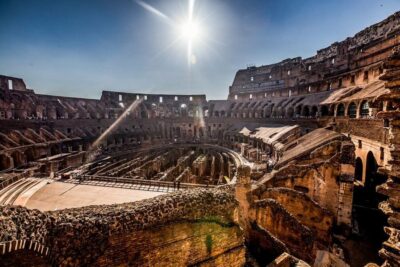
Colosseum: Underground and Ancient Rome Tour
Read our review →
Colosseum & Ancient Rome with Arena Floor Option I Max 6 People
Read our review →
Colosseum, Ancient Rome Tour or AudioGuided Tour
Read our review →
Colosseum Underground & Ancient Rome Guided Tour
Read our review →

Taormina: Ancient Theater Skip-the-Line Ticket & Audio Guide
Read our review →
Discover the Ancient Ruins of Pompeii: Day Trip from Rome
Read our review →