
Review · AMSTERDAM HISTORY TOURS
Anne Frank’s Amsterdam Jewish History WWII Exclusive Guided Tour
Amsterdam’s wartime story reaches far beyond the Anne Frank House. This 2.5-hour walking tour links Anne’s hiding place with memorials for Jewish victims, resistance fighters, Roma and Sinti people, LGBTQ+ people, deaf victims, and children deported from a Jewish orphanage.
I like the broad view and the personal guiding. You hear about Anne Frank, but also about the February Strike, Jewish resistance, Spinoza, and the city’s prewar Jewish community. Guides such as Monique, Clare, Jo, Anita, Hannah, Huibert, and Marco are praised for clear explanations, thoughtful pacing, and answering questions. The main drawback is simple: you do not enter Anne Frank House, and 12 stops in 150 minutes means some visits are brief.
Key points to know before booking

- Anne Frank House is exterior only: You learn about the hiding place from outside, but admission is not part of this tour.
- The route covers more than Anne Frank: Expect memorials tied to Jewish life, Nazi persecution, resistance, the LGBTQ+ community, and other murdered groups.
- You finish at the Holocaust Names Monument: The tour begins near Westermarkt and ends near the National Holocaust Museum area.
- Guiding is the main value: Monique, Clare, Jo, Anita, Hannah, Huibert, and Marco are among the named guides praised for their subject knowledge and personal approach.
- The price is $59.28 per person: That is fair for a private, English-language history walk, especially if your group wants context before or after visiting Anne Frank House.
- Plan for a serious walking experience: The subject is painful, and the route includes many outdoor memorials with limited time at each.
Why this tour tells more than Anne Frank’s story
Anne Frank’s hiding place is the natural starting point, but it can also become the only thing people associate with Amsterdam during the Nazi occupation. This walk widens the frame.
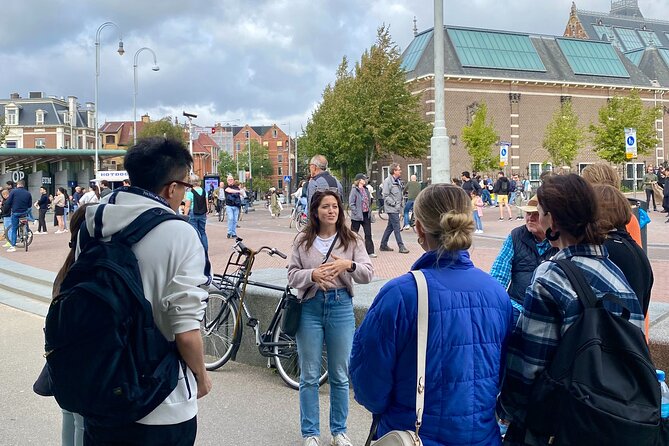
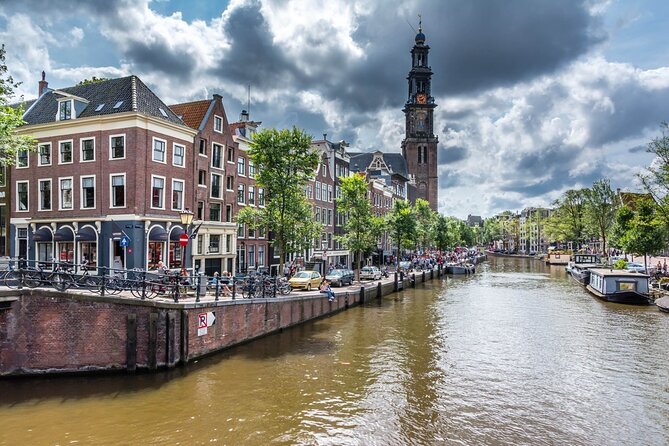
You begin at Westermarkt, outside the Anne Frank House. From there, the guide explains how Anne, her family, and four others lived in hiding for two years. You hear about life in the secret annex and the emotional importance of the nearby Westerkerk bells, which Anne could hear from the attic.
That setting gives the tour an immediate human focus. It is not only a walk through dates and names. You begin with one family, then gradually connect their experience to what happened across Amsterdam and the Netherlands.
The tour also helps you understand the city’s role during the occupation. The stops touch on persecution, public protest, Jewish resistance, deportation, and the destruction of a community. The result is a fuller picture than an isolated visit to one famous building can provide.
More WWII and D-Day Tours in the Netherlands
- Anne Frank and the Jewish History of Amsterdam Private Tour
★ 5.0 · 307 reviews - Anne Frank and Amsterdam Jewish History Walking Tour
★ 5.0 · 259 reviews - Amsterdam: Anna Frank and World War II History Walking Tour
★ 4.8 · 86 reviews
Anne Frank House and Westerkerk: a strong beginning
The first two stops are close together and set the tone.
At the Anne Frank House, you stay outside. This is important to understand before booking. The tour does not include entry, and the admission ticket is not included in the price. If you have a ticket for the house, the walking tour can give you useful background beforehand or help you think through what you saw afterward. If you cannot get a ticket, this walk still gives you a substantial account of Anne’s life in hiding, though it cannot replace the interior visit.
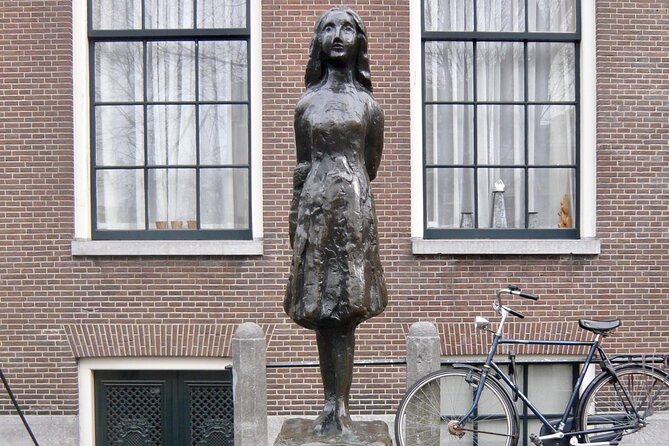
The nearby statue of Anne Frank sits with Westerkerk behind it. The church’s bells were part of Anne’s daily world, both comforting and frustrating. They reminded her that life continued beyond the attic, even as she remained trapped indoors.
I like this opening because it avoids treating Anne as a symbol only. The guide can connect the building, the church, the diary, and the city around them. Clare was singled out for a thorough presentation, while several guides were praised for explaining Anne’s story with care and clarity.
Homomonument and Dam Square: persecution and public memory
The Homomonument is one of the tour’s most useful reminders that Nazi persecution reached many groups. It commemorates LGBTQ+ people who were persecuted and killed under the Nazi regime. The stop is short, but it adds an important layer to the story.
You then walk to Dam Square, Amsterdam’s historic central square. The site once contained a Nazi recruitment office, and it now includes the National Monument, a memorial to victims of World War II and later conflicts.
The contrast is striking: one public space used for recruitment and occupation, later used for remembrance. This is the kind of connection a guide can make while you are standing in the place itself. You are not just looking at a monument. You are considering how the same square has carried different meanings over time.
The guide’s role matters here. Jo was praised for handling questions and moving between wartime history and modern topics. That ability is useful at stops like these, where a short explanation can raise larger questions about memory, identity, and public space.
Spinoza and Jewish resistance near the former Jewish quarter
The Spinoza Monument honors Baruch Spinoza, the Dutch Jewish philosopher whose ideas about religion and politics were considered radical in his own time. His later influence on the Enlightenment gives the stop a different feel from the war memorials.
This pause helps you see that Jewish history in Amsterdam did not begin with World War II. The city had a long Jewish intellectual and cultural life, with debates, institutions, families, and religious traditions that existed centuries before the occupation.
The Jewish Resistance Monument brings the route back to wartime Amsterdam. Erected in 1988, it honors Jewish resistance fighters who died during World War II. The location also marks the first mass protest against the Nazi occupation.
That point is especially valuable because it prevents a one-sided picture of Jewish life during the war. The story includes fear and persecution, but also protest and resistance. Marco was praised for adjusting the walk to the group’s pace and interests, a useful quality when a stop raises questions that deserve more than a quick answer.
More WWII and D-Day Tours in Amsterdam:
- Amsterdam: Private Anne Frank and Jewish History Tour
★ 5.0 · 26 reviews - Amsterdam Walking Tour:Anne Frank, History & Liberal Culture
★ 5.0 · 18 reviews - Vienna: World War II Historical Walking Tour
★ 4.8 · 1,772 reviews - Zagreb: City & History Walking Tour & WW2 Tunnels
★ 4.9 · 1,202 reviews
The orphanage outline and the story of deported children
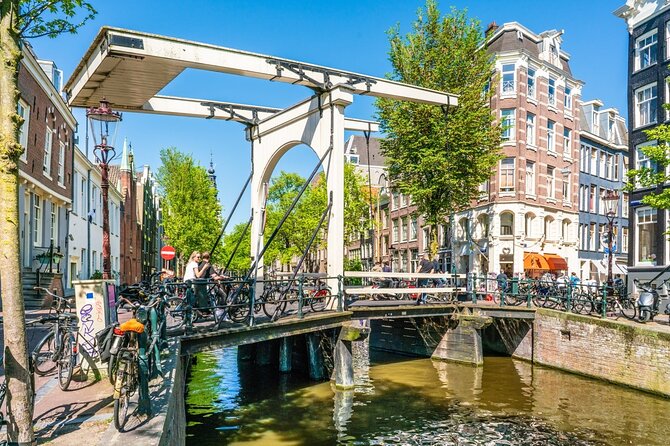
The Monument Megadlé Jethomiem is easy to miss if you are walking alone. Stones in the pavement mark the outline of a Jewish orphanage. From that building, Jewish children and their caretakers were deported to Sobibor in 1943.
This is one of the tour’s most affecting stops because it is understated. There is no grand building to enter and no large exhibit. The stones quietly mark the footprint of a place that once held children, then became part of the machinery of deportation.
You should expect several outdoor memorials like this. They require you to pay attention to the pavement, the wording, and the guide’s explanation. If you prefer major museums with long displays, the brief stop may feel too short. If you want to understand how remembrance is woven into Amsterdam’s streets, it is a powerful part of the route.
Portuguese Synagogue: the Amsterdam Jewish community before the war
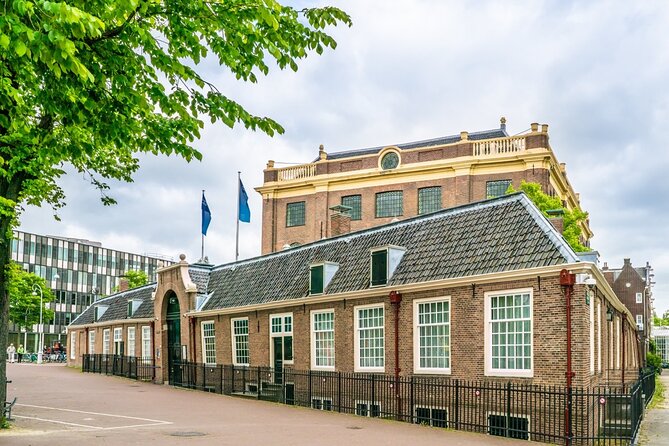
The Portuguese Synagogue is one of the route’s architectural highlights. It was once the world’s largest synagogue and reflects the strength of Amsterdam’s Jewish community before the Nazi occupation.
The tour takes you to the synagogue from outside. Entry is not included, and the Jewish Museum across the street is also not included. You can treat this as a useful orientation point and return later if you want more time indoors.
I appreciate the placement of this stop. It shows that Jewish Amsterdam was not only a wartime subject. The synagogue points to worship, migration, commerce, learning, and community life. The surrounding area helps you picture what was lost when the Nazis and their collaborators destroyed so much of that community.
The February Strike and Amsterdam’s act of protest
The Dokwerker statue recalls the February Strike of 1941. Thousands of workers joined the first public protest against Nazi persecution in occupied Europe.
This is one of the most important moments on the route because it shows Amsterdam responding collectively to the persecution of Jewish residents. The guide can place the strike within the wider story of occupation and explain why it remains such a powerful part of Dutch memory.
The statue also gives the tour a human scale. Instead of focusing only on government actions or military events, you consider ordinary workers who took a public risk. The stop does not erase the later tragedy, but it shows that resistance and solidarity were present from the start.
The Deaf Memorial and the Auschwitz Monument
The Deaf Memorial is small and easy to overlook. It honors Jewish deaf and hard-of-hearing victims murdered by the Nazis, who classified them as inferior and targeted them for systematic killing.
This stop makes the tour more specific than a general Holocaust walk. It reminds you that persecution was organized according to many identities and conditions. Groups that receive little attention in standard sightseeing deserve a place in the city’s memory.
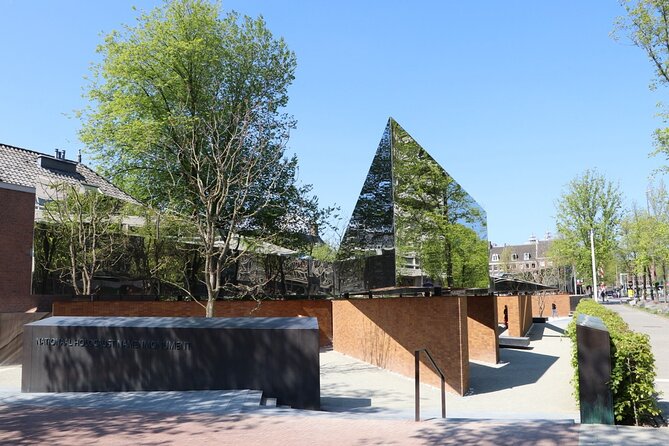
In Wertheimpark, the Auschwitz Monument uses broken mirrors to reflect the sky. The image suggests that the heavens themselves were shattered by Auschwitz and the other concentration camps.
The park offers a quieter setting after the denser city streets. You may find the change in pace helpful, though the guide still has only about 10 minutes at this stop. The monument works best when you pause and look closely rather than treating it as another quick photo stop.
The Holocaust Names Monument and Stumbling Stones
The tour ends near the National Holocaust Museum at the National Holocaust Names Monument. The memorial carries the names of 102,000 Jewish victims and 220 Roma and Sinti people murdered by the Nazis.
Names change the scale of the subject. Numbers can become hard to grasp, but a wall or stone bearing a person’s name brings the loss back to individuals and families. The inclusion of Roma and Sinti victims also reminds you that Nazi persecution reached beyond Jewish communities.
You also see Stumbling Stones, brass plaques set into the pavement at the last known residences of deported Holocaust victims. These small markers are easy to pass without noticing. Once your guide points them out, the city’s sidewalks take on a different meaning.
Ending here gives the route a clear purpose. You finish not with a single famous person, but with thousands of people whose homes, names, and lives are being remembered.
What $59.28 buys you
At $59.28 per person, the tour is priced above a casual city walk but below many private sightseeing experiences. The value comes from the guide and the route, not from admission tickets. You are paying for about 2.5 hours of interpretation across a large section of Amsterdam.
Because the activity is private and only your group participates, you have more room to ask questions and request a suitable pace. The information also says small-group and private options are available, so confirm the exact arrangement when booking if group size matters to you.
The price does not cover the Portuguese Synagogue, Jewish Museum, Anne Frank House, food, drinks, hotel pickup, luggage storage, or gratuities. Add those costs if you plan to build a full Jewish Amsterdam day around the walk.
The tour is especially good value if you already have Anne Frank House tickets and want context before entering. It is also useful if tickets are unavailable and you want a serious alternative. Just keep your expectations accurate: this is an outdoor history walk, not a museum visit.
Pace, meeting point, and practical planning
The meeting point is Westermarkt 60, near the Anne Frank House. The tour ends at the National Holocaust Names Monument, near the National Holocaust Museum. Since you do not return to the starting point, plan your next stop from the eastern end of the route.
The route is near public transportation, but hotel pickup and drop-off are not included. A taxi or Uber is recommended if you need door-to-door transport.
You need a moderate level of physical fitness. The walk lasts around 150 minutes, and most stops are outdoors. Rain is possible, so bring suitable clothing and shoes. One guide took care to check on the group during rainy weather, but you should still plan to be outside for the full experience.
There are no meals or drinks included. A guide may be flexible if you need a short snack or tea break, as Jo was during one walk, but do not count on a formal refreshment stop.
The subject matter is emotionally heavy. I would not schedule this immediately before a rushed dinner or another demanding activity. Give yourself time afterward to think about what you have seen.
Who should book this walk?
I would choose this tour if you want Anne Frank’s story placed inside the larger history of Amsterdam. It suits first-time visitors, families with older children, history-minded people, and anyone who wants a guide rather than a self-guided list of memorials.
It is also a sensible choice if Anne Frank House tickets are sold out. You will not see the annex interior, but you will learn about Anne and visit many other sites that a standard museum ticket does not cover.
I would look elsewhere if your main goal is to enter Anne Frank House, spend long periods at museum exhibits, or avoid serious Holocaust subject matter. The route is made up of many short stops, so visitors who want extended time at each site may find the pace brisk.
The satisfaction guarantee offers some reassurance, but the best reason to book is the guide. Monique was praised for her passion and willingness to share stories beyond the basic facts. Hannah, Anita, Huibert, Clare, Jo, and Marco were also singled out for clear explanations, thoughtful answers, and personal attention.
Should you book the Anne Frank Amsterdam Jewish History tour?
Book it if you want a carefully connected account of wartime Amsterdam, not just a visit to one famous address. The route’s greatest strength is its range: Anne Frank, the Homomonument, the February Strike, Jewish resistance, the Portuguese Synagogue, the Auschwitz Monument, and the Holocaust Names Monument all belong to one difficult story.
At $59.28, the walk is worthwhile for the guide-led context and private format. Pair it with a separate Anne Frank House visit if you can get tickets. If you cannot, this tour remains a meaningful way to understand the city, as long as you accept that the famous house is viewed only from outside.
FAQ
Does the tour enter Anne Frank House?
No. The tour visits Anne Frank House from the outside only, and admission is not included.
How long does the tour last?
The tour lasts approximately 2 hours and 30 minutes.
What language is the tour offered in?
The tour is offered in English.
How much does the tour cost?
The listed price is $59.28 per person.
Where does the tour begin?
The tour begins at Westermarkt 60, 1016 DL Amsterdam, near Anne Frank House.
Where does the tour end?
It ends at the National Holocaust Names Monument, near the National Holocaust Museum area in Amsterdam.
Is this a private tour?
Yes. Only your group participates in the private activity. The tour information also refers to small-group and private options.
Are the Portuguese Synagogue and Jewish Museum included?
No. Entry to the Portuguese Synagogue and Jewish Museum is not included.
Are food, drinks, hotel pickup, or luggage storage included?
No. Food and drinks, hotel pickup and drop-off, luggage storage, and coat storage are not included. Gratuities are optional.
Can I cancel for a full refund?
Yes, if you cancel at least 24 hours before the experience’s start time. Cancellations made less than 24 hours in advance are not refundable, and changes within that period are not accepted.
More Jewish Heritage Tours in Amsterdam
- Amsterdam: Jewish Quarter and History Guided Tour
★ 4.7 · 210 reviews - Budapest Jewish Heritage Memorial Walking Tour & Synagogue Entry
★ 5.0 · 568 reviews - Budapest: Jewish Heritage Guided Tour with Synagogue Ticket
★ 4.8 · 533 reviews - 3-Hour Porto Jewish Heritage Walking Tour with Local Guide
★ 4.5 · 396 reviews
Newest history tours we have reviewed in Amsterdam
- Amsterdam: Luxury Canal Cruise with Historic VR Experience★ 5.0 · 305 reviews
- Amsterdam Walking Tour: Urban Legends & History with local guide★ 5.0 · 39 reviews
- Guided Walking Tour Amsterdam – Legends, History & Ghost Stories★ 5.0 · 28 reviews
- LGBTQI+ History Tour of Amsterdam★ 5.0 · 123 reviews
- Historical Walking Tour, private with local Dutch guide★ 5.0 · 23 reviews
- Amsterdam Haunted History and Ghost Walking Tour★ 5.0 · 47 reviews
- Private Guided Historic Amsterdam Canal Cruise in a Salon Boat★ 5.0 · 21 reviews
- Amsterdam Highlights and History Walking Tour (MUST DO)★ 5.0 · 29 reviews
WWII & D-Day Tours, compared.
Zagreb: City & History Walking Tour & WW2 Tunnels
Read our review →
Pearl Harbor History Remembered Tour from Ko Olina
Read our review →
Hiroshima Peace (Heiwa) Walking Tour at World Heritage Sites
Read our review →

Pearl Harbor & USS Arizona Small-Group Tour [Early Access]
Read our review →
Anne Frank and the Jewish History of Amsterdam Private Tour
Read our review →
Browse the lists this tour appears in