Review · MEXICO CITY HISTORY TOURS
Walking Tour of the Historic Center of Mexico City
Mexico City’s historic center makes the most sense on foot, where Aztec ruins sit beside Spanish colonial buildings and grand early-20th-century palaces. This three-hour walk gives you that story in one sweep, from the Zócalo and Templo Mayor to Diego Rivera murals, the Palace of Fine Arts, and the House of Tiles.
I like the small maximum group of 10, which makes it easier to ask questions and stay close to the guide. I also like the broad mix of subjects: architecture, politics, indigenous traditions, food, music, and modern city life, rather than a tour that treats Mexico City as a string of old buildings.
The main consideration is the walking. Cobblestones, busy streets, limited seating, and Mexico City’s high elevation can make three hours tiring. The route also packs in many stops, so you get a strong introduction rather than long visits inside every site.
Key points to know before booking
- See Aztec and Spanish Mexico side by side: The route links Templo Mayor, the cathedral, colonial plazas, and modern Mexico City.
- Diego Rivera murals are a major highlight: You go inside the former Ministry of Education to see a large group of his murals.
- The group stays small: The tour allows no more than 10 participants, a useful advantage in crowded streets.
- Guides shape the experience: Fernanda, Alexia, Luis, Nat, Benjamin, and others are praised for clear English, humor, patience, and local insight.
- The route ends near major sights: You finish beside the Palace of Fine Arts and the House of Tiles, well placed for further exploring.
- Prepare for a real walk: Wear comfortable shoes, bring water, and expect stretches without a place to sit.
Why this three-hour route works as a first look at Mexico City
I like this tour because it explains Mexico City as a meeting point of cultures instead of presenting isolated monuments. The route begins in the city’s ceremonial and political heart, then moves through religious buildings, archaeological remains, government art, colonial trade centers, and public spaces that still shape daily life.
That sequence matters. You see how the Mexica capital was built around its sacred center, how the Spanish colonial city was placed over it, and how later governments used architecture, murals, and public monuments to tell their own version of Mexico.
The English-speaking guides are central to the experience. Names that appear repeatedly among the guide team include Fernanda, Alexia, Luis, Nat, Benjamin, Sarah, Gabby, Oscar, Thomas, and Eduardo. The strongest descriptions focus on guides who explain clearly, answer questions, adjust the pace, and connect old events to Mexico City today.
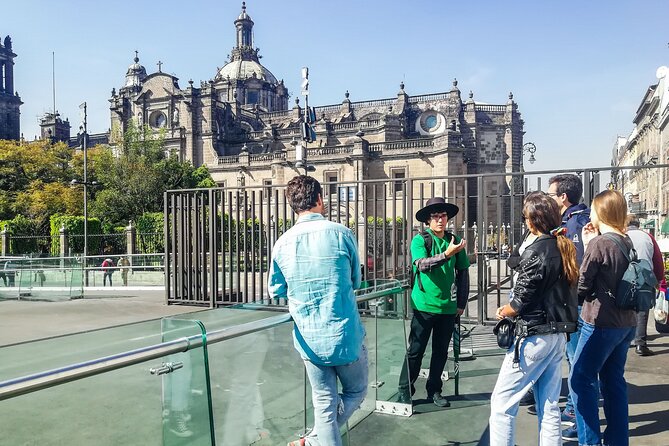
The small group helps. With up to 10 people, you should have a better chance of hearing on crowded streets and asking about details that catch your eye. The guides are also identified by green shirts and umbrellas, which helps you find the meeting point at the Zócalo.
More History Walking Tours in Mexico
- Historic Downtown Walking Tour
★ 5.0 · 1,289 reviews - Mexico City: Historic Downtown Walking Tour
★ 4.8 · 1,039 reviews - Historical and Cultural Walking Tour of San Miguel de Allende
★ 5.0 · 641 reviews
Starting at the Zócalo, Mexico City’s giant civic stage
The tour begins at Plaza de la Constitución, better known as the Zócalo. This immense square is surrounded by the National Palace, the Supreme Court of Justice, the Metropolitan Cathedral, and commercial buildings including silversmith shops.
The Zócalo is more than a photo stop. It gives you the basic map of the historic center and shows how political power, religious authority, commerce, and public life have shared the same ground for centuries. Your guide uses the square to set up the larger story of a pre-Hispanic city transformed by Spanish rule.
The listed time here is about 15 minutes. That is enough for orientation and explanation, but not enough to explore the National Palace or court buildings inside. Think of this stop as a briefing before the walking begins.
The square can be exposed to sun, and the route may be crowded. A hat and water are sensible. Guides such as Luis and Fernanda are specifically praised for helping with street crossings, finding shade, and keeping the group comfortable.
The cathedral and the remains of Templo Mayor
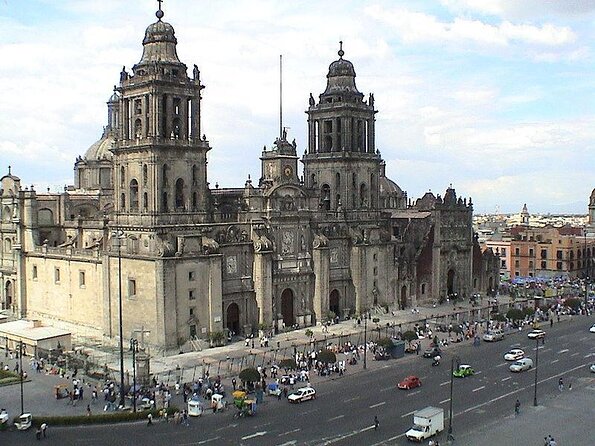
From the Zócalo, the route turns to the Metropolitan Cathedral. The guide explains the cathedral from outside, including its long construction and its Baroque and neoclassical features.
Ten minutes is a short stop for a building of this scale. You will hear the main story and examine the facade, but you should not expect a full interior visit. Admission is not included, and the tour description presents the cathedral as an exterior explanation rather than an entry.
Nearby, the route brings you to the archaeological remains of Templo Mayor. The guide views the ruins from outside and explains their importance to the Mexica, including the temples dedicated to the god of rain and the god of the sun. You also get help understanding the site’s position within the old city.
This is one of the most useful parts of the tour because the ruins can be hard to read without context. What looks like a fragment beside the colonial center becomes evidence of a major pre-Hispanic capital. The stop also makes the later cathedral and surrounding streets easier to understand.
The itinerary does not list a separate duration for Templo Mayor, and the tour does not include an archaeological museum visit. If you want a longer look at the excavations, plan to return on your own.
Diego Rivera’s murals inside the Ministry of Education
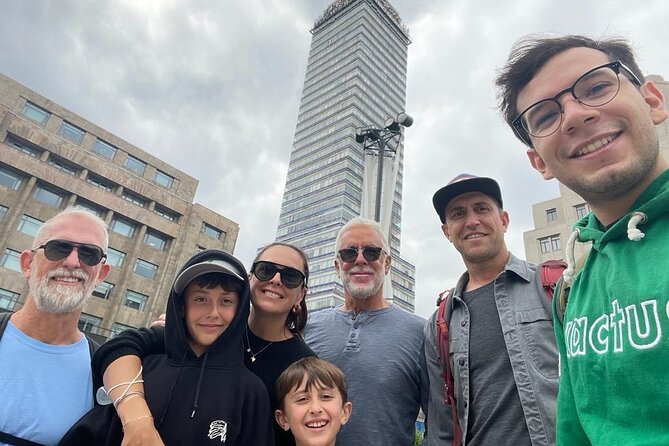
The visit to the Museo Vivo del Muralismo is the artistic centerpiece. You enter the Ministry of Education building and spend about 25 minutes looking at murals by Diego Rivera.
The setting adds interest. This is not simply a framed-art museum, but a working historic building whose walls carry scenes of festivals, traditions, labor, political struggle, trade, and social life in the early 20th century. The murals help show how public art was used to tell a national story after revolution and social change.
I would give this stop your full attention. The tour moves quickly, and 25 minutes can pass fast when you are looking at several large works. One guide, Fernanda, is praised for allowing extra time in the courtyard when the group wanted to study the murals longer, but you should not assume every visit will have spare time.
Admission to this stop is included. That improves the value of the tour, since you get an interior experience rather than only exterior explanations. It also breaks up the street walking with a quieter, shaded setting.
More Old Town and Historic Centre Walks in Mexico
- Historic Center Food Tour in Mexico City
★ 5.0 · 1,263 reviews - Mexico City Historical Centre Food Tour with 7 Authentic Tastings
★ 5.0 · 723 reviews - Private Walking Tour Gems of the Historic Center of Mexico City
★ 5.0 · 87 reviews
Plaza de Santo Domingo and the colonial trading world
Plaza de Santo Domingo shifts the story toward the Spanish viceroyalty. Here, the guide discusses major events in New Spain, the trade in spices and goods with Asia, the Spanish Inquisition, and France’s attempts to conquer Mexico.
The strength of this stop is range. It shows that colonial Mexico was tied to wider trade routes and political struggles, not cut off from the rest of the world. The plaza also helps you see how public spaces carried several roles at once: commerce, administration, religion, and ceremony.
The planned stop lasts about 15 minutes and is free to visit. As with the Zócalo, you are mainly getting interpretation and orientation rather than an interior tour of every surrounding building.
This is a good place to ask questions. The guide team is praised for handling questions about both past events and present-day Mexico, and that back-and-forth can make the colonial material easier to follow.
Resting at Plaza Tolsá with room for local subjects
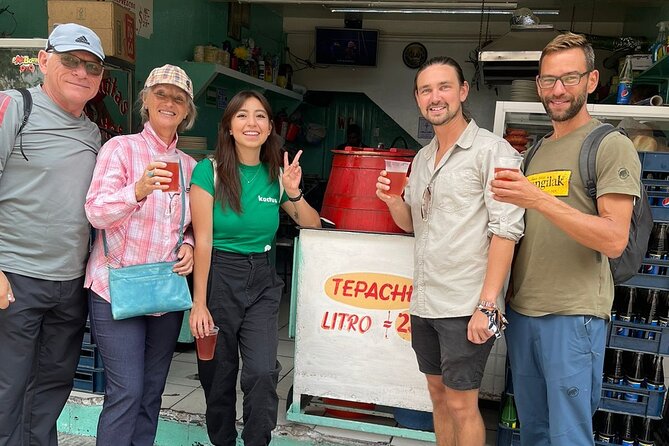
Plaza Tolsá is the route’s planned pause. You stop in the shade for about 20 minutes and discuss subjects such as indigenous languages, Day of the Dead traditions, music, politics, and Mexican food.
I value this part because it keeps the tour from becoming a parade of dates and facades. You get a chance to connect historical events with the culture you will encounter elsewhere in the city. Each guide brings a different set of examples and personal observations.
The plaza also contains the equestrian statue of Charles IV, often called El Caballito, or the little horse. You see the exterior of the National Museum of Art and the Mining Palace from here as well.
This is one of the few scheduled moments for rest. If you need a longer break, tell the guide early. The group may be able to pause, but the total route still has several stops ahead.
The archaeological window under a modern street
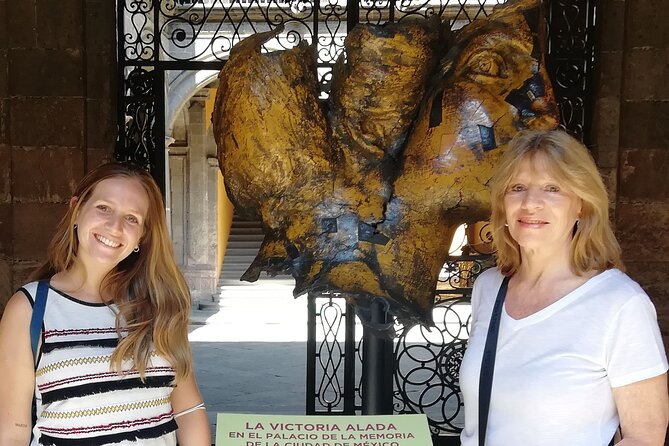
The Ventana Arqueológica is a small stop, listed at about five minutes, but it makes a useful point. You look beneath a street near the main temple and learn how older remains can survive under the present-day center.
The stop is brief, yet it reinforces the main theme of the tour: Mexico City has been rebuilt in layers. The modern pavement does not erase the earlier city. Instead, fragments appear under buildings and streets, sometimes in places you would walk past without noticing.
Admission is included. Because the stop is short, listen closely to the explanation about how the remains were found and what the site reveals. This is not a full archaeological visit, but it is a sharp visual reminder of the city’s depth.
Palace of Fine Arts, Palacio Postal, and the House of Tiles
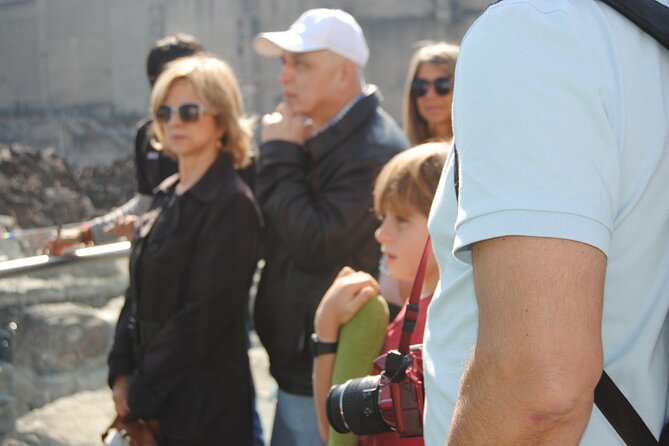
The Palace of Fine Arts is one of the route’s most recognizable sights. The tour spends about 15 minutes here, focusing on the exterior and the building’s artistic impact. The interior is not included in this walk, and the listed admission for the stop is free.
The building rewards a slow look at its exterior, especially after the earlier discussion of murals and public art. It also marks a shift from colonial Mexico to the grand civic architecture of a later period.
Next comes Palacio Postal, a still-functioning palace that reflects the economic and political ambitions behind impressive public buildings. The guide explains why such a grand structure was created and what it says about Mexico’s development.
Admission is not included here. The visit is an exterior stop, so you should not expect an extended interior tour.
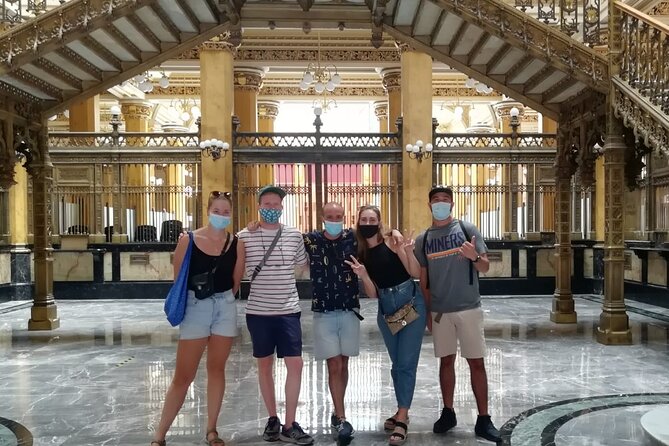
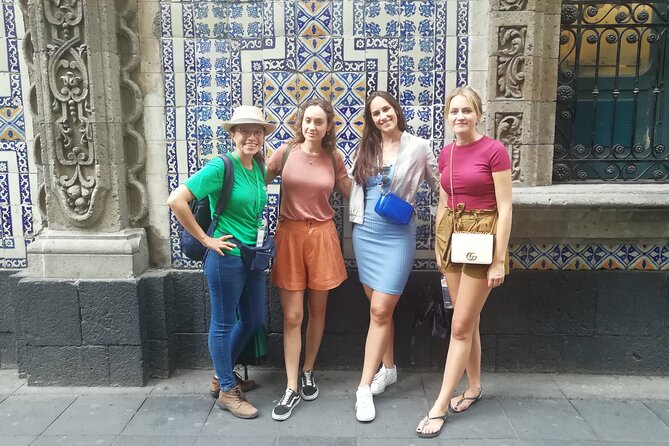
The final major stop is the House of Tiles, one of the city’s most photographed buildings. Its tile-covered facade is easy to recognize, and the stop gives you a strong closing image of the historic center.
The tour ends at Edificio Guardiola on Avenida 5 de Mayo, beside the Palace of Fine Arts and the House of Tiles. That is useful planning: you can continue sightseeing, take photographs, or return to one of the sites that received only a short explanation.
How much walking and city noise should you expect?
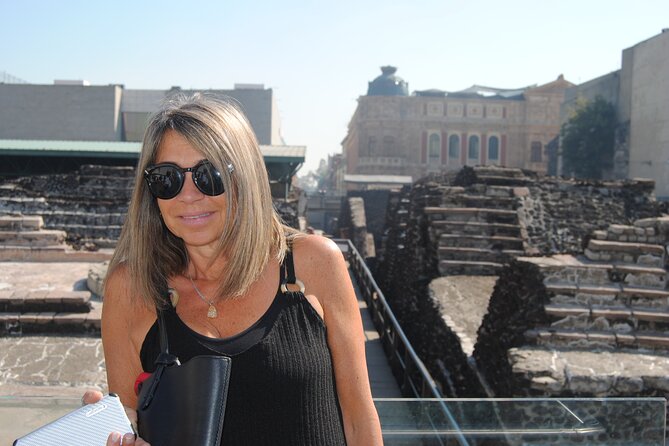
This is a three-hour walking tour, not a bus tour with brief steps off the vehicle. You will cross busy streets, walk over uneven surfaces, and spend much of the route standing while the guide talks.
Mexico City’s elevation can make the effort feel greater, especially if you have just arrived. Several people in one group may have different walking speeds, and a slower pace can mean that the full route is not completed exactly as planned. The tour is best for anyone comfortable walking for several hours with short pauses.
Guides are praised for being patient with mixed-age groups, accommodating bathroom breaks, offering shade, and adjusting to different needs. Still, the route itself has limited seating. Wear shoes with good support, carry water, and protect yourself from the sun.
The streets can also be crowded. That is part of the setting, but it means you need to stay near the green shirt or umbrella and pay attention at crossings.
Group size, English, and the value of the booking
The group limit of 10 is one of the tour’s strongest practical features. A small group is easier to manage around the Zócalo and the Palace of Fine Arts, and it gives you a better chance to ask about details that interest you.
The tour is offered in English. The guides named in the feedback are repeatedly praised for clear speech, humor, patience, and strong command of Mexican history. Alexia is noted for adding thoughtful commentary on present-day life, while Luis is praised for practical recommendations as well as historical explanations.
The exact price is not provided here, so I cannot judge the cost in pesos or dollars. The value depends on how much you want guided context. You are paying for three hours of organization, English explanation, a small group, and entry to the Ministry of Education mural visit.
Tips are not included. Some people may compare this paid booking with a tip-based walking tour, especially since the provider uses the name Kactus Free Walking Tour. Check the current price and tipping expectations before booking, then decide if the guaranteed reservation and small group are worth the difference for you.
Free cancellation is available up to 24 hours before the start time. Changes or cancellations inside that window are not refunded, and poor weather or failure to reach the minimum group size can lead to a rescheduled tour or full refund.
Who should book this historic center walk?
I would choose this tour for a first day in Mexico City, especially if you want a clear map of the center before returning to selected sites on your own. It suits people who like history explained in plain language and want more than a photo checklist.
It is also a good fit for English-speaking couples, solo visitors, friends, and families with adults who can manage three hours of walking. The guides appear comfortable with questions and different group needs, which helps if you want conversation rather than a memorized speech.
I would look elsewhere if you want long interior visits, a museum-focused experience, or a slow architecture study. The cathedral, Palacio Postal, Palace of Fine Arts, and National Museum of Art are mainly treated from outside. Templo Mayor also receives context rather than a full archaeological visit.
Should you book it?
Book this walk if you want the historic center to make sense quickly. The strongest parts are the mix of Aztec remains, colonial squares, Rivera murals, public art, and modern cultural discussion, all handled by a guide in a group capped at 10.
Skip it if you dislike standing, uneven streets, or a brisk overview. For most first-time visitors who can manage the walking, I think the route offers a useful introduction and leaves you with a smart plan for what to explore next.
FAQ
How long is the walking tour?
The experience lasts approximately three hours.
Where does the tour begin?
It begins at Plaza de la Constitución, the Zócalo, in Mexico City’s historic center.
Where does the tour end?
It ends at Edificio Guardiola on Avenida 5 de Mayo, beside the Palace of Fine Arts and the House of Tiles.
Is the tour offered in English?
Yes. The tour is offered in English.
What is included in the experience?
The three-hour walking tour in Mexico City’s historic center is included. Admission to the Museo Vivo del Muralismo and the Ventana Arqueológica is included.
Are tips and transportation included?
No. Tips and transportation to the meeting point are not included. Some food or sweets available for purchase are also not included.
Newest history tours we have reviewed in Mexico
- Coba Private Tour – Ancient Ruins & Refreshing Cenote Swim★ 5.0 · 85 reviews
- Private Walking Tour Gems of the Historic Center of Mexico City★ 5.0 · 87 reviews
- Private Tour Mexico City – Best Rated★ 5.0 · 220 reviews
- Private Historic City Tour + Street Food of Oaxaca – Best Rated★ 5.0 · 53 reviews
- Historical & Cultural Walking Tour of San Miguel de Allende★ 4.8 · 225 reviews
- Walking Tour in Mexico City for Exploring their Cultural Heritage★ 5.0 · 245 reviews
- Chichen Itza Guided Historical Tour with Lunch Included★ 4.5 · 112 reviews
- Ancient Chacchoben Mayan Ruins & Mayan Experience from Costa Maya★ 5.0 · 96 reviews
Old Town & Historic Centre Walks, compared.
Madrid Essential: Historic Center, Plaza Mayor & Royal Palace
Read our review →
Live Fado Show with Port Wine in Historic Center
Read our review →
Valencia Old Town Tour with Wine & Tapas in 11th Century Historic Monument
Read our review →
Prague Old Town, Medieval Underground and Dungeon Historical Tour
Read our review →
Cartagena: Historic Center and Getsemaní Shared Walking Tour
Read our review →
Old Town Walking Tour History and Tales in Edinburgh
Read our review →