

Review · BERLIN HISTORY TOURS
Private Taxi Tour City East & West History and Architecture 3-4h
Berlin is too spread out for a quick walking tour, and this private taxi ride tackles that problem head-on. In three to four hours, Gunter Bauer takes you from the Kaiser Wilhelm Memorial Church and Kurfürstendamm to the Brandenburg Gate, Humboldt Forum, Checkpoint Charlie, and the former East Berlin. The car lets you cover ground without wearing out your feet.
I like the custom itinerary and the way the tour mixes famous sights with useful city context. I also like the personal service, including pickup at your hotel, child seats on request, and photographs that Gunter may take during the day. The main drawback is simple: you spend much of the tour looking through a car window, so this is an overview rather than a close study of every museum or neighborhood.
Key points
- A private English-language taxi tour for your group alone, with pickup within Berlin’s S-Bahn ring.
- East and West Berlin in one outing, including Cold War sites, Prussian buildings, modern government offices, and shopping boulevards.
- A strong choice in cold or wet weather, since the vehicle is heated and air-conditioned.
- Flexible sightseeing, with the route adjusted to your interests and short stops at major sights.
- Useful for families and older visitors, with a toddler seat, booster seat, and baby seat available by request.
- Best for orientation, not for spending long periods inside museums or monuments.
Seeing Berlin’s full story from a private taxi
The appeal here is not luxury transport. It is efficiency. Berlin is a large city, and its most important sights are scattered between former royal districts, the old West, the government quarter, and the rebuilt center.
A private car gives you a moving introduction to all of it. You can pass from the grand shopping streets of the former West Berlin to the socialist scale of Alexanderplatz, then continue to the Brandenburg Gate and the government quarter without working out several public transport connections.
Gunter Bauer is the guide and driver. He offers the tour in English and shapes the commentary around your interests. That matters in Berlin, where almost every major building has more than one chapter. A church may tell the story of imperial Germany, wartime destruction, postwar design, and modern city life all at once.
You should still think of this as a survey tour. At three to four hours, the schedule cannot give you a full museum visit, a long walk through every courtyard, or detailed time at each memorial. Its strength is showing you how the pieces fit together.
More Private History Tours in Berlin
- Berlin Private Complete History All Day Walking Tour
★ 5.0 · 474 reviews - Berlin Private Half-Day Walking Tour: Discover the German Capital’s History
★ 5.0 · 244 reviews - The History of Berlin: WWII PRIVATE Walking Tour With Locals
★ 5.0 · 209 reviews
The former West: churches, shopping streets, and Berlin style
The tour often begins around Breitscheidplatz, home of the Kaiser Wilhelm Memorial Church. The damaged tower and preserved entrance portal recall the Second World War, while the modern blue-glass church beside it reflects postwar Berlin.
The church was originally built as a memorial to Kaiser Wilhelm I, not as a memorial to the war itself. Look closely at the preserved portal, where the faces of biblical figures resemble members of the Prussian royal family. The modern church, designed by Egon Eiermann, is known for its blue glass blocks and its quiet interior.
This is a good first lesson in Berlin’s habit of keeping old and new side by side. The damaged tower was nearly removed after the war, but public opposition saved it. Today the contrast between the ruined tower and the modern structure is one of the city’s clearest visual statements.
Nearby, you see Berlin Zoological Garden, one of Germany’s oldest zoos. From outside, the elephant gate and lion gate are the most striking features. The zoo began with animals connected to the royal hunting grounds and later developed buildings inspired by the regions associated with the animals.
The route then moves through the former West’s grander streets. The Theater des Westens recalls the period when Berlin’s wealthy population moved toward spacious villas and gardens beyond the crowded central districts. Its ornate exterior can look almost overdone, but that is part of its charm. Inside is an imperial box, and the building is still used for musical theater.
Kantstrasse leads toward Kurfürstendamm, usually shortened to Ku’damm. This boulevard was modeled partly on the Champs-Élysées, with broad streets, decorative lamps, shops, cafés, and entertainment venues. Its earlier image survives in the writing of George Grosz and Erich Kästner, though today the street is more associated with fashion stores and international brands.
The nearby Tauentzien is the shopping continuation of Ku’damm. Its major landmark is Kaufhaus des Westens, better known as KaDeWe. The department store covers about 60,000 square meters and is especially famous for its gourmet floor.
You do not need to shop to enjoy the visit. The food department is the point. You can browse chocolates, bread, cheese, oysters, and champagne in one place. The tour allows about 15 minutes here, so treat it as a quick look rather than a full shopping trip.
From the Tiergarten to the federal government quarter
The route leaves the shopping streets for the Tiergarten, Berlin’s great central park. It began as an electoral hunting ground, then opened to the public under Frederick the Great. Later, the landscape gardener Peter Joseph Lenné reshaped it with paths, lakes, views, and the Landwehr Canal.
The park suffered badly during the Second World War. Trees were cut down, and parts of the grounds were used for growing food. Allied-supported replanting helped restore it. As you pass through, the park gives Berlin a welcome pause between dense districts and monumental buildings.
The Victory Column, topped by the golden figure known as Goldelse, tells a less comfortable story. It originally stood in front of the Reichstag and commemorated Prussian victories over Denmark, Austria, and France. It was later moved to its present location during the Nazi period, with another drum added to mark a later victory that never came.
The House of World Cultures is another memorable stop. Its curved roof earned it the Berlin nickname Pregnant Oyster. The building was a gift from the United States to West Berlin, and the roof collapsed in 1980. It was rebuilt and now hosts non-European art, performances, and cultural events.
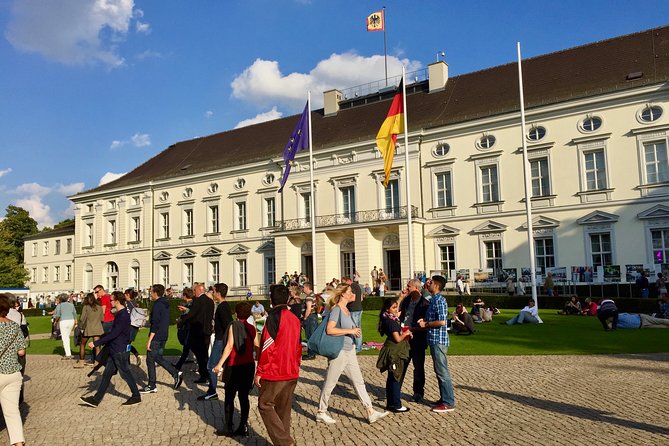
Bellevue Palace follows. This small palace is the official Berlin residence of the Federal President. It was built for August Ferdinand, the younger brother of Frederick the Great, and originally had a view toward Charlottenburg Palace. That view has long disappeared, but the building remains an important symbol of the federal capital.
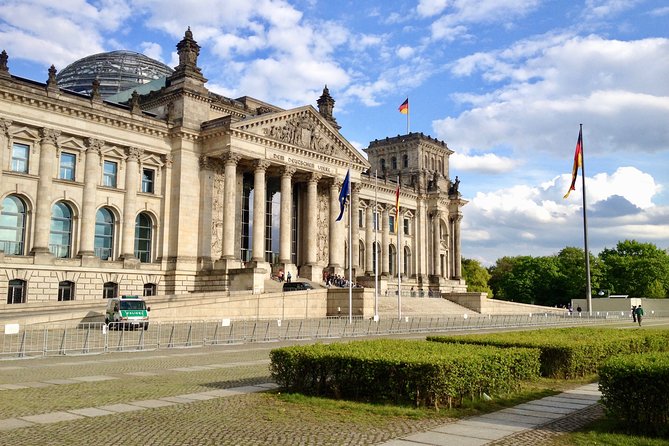
The Reichstag is one of the tour’s essential stops. Its Wilhelminian architecture, wartime damage, East German neglect, post-reunification renovation, and glass dome chart the political history of modern Germany.
The building was gutted and rebuilt in the 1990s for the reunified Bundestag. The glass dome was not part of the original architectural plan, but it now represents openness and public access. The tour also points out the Paul-Löbe Building, where much of the committee work takes place, and the Federal Chancellery, an enormous modern structure with hundreds of offices.
This stretch is especially useful if you have limited time in Berlin. You see the major government buildings, understand their roles, and get a sense of how the city expanded along the Spree.
Hackesche Höfe and the changing former East
The tour crosses into the old East Berlin and reaches Hackesche Höfe. These connected courtyards were built in 1908 as a planned mixture of workshops, small factories, offices, and apartments.
During the GDR period, the courtyards fell into poor condition and were partly used for storage. After reunification, they became one of the first major restoration projects in the area. Today, their Art Nouveau details frame shops, cafés, galleries, and locally made goods.
The stop is brief, around 10 minutes, so you will get an introduction rather than a long browse. It is still worth seeing because the courtyards show a different side of Berlin’s urban life. They were not royal spaces or government monuments. They were working places designed to combine business and home.
Berlin Central Station provides another sharp contrast. It is a huge five-level transport complex with underground and elevated tracks, shops, and large glass halls. The station replaced the old pattern of separate terminal stations serving different directions.
That change also affected Bahnhof Zoo, once the main long-distance station of West Berlin. After the new central station opened, Bahnhof Zoo lost its long-distance role, a decision that changed the daily rhythm of western neighborhoods.
The route continues through areas shaped by the Wall. You pass places connected with escape attempts, East-West train travel, and the deaths that occurred along the border. Friedrichstrasse Station was the only Berlin station where East and West rail travel connected during the Wall period. Its former departure area, now known as the Palace of Tears, preserves the difficult experience of separating from family and friends.
More Private History Tours in Germany
Jewish Berlin and the northern city center
The New Synagogue on Oranienburger Strasse is easy to recognize by its golden dome and Moorish design. The main synagogue was destroyed during the war, but the entrance building was partly reconstructed and now contains an exhibition on Jewish life in Berlin.
Security is strict. Expect airport-style checks before entering. The building’s history reflects a period when Prussia granted Jews greater civil rights and Berlin’s Jewish community wanted to present its culture with confidence. Otto von Bismarck attended the original inauguration in 1866.
Nearby, Friedrichstrasse shows another side of the city. Its northern end has long been less polished than the central section, though redevelopment has changed the area. The street eventually runs south toward Kreuzberg, giving it a useful role in understanding Berlin’s long north-south axis.
Unter den Linden leads into the city’s grandest historic center. The boulevard began as a bridle path between the royal palace and the hunting grounds. Linden trees eventually won out over competing proposals for nut trees, giving the street its name.
Here you pass the State Opera, Humboldt University, the State Library, the Neue Wache, and the former royal palaces. The Neue Wache is now a memorial to victims of war and tyranny, centered on Käthe Kollwitz’s Pietà. It is a quiet, solemn stop amid one of Berlin’s busiest ceremonial avenues.
Bebelplatz recalls both the elegance and the crimes of the old center. The square is framed by the former royal library, St. Hedwig’s Cathedral, the State Opera, and Humboldt University. A glass panel in the pavement reveals an empty library, recalling the Nazi book burning of May 10, 1933.
The German Historical Museum occupies the former armory. Its exterior decorations include replicas of death masks from dying soldiers, a grim reminder of the building’s original military purpose. The museum itself traces German history, but the tour mainly uses the building to explain how Berlin’s monuments were reused and reinterpreted.
Brandenburg Gate, Gendarmenmarkt, and the rebuilt center
Brandenburg Gate sits on Pariser Platz, Berlin’s ceremonial front room. War and the Wall once left the gate isolated, but the surrounding buildings have been reconstructed in modern form, including the Academy of the Arts, embassies, and the Liebermann House.
The gate is a short stop, usually about 15 minutes. That is enough for photographs and an explanation of its political symbolism. If you want to walk through the gate, take your time, and visit nearby institutions, you will need a separate visit.
Gendarmenmarkt is one of Berlin’s most graceful squares. The German Cathedral and French Cathedral flank the Konzerthaus, creating a carefully balanced ensemble. Despite their names, the two church buildings are not cathedrals in the usual sense. Frederick the Great added their tower structures to meetinghouses.
The French Cathedral still serves a French-speaking Reformed congregation. The German Cathedral now contains a museum about German parliamentary history. Much of the square was rebuilt during the GDR period, which makes its polished appearance another example of Berlin being repeatedly remade.
The Humboldt Forum brings the story of the royal palace up to the present. The original palace was destroyed by the East German government after the war, despite its importance as a Baroque landmark. A modern building with a reconstructed exterior and courtyard now occupies the site.
The forum includes non-European collections and holdings linked to Humboldt University. The visit is included, with about 30 minutes available. That is enough to look at the building and see part of the interior, but not enough for a full museum day.
Alexanderplatz, Nikolaiviertel, and the Wall’s most famous photo stop
Alexanderplatz shows the scale of East Berlin’s socialist rebuilding. The square was reshaped for large public gatherings, with broad open space and modern towers. The television tower remains the dominant feature and was intended to display the technical confidence of East Germany.
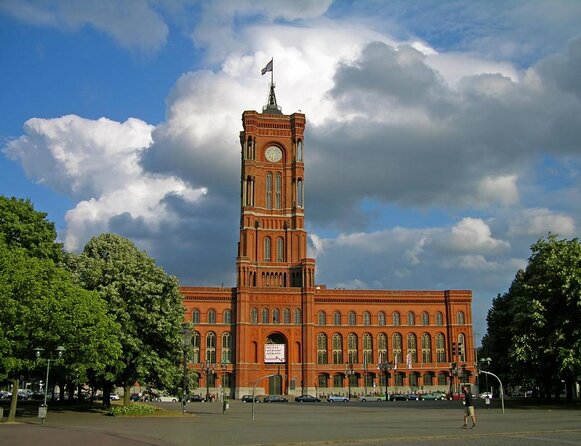
Nearby, the Red City Hall gets its name from its red brick, not from the political party of Berlin’s governing mayor. Some rooms can be visited, including a display of plaster casts of famous statues.
Nikolaiviertel offers a smaller, more intimate view of old Berlin. Much of the quarter was reconstructed during the 1980s, and only a few original buildings survived. The Nikolaikirche, Berlin’s oldest church, now functions as a city museum. The Knoblauchhaus presents Biedermeier interiors and the life of a cloth-making family.
The effect is partly theatrical, but that does not make it useless. If you want to understand what old Berlin looked like before wartime destruction and postwar rebuilding, this compact quarter gives you a helpful visual impression.
Checkpoint Charlie is a brief photo stop, usually around 10 minutes. The guardhouse and sign seen today are replicas, not the original Cold War structures. The place still matters because it recalls the 1961 tank confrontation between American and Soviet forces, one of the most dangerous moments of the Cold War.
The stop is better for orientation and photographs than for a full museum visit. If you want detailed Cold War exhibits, allow separate time at the nearby private museum.
How much does this private tour deliver?
The price is about $150.18 per person. That is not a budget sightseeing option, but the value changes with group size. For two people, it is a premium way to see Berlin. For a family or small group, the private vehicle, pickup, parking, and guide time can compare more favorably with several separate tickets, taxis, and public transport journeys.
You also pay for convenience. Transportation, WiFi, air conditioning, parking fees, and pickup within the S-Bahn ring are included. The taxi fare and tour service are both covered in the stated price.
Airport pickup from BER and pickup outside the S-Bahn ring cost extra. Lunch is not included. Plan to bring water, especially since the tour combines a warm car with frequent short stops.
The tour is also a practical choice in winter or poor weather. You remain in the heated car for much of the experience, then step out for the sights that matter most. That is especially helpful for older visitors or anyone who cannot manage a long walking tour.
Who should book this Berlin taxi tour?
Book it if you want a broad first look at Berlin, prefer private transport, or are traveling with older relatives or children. It works well for visitors who want history explained while moving between districts rather than spending the whole day in one museum.
It is also a smart first-day option. You can use the route to decide where you want to return on foot, by public transport, or for a longer museum visit.
Skip it if you prefer slow exploration, long café stops, or detailed time inside monuments. A group walking tour may cost less, and Berlin’s public transport can get you to many of these sights efficiently if you are comfortable planning the routes yourself.
Gunter’s strengths are his local stories, flexible approach, careful driving, and fluent English. He is also attentive to practical needs, from rescheduling after a delayed arrival to helping with train tickets. If that kind of human help matters to you, the private format is worth considering.
FAQ
How long is the private Berlin taxi tour?
The tour lasts approximately three to four hours.
Where can pickup take place?
Pickup within Berlin’s S-Bahn ring is included. Pickup from BER Airport or locations outside the S-Bahn ring costs extra.
Is the tour offered in English?
Yes. The tour is offered in English and is led by Gunter Bauer.
Is the vehicle private?
Yes. This is a private activity, so only your own group participates.
Are child seats available?
A toddler seat for children from six months to three years and a booster seat for older children are available. A baby seat, such as a Maxi-Cosy, can be brought on request.
What is included in the price?
Private transportation, WiFi, an air-conditioned vehicle, parking fees, and pickup within the S-Bahn ring are included. Lunch is not included.
Should you book it?
Book this tour if you want to cover a lot of Berlin in a short time, stay comfortable in bad weather, and hear the city’s political and architectural story from one guide. The private taxi format gives you speed and flexibility, while the short stops keep the route manageable.
Just set the right expectation. You will not fully visit every museum or explore each neighborhood on foot. Think of it as a well-informed city orientation with a personal driver, strong historical context, and an efficient route through Berlin’s East and West.
More Architecture and Landmark Tours in Berlin
- Venice: St. Mark’s Basilica Guided Tour & VR History Intro
★ 3.9 · 4,880 reviews - Venice’s Best: Basilica, Doge’s Palace, Gondola & History Gallery
★ 4.5 · 2,478 reviews - Córdoba: Skip-the-Line Great Mosque-Cathedral History Tour
★ 4.7 · 1,690 reviews - Pantheon Elite Guided Tour – Rome’s Iconic Ancient Temple
★ 5.0 · 1,447 reviews
Newest history tours we have reviewed in Berlin
- Berlin: Nazi History Walking Tour★ 4.8 · 33 reviews
- Berlin: History and Sightseeing with Kids (Free for Kids)★ 4.9 · 19 reviews
- Berlin: Historical Sights & Berlin Wall Tour with a Berliner★ 5.0 · 62 reviews
- Berlin: Urbex Abandoned Places & History Tour★ 4.8 · 18 reviews
- Berlin (E)Bike Tour Historical Highlights in Small groups★ 4.5 · 24 reviews
- East Berlin Food & History Tour with Eating Europe★ 4.8 · 20 reviews
- Berlin: Historic Center Walking Tour with a Real Berliner★ 5.0 · 134 reviews
- Berlin: Guided Craft Beer & Cultural Tour With Snacks★ 5.0 · 68 reviews
Architecture & Landmark Tours, compared.
St. Mark’s Basilica Guided Tour & VR History Intro
Read our review →
Venice’s Best: Basilica, Doge’s Palace, Gondola & History Gallery
Read our review →
Córdoba: Skip-the-Line Great Mosque-Cathedral History Tour
Read our review →
Pantheon Elite Guided Tour – Rome’s Iconic Ancient Temple
Read our review →
Abu Dhabi Grand Mosque, Palace, and Heritage Village
Read our review →
Chicago in a Day: Food, History & Architecture Walking Tour
Read our review →

Colosseum Special Access Tour, with Ancient Temples & Tombs
Read our review →Browse the lists this tour appears in