Review · NEW ORLEANS HISTORY TOURS
New Orleans Historic Cemetery Walking Tour
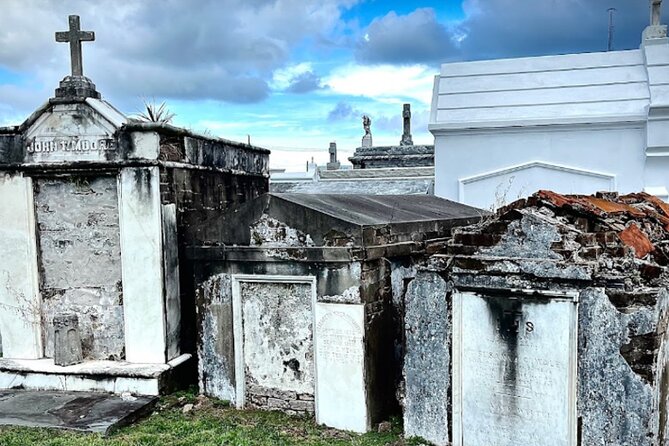
New Orleans cemeteries make more sense when you understand the city beneath your feet. High water levels, hurricanes, disease, and limited ground space helped shape the city’s famous above-ground tombs. This walk connects those burial customs with the people and events that shaped New Orleans, ending at the Hurricane Katrina Memorial.
I like the small group size, capped at 10, and the way guides such as William, Taylor, Chris, and Robert combine facts with stories. I also like the route’s focus on three cemeteries and the Katrina Memorial, rather than one quick look at a single site. The main drawback is the walking itself: expect uneven pavement, grass, heat, and a cemetery location farther from the French Quarter than some visitors expect.
Key points to know before you book
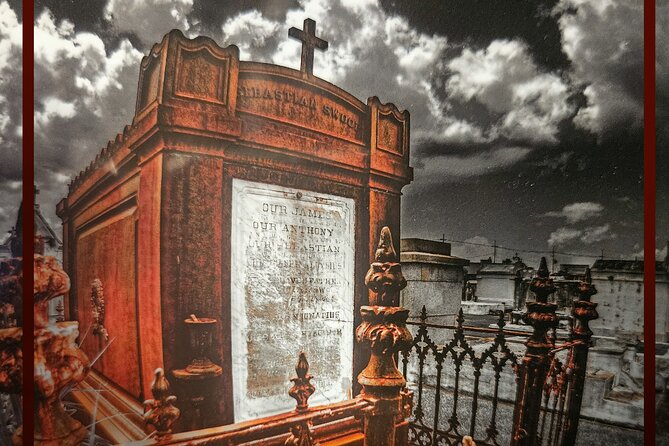
- Three cemetery stops in about two hours: The route includes St. Patrick Cemetery #2, cemetery grounds near City Park, and Charity Hospital Cemetery near the Katrina Memorial.
- Above-ground burial traditions: You learn why New Orleans tombs look different and how families could use limited burial space.
- A personal, story-led guide: Guides including Taylor, William, Chris, Robert, and Spooky Rob are praised for clear explanations, humor, and patience with questions.
- A small maximum of 10 people: This gives the guide room to remember names, adjust the pace, and answer questions.
- Outdoor conditions matter: Bring water, sunscreen, a hat, and an umbrella. Uneven pavement and grass can make this a poor fit if you need easy walking.
- The route is not centered in the French Quarter: You meet at G’s Pizza on Bienville Street and finish on Canal Street near Charity Hospital Cemetery.
Why New Orleans burial customs are the real story
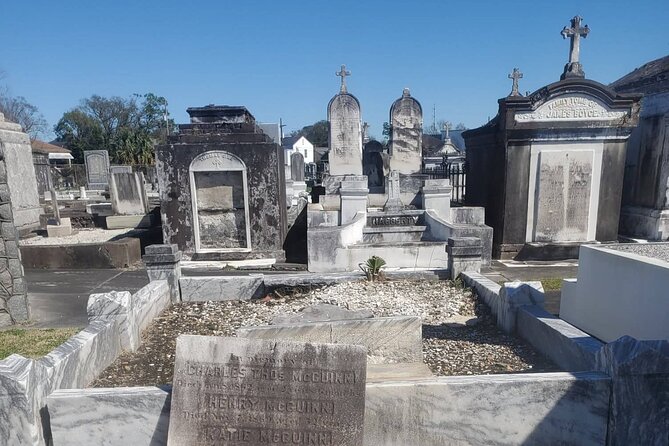
At first glance, a cemetery walk can sound like a narrow subject. In New Orleans, it is really a lesson in geography, public health, religion, immigration, and disaster.
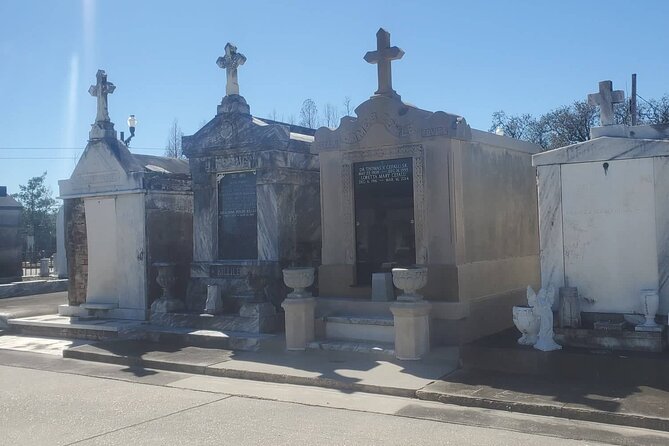
The city’s water level and wet ground made traditional underground burials difficult. The tombs you see above ground are not simply decorative markers. They reflect practical choices made in a place shaped by water, disease, hurricanes, and crowded urban space.
That is why the burial section is likely to be the most memorable part of the tour. You learn how more than one person could be placed in a small tomb over time, and how this system worked within local customs. It gives you a useful key for understanding cemeteries across New Orleans, not just the three sites on this route.
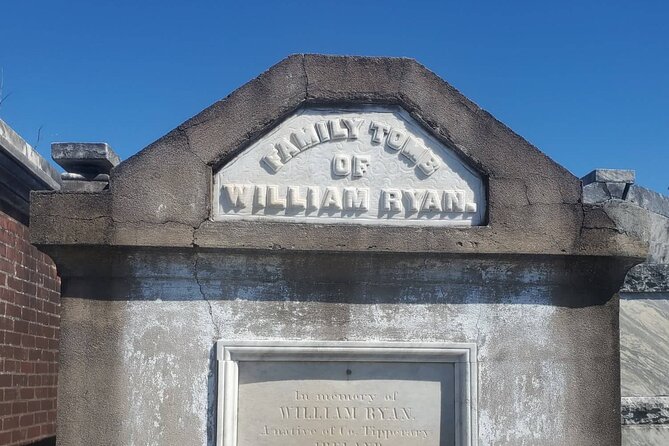
The tour also places burial traditions in a human setting. At St. Patrick Cemetery #2, the focus includes the Irish experience in New Orleans. This adds social history to the tombs and names. You are not just looking at old stone. You are considering the communities, religious traditions, and hardships behind them.
More Dark History and Haunted Tours in New Orleans
- New Orleans Small-Group Haunted History Carriage Tour
★ 4.5 · 2,289 reviews - New Orleans Haunted History Ghost Tour
★ 4.5 · 2,084 reviews - Haunted Drunken History Tour from New Orleans
★ 5.0 · 135 reviews
St. Patrick Cemetery #2: a focused 30-minute introduction
The first stop is St. Patrick Cemetery #2, where the guide explains cemetery culture and local burial practices. The stop lasts about 30 minutes, so expect a compact introduction rather than a long period of free wandering.
This is a good opening because the cemetery provides a clear setting for the basic ideas you will use during the rest of the walk. Your guide can explain how the tombs function, why above-ground burial became common, and how Catholic customs shaped cemetery life.
The Irish connection is another useful part of this stop. William has been singled out for his explanations of St. Patrick Cemetery and the struggles of the Irish community in New Orleans. That subject gives the visit more depth than a simple tour of old graves.
I would pay close attention here and save broad questions for this stop. The route moves on, and the best value comes from understanding the burial system before you see the next cemeteries.
The Mid-City cemeteries near City Park
The middle portion of the walk lasts about an hour and explores cemeteries near City Park. This is the longest part of the route, giving your guide time to connect burial customs with the wider story of New Orleans.
You may have time to look around at your own pace during part of the visit. One guide described by the operator’s response gives people time to explore inside a cemetery before gathering everyone again. That format works well because you get both guided explanation and a little quiet time to look at the tombs yourself.
This is also where the guide’s style matters most. Taylor is described as energetic and full of stories, while William is praised for taking his time and welcoming questions. Chris and Robert are also noted for making the material clear and entertaining. The best guides on this route do more than recite dates. They explain why the cemetery looks as it does and connect individual details to the city’s larger past.
The tradeoff is that the condition of the grounds can vary. Expect uneven pavement and some grass. One visitor was disappointed by the appearance of certain graves, so you should not book this expecting every cemetery to look polished or perfectly maintained. The weather can also change the feel of the visit. In the New Orleans sun, even two hours outside can become tiring.
The Katrina Memorial and Charity Hospital Cemetery
The final stop lasts about 20 minutes at the Hurricane Katrina Memorial near Charity Hospital Cemetery on Canal Street. Here, the focus shifts from older burial traditions to more recent loss.
The memorial also recalls people lost to yellow fever, hurricanes, and other disasters. That makes it a fitting final stop. The tour begins with the practical and religious reasons behind New Orleans burial customs, then ends with a place that connects death, public health, severe weather, and the city’s continuing memory.
You should expect this stop to feel more reflective than the earlier cemetery visits. It is not simply another collection of tombs. The memorial gives the route a clear ending and reminds you that disasters are not only subjects in history books. They have shaped families, neighborhoods, and the city itself.
Because the tour ends here, you do not return to the starting point. Plan your next stop around Canal Street and Charity Hospital Cemetery. This is useful if you want to continue sightseeing in that area, but less convenient if you assumed the walk would bring you back toward the French Quarter.
More Dark History and Haunted Tours in the USA
- Savannah History and Haunts Candlelit Ghost Walking Tour
★ 5.0 · 3,235 reviews - Genteel and Bard’s Savannah Dark History and Ghost Encounter Walking Tour
★ 5.0 · 1,546 reviews - The Historic Galveston Ghost Tour
★ 5.0 · 1,524 reviews - Wicked Awesome Tours: Witch Trial History and Salem Haunts!
★ 5.0 · 1,032 reviews
Guides who make the difference
The tour is built around storytelling, and the guide may be the biggest factor in how much you enjoy it.
Taylor receives repeated praise for being friendly, funny, energetic, and well informed about New Orleans. He is also noted for offering useful food suggestions and helping people cope with the heat, including offering an umbrella. William is described as warm, professional, patient, and willing to answer questions without rushing. Chris is praised for making history easy to follow, while Robert is described as organized and clear.
Spooky Rob brings a more playful name and a style that works for families. The tour does not need to become a ghost show to be entertaining. The subject already includes death, disease, storms, and old burial customs. A guide who can add humor without losing respect is valuable.
The small group limit helps here. With no more than 10 people, a guide can remember names, hear questions, and keep the group together more easily. A small group also gives you a better chance to ask about a particular tomb, tradition, or story rather than simply listening from the back.
There is some variation in the tour names used in the supplied information, including versions that refer to ghosts, voodoo, vampires, or exploration. Book based on the actual cemetery route and meeting details: this is a daytime walking tour of three cemeteries and the Katrina Memorial, not a late-night cemetery outing.
Two hours, $23.99, and what the price buys
At $23.99 per person, this is a reasonable price for a two-hour guided walk, especially with a maximum group size of 10. You are paying for the guide’s local knowledge, the structure of the route, and explanations that would be hard to assemble from a casual visit.
The value is strongest if you want context. You can visit cemeteries on your own, but it is easy to miss why the tombs were built above ground or how burial practices developed. A good guide turns the sites into a connected story rather than a series of old walls and names.
The price is less attractive if you want a long, unhurried cemetery visit or a broad tour of the entire city. The cemetery stops are spread across roughly two hours, and the route includes walking between sites. You will not spend an entire afternoon at one cemetery.
The tour is often booked about 29 days ahead, so I would reserve in advance if your New Orleans dates are fixed. Reservations are required because the city limits the number of people a guide may lead. Confirmation arrives when you book.
Getting there, finding the start, and finishing on Canal Street
The meeting point is G’s Pizza, 4840 Bienville Street, New Orleans, Louisiana 70119. Check-in begins 30 minutes before departure, and the tour leaves on time. Late arrivals are not accepted, so do not plan to arrive at the last minute.
Finding the starting location may take a little attention. One person found it difficult to locate, so check the address before leaving your hotel and allow extra time. The meeting point is near public transportation, and the operator specifically encourages using New Orleans streetcars for cemetery visits.
The walk ends at the Hurricane Katrina Memorial, 5056 Canal Street, near Charity Hospital Cemetery. Since the start and finish are different, you should think of this as a point-to-point outing. It works well if your next plan is near Canal Street. It is less convenient if you need to return to G’s Pizza immediately.
Drinks are not provided, but you may bring your own. I would treat water as essential, not optional, especially in warm weather.
Heat, rain, and the walking conditions
New Orleans weather can change quickly, and the tour runs outdoors. Bring sunscreen, a hat, comfortable shoes, and an umbrella. An umbrella helps with both sun and rain.
The operator says normal rain, cold, snow, sleet, and other ordinary bad weather do not automatically cancel the tour. Flooding, tropical storms, hurricanes, fires, and cloud-to-ground lightning are listed as reasons for cancellation. The experience also requires good weather and a minimum number of participants, so a cancellation can result in another date or a full refund.
The walking surface deserves honest attention. You may cross uneven pavement and grass, and the historic cemetery grounds are not designed like a modern paved attraction. The operator tries to accommodate people with mobility issues, but the terrain presents real challenges.
This is not the right choice if you need a smooth, easy route or cannot comfortably walk outdoors for close to two hours. Service animals are allowed, but anyone with limited mobility should assess the conditions carefully before booking. One unhappy experience came from a party that needed a bus-style outing, which shows why matching the tour to your physical ability matters.
Who will enjoy this cemetery walk
I would recommend this tour to people who want New Orleans history beyond the French Quarter. It suits history fans, families with older children, couples, and small groups who enjoy asking questions and hearing local stories.
It is especially useful early in your visit. The guide’s explanations can help you understand other cemeteries you may see later, and guides such as Taylor have also offered suggestions for nearby food and sights.
Families can enjoy the mix of serious history and light humor, though parents should prepare children for topics involving death, disease, and disasters. The route is educational rather than frightening, even though some guides use spooky nicknames and the subject has an obvious gothic side.
I would choose something else if your main goal is a French Quarter ghost walk, a bus tour, or a short cemetery photo stop. This route is farther from the French Quarter, requires outdoor walking, and gives more attention to burial customs and city history than to theatrical scares.
Should you book the New Orleans Historic Cemetery Walking Tour?
Book it if you want a reasonably priced, small-group history walk that explains why New Orleans cemeteries look the way they do. The strongest features are the three cemetery stops, the clear discussion of above-ground burial, the Irish New Orleans connection at St. Patrick Cemetery, and the thoughtful finish at the Katrina Memorial.
Choose your date with care, arrive early, and bring water, sunscreen, sturdy shoes, and an umbrella. If uneven ground or heat will make two hours difficult, skip this walk or choose a less demanding format.
The tour can be canceled up to 24 hours before the start for a full refund. Within 24 hours, changes and cancellations are not accepted for a refund. For most visitors who want a more meaningful look at New Orleans than a quick pass by a tomb, $23.99 is a fair price for the access, structure, and storytelling.
FAQ
Where does the tour begin?
The tour begins at G’s Pizza, 4840 Bienville Street, New Orleans, Louisiana 70119.
Where does the tour end?
The tour ends at the Hurricane Katrina Memorial near Charity Hospital Cemetery, 5056 Canal Street, New Orleans.
How long does the walking tour last?
The tour lasts about two hours. The scheduled stops include 30 minutes at St. Patrick Cemetery #2, one hour in the Mid-City cemetery area near City Park, and 20 minutes at the Katrina Memorial.
How early should I arrive?
Check-in begins 30 minutes before departure. The tour leaves on time, and late arrivals are not accepted.
Is the tour suitable for people with mobility issues?
The operator tries to accommodate people with mobility issues, but historic New Orleans terrain can include uneven pavement and grass. A moderate level of physical fitness is recommended.
Can I cancel for a refund?
Yes. You can cancel at least 24 hours before the start time for a full refund. Cancellations or changes made less than 24 hours before the experience are not refunded. If severe weather or an insufficient number of participants causes the operator to cancel, you will be offered another date or a full refund.
More History Walking Tours in the USA
- History and Hauntings of Salem Guided Walking Tour
★ 5.0 · 14,564 reviews - Boston: Freedom Trail History Small Group Walking Tour
★ 5.0 · 6,450 reviews - Historic Charleston Guided Sightseeing Walking Tour
★ 5.0 · 6,216 reviews - Historic Savannah Guided Walking Tour
★ 5.0 · 2,918 reviews
More History Walking Tours in New Orleans
- New Orleans Garden District History Walking Tour
★ 5.0 · 2,879 reviews - French Quarter Historical Sights and Stories Walking Tour
★ 5.0 · 2,724 reviews - New Orleans Food and History Walking Tour
★ 5.0 · 1,544 reviews - New Orleans Cocktail History Walking Tour in the French Quarter
★ 5.0 · 604 reviews
Newest history tours we have reviewed in the USA
- Nashville: Belle Meade Historic Mansion Tour★ 4.8 · 63 reviews
- Beaufort: Local History and Film Sites Tour by golf cart★ 4.9 · 102 reviews
- Boston: Guided Seafood Tasting and History Tour★ 4.9 · 90 reviews
- Beaufort: Gullah Heritage Tour★ 4.8 · 26 reviews
- Beaufort: Historic City Tour by Bus★ 4.9 · 228 reviews
- Austin: Downtown Austin Haunted History Tour★ 4.4 · 31 reviews
- Austin: Morning History Walking Tour of Downtown Austin★ 4.9 · 71 reviews
- Atlanta: Beltline Food, Street Art, and History Walking Tour★ 5.0 · 47 reviews
Dark History & Haunted Tours, compared.

Savannah History and Haunts Candlelit Ghost Walking Tour
Read our review →

New Orleans Small-Group Haunted History Carriage Tour
Read our review →


Genteel and Bard’s Savannah Dark History and Ghost Encounter Walking Tour
Read our review →