Review · ROME HISTORY TOURS
Ancient Rome: Archeological area Largo Argentina
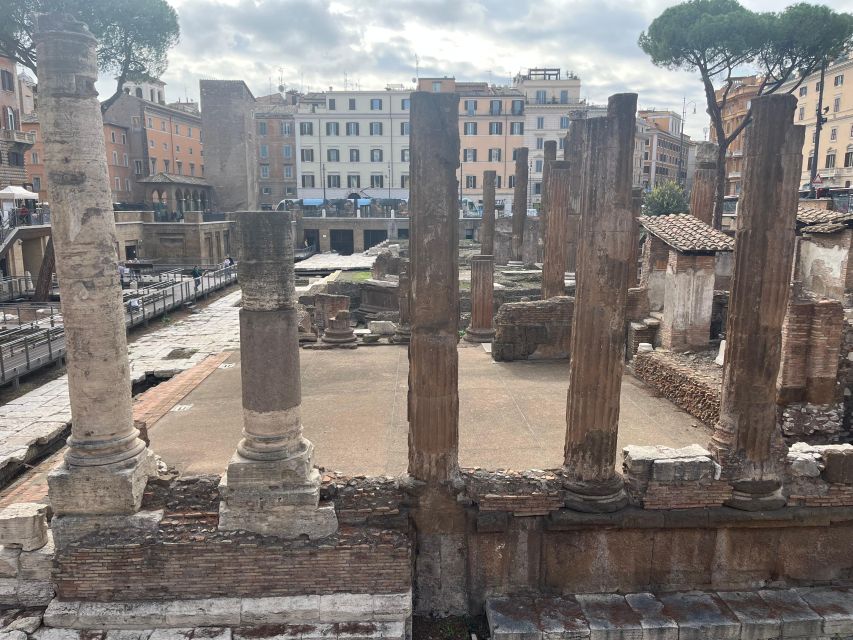
Julius Caesar was killed at Largo Argentina, not in a grand palace or on a battlefield, but beside the ancient Curia of Pompey on the Ides of March in 44 BC. That sharp connection to one of Rome’s most famous political murders gives this otherwise compact archaeological site its charge. I especially like the four temples from the 4th to 1st centuries BC and the way the ruins sit in plain view among modern streets, buses, and city traffic.
I also like the multimedia film, which helps you picture buildings that are now mostly foundations and broken columns. The main drawback is value: at $23, this is not a bargain for a one-hour stop, especially since much of the archaeological area can be seen from outside and one recent booking found the regular gate ticket easy to buy. The reserved entry and film matter most if you want context, not just a quick look.
Key points about Largo Argentina
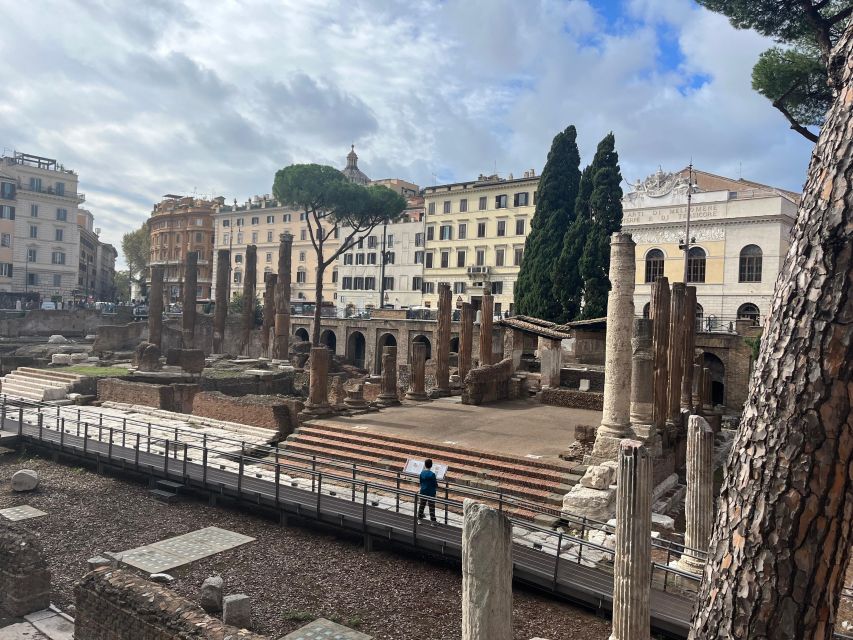
- Julius Caesar’s assassination site: See the remains of the Curia of Pompey, where ancient sources place Caesar’s killing in 44 BC.
- Four Roman temples: View sacred buildings dating from the 4th through 1st centuries BC.
- A 25-minute visual introduction: The film at Touristation shows reconstructions of the ancient buildings and gives you a useful start before the ruins.
- A two-thousand-year site: Imperial temple changes and medieval structures reveal that the area kept being used long after the Republic.
- A short, self-guided visit: Plan for about one hour, with an English app audio guide rather than a live guide.
- A useful location tip: Redeem your voucher at Piazza d’Aracoeli 16, then allow roughly six minutes to walk to Largo Argentina.
Why Largo Argentina matters in modern Rome
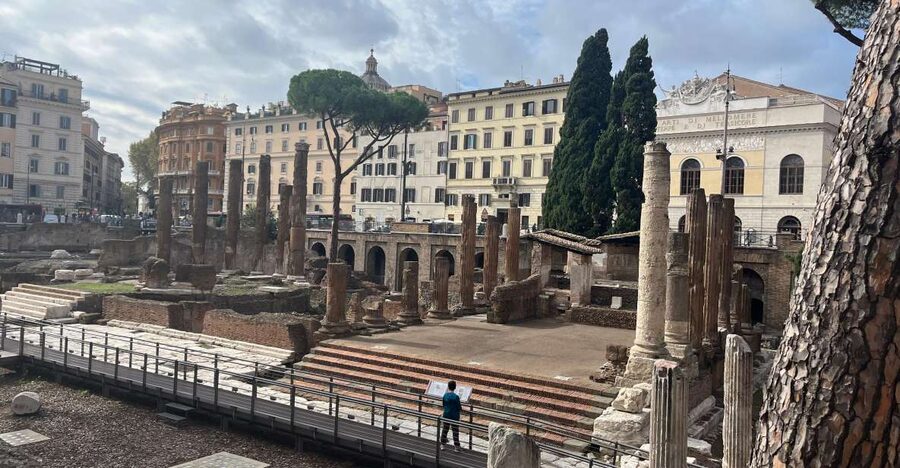
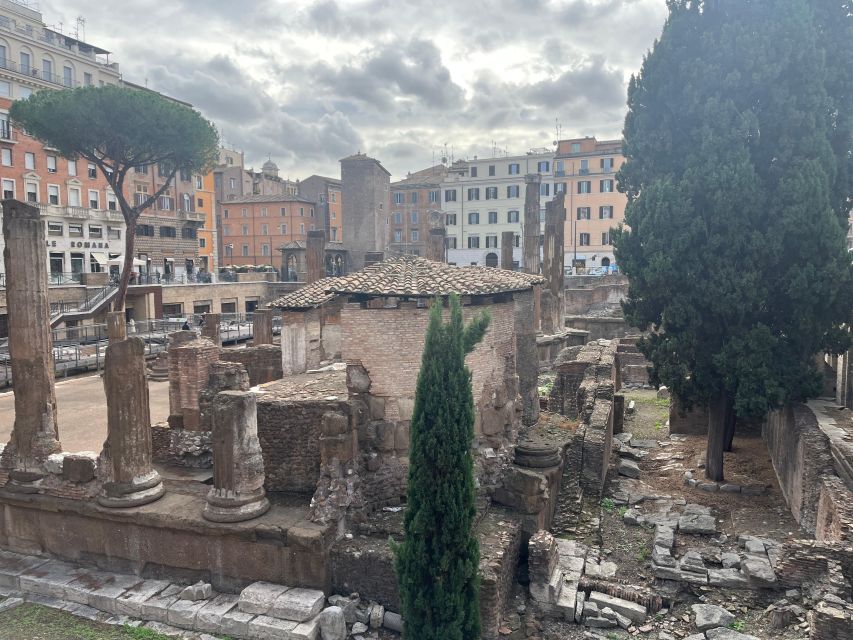
Largo di Torre Argentina is one of those Roman places where the present day and ancient past occupy the same frame. You look down into a broad archaeological hollow while modern Rome carries on around it. The site is not presented as a restored monument with polished columns and complete rooms. Instead, you see foundations, temple platforms, fragments, and layers of later construction.
That makes the area especially useful for understanding how Rome developed. The ruins do not belong to one single moment. The temples were built between the 4th and 1st centuries BC, then changed during the imperial period. Medieval structures later appeared among the ancient remains. The site records more than one period of Roman life, all in one compact space.
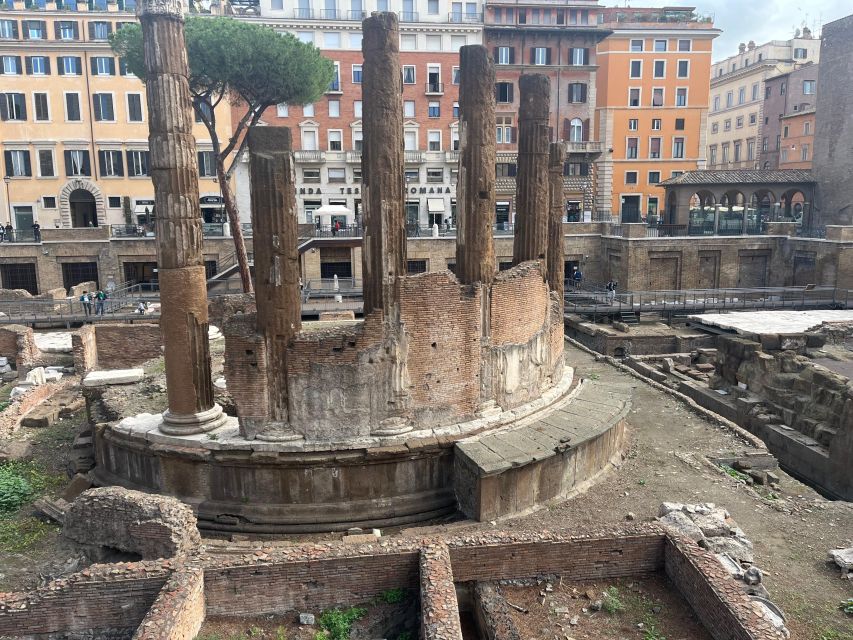
The most famous association is the death of Julius Caesar. On March 15, 44 BC, Caesar was attacked by a group of senators. The remains of the Curia of Pompey mark the setting identified by ancient sources. You will not see a preserved assassination chamber with a dramatic plaque and theatrical staging. You will see the tuff base and surviving archaeological traces, then use the audio material and film to connect those fragments to the event.
That restraint is part of the appeal. Rome often asks you to imagine the missing walls, roofs, statues, and crowds. Largo Argentina gives you enough evidence to anchor the story without turning the place into a theme park.
More Ancient History Tours in Italy
- Colosseum: Underground and Ancient Rome Tour
★ 4.7 · 12,691 reviews - Colosseum & Ancient Rome with Arena Floor Option I Max 6 People
★ 5.0 · 3,306 reviews - Rome: Colosseum, Ancient Rome Tour or AudioGuided Tour
★ 4.4 · 2,879 reviews
Starting at Touristation Aracoeli
Your selected time refers to the Touristation Aracoeli office, not the entrance to the excavation. This is the most important practical detail in the booking. Go first to Piazza d’Aracoeli 16 to redeem your voucher.
The office is marked by orange flags and a fountain in front of the entrance. From there, the archaeological area is about a six-minute walk, so do not arrive at the excavation expecting to show your booking there. Build that short transfer into your schedule, especially if you have timed plans elsewhere in central Rome.
The package includes assistance at the meeting point, a paper city map, and WiFi. Those extras will not transform the visit, but they can be handy if you are finding your way around Rome for the first time. You should also bring your passport, as it is listed among the required items.
The gathering point is in a busy central part of Rome, so the office works best as a starting place rather than a place to linger. Once you have collected the material, walk over to Largo Argentina and continue with the archaeological portion.
The multimedia film before the ruins
The included ancient Rome video lasts about 30 minutes, though the presentation has been described as roughly 25 minutes. It uses visual overlays and reconstructions to show how the buildings may have looked in antiquity. That is useful here because the site itself is largely made up of low walls, foundations, and scattered remains.
I like this part of the experience because it gives you a visual key before you face the stones. You can watch temple forms and ancient structures appear on screen, then compare those images with what remains at Largo Argentina. For children, first-time Rome visitors, and anyone who finds archaeological foundations hard to read, this may be the most valuable part of the package.
The film is also the clearest reason to choose this experience over simply viewing the ruins from the street. The archaeological area is compact, and the video provides the scale that the excavation alone cannot. Still, it takes close to half an hour of your one-hour visit, so you should decide what you want from the stop.
If you mainly want a photograph of the ruins and a quick reminder that Caesar was killed here, the film may feel like too much. If you want an introduction to ancient Rome that makes the site easier to understand, it earns its place.
Walking through the four temples
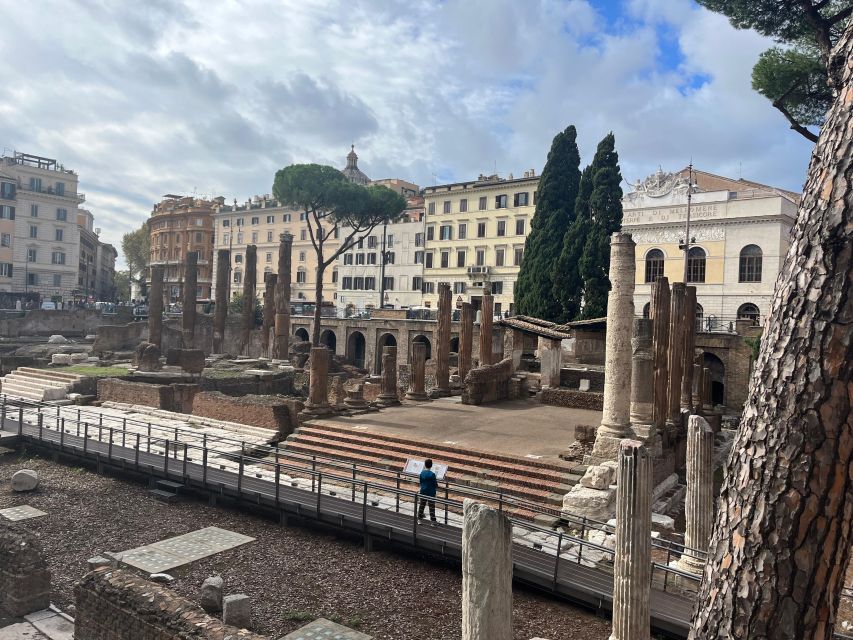
After the office and film, you reach the Largo Argentina excavations. The center of the visit is the group of four temples, dated from the 4th to the 1st centuries BC. Their remains sit below the modern street level, creating a clear physical separation between modern Rome above and Republican Rome below.
You will not tour four intact interiors. The interest lies in comparing their platforms, outlines, and surviving architectural pieces. The app audio guide can help you follow the layout and understand why the temples were built in this area.
The setting also gives you a useful lesson in Roman archaeology. Ancient buildings were not always removed when new periods arrived. They were altered, reused, buried, or built around. Later imperial changes and medieval structures remain part of the story here, so you are looking at a long sequence of use rather than a single frozen ruin.
The four temples can be difficult to distinguish at first glance. I recommend using the audio guide slowly and looking for the differences in foundations and placement instead of trying to identify every stone. The site rewards a few minutes of patient observation more than a rushed circuit.
More Ancient History Tours in Rome
- Colosseum Underground & Ancient Rome Guided Tour
★ 4.5 · 2,590 reviews - Pantheon Elite Guided Tour – Rome’s Iconic Ancient Temple
★ 5.0 · 1,447 reviews - Ancient Rome: Colosseum Underground Group Tour
★ 4.5 · 1,059 reviews - Colosseum Express Guided Tour and Ancient Rome Admission Included
★ 4.0 · 1,008 reviews
The Curia of Pompey and Caesar’s death
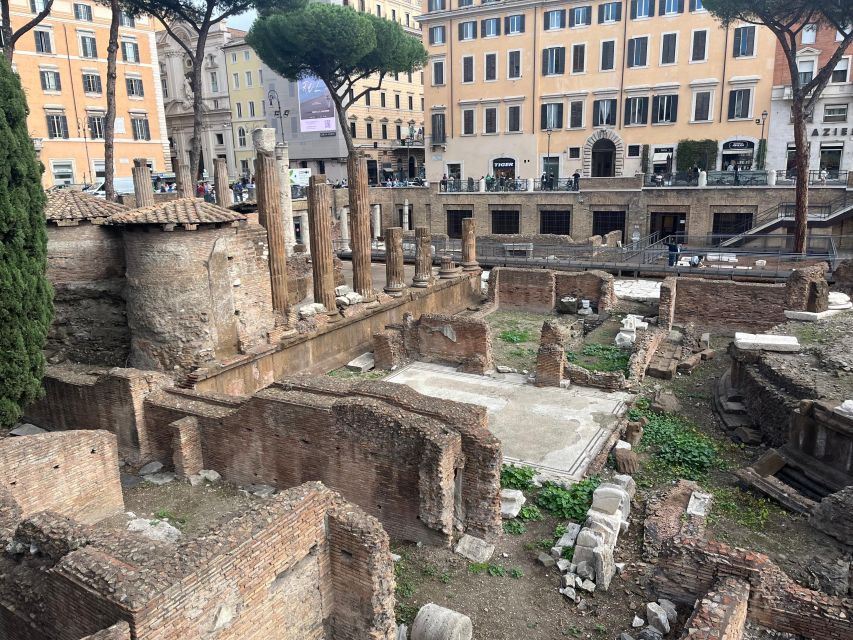
The Curia of Pompey is the emotional center of Largo Argentina. Its tuff base marks the place associated with the Senate meeting hall where Julius Caesar was attacked. This is the point where the archaeological remains connect most directly with a specific event known across the world.
The story is powerful because the physical setting is so ordinary. There is no complete hall left to place Caesar in, and the ruins do not recreate the attack. Instead, the surviving base and the surrounding excavation give you a fixed location for an event that changed Roman politics.
Use the audio guide here rather than relying only on a quick glance. The site’s importance is easy to miss if you do not know which remains relate to the Curia of Pompey. Ancient sources identify this as the place of the assassination, and the visit lets you stand near the actual archaeological setting rather than seeing Caesar’s death only through statues, paintings, or films.
This is also a good spot to pause over the difference between history and legend. Rome often presents famous stories in grand surroundings. Largo Argentina is more modest. Its power comes from the contrast between a small, weathered archaeological trace and the enormous historical consequences of what happened there.
Imperial and medieval layers
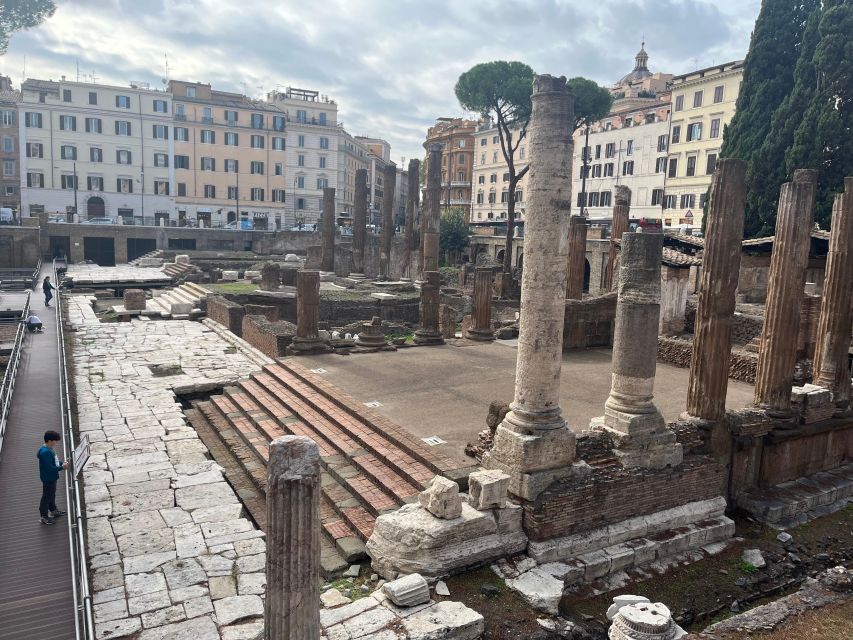
Largo Argentina was not abandoned after the Republican period. The sacred area preserves signs of later imperial phases of the temples and structures from the medieval age. Those later remains may not have the instant fame of Caesar, but they make the visit more useful.
I like this layered view because it keeps ancient Rome from becoming a single chapter. Buildings changed purpose, streets shifted, and later generations built among older foundations. The site shows how Rome kept adapting its old spaces instead of simply preserving them untouched.
The archaeological excavation also reflects the work carried out in the area between 1926 and 1930. Excavations and demolitions exposed temples and other finds that had been hidden beneath later construction. You can see the result of that process today, with a large open excavation surrounded by modern city life.
The word sacred can sound grand, but the experience itself is fairly simple. You walk around an excavation, listen to explanations, and piece together the remains. That simplicity is useful if you want a short history stop between larger monuments.
The small museum and what you can see from outside
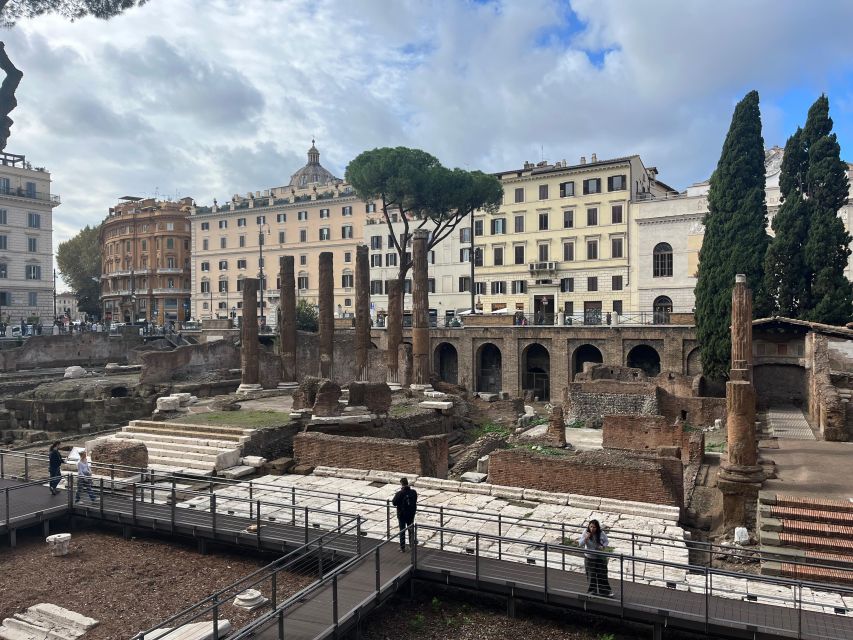
A practical point deserves attention: much of Largo Argentina is visible from outside the excavation. One booking found that it was possible to see the main area from the street and buy a ticket directly at the front gate. There is also a small underground museum, which adds something beyond the exterior view.
This does not make the paid visit pointless, but it changes the value calculation. If you are satisfied with a street-level look, you may not need the reserved entry. If you want to enter, use the English audio guide, watch the reconstruction film, and see the museum, the ticket offers a fuller experience.
The site is also compact enough that you should not expect a full morning or afternoon here. The stated duration is one hour, and that feels appropriate when the film, walk, and archaeological visit are taken together. The short length makes Largo Argentina easy to fit into a day focused on central Rome.
Do not bring large bags, luggage, glass objects, pets, alcohol, or drugs. These restrictions are simple, but checking your bag before setting out can prevent an awkward problem at the entrance.
Is $23 a fair price?
At $23 per person, the cost is reasonable only if you value the added material. You are paying for reserved entry, the multimedia film, the English app audio guide, meeting-point assistance, a map, and WiFi. You are not paying for a live guide, food, transport, or a long walking tour.
The strongest value comes from the video and the chance to enter the excavation without arranging the ticket yourself. The film gives shape to ruins that can otherwise look like a confusing collection of stones. The audio guide adds detail once you are inside.
The weakest value is the entry itself. Since the area can be viewed from outside and direct admission may be available at the gate, the skip-the-line element may not be essential. One recent booking found that the reserved access was unnecessary. Conditions can vary, but you should not assume the ticket saves a large amount of time.
For me, the package makes most sense for a first visit to Rome, a family needing visual explanations, or anyone especially interested in Caesar and Republican history. Independent visitors who already understand Roman archaeology may prefer the cheaper and simpler option of viewing the ruins from outside.
Who should book this experience?
I would choose it if you want a short, focused introduction to one of Rome’s oldest archaeological areas. The English audio guide and visual film are helpful when you do not have a live guide and want more than a quick photo stop.
It also suits you if Julius Caesar is a major reason you are visiting Rome. The Curia of Pompey gives the assassination story a real place, while the four temples add a wider look at Rome before the imperial age.
Families may appreciate the reconstruction film, though the archaeological area itself requires patience and imagination. You will not find a large collection of intact buildings or a long route packed with attractions.
I would skip the paid experience if you are moving quickly through Rome, are comfortable reading ruins without much explanation, or only want to see the site from the street. In that case, the $23 may be better spent on an attraction where the ticket gives you access to much more space.
Final verdict: a compact stop with a famous address
Largo Argentina is worth your time because it places a famous historical event in a real archaeological setting. The four temples, Curia of Pompey, imperial changes, and medieval traces give the site more depth than the Caesar story alone.
The experience is best understood as a self-guided archaeological visit with a useful film, not as a guided tour. Allow for the office meeting point at Piazza d’Aracoeli 16, the short walk to the excavation, and roughly one hour overall.
Book it if you want context, visual reconstructions, and reserved entry. Do not book it expecting a grand monument, a live guide, or a large museum. For the right visitor, it is a clear and compact way to connect modern Rome with the place where Caesar met his end.
FAQ
Where does the experience begin?
You begin at the Touristation Aracoeli office at Piazza d’Aracoeli 16. A fountain and orange flags are in front of the entrance.
Does the selected time refer to Largo Argentina?
No. The selected time refers to the Touristation Aracoeli office, where you redeem your voucher before going to the archaeological area.
How long does the experience last?
The stated duration is one hour. The multimedia presentation takes about 25 to 30 minutes, followed by the visit to Largo Argentina.
Is this a guided tour?
No. A live guided tour is not included. The package includes an English app audio guide instead.
What can you see at Largo Argentina?
You can see four temples dating from the 4th to 1st centuries BC, the tuff base of the Curia of Pompey, imperial temple remains, medieval structures, and other archaeological finds.
Is Largo Argentina connected to Julius Caesar?
Yes. The remains of the Curia of Pompey mark the site associated with Julius Caesar’s assassination on the Ides of March in 44 BC, according to ancient sources.
Is a multimedia video included?
Yes. An ancient Rome multimedia video lasting about 30 minutes is included. One description of the presentation puts it at roughly 25 minutes.
What should I bring?
Bring your passport. Pets, glass objects, luggage, large bags, alcohol, and drugs are not allowed.
Can I cancel the booking?
Yes. You can cancel up to 24 hours in advance for a full refund. A reserve-now-and-pay-later option is also available.
More Archaeological Site Tours in Rome
- Discover the Ancient Ruins of Pompeii: Day Trip from Rome
★ 3.5 · 2,247 reviews - Ancient Ruins Tour – Guided Arizona Desert Tour by UTV
★ 5.0 · 684 reviews - Ancient Olympia: Archaeological Site and Museum Entry Ticket
★ 4.3 · 555 reviews - Ancient Chacchoben Mayan Ruins & Mayan Experience from Costa Maya
★ 5.0 · 96 reviews
More Ancient Rome and Colosseum Tours in Rome
- Rome: Colosseum with Arena, Roman Forum and Palatine Guided Tour
★ 4.0 · 5,598 reviews - Colosseum with Arena, Roman Forum and Palatine Hill Guided Tour
★ 4.5 · 3,526 reviews - Rome: Colosseum Arena, Roman Forum & Palatine Hill Tour
★ 4.5 · 1,874 reviews - Colosseum, Roman Forum & Palatine Hill Guided Tour
★ 4.5 · 1,568 reviews
Newest history tours we have reviewed in Rome
- Ancient Rome Half-Day Segway Tour★ 4.8 · 25 reviews
- Colosseum Forum Ancient Rome Small Group Tour for Kids Families★ 5.0 · 198 reviews
- VIP Colosseum Underground and Ancient Rome Small Group Tour★ 4.5 · 332 reviews
- Colosseum & Ancient Rome Semi-Private Tour★ 5.0 · 208 reviews
- Small-Group Rome to Pompeii & Amalfi: Day of History & Sea★ 5.0 · 239 reviews
- Colosseum & Ancient Rome Guided Walking Tour★ 5.0 · 332 reviews
- Ancient Rome at Twilight Walking Tour★ 5.0 · 276 reviews
- Ancient Rome Tour in a Golf Cart★ 4.5 · 72 reviews
Ancient Rome & Colosseum Tours, compared.
Colosseum: Underground and Ancient Rome Tour
Read our review →
Colosseum with Arena, Roman Forum and Palatine Guided Tour
Read our review →
Colosseum with Arena, Roman Forum and Palatine Hill Guided Tour
Read our review →
Colosseum & Ancient Rome with Arena Floor Option I Max 6 People
Read our review →
Colosseum, Ancient Rome Tour or AudioGuided Tour
Read our review →
Colosseum Underground & Ancient Rome Guided Tour
Read our review →
Colosseum Arena, Roman Forum & Palatine Hill Tour
Read our review →