
Review · SICILY HISTORY TOURS
Ancient Syracuse: private guided tour of the Neapolis archaeological park
Syracuse’s ancient ruins make far more sense with someone to connect the broken stones, carved caves, and grand theater into one story. This private walking tour takes you through Neapolis Park, including the Greek theater, Ear of Dionysius, stone quarries, and Roman amphitheater. Guides such as Eva and Martina bring strong local knowledge and are happy to answer questions.
I like the personal format, especially for families or small groups with different interests. I also like the choice of morning or afternoon departures, plus the chance to spend time on details you might miss alone, such as the acanthus leaves that inspired ancient marble decoration. The main drawback is important: park admission costs extra, and the Greek theater can be partly hidden by temporary seating during the performance season.
Key points
- A private guide makes the ruins easier to understand, especially the theater, quarries, and Roman amphitheater.
- The Ear of Dionysius has striking acoustics, making it one of the most memorable stops.
- The Greek theater may be covered in spring and summer, when performances use temporary wooden seating.
- Admission is not included, so allow time to buy the park ticket before the walk.
- Morning departures may be more comfortable, particularly in hot weather.
- The tour is best for small groups, families, and history-minded visitors who want to ask questions along the way.
Walking into Syracuse’s ancient quarter
Neapolis Archaeological Park holds the main ancient monuments of Syracuse in one large area. You are not just looking at one isolated ruin. You move among a Greek theater, Roman remains, quarries cut into the rock, and a dramatic cave tied to the city’s darker legends.
That variety is the reason I find a guided visit worthwhile. Without context, the park can feel like a collection of weathered stone. With a guide, you can follow how Syracuse changed from a major Greek power to a Roman city, and you can see how theaters, quarries, and public buildings served very different purposes.
The meeting point is at Largo Anfiteatro, 2, beside the archaeological park. The activity returns to this same point, which makes the arrangement simple if you are staying in Syracuse or combining the visit with other sightseeing.
The tour is offered in English and is private for your group. That matters here. The ruins cover a broad area, and you can ask your guide to slow down, explain a carving, repeat a point, or spend more time at the places that interest you most.
More Ancient History Tours in Italy
- Colosseum: Underground and Ancient Rome Tour
★ 4.7 · 12,691 reviews - Colosseum & Ancient Rome with Arena Floor Option I Max 6 People
★ 5.0 · 3,306 reviews - Rome: Colosseum, Ancient Rome Tour or AudioGuided Tour
★ 4.4 · 2,879 reviews
The Greek theater, Syracuse’s grand stage
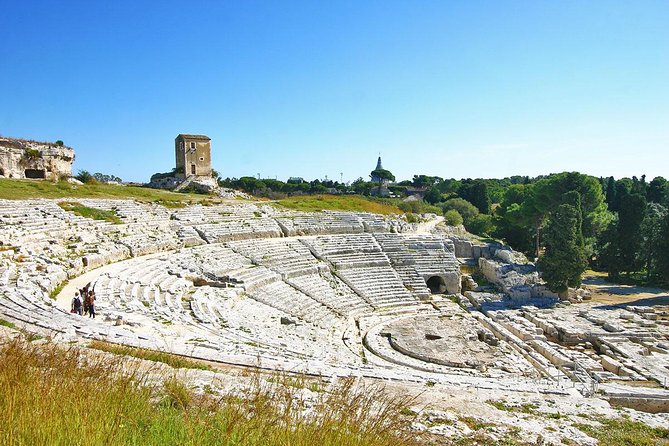
The Teatro Greco is the main attraction. Cut into the hillside, it is the most important ancient Greek theater in Sicily and the place where the scale of ancient Syracuse becomes clear.
Your guide explains how the theater worked and why it mattered to the city. The point is not simply that the theater is old. It was a public space for drama, civic life, and shared stories, built on a scale that still feels impressive from the seating area.
The scheduled visit here lasts about 40 minutes, giving you time to look carefully rather than make a quick stop for photographs. A guide can also help you notice the shape of the seating, the stage area, and the way the theater fits into the rock.
There is one major seasonal warning. During the performance season, usually in spring and summer, temporary wooden bleachers cover part of the theater. The shows are an important part of Syracuse’s cultural life, but the seating can block the view of the ancient structure.
If seeing the uncovered Greek theater is your main reason for booking, check the conditions before you reserve. The theater may still be interesting during this period, but you should not expect the open view shown in promotional photographs.
Summer heat is another practical concern. Much of the park is exposed, and one family found an umbrella useful for shade. I would choose a morning departure if you have flexibility, wear a hat, and bring water. Comfortable walking shoes are recommended.
The Ear of Dionysius and the ancient quarries
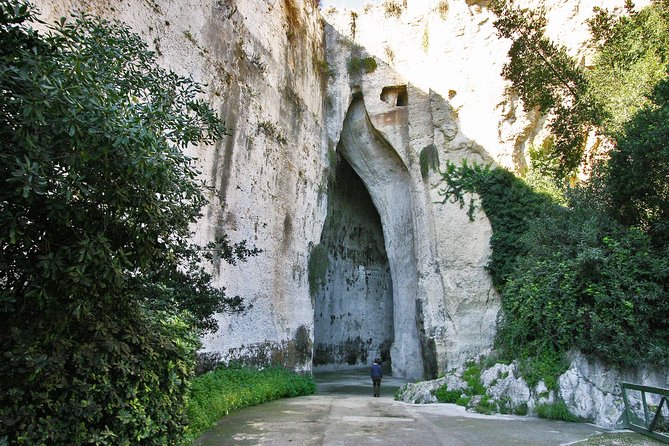
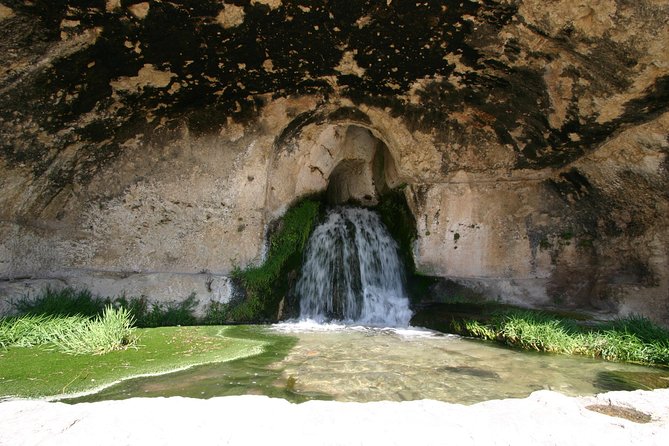
The Ear of Dionysius is the park’s most famous cave and one of its most memorable stops. It is a tall, narrow space cut into the limestone, with acoustics that make even a quiet voice carry in an unusual way.
The name is linked to the tyrant Dionysius, though the cave’s exact ancient use and later stories are part of the site’s long tradition. Your guide places the cave within the broader quarry area and explains why these excavated spaces mattered to Syracuse.
The visit lasts about 15 minutes, but the cave can hold your attention longer than that. Pay attention to the sound. Singing or speaking inside can reveal the acoustics far better than a photograph does.
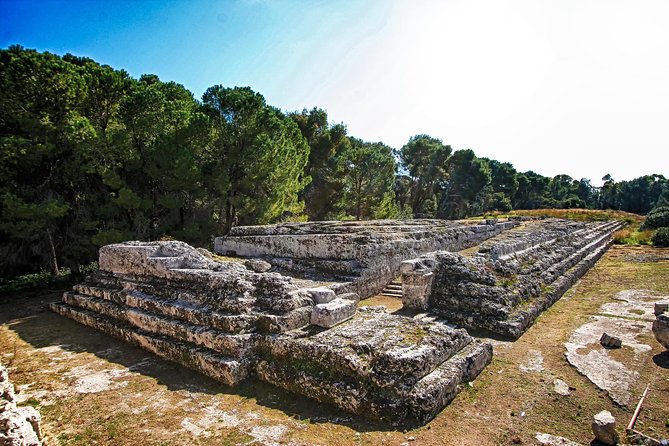
The ancient Greek stone quarries surround this part of the walk. They are not polished monuments. They are rough, cut spaces that show how much labor went into building Syracuse and how the same excavations could later be used for other purposes.
This is where a guide’s storytelling has real value. The quarries can look like simple cavities in the rock if you do not know what you are seeing. Explanations about their function, scale, and connection to the city help turn an otherwise brief stop into a meaningful part of the tour.
The Roman amphitheater and a change of era
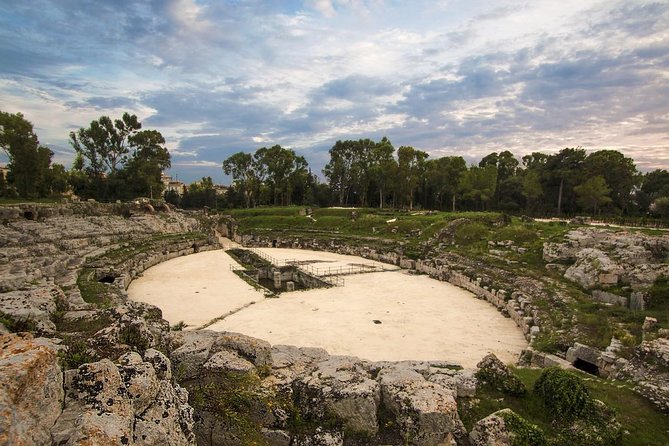
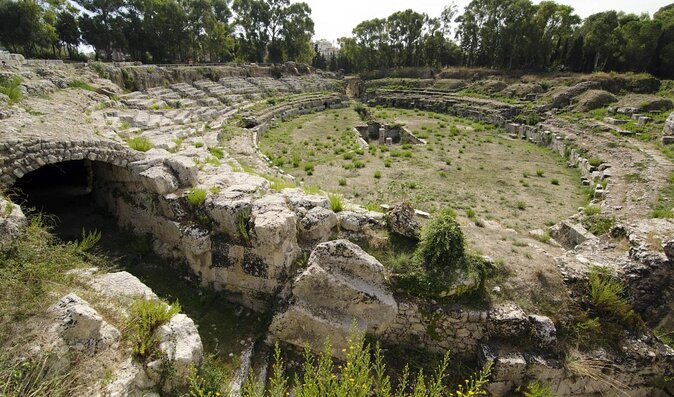
The Anfiteatro Romano di Siracusa shows a later chapter in the city’s story. Unlike the Greek theater, which was built around drama and civic performance, the Roman amphitheater was designed for public spectacles, including gladiatorial contests.
The stop lasts about 15 minutes. Your guide explains how the amphitheater was arranged and what happened in its arena. You will not spend as long here as at the Greek theater, but the contrast between the two buildings is useful.
The Greek theater reflects Greek public culture and drama. The Roman amphitheater points to a different style of entertainment and a different political world. Seeing both in one park helps you understand that Syracuse was not frozen in one ancient period. The city changed hands, customs, and priorities over time.
The amphitheater is also a good place to appreciate the scale of the park. The walking route connects monuments that may feel separate on a map but belong to one archaeological area. A guide helps you keep that larger picture in view.
More Private History Tours in Italy
- Ancient Ostia Antica Semi-Private Day Trip from Rome by Train with Guide
★ 4.5 · 579 reviews - Colosseum & Ancient Rome Semi-Private Tour
★ 5.0 · 208 reviews - Ancient Pompeii Private Tour: Skip the Line & Kid-Friendly Option
★ 5.0 · 167 reviews - Skip-the-Line Half-Day Private Tour Ancient Pompeii Highlights with Native Guide
★ 5.0 · 146 reviews
Why a private tour works well here
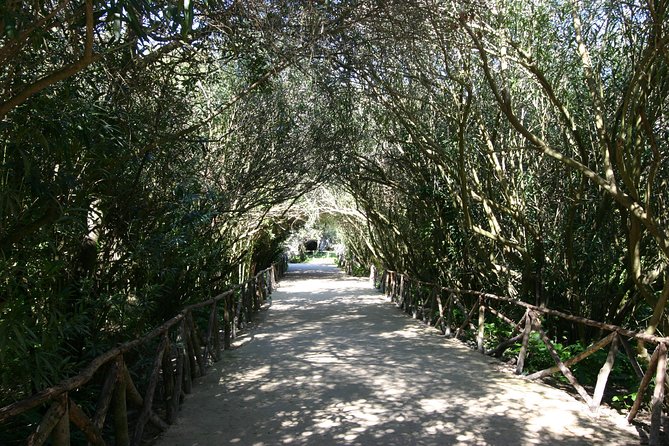
The main benefit is not simply having someone recite dates. It is the freedom to ask questions as the ruins raise them.
Families can adapt the pace for children. One guide, Eva, was especially good at engaging a 10-year-old interested in history. That sort of flexibility is hard to get in a large group, where the guide must keep moving and follow a fixed script.
A private tour also suits adults who want architectural detail. Eva has pointed out small features that are easy to miss, including living acanthus plants beside ancient carved versions used in marble decoration. Those connections between the natural world and the stonework give the park extra interest.
You may also prefer the private format if your group has a specific focus. Ask about theater design, Roman public life, ancient construction, local legends, or the city’s wider history. The guides can respond to your questions instead of giving only a standard overview.
The tour is conducted on foot, so the group stays close to the monuments. Most people can participate, and service animals are allowed. You should still expect uneven ground and a fair amount of walking, which makes sensible footwear more important than stylish footwear.
Timing, heat, and the ticket issue
The experience is advertised as about 90 minutes, while the detailed route can take close to two hours. One private group spent two hours in the park before continuing on to a separate museum visit. I would allow roughly two hours if you want to listen carefully and avoid rushing.
The entrance fee is not included in the standard tour price of $108.24 per person. That price covers the professional guide and private walking tour. A tour-plus-ticket option may be available, but you should confirm which version you are selecting before payment.
This extra cost is easy to overlook, so treat it as part of your planning. Some visitors qualify for reduced or free admission, but those categories require identification at the ticket office. The separate ticket arrangement can therefore be useful for groups with children, teachers, or other eligible visitors, though it may add a step before the tour begins.
Buy the ticket early when possible, especially if you are visiting at a busy time. The meeting point is important as well. Go to Largo Anfiteatro, 2, rather than assuming your guide will find you elsewhere inside the park.
The hot season deserves special planning. Pick a morning departure if you can, bring water, and consider an umbrella for shade. Afternoon visits may suit your schedule, but exposed paths and stone surfaces can make the heat feel stronger.
The guides make the difference
The strongest part of this experience is the guide. Eva is repeatedly singled out for her clear explanations, patience, warmth, and ability to answer questions. She has also helped groups connect the archaeological park with Syracuse’s broader story, including the nearby island district of Ortigia.
Martina has also guided the tour and is described as local, well spoken, and highly educated in the subject. The important point for you is that the experience depends on the individual guide assigned to your date, but both names associated with the tour have been praised for making complicated history easy to follow.
That matters because the park has no single dramatic viewpoint that explains everything at once. You need the links between places. The guide supplies those links, points out smaller details, and gives you a way to understand why the monuments were built.
The best guides also know when to pause. A good visit should leave room for you to look at the theater, test the cave’s acoustics, and take in the scale of the quarries without feeling hurried.
Is $108.24 per person good value?
For one or two people, the price may feel high because park admission is extra and the tour lasts only about 90 minutes to two hours. You are paying for a private guide rather than a long full-day excursion, transport, or a museum ticket.
For a family or larger private group, the calculation can look better, especially if group discounts apply. The private setting also gives you more control than a general group tour. If one person wants architectural detail while another needs a slower pace, the guide can adjust.
I see the value most clearly if you are not confident reading archaeological sites on your own. Syracuse’s ruins are important, but they do not always explain themselves. If you would otherwise walk through, take a few photographs, and leave without understanding the site, a private guide can justify the cost.
The value drops if you only want a quick look at the Greek theater or if the covered stage during performance season would disappoint you. In that case, confirm the theater’s condition first and decide if the Ear of Dionysius, quarries, and Roman amphitheater still make the visit worthwhile.
Who should book this Syracuse tour?
I would recommend it to families, couples, and small groups who want a personal introduction to ancient Syracuse. It is especially useful for anyone who enjoys asking questions or wants history explained in plain language.
Children with an interest in ancient civilizations can benefit from the private pace. The theater and cave offer strong visual and sensory hooks, while the guide can keep the explanations lively rather than delivering a long lecture.
It also works well as an introduction before exploring more of Syracuse. One group paired the park with a meal and a separate archaeological museum visit, creating a fuller day without asking the park tour to cover everything.
I would be more cautious if you have limited mobility, dislike walking, or are visiting during the hottest part of the day. The activity is described as suitable for most people, but you should still expect an outdoor archaeological site and comfortable walking shoes are a must.
Free cancellation is available up to 24 hours before the start time. Changes made within 24 hours are not accepted, and poor weather can lead to a new date or a full refund. Confirmation is sent within 48 hours, subject to availability.
Should you book it?
Book this tour if you want Syracuse’s ancient ruins explained by a guide who can answer questions and adjust the pace to your group. Eva and Martina are strong names to look for, and the private format is particularly useful for families.
Before booking, check three things: the separate park admission, the exact duration you want, and whether the Greek theater is covered for performances. If those details work for your plans, the tour offers a focused, human way to understand Neapolis Park rather than simply walking past its stones.
FAQ
How long does the private tour last?
The activity is listed as approximately 90 minutes, while the detailed visit through the archaeological park can take about two hours. Plan for extra time if you want to move slowly or ask many questions.
What monuments are included?
The walk includes the Greek theater, Ear of Dionysius, ancient Greek stone quarries, and Roman amphitheater within Parco Archeologico della Neapolis.
Is the park admission included?
No. The standard experience includes the professional guide and private walking tour, but the entrance fee is extra. A tour-plus-ticket option may be available.
Where does the tour start?
The meeting point is Largo Anfiteatro, 2, 96100 Siracusa, Italy. The tour ends back at the same meeting point.
Is the tour private?
Yes. Only your group participates in the private activity.
Is the tour offered in English?
Yes. The experience is offered in English.
Can I choose the departure time?
You can choose from morning or afternoon departure times, subject to availability.
What happens if the Greek theater is covered?
During the performance season, usually in spring and summer, temporary seating can cover part of the theater. The theater remains part of the visit, but its ancient structure may be only partly visible.
More Archaeological Site Tours in Italy
- Discover the Ancient Ruins of Pompeii: Day Trip from Rome
★ 3.5 · 2,247 reviews - Ancient Rome: Archeological area Largo Argentina
★ 3.9 · 49 reviews - Ancient Ruins Tour – Guided Arizona Desert Tour by UTV
★ 5.0 · 684 reviews - Ancient Olympia: Archaeological Site and Museum Entry Ticket
★ 4.3 · 555 reviews
Newest history tours we have reviewed in Italy
- Bologna: Street Food Tour in the Historic Center★ 4.8 · 125 reviews
- Asti Historic Town Walking Tour★ 4.5 · 82 reviews
- Ancient Rome: Archeological area Largo Argentina★ 3.9 · 49 reviews
- Ancient Rome Half-Day Segway Tour★ 4.8 · 25 reviews
- Alghero: Historic Center Walking Tour with A Local Guide★ 4.8 · 120 reviews
- Alghero: walking tours around the ancient city★ 4.6 · 30 reviews
- Amalfi Organic Lemon Tour & Tasting in the Historical Garden★ 4.9 · 46 reviews
- Alba: History Walking Tour and Food Tasting with a Local★ 4.8 · 20 reviews
Archaeological Site Tours, compared.
Discover the Ancient Ruins of Pompeii: Day Trip from Rome
Read our review →
Ancient Ruins Tour – Guided Arizona Desert Tour by UTV
Read our review →
Ancient Olympia: Archaeological Site and Museum Entry Ticket
Read our review →
Ancient Chacchoben Mayan Ruins & Mayan Experience from Costa Maya
Read our review →
Coba Private Tour – Ancient Ruins & Refreshing Cenote Swim
Read our review →
Alanya: Ancient Ruins & Hidden Coves of Gazipaşa w/ Cave
Read our review →
3-Day Ancient Greek Archaeological Sites Tour from Athens
Read our review →
Ancient Rome: Archeological area Largo Argentina
Read our review →Browse the lists this tour appears in