
Review · WASHINGTON DC HISTORY TOURS
DC: Georgetown History & Architecture Tour with Local Guide
Georgetown is older than Washington, DC, and this two-hour walking tour shows you why that matters. You move from the C&O Canal to cobblestone lanes, old churches, grand homes, and Georgetown University while a local guide connects the buildings to presidents, merchants, immigrants, Black residents, women who challenged convention, the Kennedys, and Taylor Swift.
I like the small-scale, street-level history, especially the details you might miss alone: fire insurance marks, coal chutes, ironwork, gas lanterns, and the yard of the Old Stone House. I also like the guides’ lively, personal style. Vicky, Wesley, Becca, Ingeborg, Georgia, and Wayne have all been praised for clear storytelling, good humor, and useful dining tips.
The one thing to keep in mind is the title. This is partly an architecture tour, but the focus leans toward neighborhood stories, famous residents, and local gossip. If you want a detailed study of architectural styles, you may find the history and celebrity anecdotes take more time than the buildings themselves.
Key points to know before you book
- Georgetown predates Washington, DC: You explore a colonial port town that was already established before the capital was planned.
- The route mixes famous sights with small details: Look for original firemarks, coal chutes, ironwork, gas lanterns, and old homes.
- The C&O Canal sets the scene: Lock 3 introduces Georgetown’s industrial past before the walk turns toward elegant streets.
- The Kennedy connection is a major thread: You hear about John and Jackie Kennedy’s years in Georgetown, before and after his assassination.
- The tour ends at Georgetown University: The final stop gives you a look at the campus and explains how the neighborhood shaped it.
- Expect stories as much as architecture: Guides are praised for humor, local tips, and tales about politicians, celebrities, immigrants, and community life.
Why Georgetown makes a better history lesson than a quick photo stop

Georgetown can look polished at first glance. M Street has shops, restaurants, and plenty of people taking photos. But the neighborhood began as a separate town on the Potomac, and its older streets reveal a working port, an industrial canal, a university community, and a long record of social change.
That is the useful frame for this tour. Instead of treating Georgetown as a row of handsome houses, your guide explains how the area developed and why it still feels different from the grand avenues around the National Mall.
I especially like the contrast between the canal and the residential lanes. The canal points to trade and industry. A few blocks later, the houses suggest wealth, status, and old Washington connections. The walk makes those two sides feel like parts of one neighborhood rather than separate attractions.
The guides also bring in people who can disappear from a standard presidential history. You hear about Black Georgetown, immigrant communities, and women who pushed against the rules of their time. That broader approach gives the neighborhood more substance than a parade of famous names.
More Architecture and Landmark Tours in the USA:
- Chicago in a Day: Food, History & Architecture Walking Tour
★ 5.0 · 1,153 reviews - Historic Charleston Walking Tour: Rainbow Row, Churches, and More
★ 5.0 · 691 reviews - Charleston’s Best Highlights: History, Culture & Architecture
★ 5.0 · 422 reviews
Starting at C&O Canal Lock 3
The meeting point is C&O Canal Lock 3, between Thomas Jefferson Street and 30th Street NW. There is no conventional street address, so this is one place where you should plan ahead.
If you use a taxi or rideshare, the suggested destination is Baked & Wired at 1052 Thomas Jefferson Street NW. From there, the tour start is about a two-minute walk, and the bridge near the bakery gives you a clear view of the meeting area. A pastry before the tour is a sensible bonus, especially if you have just arrived from another part of the city.
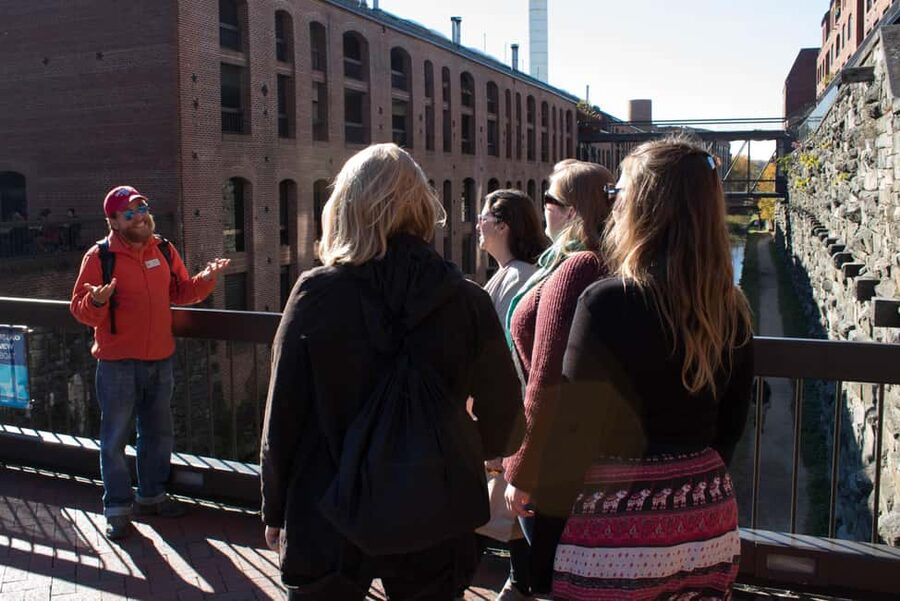
The canal stop lasts about 15 minutes. You have time for photos and an introduction to the waterway that once served the industrial side of Georgetown. This opening is more than a scenic backdrop. It establishes the working history of the area before the walk shifts to homes, churches, university buildings, and public figures.
The canal is also a good place to get your bearings. You are not starting in the middle of M Street’s retail traffic, so the first explanation has room to breathe. From here, the route gradually moves into the neighborhood’s more polished streets.
Old Stone House and the clues in the buildings
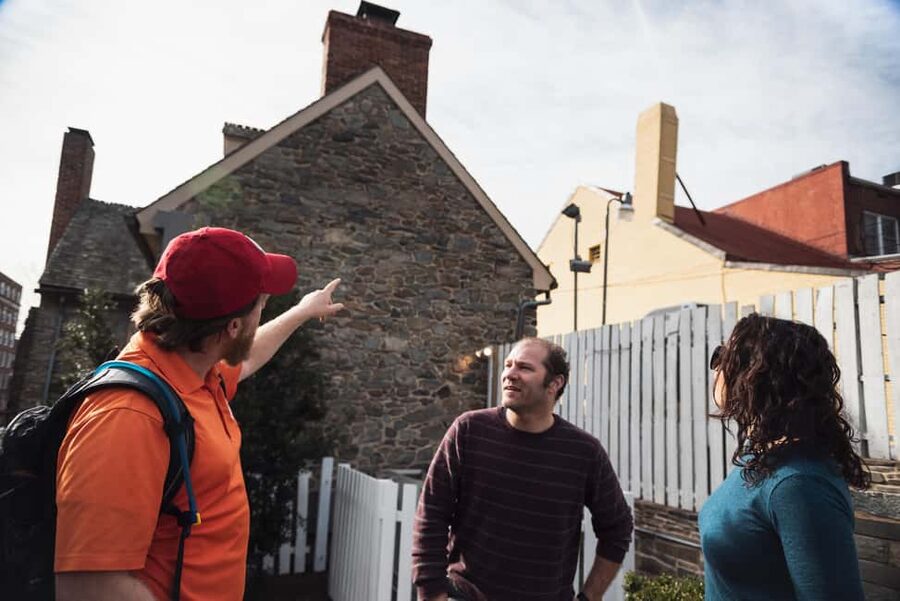
The Old Stone House is the next key stop, with about 10 minutes for a visit and photos. It is described as the oldest residential building in the district and is now a National Park site. The tour includes access to the yard, which gives you a closer look than a quick pass along the sidewalk.
This stop works because it makes Georgetown’s age concrete. An old date attached to a neighborhood can feel abstract. An early residence, preserved in place, gives you something you can actually see and photograph.
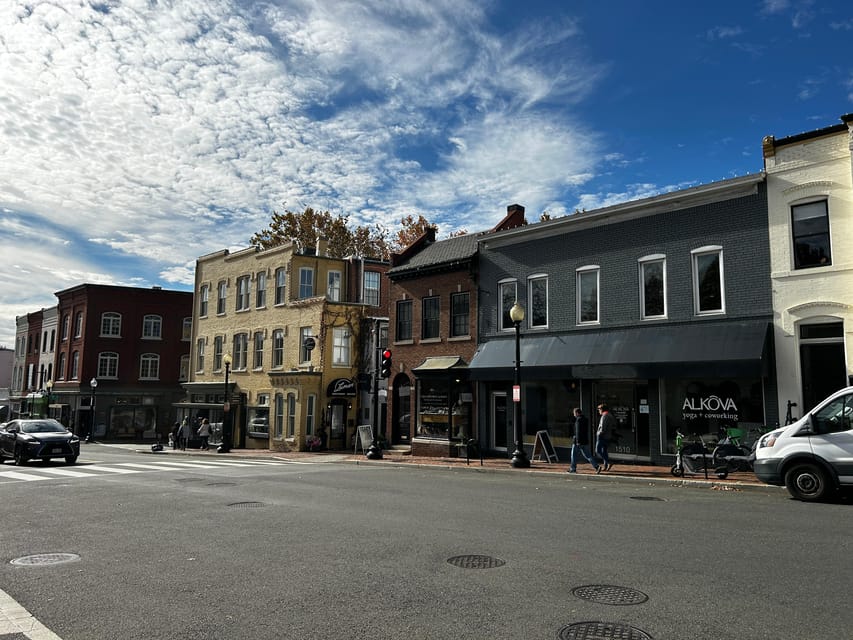
After that, the walk reaches M Street, one of Georgetown’s best-known streets. The tour does not treat it only as a shopping area. Your guide points out the layers of the neighborhood and explains how the commercial street fits into the older town.
As you continue, watch the houses rather than simply admiring their color and trim. The guide may call out original firemarks, which identified insurance companies, along with coal chutes, ironwork, and gas lanterns. These modest features are valuable because they show how people heated, lit, protected, and managed their homes.
The route includes 18th and 19th-century houses, with attention to the people who lived in them. You get a sense of how different residents shaped the same streets over time. That is one reason I would choose this walk over an unstructured stroll if you want context without spending half a day inside a museum.
Newton D. Baker House and the residential lanes
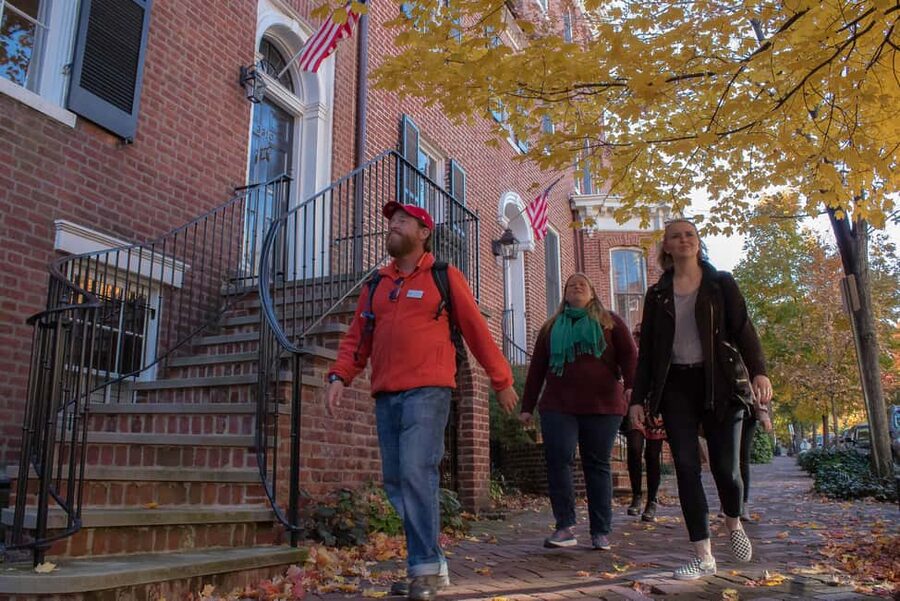
The Newton D. Baker House receives a shorter stop of about five minutes. It is a photo point and a place for a focused explanation, rather than a long interior visit.
This part of the route is typical of the tour’s rhythm. You stop often, but most stops are brief. That keeps the walk moving and lets you cover several parts of Georgetown in two hours. The tradeoff is that you should not expect an extended examination of any single house.
The residential streets are where the neighborhood’s character comes through best. You pass Victorian homes, older churches, and narrow lanes that feel removed from the formal center of Washington. The guide’s job here is to help you read the street: which details are original, what building materials tell you, and how the homes reflect the people and periods behind them.
If architecture is your main interest, listen closely during these stretches. The walk offers useful visual clues, but it is not a technical lecture on architectural classification. One four-star assessment made this exact point: the tour delivers history and short stories more strongly than a formal architecture study. I think that is a fair expectation to set before booking.
More Guided Tours in the USA:
- History and Hauntings of Salem Guided Walking Tour
★ 5.0 · 14,564 reviews - Historic Charleston Guided Sightseeing Walking Tour
★ 5.0 · 6,216 reviews - Historic Savannah Guided Walking Tour
★ 5.0 · 2,918 reviews - 2-Hour Gettysburg Battlefield Guided History Bus Tour with a National Park Guide
★ 4.5 · 2,201 reviews
Georgetown stories, Kennedys, and modern fame

The central Georgetown portion takes about 45 minutes, making it the longest section of the tour. This is where the major themes come together: colonial beginnings, historic houses, community life, political connections, and famous residents.
The Kennedy story is a key draw. You hear about John and Jackie Kennedy’s time in Georgetown, including the period before and after his assassination. The topic adds a personal layer to the neighborhood, showing how Georgetown became connected to Washington’s political and social world.
You also hear about presidents who lived in Georgetown when they were still members of Congress. That detail helps explain the area’s reputation as a place where national politics and private domestic life overlap.
The tour also brings the story into the present with references to Taylor Swift and other modern celebrity connections. These anecdotes can make the history easier to remember, though they may not satisfy you if you want a strictly academic presentation.
That balance depends partly on your guide. Vicky has been described as especially warm, attentive, and full of useful recommendations. Wesley is praised for combining information with an entertaining approach. Wayne’s jokes added a lighter touch for one group, while Ingeborg has been credited with making the architecture and history feel vivid. Becca, Georgia, Catherine, Katherine, and others have also led tours described as friendly, engaging, and easy to follow.
The repeated pattern is clear: guides are expected to make the material conversational, not just recite dates. That suits Georgetown, where a house often matters because of the people and events tied to it.
Martin’s Tavern and the personal side of Georgetown
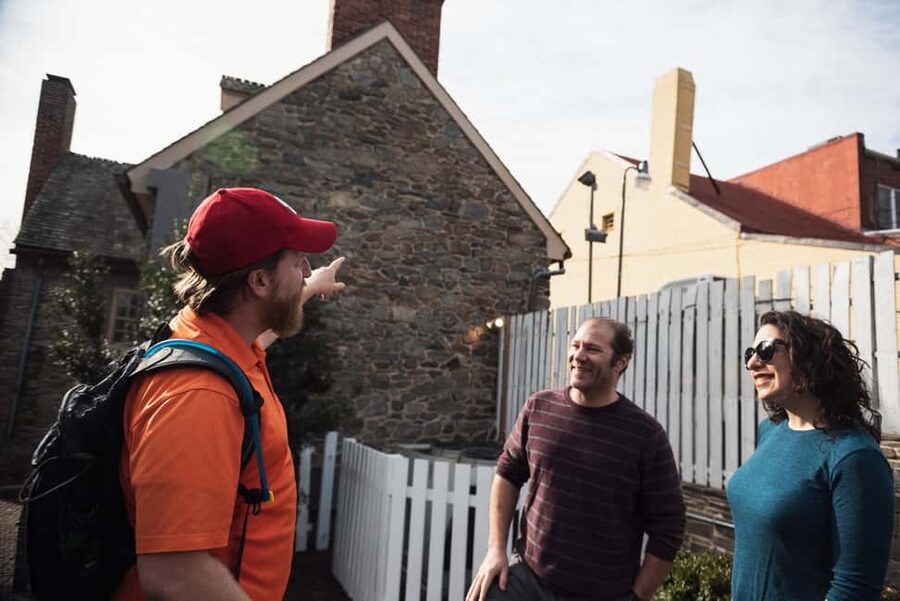
Martin’s Tavern is a five-minute photo stop. The itinerary does not describe a meal or an indoor visit, so you should treat it as an exterior landmark rather than a dining break.
Its place on the route reinforces the tour’s interest in political and social connections. Georgetown’s taverns, homes, churches, and restaurants have long served as meeting places, and the guide uses sites like this to connect ordinary streets with larger national stories.
This is also where the tour’s gossip and history blend is most noticeable. That can be fun. A guide who can explain both a political connection and the look of a nearby house gives you a more human sense of the neighborhood.
Still, if you prefer only documented architectural facts, you may want to steer your questions in that direction. The guides appear willing to answer questions, and one couple said their guide continued a little longer to show them more. Do not count on extra time, but it suggests that the pace can allow conversation when the group is small.
The Wave Wall and Georgetown University

The Wave Wall is another short stop, listed at about five minutes. It offers a photo opportunity and a brief explanation before the group continues toward the university.
The tour ends at Georgetown University, with about 10 minutes for photos and free time. You visit the campus rather than simply viewing it from a distant street. The final stop also explains how Georgetown’s neighborhood influenced the university and how the two have developed alongside each other.
Ending here gives the route a clear arc. You begin with a canal tied to commerce and industry, pass through homes and public gathering places, and finish at an institution that has shaped the area’s identity.
The university stop is likely to be especially useful if you are considering a separate campus visit. One person who had attended Georgetown University still learned new things about both the school and the rest of the neighborhood. That suggests the campus portion is not just filler, though it is brief.
The supplied description also mentions learning more about Abraham Lincoln and his grand memorial. The listed walking route, however, finishes at Georgetown University and does not include a visit to the Lincoln Memorial. Treat that as broader Washington context rather than a memorial stop on this tour.
Pace, group size, and walking comfort
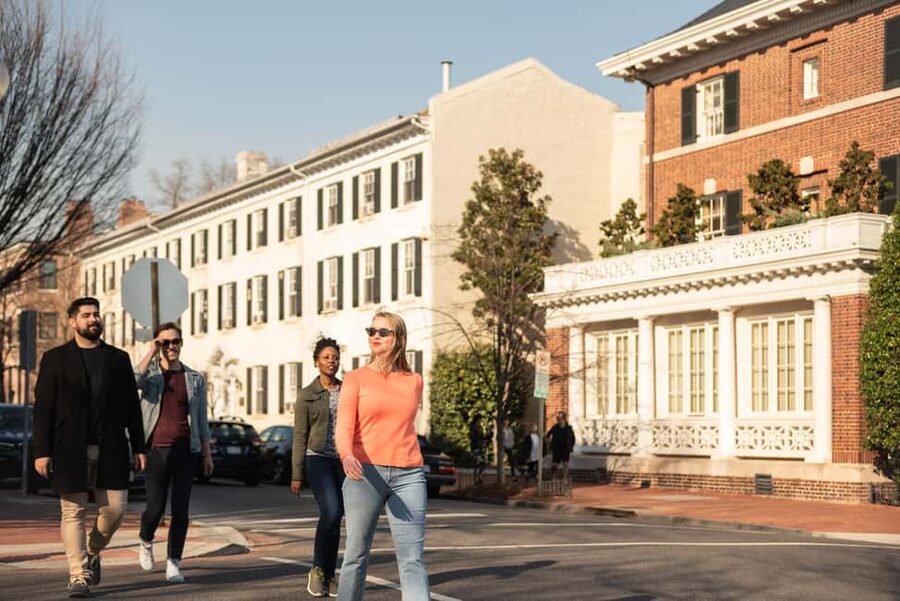
This is a two-hour walking tour with no bus or vehicle transfer. You move through streets, canal paths, and historic areas at a steady but generally manageable pace.
Several guides have been praised for keeping the walk comfortable rather than rushing. One review specifically noted that the tour suited people who were not especially fit, and another mentioned that the guide was considerate of older participants who could not move quickly. That does not remove the need for comfortable shoes, but it suggests a low-key format rather than a forced march.
Group size can vary. One tour had eight people, which was described as a good balance, while another booking became a private tour. A small group makes it easier to hear questions and look closely at house details. You should not assume every departure will be private, but the format appears capable of feeling personal when numbers are low.
English is the tour language. The guide is a professional licensed local expert, and the experience lasts two hours. Gratuity is not included, so plan for that separately if the guide gives you a tour you value.
Is $39 a fair price?
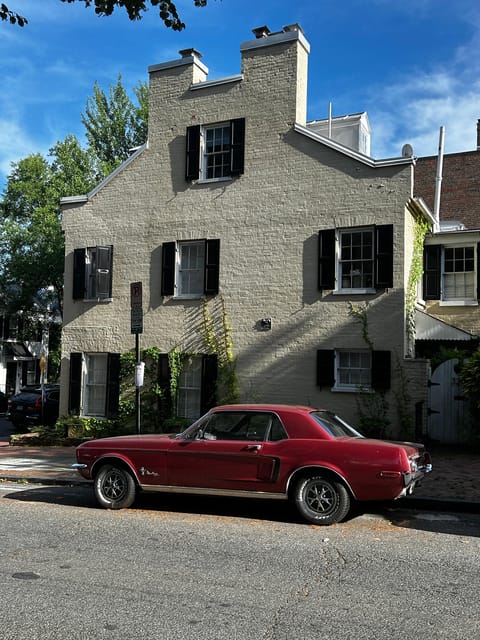
At $39 per person, this is a reasonable price for two hours with a licensed guide, especially because the route covers several different sides of Georgetown. You are paying not just for movement between landmarks, but for the explanations that connect the canal, homes, political figures, community history, and university.
The value is strongest if you are new to Georgetown or want a clear introduction before exploring on your own. A guide can point out details you would probably walk past, then leave you with a better sense of which streets and buildings deserve a second look.
The value is less certain if you already know Georgetown well or want a specialist architecture tour. The walk is not designed as a long interior visit, and most stops are short. You are buying a lively overview, not a scholarly building survey.
The flexible booking terms also help. You can reserve now and pay later, and cancellation is available up to 24 hours ahead for a full refund. Check the exact departure time when booking, since the tour schedule varies.
Who should take this Georgetown walk?
I would recommend it to first-time DC visitors who have already seen, or plan to see, the National Mall and want a different side of the city. Georgetown feels more intimate and residential, and the tour gives you a useful break from monuments and large museums.
It also suits anyone interested in political history, old houses, neighborhood change, or local stories about famous residents. Families and older visitors may appreciate the relaxed pace, while solo visitors can use the guide’s dining and shopping suggestions to plan the rest of their time in Georgetown.
Architecture fans should book with a clear idea of what they are getting. You will see plenty of historic buildings and learn how to spot small period details, but the main appeal is the mix of architecture, history, personalities, and local color.
Should you book it?
Book this tour if you want a readable introduction to Georgetown rather than a technical architecture lecture. The route covers the canal, Old Stone House, M Street, residential lanes, Martin’s Tavern, the Wave Wall, and Georgetown University, while the guides add stories about the Kennedys, presidents, Black Georgetown, immigrants, women, and modern celebrities.
Skip it if you want extensive indoor access, a visit to the Lincoln Memorial, or a tightly structured architectural survey. For most visitors, though, $39 buys a well-paced orientation and the kind of small details that make a later independent walk much more rewarding.
FAQ
How long does the Georgetown history and architecture tour last?
The tour lasts two hours.
Where does the tour begin?
It begins at C&O Canal Lock 3, between Thomas Jefferson Street and 30th Street NW. The location appears on Google Maps as C&O Canal Lock 3 and does not have a standard street address.
What should I use as a taxi or rideshare destination?
Use Baked & Wired at 1052 Thomas Jefferson Street NW, Washington, DC 20007. The meeting point is about a two-minute walk away, and you can see the start from the bridge near the bakery.
Where does the tour finish?
The tour finishes at Georgetown University.
Is Georgetown University included?
Yes. The tour includes a visit to the campus, with photo time and free time at the end.
Is the Lincoln Memorial part of the walking route?
No. The listed route ends at Georgetown University and does not include a visit to the Lincoln Memorial.
What language is the tour offered in?
The live guided tour is offered in English.
What is included in the $39 price?
The price includes a professional licensed guide, a two-hour guided walking tour with a local expert, access to the yard of one of Georgetown’s oldest houses, and a visit to Georgetown University. Gratuity is not included.
Newest history tours we have reviewed in the USA
- Self Guided Detroit’s Spirit and History Solo Walking Tour★ 4.5 · 41 reviews
- Best Downtown Detroit Historical Walking Tour★ 5.0 · 56 reviews
- Detroit’s Hidden History Guided Walking Tour★ 5.0 · 48 reviews
- Private Nightlife Tour in Denver: Culture, History, and Cocktails★ 5.0 · 48 reviews
- Historical Walking Tour Of Denver With A Haunting Twist★ 5.0 · 19 reviews
- Tip Based: Capitol Hill History & Ghost Tour★ 5.0 · 34 reviews
- Denver – Capitol Hill Guided Walking Ghost / History Tour★ 4.5 · 75 reviews
- JFK Historical Tour★ 5.0 · 22 reviews
Architecture & Landmark Tours, compared.

St. Mark’s Basilica Guided Tour & VR History Intro
Read our review →
Venice’s Best: Basilica, Doge’s Palace, Gondola & History Gallery
Read our review →
Córdoba: Skip-the-Line Great Mosque-Cathedral History Tour
Read our review →
Pantheon Elite Guided Tour – Rome’s Iconic Ancient Temple
Read our review →
Abu Dhabi Grand Mosque, Palace, and Heritage Village
Read our review →
Chicago in a Day: Food, History & Architecture Walking Tour
Read our review →

Colosseum Special Access Tour, with Ancient Temples & Tombs
Read our review →Browse the lists this tour appears in