
Review · SALEM HISTORY TOURS
Best Salem Witch Trials Historical Walking Tour
Salem’s witch trials make more sense when you connect names to places. This walk takes you from the memorial benches for the 20 people who died to the home of Judge Jonathan Corwin, then on to former jail, court, and meeting-house sites. Much of the 1692 town is gone, so the tour is as much about what happened on these streets as what you can still see.
I like the personal stories of people such as Bridget Bishop, Giles Corey, Betty Parris, and George Corwin. I also like the compact route, which covers about a mile and ends downtown, leaving you close to Salem’s other sights. The main drawback is clear: several stops are modern buildings or empty sites, and some groups spend more time listening than looking at surviving historic structures.
Key points to know before you book
- The Witch House is the only surviving Salem building with direct ties to the 1692 trials.
- The route covers about one mile in 90 minutes, with frequent stops for stories and questions.
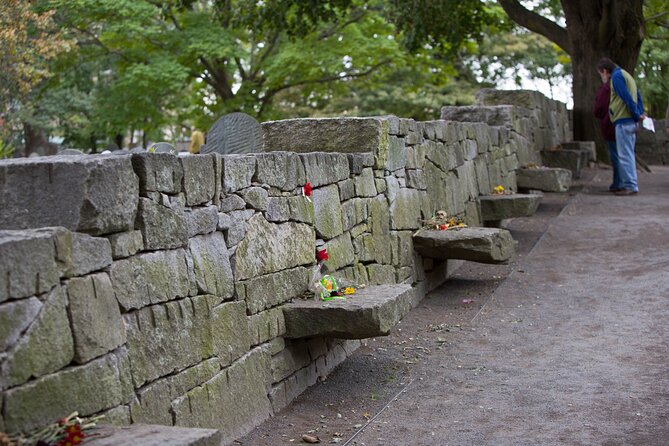
- The Salem Witch Trials Memorial gives the tour its strongest emotional moment, with 20 stone benches naming those who died.
- Several famous locations no longer exist, including the trial court and witchcraft jail, so expect explanation rather than preserved rooms.
- Bob is a guide worth requesting if available, based on the vivid, period-focused style he has brought to the walk.
- October requires extra planning, since parking, traffic, crowds, and street vendors can slow your arrival.
What this Salem walking tour is really about
This is not a tour through a preserved 1692 village. It is a guided walk through a modern city that still follows the old street plan in places, with a guide filling in the missing pieces.
That difference matters. You will not enter the original courthouse, jail, or execution site during this 90-minute route. Those buildings are gone, and the hanging site is more than a mile away from the downtown route. Instead, you will stop where important events took place and hear how Salem’s fear, family disputes, religion, money, and local power turned into a legal disaster.
The guide uses the remaining buildings, street names, memorials, old locations, and sometimes historical images to build the story. The best guides give you a clear timeline, explain who held power, and show how one accusation led to another. Some guides focus more on colorful anecdotes, so do not hesitate to ask for chronology or clarification if the story begins to feel scattered.
The tour is offered in English at 10 a.m., 1 p.m., and 4 p.m. You check in at the Salem Historical Tours office at 8 Central Street and should arrive 15 minutes early. The group can reach 40 people, which is large enough to affect how easily you hear the guide, especially on crowded October streets.
More Dark History and Haunted Tours in the USA
- Savannah History and Haunts Candlelit Ghost Walking Tour
★ 5.0 · 3,235 reviews - New Orleans Small-Group Haunted History Carriage Tour
★ 4.5 · 2,289 reviews - New Orleans Haunted History Ghost Tour
★ 4.5 · 2,084 reviews
Starting at 8 Central Street
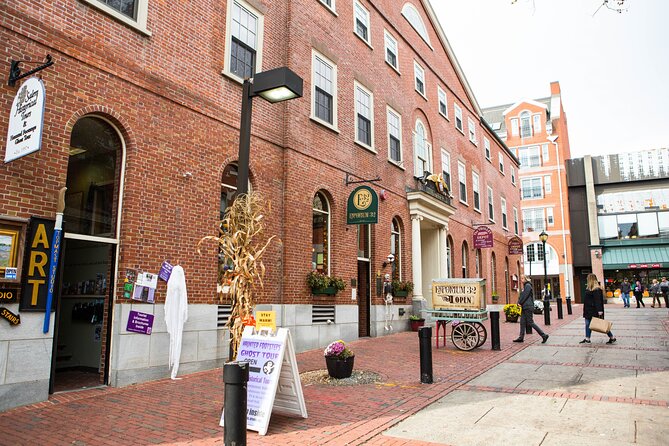
The meeting point is convenient for a downtown visit, but give yourself more time than your navigation app suggests. Salem parking and traffic can be difficult at any time, and October is especially demanding. Arriving late can mean trying to find a moving group in crowded streets.
The route returns to the downtown area, with the guide able to point you toward your next stop. That makes this a smart first activity of the day. You get an orientation to central Salem, then can return to the Witch House, memorial, museums, restaurants, or shops that caught your attention.
The walk lasts about 90 minutes. You will cover roughly one mile, but the time is not spent walking continuously. Expect frequent stops, standing, and short explanations at each location. Wear comfortable shoes and dress for the forecast. The tour operates in all weather, and Salem’s brick, cobblestone, narrow, and uneven sidewalks can be tiring in rain or cold.
The Salem Witch Trials Memorial and the weight of the story
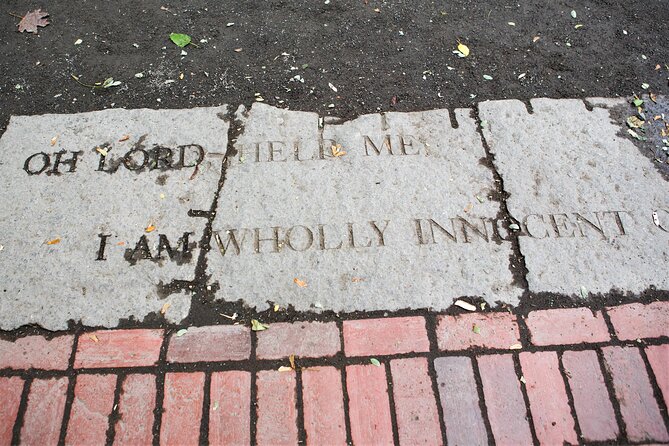
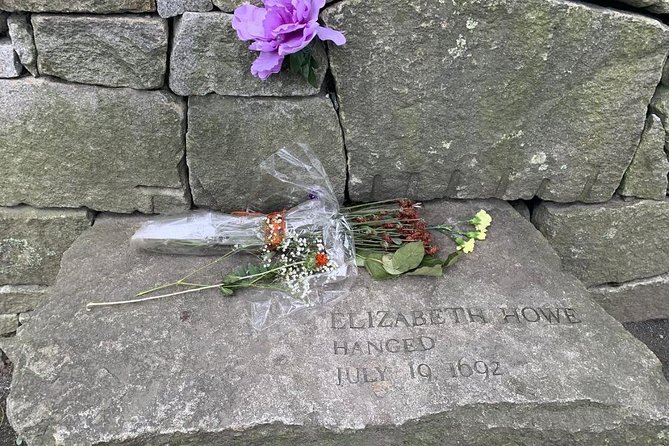
The memorial is the emotional center of the walk. Dedicated in 1992, it remembers the 20 people who died during the 1692 witchcraft trials. Each stone bench gives a name, date of death, and manner of death.
The design uses six stone walls with openings that allow the words of the accused to appear interrupted at the edges. That symbolism helps explain the failure of the legal process: testimony was cut off, evidence was treated carelessly, and ordinary neighbors were pulled into a crisis that moved faster than reason.
You have about ten minutes here, enough for the guide to explain the memorial and tell several victim stories. It is worth paying attention to the names, because the rest of the route gives those names places and circumstances. The memorial is also an easy spot to revisit later at your own pace.
One practical point: the guide may explain the memorial from its edge rather than walk through every bench with the group. If you want to read each name or take time with the design, plan to return after the tour.
Rockafellas and the old meeting house
Rockafellas is now a restaurant in the Daniel Low and Company building, but the location once held Salem’s First Church and the town meeting house. That connection puts you near the civic and religious heart of the crisis.
There is no preserved trial room to enter here. The value is in understanding how closely government, church life, and community decisions were linked in 1692. The meeting house was not just a place for worship. It was part of the setting where Salem’s public life unfolded.
This stop is brief and viewed from outside. Admission to the restaurant is not included, and you should not expect a restaurant visit as part of the tour. It is a good example of the tour’s basic method: the guide points to a present-day building and explains the vanished structure and events connected with its site.
More History Walking Tours in the USA
- History and Hauntings of Salem Guided Walking Tour
★ 5.0 · 14,564 reviews - Boston: Freedom Trail History Small Group Walking Tour
★ 5.0 · 6,450 reviews - Historic Charleston Guided Sightseeing Walking Tour
★ 5.0 · 6,216 reviews - Historic Savannah Guided Walking Tour
★ 5.0 · 2,918 reviews
The Joshua Ward House and George Corwin
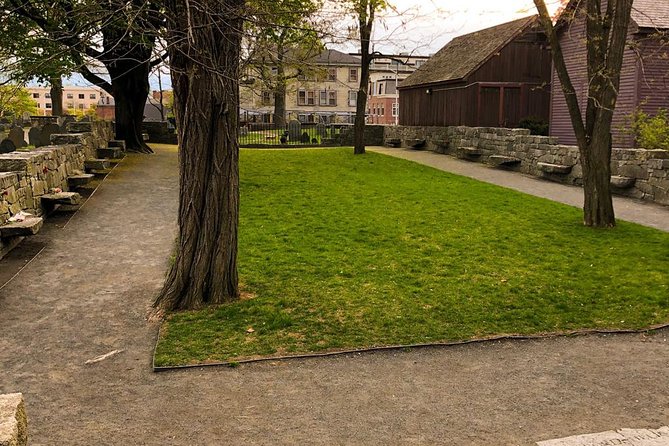
The Joshua Ward House now operates as the Merchant Hotel. The site once held the home of George Corwin, the High Sheriff of Essex County during the trials.
Corwin was not a minor official on the edge of the story. He signed arrest and execution warrants, seized property from accused people, and was accused of torturing prisoners in his home. This stop brings attention to the machinery behind the trials. The tragedy was not only a wave of fear and accusation. It also involved officials who made arrests, held prisoners, handled property, and carried out court orders.
The house itself is not presented as Corwin’s surviving home. You are looking at the site, not entering a preserved interior from 1692. The guide’s explanation is what makes this stop worthwhile, particularly if you want to understand how authority turned suspicion into punishment.
The Witch House, Salem’s key surviving building
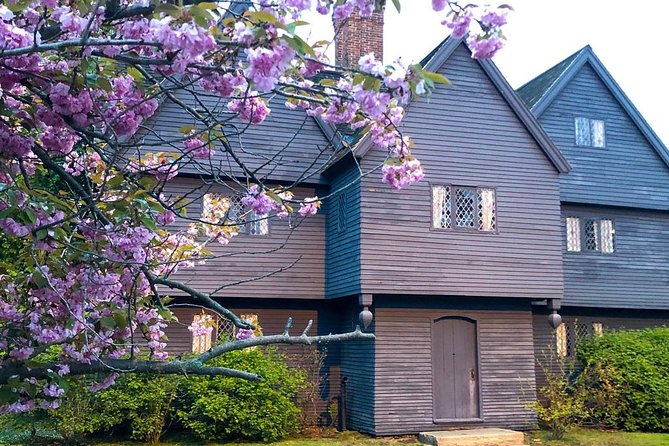
The Witch House is the strongest physical link to the trials. Dating to the 1660s, it was the home of Judge Jonathan Corwin, one of the men involved in deciding who might be treated as a witch.
The name can be misleading. This was not a home belonging to a person accused of witchcraft. It is called the Witch House because of Corwin’s role in the trials and because he met there with other officials, including Judge Hathorne, to discuss accusations and legal action.
The tour stops outside the house. Admission is not included, so you will need a separate ticket if you want to go inside. I recommend treating the walking tour as an introduction, then deciding if you want to return for the museum visit. The exterior alone gives you a rare sense of scale and age in a city where so many trial-era structures have disappeared.
This is also one of the stops most likely to satisfy someone who wants a real historic building rather than a location marked only by a story. If surviving architecture is your main reason for booking, make sure you reserve extra time for the Witch House itself.
Betty Parris and the street named for Stephen Sewall
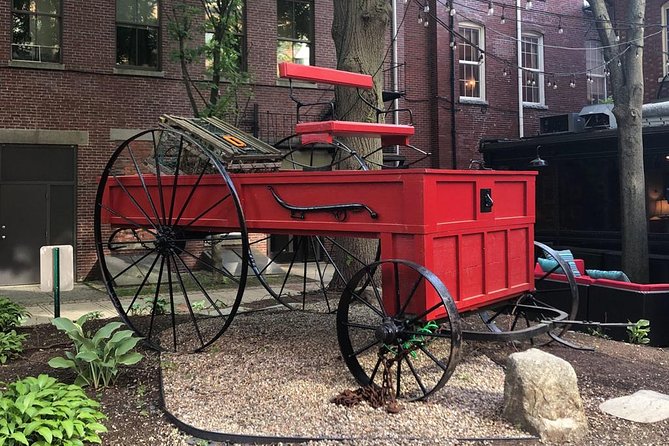
The Salem YMCA occupies a modern site on Sewall Street. The street honors Stephen Sewall, a judge connected with the Witchcraft Court.
The location also relates to Betty Parris, the nine-year-old daughter of Reverend Samuel Parris. Betty was moved to this area in July 1692. Her early fits and accusations helped set the crisis in motion, along with the actions of her cousin and other young people.
The original house is gone, so this stop depends on the guide’s storytelling. Its value is in showing how the crisis began with specific people and family settings rather than appearing out of nowhere. A good explanation here should connect the children’s behavior, the adults around them, the religious climate, and the rapid growth of accusation.
Bridget Bishop at Lyceum Hall
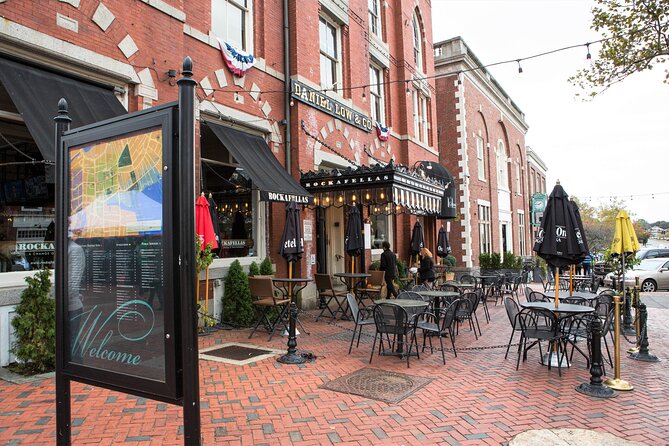
Turner’s Seafood operates in Lyceum Hall, built on land once owned by Bridget Bishop and her husband, Edward. Bishop was the first woman executed during the 1692 trials.
Her story is especially useful for understanding how quickly suspicion could become a death sentence. The tour explains that only eight days passed between her arrest, trial, and execution. That compressed timeline is hard to grasp until you attach it to one person and one place.
This is another exterior stop, and the seafood restaurant is not included in the tour price. You can return later if you want to eat there, but the historical point is the land and Bishop’s story, not the present restaurant interior.
The Witch Dungeon Museum and the reality of imprisonment
The Witch Dungeon Museum is not itself a building from the 1692 trials. The guide uses it to explain how prisoners were held and what jailing could involve.
People were confined in tiny spaces, sometimes no larger than a closet or phone booth, and prisoners had to pay for their own time in jail. That detail changes the way you picture the ordeal. Arrest was not a brief pause before a fair hearing. It could mean confinement, expense, poor conditions, and separation from family.
The tour does not include museum admission. You may also get a photo opportunity in the pillories, or stocks, depending on how the stop is handled. This section is more about the prison system than a surviving trial site, so visitors expecting original cells should adjust their expectations.
The Bewitched statue and Salem’s modern witch image
The statue of Elizabeth Montgomery as Samantha Stevens, from the television show Bewitched, provides a lighter pause. You can take a photo and hear about episodes filmed in Salem.
The statue also lets the guide point out the irony of placing a popular fictional witch figure on land with its own connection to the 1692 story. It is not a serious memorial, but it shows how Salem has turned witchcraft into several overlapping identities: painful history, folklore, entertainment, and tourism.
This stop is short and works well as a change of tone. The tour does not treat the trials as a costume story, but Salem’s modern image is part of the city you are walking through.
The Witchcraft Court and the old jail site
The Salem Masonic Building marks the area where the Witchcraft Court, known as the Court of Oyer and Terminer, operated in the middle of Washington Street. Most of the trials took place here, with additional proceedings in January 1693.
The court’s decisions are among the most important parts of the story. One accused person was found innocent by a jury, but the judges rejected that decision. That detail shows how little protection a favorable jury decision could provide once the judges had accepted the logic of the prosecution.
The original courtroom is gone, and you should expect a street-side explanation rather than a preserved chamber. Still, this is one of the most useful locations for understanding the legal failure. Ask the guide how the court handled evidence and why accusations were allowed to carry such force.
At 50 St. Peter Street, the group reaches the former Witchcraft Jail site. The jail itself is gone, but the place connects to several prisoners, including Giles Corey. Corey was pressed under heavy stones during interrogation after refusing to enter a plea, and some prisoners died in jail.
This stop gives the tour its starkest reminder that the victims were not only the people executed. Imprisonment itself could be fatal, and the process affected accused people long before a final judgment.
What the route cannot show you
The tour’s biggest limitation is also a fact of Salem’s history: many trial-era buildings have vanished. You will not see the original courtroom, jail, sheriff’s house, or a confirmed hanging tree on this walk.
The execution site is more than a mile from the downtown route. Taking the whole group there would add substantial time and create problems for children, older people, and anyone with mobility limits. The guide instead focuses on locations that can be reached in a roughly one-mile circuit.
That choice keeps the tour manageable, but it can disappoint anyone expecting a series of preserved sites. At some stops, you will stand outside a modern building while listening to a historical explanation. The experience works best when you value place-based storytelling and context, not only original walls.
Guide style, group size, and the quality of the storytelling
The guide makes a large difference here. The strongest guides create a timeline and make the people easy to distinguish. Bob has been especially praised for bringing the 1600s figures to life while keeping the dark material understandable. Other guides have been described as warm, funny, patient with questions, and attentive to the group’s walking pace.
The style can vary. Some presentations lean on many small anecdotes without enough explanation of how events led from one stage to the next. If you prefer a clear historical structure, ask early for the basic sequence: the first accusations, the spread of the panic, the court proceedings, the executions, and the later collapse of the case.
The maximum group size is 40. That is not an intimate seminar, and you may need to position yourself near the guide to hear well. On the other hand, a group walk can feel lively, and the frequent stops make it possible to ask questions.
Is $30 a fair price?
At $30 per person, this is a moderate price for a 90-minute guided walk. You are paying for a local guide, route planning, historical research, and an explanation of sites you would otherwise pass without knowing their importance.
The value is strongest if you arrive with little background or want a useful introduction before visiting Salem’s museums. The tour helps you see why a modern restaurant, street name, hotel, or office building matters. It also saves you from piecing together the downtown locations alone.
The value is weaker if you want entrance to historic interiors. Admission to the Witch House, Witch Dungeon Museum, and other attractions is not included. Parking, transportation, food, and restrooms are also your responsibility.
I would book it early for October, when it is often reserved weeks ahead. The free cancellation policy allows a full refund when you cancel at least 24 hours before the start time, but changes or cancellations inside that window are not accepted.
Who should book this walk?
This tour suits first-time Salem visitors, families with older children, and anyone who wants the witch trials explained through real people rather than only through legends. A 14-year-old with an interest in the subject should be able to follow it, provided an adult accompanies them.
It is also a good fit if you want to get your bearings downtown. The route passes enough central landmarks to help you plan the rest of your day.
I would be cautious if you have trouble walking or standing for 90 minutes. Salem’s narrow sidewalks, bricks, cobblestones, stairs, and October crowds can make the route harder than the one-mile distance suggests. Service animals are allowed, but every participant must be able to complete the route within the scheduled time.
Should you book the Salem Witch Trials Historical Walking Tour?
Book it if you want a focused introduction to the 1692 trials and understand that many important locations are now gone. The best parts are the memorial, the Witch House, the stories of victims and officials, and the chance to connect the old events with Salem’s present streets.
Skip it if you expect a preserved courthouse, original jail cells, or a walk to the hanging site. You may find the repeated exterior stops slow if you already know the story or prefer museum exhibits.
For most first visits, I would take the 10 a.m. tour, listen for the guide’s timeline, then return to the Witch House and Salem Witch Trials Memorial on your own. That approach gives you both the guide’s local context and enough quiet time to take in the sites that matter most.
FAQ
How long is the Salem Witch Trials Historical Walking Tour?
The tour lasts approximately 90 minutes and covers about one mile, with frequent stops for explanations and questions.
Where does the tour begin?
It begins at the Salem Historical Tours office at 8 Central Street, Salem, Massachusetts. You should arrive 15 minutes before the scheduled start.
What time does the tour depart?
Tours depart at 10 a.m., 1 p.m., and 4 p.m.
Is the tour offered in languages other than English?
The tour is offered in English.
Does the tour include admission to the Witch House or museums?
No. Admission to the Witch House, Witch Dungeon Museum, and other paid sites is not included.
Is the tour accessible for people with mobility concerns?
The route can be difficult for people with mobility or accessibility concerns. It includes narrow and uneven sidewalks, bricks, cobblestones, and stairs, and each participant must be able to complete the one-mile route within 90 minutes.
What happens if the weather is bad or I need to cancel?
The tour operates in all weather, so dress appropriately. You can cancel for a full refund up to 24 hours before the experience begins. Changes or cancellations made less than 24 hours before the start time are not accepted.
Newest history tours we have reviewed in the USA
- Nashville: Belle Meade Historic Mansion Tour★ 4.8 · 63 reviews
- Beaufort: Local History and Film Sites Tour by golf cart★ 4.9 · 102 reviews
- Boston: Guided Seafood Tasting and History Tour★ 4.9 · 90 reviews
- Beaufort: Gullah Heritage Tour★ 4.8 · 26 reviews
- Beaufort: Historic City Tour by Bus★ 4.9 · 228 reviews
- Austin: Downtown Austin Haunted History Tour★ 4.4 · 31 reviews
- Austin: Morning History Walking Tour of Downtown Austin★ 4.9 · 71 reviews
- Atlanta: Beltline Food, Street Art, and History Walking Tour★ 5.0 · 47 reviews
Dark History & Haunted Tours, compared.

Savannah History and Haunts Candlelit Ghost Walking Tour
Read our review →

New Orleans Small-Group Haunted History Carriage Tour
Read our review →
Genteel and Bard’s Savannah Dark History and Ghost Encounter Walking Tour
Read our review →
Shadows of York: Ghost Walk and Horrible History.
Read our review →Browse the lists this tour appears in