Review · INDIA HISTORY TOURS
Agra Fort: Guided UNESCO Heritage Walking Tour
Agra Fort tells its story through contrasts: a military citadel with graceful marble halls, royal gardens, and a window where Shah Jahan spent his final years looking toward the Taj Mahal. I love the mix of power and personal drama, especially at Musamman Burj, and I like having a guide point out details you could easily miss in the broad courtyards. The one concern is time. One hour is enough for a sharp overview, but not for every corner of this enormous fort.
I also like the private format. Guides such as Gagan and Shahid Khan are noted for clear communication, useful photography help, and keeping visitors away from aggressive photographers and vendors near the entrance. Still, you must arrange your own transport, and the fort’s uneven ground means comfortable shoes are not optional.
Key Points at a Glance
- Shah Jahan’s final view: Visit Musamman Burj, linked to the emperor’s imprisonment by his son Aurangzeb and his view toward the Taj Mahal.
- A private one-hour visit: Move at your own pace with an English- or Hindi-speaking guide rather than joining a large group.
- Three major Mughal spaces: See the Diwan-i-Am, Diwan-i-Khas, and Jahangiri Mahal, each serving a different royal purpose.
- A possible look inside the mirrored palace: If access is open, the reflective decoration offers a sharp change from the fort’s red sandstone walls.
- Useful help at the entrance: The guide can clarify the meeting point, help with photos, and assist around queues and persistent vendors.
- Easy to pair with the Taj Mahal: Agra Fort is about 2.5 kilometers from the Taj Mahal, making both practical on the same day.
Why Agra Fort Deserves More Than a Quick Photo Stop
The Taj Mahal gets the famous postcard, but Agra Fort gives you a better sense of how Mughal power worked. This was not simply a palace. It was a fortified imperial center, a royal residence, a place of government, and a carefully arranged display of status.
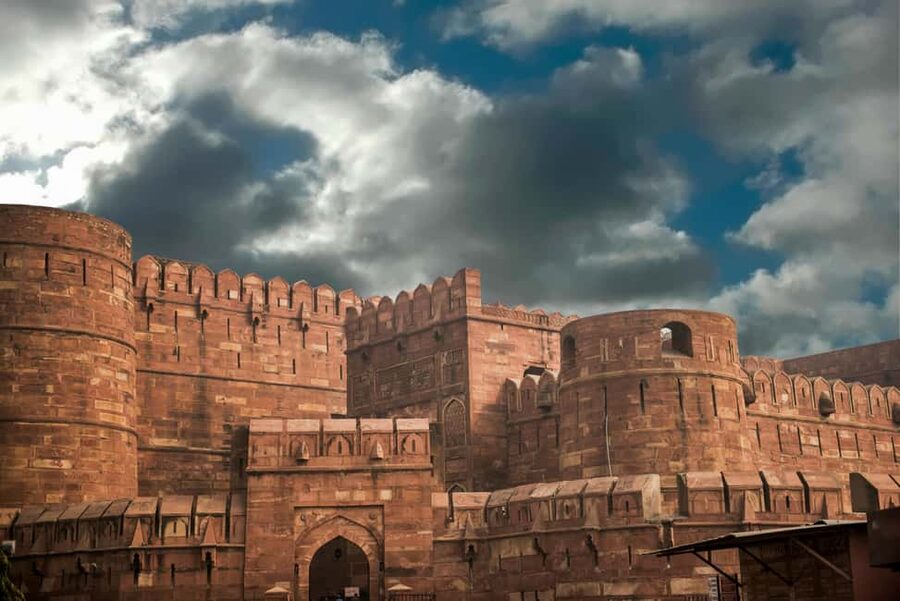
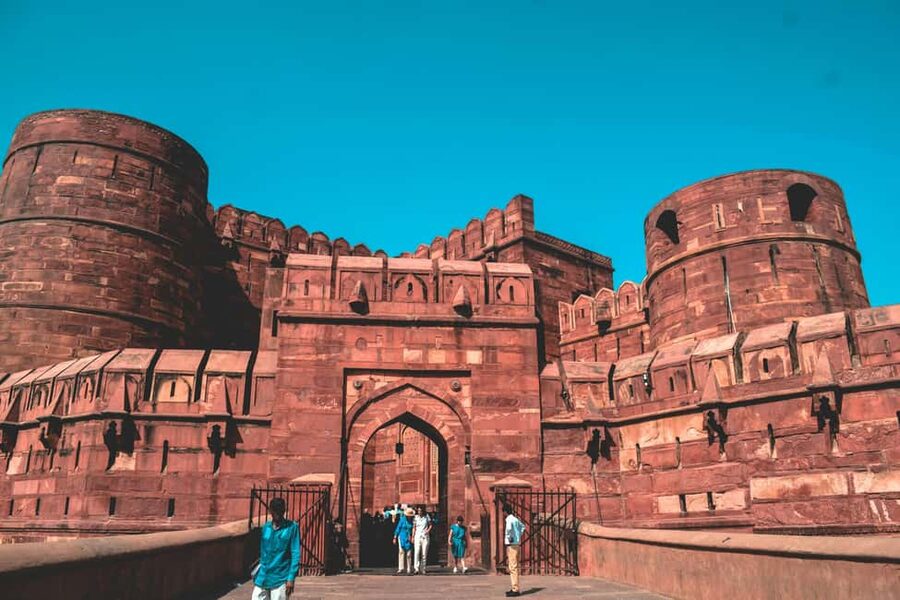
The fort is a UNESCO World Heritage Site, and its scale becomes clear as soon as you approach the walls. You enter through Amar Singh Gate, the only visitor entrance, then pass into a complex of courtyards, halls, balconies, gardens, and restricted areas. The setting can feel confusing without context. A guide helps turn separate buildings into a story about Akbar, Jahangir, Shah Jahan, and Aurangzeb.
I find that especially useful here because the fort mixes several design traditions. Rajput forms, Persian planning, and Islamic arches appear side by side. Marble screens sit near red sandstone walls. Jharokhas, or projecting enclosed balconies, frame the courtyards and show how royal architecture could be both decorative and practical.
At $6 per person, this is inexpensive by guided-tour standards. The real value is not in the length of the visit. It is in having someone explain why a hall mattered, who used it, and how the fort changed as Mughal rulers reshaped it.
More Castle and Palace History Tours in India
- Private Heritage Walking Tour in Jaisalmer Fort and Old Bazaar
★ 5.0 · 306 reviews - Private Jaisalmer Fort & old city tour
★ 5.0 · 168 reviews - Kochi Tour Guide -A Heritage walking tour in Fort kochi and Mattancherry !
★ 5.0 · 143 reviews
Entering Through Amar Singh Gate
Your visit begins at Amar Singh Gate, the sole entry point for visitors. This detail matters because you cannot simply meet your guide at any convenient section of the fort. The local provider sends the guide’s contact details by WhatsApp, or by email if you do not use WhatsApp, one day before the tour.
I recommend checking those messages carefully. The guide’s WhatsApp number is also placed on your booking voucher, so you have a direct way to confirm the meeting point or ask for help before the visit. Since transfers are not included, you need to reach the fort independently.
Expect a bag check at the entrance. Large bags and prohibited items are not allowed, and drones and tripods are usually prohibited without special permission. Bring a camera if you want photos, but keep your belongings simple.
The approach can be busy, with photographers and vendors near the entrance. Guides such as Gagan have helped visitors avoid scam photographers and unwanted sales pressure. That kind of practical assistance may sound minor, but it makes the first few minutes much easier, especially if this is your first visit to Agra.
Understanding the Fort’s Military and Royal Sides
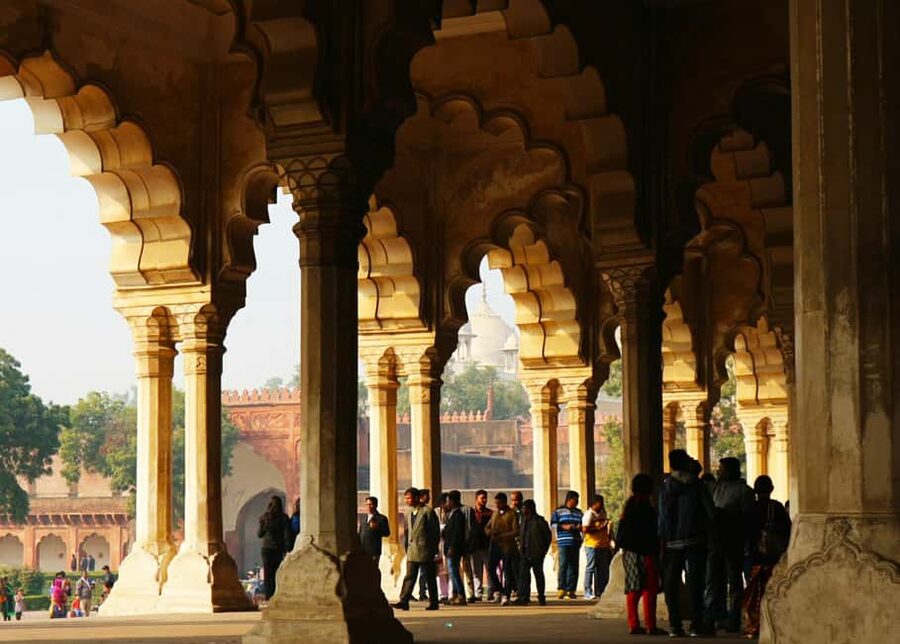
Once inside, your guide explains the fort’s double identity. Its thick walls and commanding position speak to defense, while the carved marble, formal halls, and gardens reveal life at court.
That contrast gives the tour its shape. You move from spaces designed to control access and protect the emperor to rooms made for ceremonies, private audiences, and royal comfort. The architecture is not just pretty decoration. It reflects rank, security, ritual, and daily government.
The fort served under several Mughal rulers. Akbar developed the red sandstone stronghold, while Jahangir and Shah Jahan added or altered sections. Shah Jahan favored pale marble and refined ornament, so parts of the fort show a clear shift from a rugged military base to a more elegant palace complex.
A good guide will help you notice small features rather than simply point out large buildings. Look at the arches, the jharokhas, and the marble carvings. You may also see how carefully sightlines were arranged through courtyards and toward distant views.
Because the experience lasts only one hour, the guide will focus on the main accessible highlights. That is a benefit if you want a clean introduction, but a limitation if you hope to wander widely. The fort is huge, and you should not expect to see every palace or rampart in detail.
Diwan-i-Am, Where the Emperor Met His Subjects
The Diwan-i-Am, or Hall of Public Audience, is one of the clearest places to picture Mughal government. This pillared chamber was used for formal meetings with subjects and officials. Here, the emperor was not hidden away in a private palace. He appeared before people in a carefully controlled public setting.
Your guide can explain how the hall functioned and help you read the space as a stage for imperial authority. The open, repeated arches create a sense of order, while the arrangement directed attention toward the ruler’s position.
For me, this is where a short guided visit earns its keep. An unaccompanied walk might leave you seeing only rows of columns. With context, the hall becomes a place of petitions, ceremony, and public power.
It is also a useful counterpoint to the quieter royal apartments later in the tour. The Diwan-i-Am shows the emperor acting as ruler. Other rooms show him as host, family member, and private monarch.
More History Walking Tours in India
- Fontainhas Heritage Walk by Make It Happen
★ 5.0 · 2,834 reviews - The Great Indian Food Tour: Old Delhi Food and Heritage Walk
★ 5.0 · 1,698 reviews - Old Goa Heritage Walk by Make It Happen
★ 5.0 · 797 reviews - Old Delhi Food, Heritage&Cultural Walk with Rickshaw ride to Masterji Kee Haveli
★ 5.0 · 742 reviews
Diwan-i-Khas and the Memory of the Peacock Throne
The Diwan-i-Khas, or Hall of Private Audience, served a more selective purpose. This was where the emperor met important officials, envoys, and favored visitors in a more restricted setting.
The decoration is more refined, with marble work and elegant arches that reflect the court’s taste. Your guide may also identify the spot associated with the Peacock Throne. The original throne is no longer there, but the location helps you imagine the display of wealth and authority that once centered the room.
Do not expect a restored throne waiting for a photograph. The interest lies in understanding what the space represented. The hall was designed to make access to the emperor feel rare and important.
This is one of the places where a guide can add scale to the story. The building itself is not enormous, but its purpose was precise. The Diwan-i-Am was for public audiences. The Diwan-i-Khas was for high-level meetings. Those names are easy to blur together without explanation, so listen for the distinction.
Jahangiri Mahal and the Fort’s Blended Style
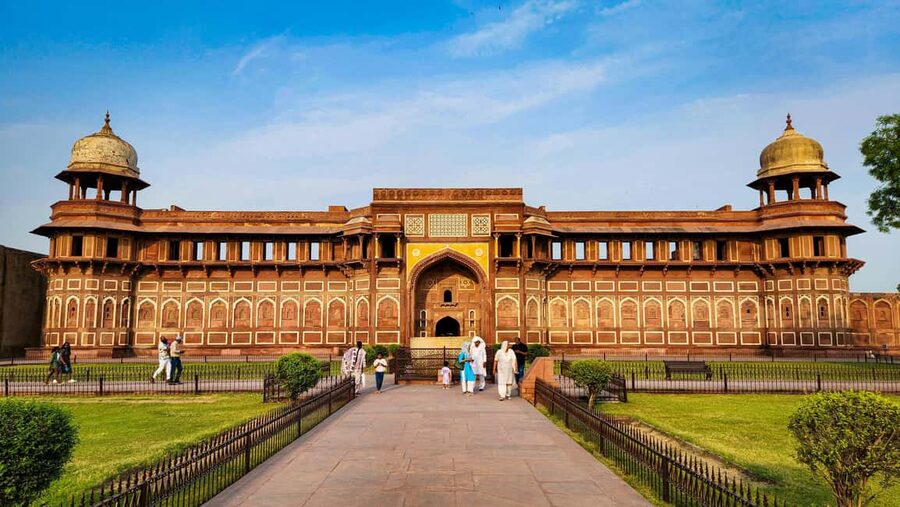
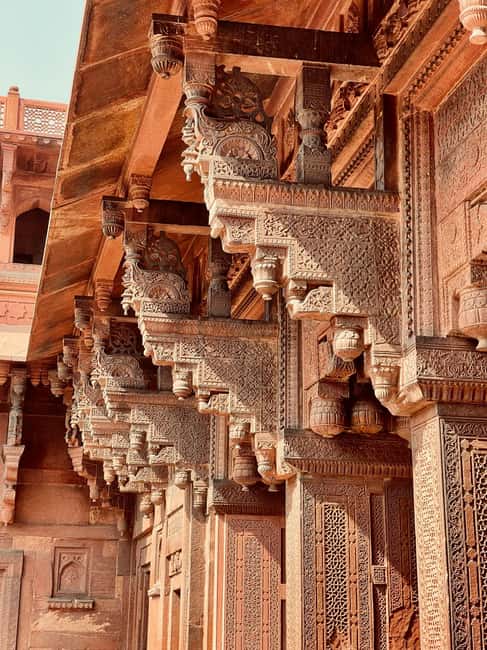
Jahangiri Mahal provides another look at the fort’s architectural mixture. Its forms bring together Rajput, Persian, and Islamic influences, showing that Mughal building was not a single, fixed style.
Look for the interplay of heavy sandstone, carved detail, arches, and balconies. The building feels more like a palace than a formal audience hall, and it helps you picture the domestic side of imperial life.
The name points to Jahangir, but the fort’s buildings reflect work carried out and altered across different reigns. A guide can help separate the ruler connected with a building from the ruler who commissioned or modified it.
This stop is also a reminder that the fort was used by a royal household, not just an emperor and his court officials. The spaces had to support ceremony, privacy, movement, and protection all at once.
Musamman Burj and Shah Jahan’s Final Years
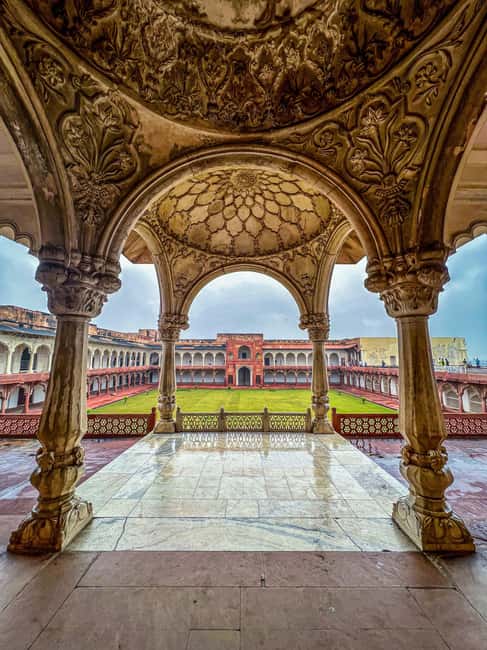
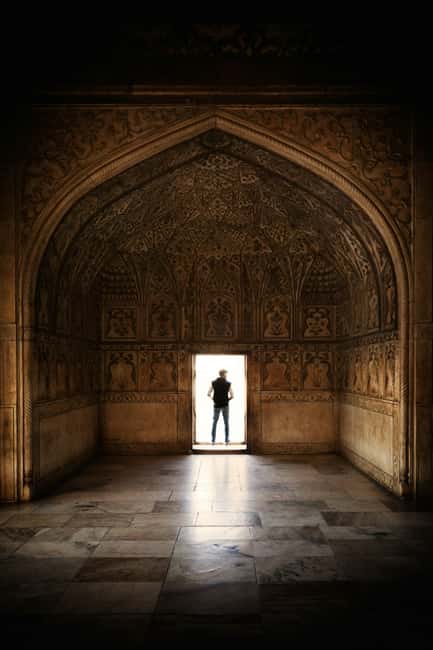
Musamman Burj is the emotional center of the tour. This is the spot associated with Shah Jahan’s imprisonment by his son Aurangzeb. From here, Shah Jahan could look toward the Taj Mahal, the monument built for his wife Mumtaz Mahal.
The view gives the story its human weight. It is easy to reduce Mughal history to rulers, battles, dates, and buildings. Musamman Burj brings the family conflict into focus. Shah Jahan was not simply a builder connected to the Taj Mahal. He was also an aging emperor confined by his own son, with the monument to his wife visible in the distance.
The view toward the Taj Mahal is one of the best reasons to bring a camera. A guide who knows the fort can help you find strong viewing points and take photos. Shahid Khan, in particular, is noted for knowing good photo locations and helping visitors make the most of them.
The Taj Mahal is about 2.5 kilometers away, so the view is not a replacement for visiting the monument itself. Instead, it changes how you see it. From the fort, the Taj Mahal becomes part of Shah Jahan’s personal story rather than an isolated monument.
The Mirrored Palace and Anguri Bagh
If accessible during your visit, the mirrored palace offers a different mood from the open audience halls. Reflective surfaces catch the light and create a room built around shimmer and visual effect.
Access can vary, so do not treat this as a guaranteed stop. That uncertainty is worth keeping in mind if the mirrored palace is the main reason you want the tour. The fort’s accessible areas may change, and the guide can tell you what is open on the day.
Anguri Bagh provides another shift. Its geometric garden layout reflects the Mughal love of order, symmetry, and carefully planned outdoor space. The name refers to grapes, and the garden was associated with royal enjoyment.
The garden is valuable because it shows how the fort was not only a collection of stone buildings. Gardens offered a controlled natural setting within the palace complex. Their lines, beds, and proportions created calm after the heavier walls and formal halls.
You will likely want photos here, but remember that the tour is short. Pause for a few good images, then keep moving so you do not lose time needed for the main interiors.
What the Guide Adds to a One-Hour Visit
A one-hour fort visit is brief enough that the guide’s style matters. You need clear explanations, good pacing, and a willingness to adjust when the entrance is crowded or you arrive late.
Gagan has 17 years of guiding experience and is noted for arriving on time, communicating clearly, explaining the fort’s history, taking photos, and helping visitors avoid scams near the entrance. Shahid Khan is described as active and enthusiastic, with a strong eye for photo spots and practical help during a weekend rush.
The provider assigns the guide, so you cannot count on booking a particular person unless that is confirmed in advance. Still, the supplied guide information names both Gagan and Shahid Khan as examples of the kind of support available.
English and Hindi are the available tour languages. The private-group format means you can ask questions without waiting for a large group to catch up. It also gives the guide more room to adjust the pace, though one hour still sets a firm limit.
If you arrive late, contact the guide as soon as possible. One guide has been praised for patiently waiting for a delayed party, but you should not assume every minute can be added to the end of the visit.
Timing, Comfort, and Pairing It With the Taj Mahal
The fort involves plenty of walking over uneven surfaces. Wear comfortable shoes, especially if you plan to visit the Taj Mahal later the same day. The short tour does not make the ground easier.
Since the Taj Mahal is only about 2.5 kilometers away, combining the two sites makes good practical sense. The fort gives you Mughal politics, palace life, and a direct link to Shah Jahan. The Taj Mahal then gives you the finished expression of his devotion to Mumtaz Mahal.
You will need to arrange the movement between the two sites yourself because transfers are not included. The tour is best for someone who already has a plan for getting to Amar Singh Gate and continuing to the Taj Mahal or another Agra stop.
Photography is allowed, which is useful at the Musamman Burj views, Anguri Bagh, and the main architectural spaces. Drones and tripods are usually not allowed without special permission. Keep your camera setup light and avoid carrying equipment you may have to leave behind.
Is the $6 Price Good Value?
At $6 per person, this is a strong value if you want more than a self-guided walk. The price is low enough that the main question is not cost. It is whether one hour matches your interests.
I would book it for a first visit, a tight Agra schedule, or a traveler who wants the important buildings explained without paying for a full-day tour. The private format, guide assistance, and focus on the best-known spaces make it efficient.
I would be more cautious if you want long periods for photography, detailed architectural study, or an unhurried walk across the entire fort. In that case, one hour may feel compressed. The fort is too large for a full exploration in this format.
The free cancellation option up to 24 hours before the tour and reserve-now, pay-later booking also make it easier to fit into a changing India itinerary. Those policies do not replace careful planning, but they reduce the risk of committing too early.
Who Should Book This Agra Fort Tour?
I recommend this experience to first-time Agra visitors, couples combining the fort with the Taj Mahal, solo visitors who want help at the entrance, and anyone interested in Mughal architecture but unsure what to look for.
It also suits photographers who want help locating the best views, though the short duration limits how long you can wait for ideal light. Families may appreciate the private format and the guide’s ability to keep the pace flexible, but uneven ground and extended walking still need consideration.
You may want a longer or more specialized visit if you already know Agra Fort well. The one-hour plan is an introduction, not a complete study of the site.
Should You Book It?
Book this tour if you want the fort’s major stories explained clearly, especially Shah Jahan’s imprisonment, the Diwan-i-Am and Diwan-i-Khas, Jahangiri Mahal, the mirrored palace if open, and Anguri Bagh.
The strongest reasons to choose it are the low price, private format, English or Hindi guidance, and practical help with photos, meeting arrangements, queues, and vendors. The main compromise is the one-hour limit and the lack of included transport.
For most first-time visitors, I think the balance works well. Arrive with comfortable shoes, keep your bag small, confirm the meeting details through WhatsApp or email, and treat the tour as a focused introduction before visiting the Taj Mahal nearby.
FAQ
How long is the Agra Fort guided tour?
The tour lasts one hour.
What is the price of the experience?
The price is $6 per person.
Is the tour private?
Yes. The experience is offered for a private group.
Which languages are available?
The live guide can conduct the tour in English or Hindi.
Is transportation included?
No. Transfers are not included, so you must arrange your own transportation to and from the fort.
Where do I meet the guide?
You will receive the guide’s contact details from the local provider by WhatsApp one day before the tour. If you do not use WhatsApp, the details can be sent by email. Amar Singh Gate is the visitor entrance.
What buildings are included in the visit?
The tour includes the Diwan-i-Am, Diwan-i-Khas, and Jahangiri Mahal. It also covers Musamman Burj, Anguri Bagh, and the mirrored palace if that area is accessible.
Can I take photographs?
Yes. Photography is allowed. Drones and tripods are usually prohibited unless you have special permission.
What should I bring?
Bring comfortable shoes and a camera. The fort has uneven surfaces and requires plenty of walking.
Can I visit the Taj Mahal on the same day?
Yes. The Taj Mahal is about 2.5 kilometers from Agra Fort, so visiting both on the same day is practical. You must arrange transportation between the sites yourself.
Can I cancel the tour?
You can cancel up to 24 hours in advance for a full refund. The reserve-now, pay-later option lets you book without paying immediately.
More UNESCO World Heritage Tours in India
- World heritage Somnathpur sculptures and Talakadu temple mystery
★ 5.0 · 79 reviews - 2 days Private tour of Hampi world heritage site from Bangalore by car
★ 5.0 · 75 reviews - World heritage Ahmedabad city tour in private car with guide and lunch
★ 5.0 · 44 reviews - Private Elephanta Caves UNESCO World Heritage Site Tour
★ 5.0 · 34 reviews
Newest history tours we have reviewed in India
- Private Elephanta Caves UNESCO World Heritage Site Tour★ 5.0 · 34 reviews
- World heritage Ahmedabad city tour in private car with guide and lunch★ 5.0 · 44 reviews
- Heritage Walk: Recommended by Gigi Hadid as a must-do in Mumbai★ 5.0 · 122 reviews
- Mumbai: South Mumbai Heritage Walking Guided Tour★ 4.5 · 69 reviews
- Hill-station & Heritage: Lonavala & Karla Caves Tour from Mumbai★ 5.0 · 60 reviews
- Best South Mumbai Heritage Walk★ 5.0 · 122 reviews
- The Cultural And Historical Walking Tour in Margao★ 5.0 · 280 reviews
- Old Delhi Walking Tour: Food, Culture & Spice Bazaars★ 5.0 · 94 reviews
Castle & Palace History Tours, compared.

Edinburgh Castle Guided History Tour with Tickets
Read our review →
Madrid Essential: Historic Center, Plaza Mayor & Royal Palace
Read our review →
Venice’s Best: Basilica, Doge’s Palace, Gondola & History Gallery
Read our review →
Imperial Palace and Shogun Historical Walking Tour
Read our review →
Saadian Tombs & Bahia Palace, Medina Guided Tour
Read our review →
Charleston historical walking tour with a Professor of History at The Citadel
Read our review →
Abu Dhabi Grand Mosque, Palace, and Heritage Village
Read our review →