
Review · SPAIN HISTORY TOURS
Albayzín y Sacromonte, Unesco Heritage Neighborhoods
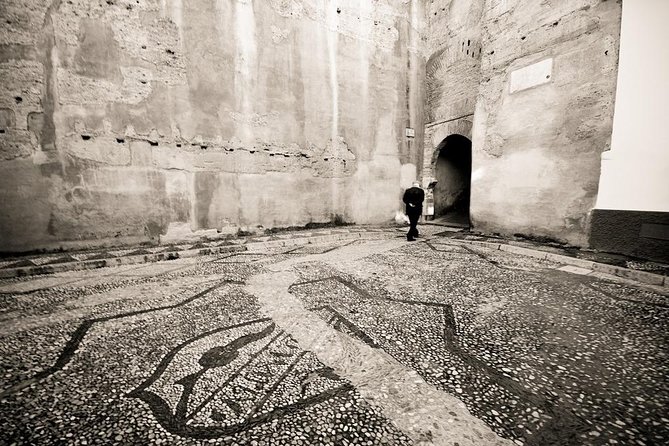
Granada’s oldest hills are best understood on foot, and this tour takes you through two of the city’s most unusual districts. In the Albaycín, Muslim-era lanes twist past cármenes, cisterns, churches, and old walls. In Sacromonte, cave homes and flamenco traditions tell a different part of Granada’s story, with the Alhambra spread across the valley.
I like two things here: the guide handles the maze of lanes, and the route gives you several fine viewpoints without adding a monument ticket. The main consideration is the walking. You’ll go uphill and downhill on cobblestones and stairs, so sturdy shoes and a little patience matter.
Key points to know before booking
- Two historic hill districts: See the Albaycín and Sacromonte in one guided walk.
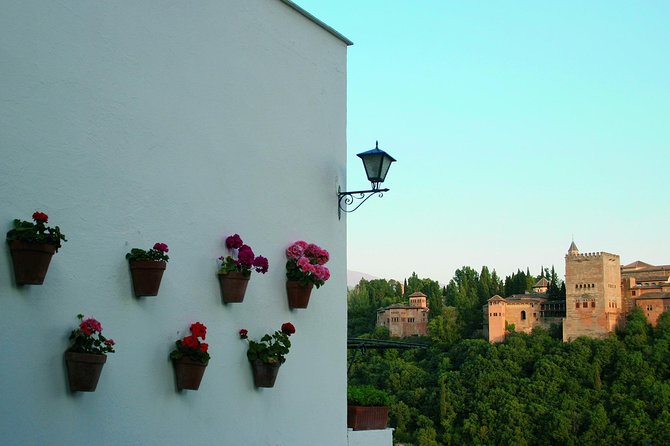
- Strong Alhambra views: The San Nicolás and San Cristóbal areas offer memorable views toward the palace and Granada.
- A small group: The tour accepts a maximum of 15 people, which should make it easier to hear the guide.
- A sunset-friendly start: The walk begins at 5:00 pm, a useful time for softer light and cooler streets.
- Free sights along the way: Monument admission is not included, but no separate ticket is required for the walking route itself.
- Real physical effort: Expect inclines, stairs, narrow cobbled lanes, and roughly two to three hours on foot.
Why Albaycín and Sacromonte belong together
These neighborhoods sit across Granada’s hills, yet they offer different views of the city’s past. The Albaycín grew as one of Muslim Granada’s main centers, alongside the Alhambra, Realejo, and the old lower-city district of Bib-Arrambla. Sacromonte developed as a hillside suburb associated with Granada’s Roma community, cave homes, music, and flamenco.
That contrast gives the tour its shape. You begin with the older Islamic city, where the street plan still feels difficult to read, then continue toward a drier, more open hillside cut by ravines and cave dwellings. I find that this pairing makes more sense than seeing either district alone.
The route is not a monument-by-monument ticketed visit. It is a guided walk through living neighborhoods, public viewpoints, historic remains, and streets where the setting matters as much as any single building. That makes the $21.78 price fair for visitors who want context and direction, but less useful if you only want formal interiors or a short ride to a viewpoint.
More UNESCO World Heritage Tours in Spain:
- Essentials of Valencia and its World Heritage Sites
★ 4.5 · 405 reviews - Alcalá World Heritage Tour
★ 4.8 · 24 reviews - World Heritage Shirakawa-go and Experience Tours from Kanazawa
★ 5.0 · 4,049 reviews
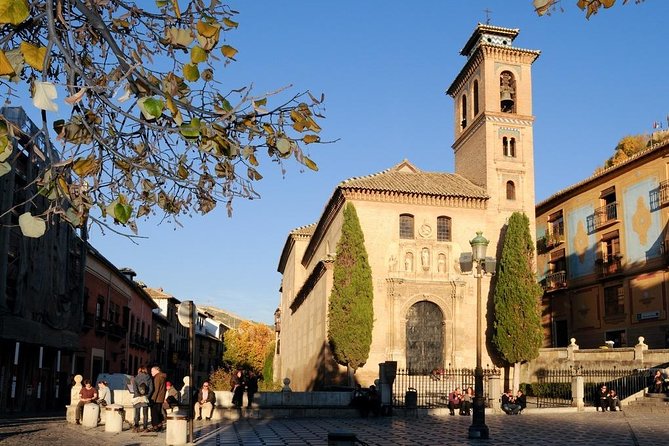
Starting at Plaza de Santa Ana at 5:00 pm
The meeting point is Plaza de Santa Ana, near the center of Granada. The tour ends in the Albaycín, so you do not return to the starting point. Plan that final detail before you set out, especially if you have dinner reservations or need to reach another part of town.
The 5:00 pm start is practical. It avoids the hottest part of the afternoon and can bring you toward the viewpoints as the light improves. The exact sunset effect will depend on the season, but the timing generally suits photography. You’ll want your phone or camera ready, though it is worth letting the group move rather than stopping in the middle of every narrow lane.
The group limit is 15 people. That is not a private tour, but it is small enough to keep the guide within earshot on most streets. Guides who have led this experience include Ana, Jaime, Juana, and Alexandra. The particular guide assigned to your date may differ, so book this for the route and subject matter rather than for a guaranteed individual.
Entering the Albaycín through Granada’s Muslim past
The Albaycín is the more atmospheric half of the walk. Its lanes turn sharply, narrow without warning, and climb toward small squares and viewpoints. That design is not a modern inconvenience added by accident. It reflects an old hillside neighborhood that developed before cars and straight avenues shaped city travel.
At its height, the district was home to about 40,000 people and around 30 mosques. You will not see all of that original city intact, but fragments remain: old mosque sites, minarets, Spanish-Muslim cisterns, walls, and traces folded into later Christian buildings.
A guide is especially useful here because the physical remains can be easy to miss. A cistern may look like a plain structure until someone explains its purpose. A church may occupy the site of a former mosque, and a quiet lane may follow a street plan that is centuries old. The walk connects those details instead of leaving you to guess what you are seeing.
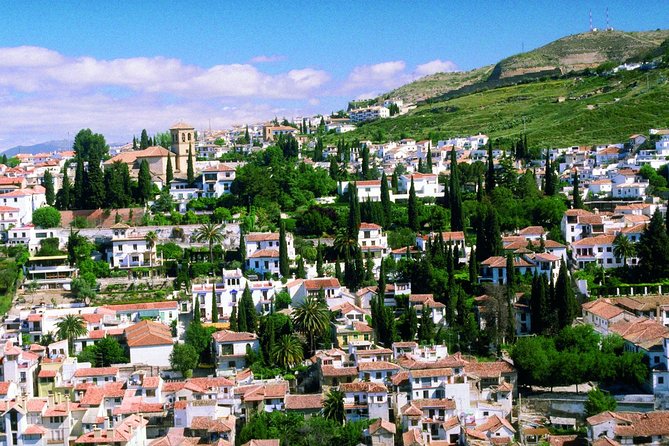
The district also contains many cármenes. These are Granada homes with gardens, often hidden behind simple walls. Their combination of private outdoor space, hillside views, and Mudejar features is closely tied to the character of Granada. You should not expect to enter private homes on this walk, but you can learn how these houses fit into the neighborhood.
The Albaycín is still an everyday district, not only a historic display. You may pass local shops, homes, churches, and residents going about their routines. That gives the route a more grounded feel than a walk limited to major monuments.
San Nicolás and San Cristóbal viewpoints
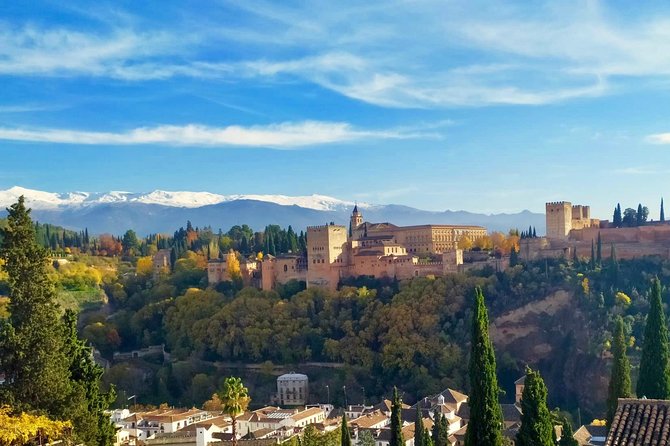
The great reward of the Albaycín comes at its viewpoints. San Nicolás and San Cristóbal offer broad views over Granada, with the Alhambra rising across the valley and the Sierra Nevada beyond it.
San Nicolás is the better-known name, but the walk’s value is not limited to one famous terrace. The route can help you understand how the Alhambra sits in relation to the city, the valley, and the hills around it. From ground level, the palace can seem like an isolated attraction. From the Albaycín, it becomes part of Granada’s larger setting.
These stops also provide breathing room after the tighter lanes. You can pause for photographs, listen to the guide, and take in the view without rushing straight through. One practical point: a popular viewpoint can become crowded, and a person with a selfie stick can easily block other people’s sightlines. Keep your camera use considerate, especially during the group’s explanation.
The views are strongest when the weather is clear. Since the tour is outdoors, clouds, haze, or changing light can affect what you see. The route still has historical value in poor conditions, but the famous Alhambra photograph depends on visibility.
More History Tours in Spain:
- Madrid Essential: Historic Center, Plaza Mayor & Royal Palace
★ 5.0 · 6,416 reviews - Barcelona: Tapas Walking Tour with Food, Wine, and History
★ 4.8 · 4,261 reviews - Sevilla Food Tour: Tapas, Wine, History & Traditions
★ 5.0 · 3,468 reviews - Valencia Old Town Tour with Wine & Tapas in 11th Century Historic Monument
★ 5.0 · 3,234 reviews
Crossing toward Sacromonte’s cave homes
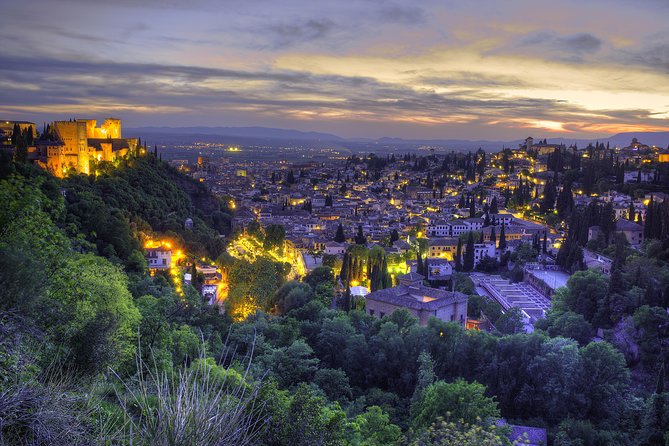
Sacromonte changes the mood. The reddish, dry hillside is marked by pitas and prickly pears, and the open views become a bigger part of the experience. Across the valley, you can look back toward the Alhambra, the white homes of the Albaycín, and the greenery along the Darro.
The district is traditionally linked with Granada’s Roma community, whose language includes caló. Roma people arrived in Spain in the 15th century after moving through Europe and North Africa, with earlier origins in India. That background helps explain why Sacromonte is more than a collection of scenic caves. It is also a place shaped by migration, community, music, and changing ideas about identity.
The caves are grouped around ravines, forming lanes of their own. Their layouts are simple and practical, commonly placing the kitchen near the entrance and the dining area, with one or two bedrooms farther inside. Conditions depended on the land and on what each household could create.
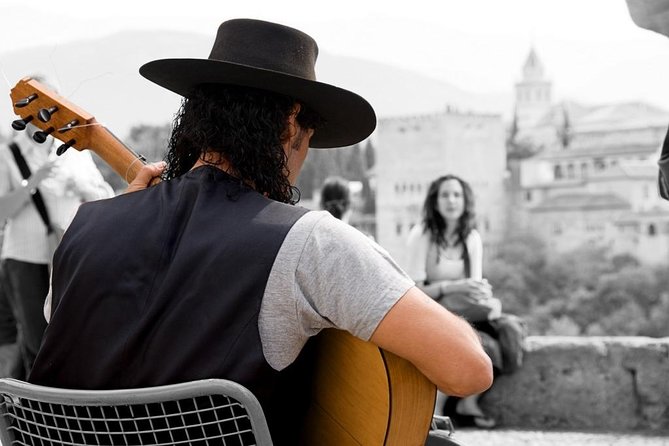
These homes have been associated for centuries with Roma families, bohemians, and flamenco performers. Sacromonte’s famous zambras grew from this setting. A zambra is a flamenco performance tradition tied strongly to Granada’s Roma community, and the cave setting has helped give Sacromonte its musical reputation.
This tour does not include a flamenco performance, food, or drinks. That is important when comparing it with evening shows. Here, you are learning about the district and seeing its physical setting rather than attending a staged performance.
How strenuous is the walk?
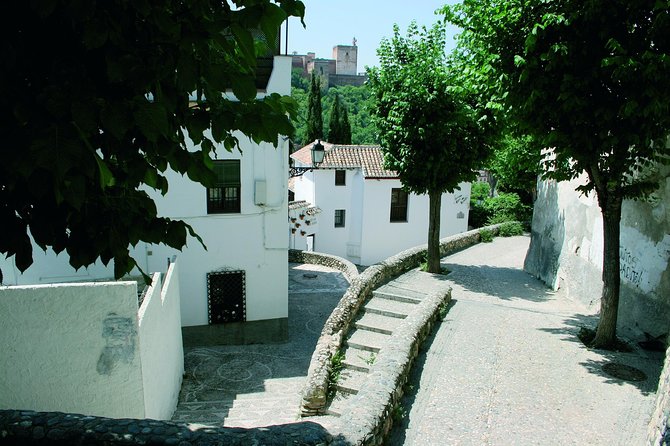
The route takes about two and a half hours, with the stated duration ranging from two to three hours. It is not described as an extreme hike, but it is not a flat city stroll. You’ll handle hills, uneven cobblestones, narrow streets, and stairs.
One useful description of the pace is reasonable rather than rushed. There are breaks for photographs and explanations, and you should have time to look around. Still, the hills can feel tiring, especially after a full day at the Alhambra or in central Granada.
Wear shoes with good grip. Avoid treating this as a chance to show off new footwear. The Albaycín’s stones and steps are part of its charm, but they are not always kind to tired feet.
Most people can take part, according to the tour information, and the group is limited to 15. No special accessibility details are provided, so anyone who needs step-free access or has difficulty with steep streets should confirm suitability before booking.
What the $21.78 price includes
At $21.78 per person, the cost is modest for a guided walk lasting around 2 hours and 30 minutes. You are paying for an official tourism guide, route planning, historical explanation, and the convenience of moving through streets that are easy to lose your way in.
The value is highest if you want to understand the relationship between Muslim and Christian Granada. The Albaycín’s remains make more sense with explanation, and Sacromonte’s caves and flamenco traditions have more meaning when presented as part of the city’s social history.
The price does not include monument tickets, food, or drinks. Since this route is mainly outdoors, that keeps the basic cost low. If you want to enter paid sites or add a flamenco show, those would be separate plans.
You can cancel for a full refund up to 24 hours before the 5:00 pm start time. Changes or cancellations made less than 24 hours before the start are not accepted for a refund, based on the local time in Granada.
The guide makes the difference
A strong guide can turn a pretty walk into a useful one. This route needs someone who can explain why the streets look the way they do, point out Islamic traces, and connect Sacromonte’s cave homes with Granada’s Roma and flamenco traditions.
Jaime has been praised for giving a clear overview of the two districts and explaining the relationship between Muslim and Christian communities. Juana has led the route at a comfortable pace, making the hills manageable rather than frantic. Ana and Alexandra have also received warm praise for their work.
That said, guide quality can vary from one date to another. The tour has an excellent overall rating of 4.8 from 250 reviews, with 95 percent recommending it, but there are also serious reports of guides failing to appear at the meeting point. Those reports are a small minority, but they matter because a missed start can ruin an evening.
Check your confirmation carefully. Arrive at Plaza de Santa Ana early, keep the provider’s contact details available, and make sure you are at the exact meeting point. The practical risk is not the walking or the content. It is the rare but significant possibility of a meeting-point mix-up or an absent guide.
Who should book this Granada walk?
I would choose this tour if you want a compact introduction to Granada’s hill districts and prefer a guide to wandering alone. It is especially useful early in your stay, when you are still learning the city’s shape and want to return later with better bearings.
It suits history-minded visitors, photographers, and anyone drawn to old neighborhoods rather than only grand monuments. The Alhambra views are a major bonus, but the tour’s real strength is the connection between streets, surviving Islamic features, Christian reuse, cave homes, and flamenco culture.
I would think twice if you dislike hills, stairs, or uneven paving. I would also skip it if you want interior access to monuments, a food tour, or a flamenco show. This is a walking and storytelling experience, not a ticketed palace visit or evening performance.
Should you book it?
Yes, if you want to see Granada’s Albaycín and Sacromonte with a clear route and useful historical context. The price is reasonable, the group size is controlled, and the combination of winding streets, cave homes, and Alhambra views gives you more than a standard city stroll.
Book with sensible expectations. Bring comfortable shoes, allow the full two and a half hours, and remember that the walk ends in the Albaycín rather than back at Plaza de Santa Ana. If you can manage the hills, this is one of the better low-cost ways to understand the parts of Granada that are easiest to admire and hardest to read on your own.
FAQ
How long does the Albaycín and Sacromonte tour last?
The visit lasts about 2 hours and 30 minutes, with the expected duration given as approximately two to three hours.
What time and where does the tour begin?
It begins at 5:00 pm at Plaza de Santa Ana, Pl. de Sta. Ana, in Granada.
Where does the tour finish?
The tour ends in the Albaycín neighborhood rather than at the starting point.
Is the tour offered in English?
Yes. The experience is offered in English.
Are monument tickets, food, or drinks included?
No. Monument admission, food, and drinks are not included. The official tourism guide and the 2-hour-30-minute visit are included.
How many people can join the tour?
The group has a maximum of 15 participants.
Newest history tours we have reviewed in Spain
- Tapas&Tours with Leo – Tasting Culture and History★ 5.0 · 35 reviews
- Private Jewish History Tour★ 4.5 · 32 reviews
- Granada: 3-hour Historical Tour by Segway★ 5.0 · 104 reviews
- Full-Day Tour Exploring History, Nature and Aloe Vera Farm★ 4.5 · 40 reviews
- Skip the Line Get Your Alhambra Ticket Now and Step into History★ 4.0 · 22 reviews
- Girona Jewish Heritage small group from Girona★ 4.5 · 68 reviews
- Girona History, Legends, and Food Walking Tour with food tasting★ 5.0 · 195 reviews
- Girona History and Legends Tour Small Group from Girona★ 5.0 · 299 reviews
UNESCO World Heritage Tours, compared.
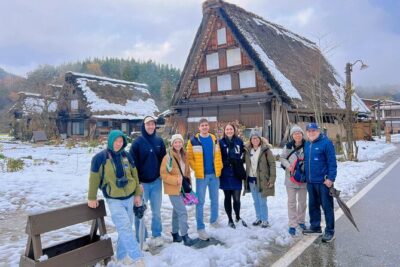
World Heritage Shirakawa-go and Experience Tours from Kanazawa
Read our review →
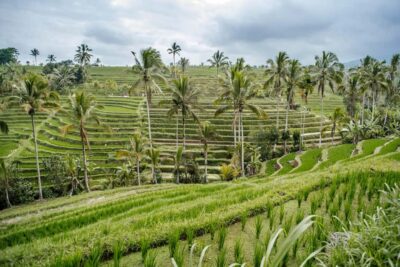
Bali: Tanah Lot UNESCO World Heritage Sites Full-Day Tour
Read our review →
World Heritage Kyoto & Nara Uji Authentic Matcha Experience
Read our review →
UNESCO’s Ayutthaya Historical Park: Full-Day Tour from Bangkok
Read our review →
Rotterdam: Kinderdijk UNESCO World Heritage Entry Ticket
Read our review →
From Busan: Gyeongju UNESCO World Heritage Guided Day Tour
Read our review →Browse the lists this tour appears in