
Review · ITALY HISTORY TOURS
2 Hours Private Historical Tour in Genoa
Genoa reveals itself best from a small vehicle that can slip through narrow lanes and spare you some serious uphill walking. This private two-hour tour carries you between medieval streets, grand palaces, old markets, the cathedral, and the harbor while your guide handles the route and the city traffic.
I like the easy overview and the way the tour reaches places you might miss on foot, especially Sarzano Square, Giardini Luzzati, and the lanes around San Lorenzo. I also like the private format for two, which costs about $57 per person at the listed group price and lets you ask questions as you go.
The main caution is the vehicle itself. Most rides go smoothly, but a few outings have been delayed by a flat tire, a broken spoke, or a mechanical failure. Bad weather can also cancel the tour, so leave room in your Genoa schedule.
Key points to know before booking
- A private two-hour orientation: The tour is priced at $114.93 for up to two people, making it a good value for a couple who wants a quick first look at Genoa.
- A rickshaw-style ride through narrow streets: You can cover more ground than you would on foot and avoid doing all of Genoa’s hills under your own power.
- Ten central stops: The route links Sarzano Square, Via Garibaldi, Columbus’ House, Piazza Banchi, San Lorenzo, De Ferrari Square, Palazzo San Giorgio, and the Old Port.
- Strong local guiding: Guides including Eleonora, Yusuf, Giulia, Sophie, Beatrice, and Lucia have been praised for history, warmth, and useful restaurant or sightseeing advice.
- Best for a port call: The meeting point is near the cruise terminal, and the route ends where it begins.
- Allow for weather and vehicle delays: Bring sun protection, expect a breeze, and avoid booking this as your only activity if you have a tight departure deadline.
Why a rickshaw makes sense in Genoa
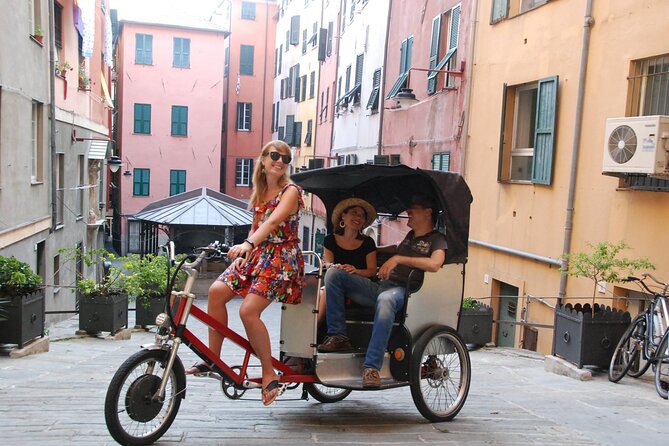
Genoa is compact on a map but tricky underfoot. The old center has narrow medieval lanes, steep streets, limited open squares, and a jumble of buildings that can make your first hour feel like a puzzle. A rickshaw-style electric vehicle gives you a moving seat while still keeping you close to street life.
You can look up at church towers, palace facades, and balconies instead of watching every step. The vehicle also reaches corners where a large sightseeing bus cannot go. That is the real point of this tour: not luxury, but access and energy saved.
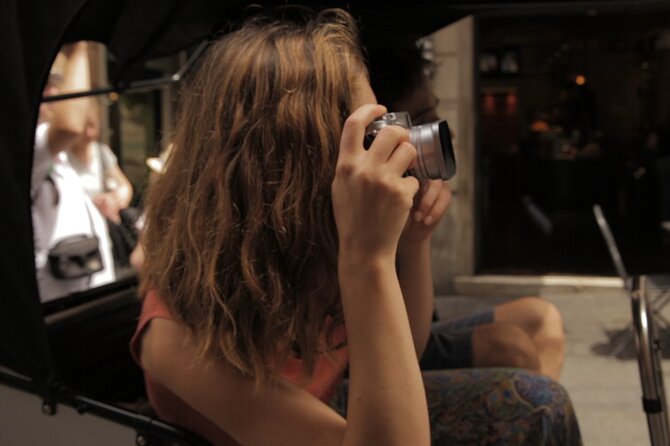
The ride has a relaxed pace, with stops for photos and short explanations. You are not pedaling, though some versions of the vehicle have been described as electric bicycles or pedal bikes. The exact vehicle may vary, so I would not book this expecting a particular model.
The tour is private for your group, up to two people. That matters in a city where questions often lead to the best stories. If you want to ask about Genoese food, port life, local churches, or places to return to later, you will not be waiting for a large group to catch up.
More Private History Tours in Italy
- Ancient Ostia Antica Semi-Private Day Trip from Rome by Train with Guide
★ 4.5 · 579 reviews - Colosseum & Ancient Rome Semi-Private Tour
★ 5.0 · 208 reviews - Ancient Pompeii Private Tour: Skip the Line & Kid-Friendly Option
★ 5.0 · 167 reviews
Starting near the cruise terminal
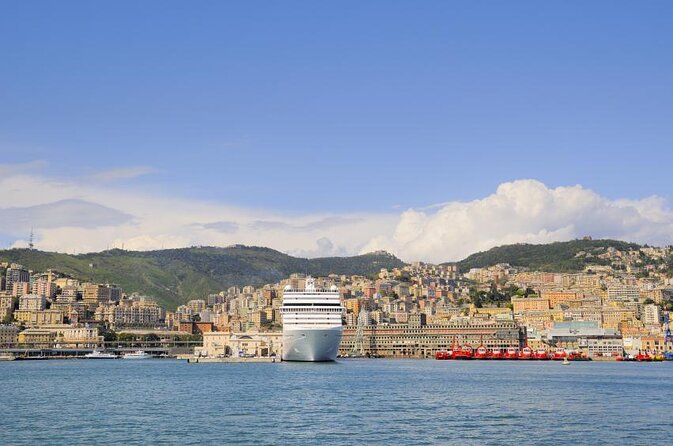
The meeting point is in the square in front of the terminal exit, at Galata Museo del Mare on Calata Ansaldo De Mari. This is practical for a cruise stop, since you do not need to cross the whole city before beginning.
Look for the driver in the square rather than inside the museum. The experience ends back at the same meeting point, which makes it easier to plan a return to the ship. Still, I would leave a generous buffer after the scheduled end. One mechanical delay lasted about 30 minutes, and another outing was shortened after a flat tire.
The tour is offered in English. Some past departures have also been conducted in German, but English is the stated language for this experience. Guides may contact you to arrange the meeting details, so keep your phone available around the start time.
Sarzano Square and Genoa’s earliest core
The first stop is Piazza Sarzano, a useful introduction to Genoa’s oldest center. This area is linked with the city’s original nucleus, known in ancient times as Ianua. The square gives you a first look at the bell tower of Sant’Agostino church, a small temple, and colorful Ravecca Street behind it.
Fifteen minutes here is enough to get oriented without turning the opening stop into a lecture. The setting also hints at Genoa’s unusual mix: quiet corners, worn stone, bright walls, and a major port city’s long memory.
From here, the route continues to the small Church of Santi Cosma e Damiano. The stop lasts only five minutes, but that short pause fits the rhythm of the old center. You get a quick look at one of the medieval district’s churches, then move on before the tour becomes a series of long indoor visits.
Admission is free at the listed stops, though this is primarily an exterior and orientation tour. If you want time inside churches or museums, save those for a later visit.
Via Garibaldi and the palace quarter
Via Garibaldi is one of the tour’s major sights. The street was once called Strada Maggiore, then Strada Nuova, and later Via Aurea, or Golden Street. In 1882, it took its current name in honor of Giuseppe Garibaldi.
The setting changes sharply from the tight medieval lanes. Here you see broad, elegant facades and imposing palaces built for Genoa’s powerful families. The street is part of the historic center’s grand architectural core, with palace fronts that reward a slow look upward.
The tour allows about 15 minutes. That gives you time to take photos and hear the basic story, but not enough for a full palace visit. If the palaces are your main reason for coming to Genoa, plan to return on foot and visit the interiors separately.
This is one place where the vehicle is both helpful and limiting. It gets you there without a long walk, but the best details are often above eye level. Ask your guide which facades deserve a second look, then return later if you want more time.
Same streets, a different century:
- Colosseum: Underground and Ancient Rome Tour
★ 4.7 · 12,691 reviews - Rome: Colosseum with Arena, Roman Forum and Palatine Guided Tour
★ 4.0 · 5,598 reviews - Venice: St. Mark’s Basilica Guided Tour & VR History Intro
★ 3.9 · 4,880 reviews - Colosseum with Arena, Roman Forum and Palatine Hill Guided Tour
★ 4.5 · 3,526 reviews
Columbus’ House and the medieval walls
Near Porta Soprana, just outside the medieval walls, you will see the building known as Columbus’ House. It is probably an 18th-century reconstruction of the medieval home where Christopher Columbus spent part of his youth.
The house has two floors. His father, Domenico Columbus, is said to have used the ground floor as a wool-weaving and trading workshop, while the family lived above. Written sources place Columbus here between 1455 and 1470.
The original building was likely destroyed during the French fleet’s bombardment of Genoa in 1684. That detail gives the stop some needed perspective. You are not looking at an untouched medieval home, but at a later reconstruction connected with a major figure in maritime history.
The visit lasts about ten minutes and is included as a free exterior stop. If you want to go inside, confirm the plan with your guide, since the tour schedule is built around brief visits at many locations.
Piazza Banchi and the city’s commercial past
Piazza Banchi sits near one of Genoa’s key docks and once served as the city’s grain market. In the 12th century, money changers worked under the porticoes, giving the square its name, piazza dei banchi.
This is a small but important stop because it explains how Genoa worked. The city’s power came not only from palaces and churches, but also from finance, shipping, trade, and the constant movement of goods around the harbor.
You get about 15 minutes here. That is enough to see the porticoed buildings and understand the square’s role, especially when your guide connects it with the Old Port later in the route.
San Lorenzo and the heart of medieval Genoa
The stop described around Il Cittadino and the Archdiocese of Genoa brings you to the city’s central cathedral area. Genoa’s most important church is the Cattedrale di San Lorenzo, whose striped stone exterior and artistic details have generated plenty of local legends.
The area became the heart of the growing city after the cathedral was relocated and new walls were built. In a city with few open squares, the cathedral forecourt gave medieval Genoa a place for political and social life.
The tour allows 15 minutes here. You can study the cathedral facade, hear the stories tied to its walls, and see how the church fits into the surrounding lanes. This is one of the better stops for understanding Genoa as a medieval city rather than simply a port with attractive buildings.
You may want to return later for a proper cathedral visit. The short schedule is ideal for orientation, not for a detailed look at every chapel or artwork.
Giardini Luzzati and the city between old and new
Giardini Luzzati offers another glimpse of the medieval center. The tour keeps this stop fairly brief, about ten minutes, and its appeal is less about one famous monument than about the feel of the neighborhood.
This is the kind of place that can be hard to find on your own during a first visit. The route shows you another side of central Genoa beyond the headline sights, with lanes and small urban spaces that help you understand how the old center is laid out.
Do not expect a long garden visit. Think of it as a local pause between the cathedral quarter and the city’s grand civic center.
De Ferrari Square and Genoa’s public face
Piazza Raffaele De Ferrari is Genoa’s main square and the largest formal space on this route. It is named for Raffaele De Ferrari, Duke of Galliera, who gave a large sum in 1875 toward port expansion.
At the center is a monumental bronze fountain, designed by Cesare Crosa di Vergagni in 1936. Around the square are the Teatro Carlo Felice, the Accademia Ligustica di Belle Arti, Palazzo Ducale, the Liguria regional offices, and Palazzo della Nuova Borsa.
The buildings show several eras of Genoa at once. Carlo Barabino designed both the opera house and the academy, while the New Stock Exchange is a notable example of Genoese Art Nouveau from 1912.
You have about ten minutes here. That is enough for a broad introduction and photographs, though the square deserves a longer stop if you care about architecture. The vehicle lets you arrive without spending your energy on the climb from the older lanes, but you will need to return on foot for a closer look at the surrounding buildings.
Palazzo San Giorgio and the Old Port
Palazzo San Giorgio is another brief stop in the medieval center. The tour treats it as part of the city’s group of historic palaces, linking the old commercial quarter with the waterfront.
The final stop is Genoa’s Old Port, where the city opens toward the sea. The waterfront plaza was redesigned by Genoese architect Renzo Piano and now provides room for cultural events, recreation, harbor views, and several major attractions.
This is a fitting end because the route has followed Genoa’s story from its earliest core through trade, finance, religion, civic power, and port life. You get about 15 minutes here, enough to take in the waterfront and note places to revisit.
The Old Port is also where you may want extra time after the tour. Since the official route ends back at the terminal meeting point, ask your guide for suggestions if you would like to continue exploring before returning to the ship.
The guides make the difference
The strongest part of the experience is the guide. Eleonora has been praised for local knowledge and for being from Genoa, which gave her explanations a strong sense of place. Yusuf, also written as Yousef or Jousef, is repeatedly singled out for his friendly manner, historical explanations, and ability to make the ride feel effortless.
Giulia is another particularly good choice if available. She grew up in Genoa and can connect the landmarks with local life. Sophie has been described as engaging and well informed, while Beatrice, Lucia, Gavino, Julia, Lulu, and other guides have also received warm feedback.
You should expect a conversational tour rather than a formal academic talk. The best guides stop often, leave room for photographs, answer questions, and help you decide what deserves a second visit. One guide even gave a useful dinner recommendation and dropped a couple at their hotel, though that should not be treated as a standard part of the service.
Price, pace, and practical value
At $114.93 for up to two people, the tour works out to about $57.47 each for a private two-hour introduction. That is reasonable if you are arriving by cruise and want to cover a wide area without paying for a full-day private guide.
The value is strongest for two people who want comfort, local commentary, and a route through difficult streets. It is less compelling if you already know Genoa well or prefer to spend two hours inside museums and churches.
The schedule is brisk. Ten stops in two hours means many pauses last only five to 15 minutes. You will see a lot, but you will not study every site in detail. I like this format as a first activity, then I would return to Via Garibaldi, San Lorenzo, or the Old Port on foot.
The tour has a 4.8 rating from 248 reviews, with 94 percent recommending it. That is a strong record, but the mechanical problems deserve attention. Most reports describe a smooth ride, yet one group changed vehicles three times and finished 30 minutes late. Another had a flat tire that shortened the outing.
Book with some flexibility if your ship’s departure time is close. Good weather is required, and a cancellation for poor conditions brings either a different date or a full refund. You can cancel for a full refund up to 24 hours before the start time, but late cancellations are not refunded.
Who should book this Genoa tour?
I would choose this experience if you are in Genoa for only a few hours, have limited mobility, dislike steep walking, or want to get your bearings before exploring alone. It also suits couples who prefer a private guide instead of a large group.
Families and older visitors may appreciate the saved energy, though the supplied information does not specify seating limits beyond a group of two. Service animals are allowed, and the meeting point is near public transportation. Most people can take part.
I would skip it if your main goal is long museum visits, a slow architectural study, or a guaranteed finish to the minute. The vehicle is practical and fun, but it can have mechanical trouble, and the tour only gives you a quick look at each place.
Should you book it?
Book this tour if you want a friendly, efficient introduction to Genoa’s old center and waterfront, especially during a cruise stop. The route is well chosen, the private price is fair for two, and a good guide such as Eleonora, Yusuf, Giulia, or Sophie can turn a confusing city into one you understand.
Schedule it early in your visit, bring sunscreen or a hat, and keep time afterward for a second look at the cathedral, Via Garibaldi, or the Old Port. If your schedule is tight, leave a buffer for weather or a vehicle problem. With that small safeguard, this is a smart way to see Genoa without wearing out your legs.
FAQ
How long does the Genoa historical tour last?
The tour lasts approximately two hours.
How much does the tour cost?
The listed price is $114.93 per group of up to two people.
Where does the tour begin?
It begins at Galata Museo del Mare, Calata Ansaldo De Mari 1, in Genoa. The driver meets you in the square in front of the terminal exit.
Where does the tour finish?
The tour ends back at the original meeting point.
What language is offered?
The tour is offered in English.
Is this a private tour?
Yes. Only your group participates, with a maximum of two people at the listed price.
What places does the tour visit?
Stops include Piazza Sarzano, the Church of Santi Cosma e Damiano, Via Garibaldi, Columbus’ House, Piazza Banchi, the San Lorenzo cathedral area, Giardini Luzzati, Piazza De Ferrari, Palazzo San Giorgio, and the Old Port.
Can I cancel for a full refund?
Yes. You can cancel at least 24 hours before the start time for a full refund. Cancellations or changes made less than 24 hours before the start time are not refunded. If poor weather cancels the tour, you will be offered another date or a full refund.
More Two-Hour Tours in Italy
- Genoa: 2-Hour Guided Walking Tour of the Historical Center
★ 4.2 · 605 reviews - Palermo in 2 hours Main monuments and historic markets
★ 5.0 · 136 reviews - 2-Hour Gettysburg Battlefield Guided History Bus Tour with a National Park Guide
★ 4.5 · 2,201 reviews - Kyoto Gion: 2-Hour Geisha Culture & History Walking Tour
★ 5.0 · 1,186 reviews
Newest history tours we have reviewed in Italy
- Genoa Food, Wine Tasting & History Walking Tour★ 5.0 · 212 reviews
- Genoa Day Tour: 4 hours of History with Focaccia , Prosecco & Joy★ 5.0 · 41 reviews
- Florence tour of the historic center. Stories, legends and gossip★ 5.0 · 27 reviews
- The History of Florence: The Renaissance Era Private Tour★ 5.0 · 49 reviews
- Florence Highlights: Guided Walking Tour of the Historic Center★ 5.0 · 27 reviews
- Private Tour of the Historic Center of Florence by Golf Car★ 4.5 · 40 reviews
- Private Chianti Classico Tour with wine and food tasting in a Historic Estate★ 4.5 · 23 reviews
- Private Guided Visit Florence’s Santa Croce Basilica and Ancient Leather School★ 5.0 · 19 reviews
Private History Tours, compared.
Private Guided Historic Electric Cart Tour of St. Augustine
Read our review →
Private Full-Day Tour of Historical Alexandria
Read our review →
Private Tour of the Historic City in a Ford T Car
Read our review →
Madrid Historical Tour with Local Guide in Eco Tuk Tuk Private
Read our review →
Private Biblical Tour Ancient Corinth & Isthmus Canal from Athens
Read our review →
Private Kathmandu Sightseeing Tour | UNESCO World Heritage sites
Read our review →
Historic Porto by Private Electric Tuk Tuk to Top Landmarks
Read our review →Browse the lists this tour appears in