

Review · BOSTON HISTORY TOURS
Boston: Freedom Trail History Small Group Walking Tour
Boston’s Freedom Trail packs the American Revolution into about two miles of city streets. This tour makes that history easier to follow by linking the famous sites with the people, arguments, rumors, and hard choices that shaped the revolt against Britain. Granary Burying Ground and the Boston Massacre Site are especially powerful because you are standing where the story actually unfolded, not just looking at names in a museum.
I like two things right away: the 15-person maximum, which makes it easier to hear and ask questions, and the guide’s storytelling. Guides such as Maura, Nick, Cyrus, Alejandro, Zoe, and others are praised for making the past clear without simply reciting dates. The main drawback is the pace. You cover many sites in 150 minutes, so this is an outdoor overview rather than a leisurely visit inside every historic building.
Key points at a glance
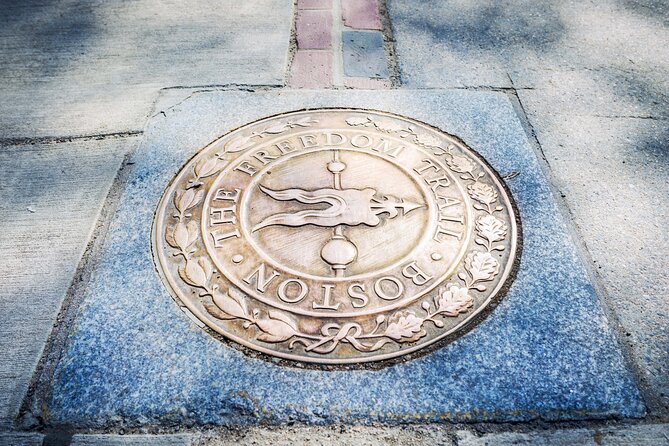
- All 16 Freedom Trail landmarks: Follow the complete official route from Boston Common to Copp’s Hill Terrace.
- Small group format: With no more than 15 people, you can usually stay close to the guide on busy sidewalks.
- Strong storytelling: The tour focuses on the 15 tense years leading to the American Revolution, including competing views of loyalty and rebellion.
- Famous gravesites: See the final resting places of Paul Revere, Samuel Adams, John Hancock, and other important figures.
- Useful midway pause: Quincy Market provides about 10 minutes for a drink, snack, or restroom stop.
- North End finish: End near Old North Church, Italian restaurants, and views toward the USS Constitution and Bunker Hill Monument.
Why this Freedom Trail tour works
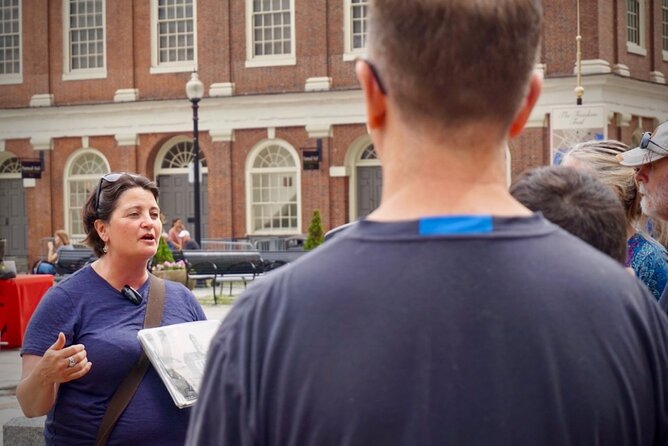
Boston has plenty of historic markers, but the hard part is knowing what matters and why. A good guide turns the red-brick route into a connected story. The events at the Old South Meeting House lead naturally to the Boston Tea Party, while the Boston Massacre Site makes more sense after you understand the tension between local residents and British troops.
This tour concentrates on the 15-year period before the Revolution. That is a useful choice. You are not given a random collection of old buildings. Instead, you follow the growing dispute over taxes, military power, representation, loyalty, and independence.
The small group matters here. Parts of downtown Boston can be crowded, especially near Faneuil Hall and Quincy Market. A group of 15 is still large enough to have energy, but far easier to keep together than a tour of several dozen people. You can also hear the guide’s explanations without standing right beside a loudspeaker.
The guides receive the strongest praise for being clear, funny, warm, and fair-minded. Nick, for example, is noted for placing familiar Revolution stories in context rather than repeating simple patriotic slogans. Other guides, including Maura and Cyrus, are praised for keeping children and adults interested through personal stories and lively delivery.
More History Walking Tours in Boston
- Boston: Freedom Trail History Small Group Walking Tour
★ 5.0 · 6,450 reviews - Boston Pizza Lovers Food and History Walking Food Tour
★ 4.5 · 1,082 reviews - Boston History Tour: Scenic Walk Through Time & Landmarks
★ 5.0 · 627 reviews
Starting at Boston Common and the State House
Meet inside Boston Common at the Boston Foundation Monument, near the northern boundary of the park and opposite 50 Beacon Street. Look for the granite memorial with a bronze relief of two men shaking hands. It refers to the arrival of the Puritans in 1630.
This is a practical starting point because Boston Common is easy to identify and the Freedom Trail begins here. The guide introduces the city’s early setting before leading you toward the Massachusetts State House.
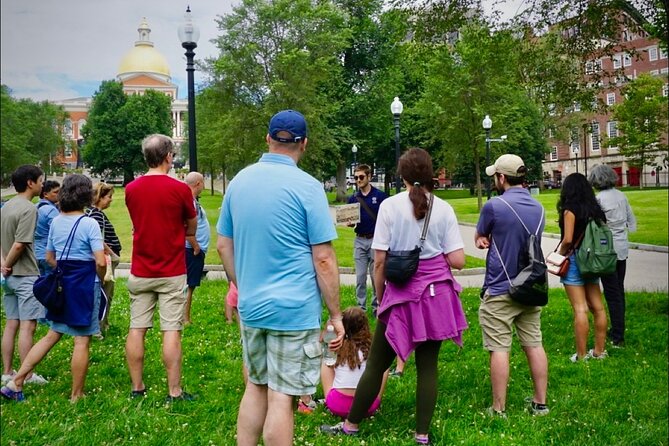
Boston Common is not just a green space on the route. It helps you picture the edge of Colonial Boston, when the city was much smaller and public land played a central role in civic life. You will have a short guided visit here, followed by the State House, Park Street Church, and Granary Burying Ground.
The State House is an impressive early stop, but remember that the tour does not include museum admissions. You will see the exterior and hear the relevant history rather than touring every interior room.
Granary Burying Ground and Boston’s famous names
Granary Burying Ground is one of the most memorable stops. The cemetery holds the graves of Samuel Adams, Paul Revere, John Hancock, Benjamin Franklin’s parents, and other figures linked to Boston’s political and religious life.
The guide spends about 25 minutes here, one of the longer stops on the route. That extra time helps. You are not simply asked to spot a gravestone and move on. The cemetery gives the guide room to explain who these people were and how their roles fit into the growing conflict.
I find this stop valuable because it puts human scale on a political story. The Revolution was not just about famous speeches and battles. It involved merchants, printers, ministers, politicians, soldiers, and ordinary residents deciding what loyalty meant.
The ground can be uneven, and the tour continues on foot after the cemetery. Wear shoes that can handle several hours of pavement and historic paths.
Churches, Franklin, and the early city center
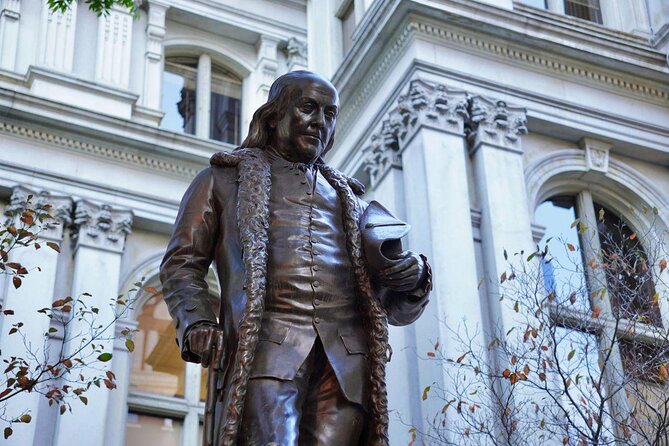
The route continues past King’s Chapel, then to the Boston Latin School site and the statue of Benjamin Franklin. The school site is connected to the country’s oldest public school, while Franklin’s statue recalls his Boston childhood before his later career in Philadelphia and abroad.
These stops are brief, but they widen the story beyond the Revolution’s best-known names. Boston was a center of education, printing, religion, trade, and political debate long before fighting began.
Old City Hall and the Old Corner Book Store add another layer. The Old Corner Book Store is tied to Boston’s literary past, while the surrounding streets show how much of the historic center remains woven into the modern city. You are often walking beside offices, shops, traffic, and restaurants rather than through a preserved historical park.
That mix is part of the appeal. Boston’s past is not shut behind a fence. It sits beside today’s sidewalks, which can make the city feel more immediate. The tradeoff is that street noise and crowds can sometimes compete with the guide’s voice.
More History Walking Tours in the USA
- History and Hauntings of Salem Guided Walking Tour
★ 5.0 · 14,564 reviews - Historic Charleston Guided Sightseeing Walking Tour
★ 5.0 · 6,216 reviews - Savannah History and Haunts Candlelit Ghost Walking Tour
★ 5.0 · 3,235 reviews - Historic Savannah Guided Walking Tour
★ 5.0 · 2,918 reviews
Old South Meeting House and the arguments before rebellion
At Old South Meeting House, the tour reaches one of the clearest links between debate and action. This was a major gathering place, and its role in the events leading to the Boston Tea Party makes it one of the route’s essential stops.
The guide explains the arguments that filled the meetinghouse. You hear about taxes, trade, British authority, and the pressure building among Boston residents. The point is not simply that everyone wanted independence from the beginning. Many people were unsure, divided, or still loyal to the crown.
That uncertainty is one of the tour’s best themes. The people you meet in the story are forced to choose between community pressure, personal safety, economic interests, and political ideals. Guides who explain these competing positions give you a more useful picture than a simple heroes-versus-villains account.
The tour includes a guided stop of about 10 minutes here. Entry inside is not included, so check separately if you want to explore the meetinghouse beyond the outdoor explanation.
Old State House and the Boston Massacre Site
The Old State House is one of the visual highlights of the walk. Its historic facade rises above the modern street, making the old center of government feel surprisingly close to present-day Boston.
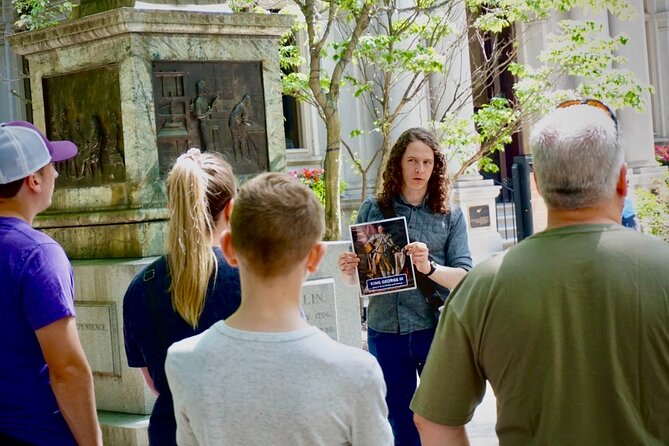
Nearby, the Boston Massacre Site marks the confrontation between British soldiers and local residents in 1770. The event became powerful political material for both sides. Its name helped shape public opinion, while the legal aftermath raised questions about military authority, self-defense, and responsibility.
This is where the guide’s handling of context matters most. Some guides, including Nick according to the supplied comments, explain the competing interpretations and the myths that grew around the event. That approach is useful because it lets you understand why the incident mattered politically without pretending that the historical record is simple.
Expect about 15 minutes at the site. It is located in a busy area, so the guide may need to gather the group tightly and speak over street activity.
Faneuil Hall and a useful stop at Quincy Market
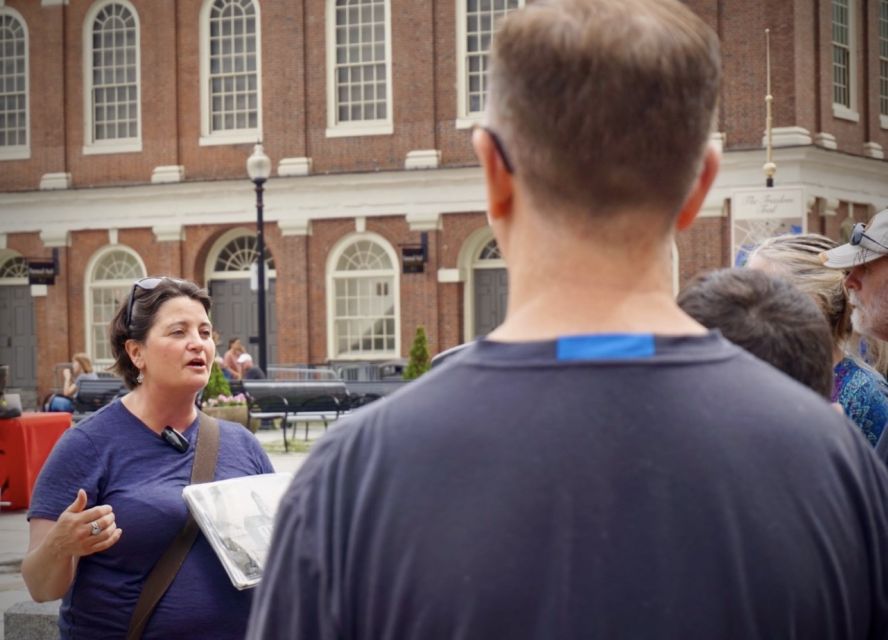
Faneuil Hall is next, with a shorter guided visit of about five minutes. The building is associated with public meetings and political speech, and it remains one of Boston’s best-known civic landmarks.
You then reach Quincy Market for a 10-minute break. This is a smart point to pause. By now, you have walked through the downtown section, and you may want water, a snack, or a restroom before continuing into the North End.
Do not treat the break as a full meal stop. Ten minutes can disappear quickly, especially if the market is crowded. If you need more time, plan to return later, or eat after the tour ends.
Paul Revere’s home and the North End
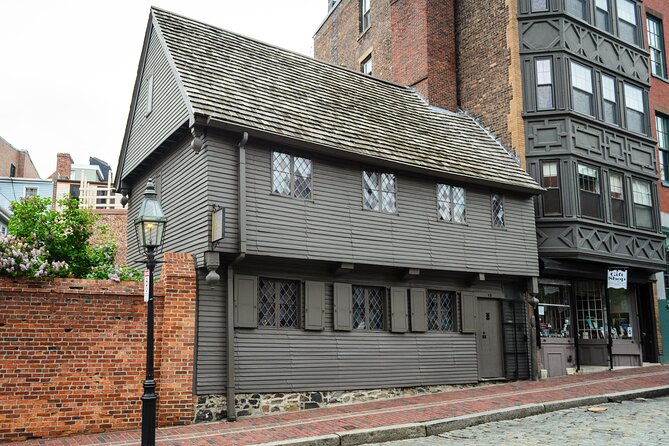
The route turns into Boston’s North End, where the streets become narrower and the atmosphere changes. Paul Revere House is the oldest surviving building in downtown Boston and gives the guide a natural opening to explain Revere’s work, family life, and place in the revolutionary story.
One useful correction often made on this route is that Paul Revere did not complete the entire famous midnight ride. The popular version of the story simplifies what happened, and a good guide can separate the later legend from the actual sequence of events.
Hanover Street follows, giving you a quick look at the North End’s restaurant district. The tour ends near one of Boston’s best areas for Italian food, so this is a good place to continue your evening. Guides have also been praised for useful restaurant suggestions, including pizza and North End dining.
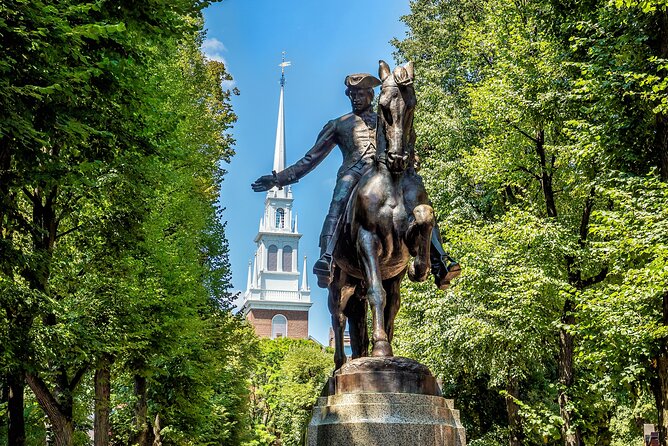
The Paul Revere Statue is another short stop. It is a familiar image, but seeing it after visiting Revere’s home gives the symbol more meaning. You have already heard about the person behind the statue, not just the name attached to it.
Old North Church and Copp’s Hill
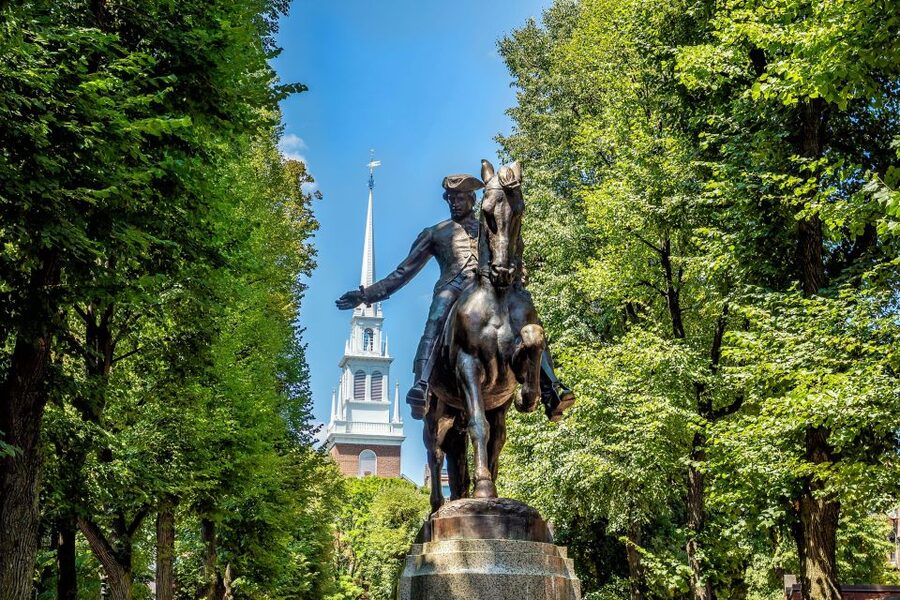
Old North Church is linked to the lantern signal that warned Paul Revere about British troop movements. The stop lasts about 10 minutes and helps connect the North End’s narrow streets with the opening movements of the Revolution.
Copp’s Hill Burying Ground comes next. It is less famous than Granary Burying Ground, but it offers another look at Boston’s early residents and the people who lived through the city’s conflict.
The final viewpoint is Copp’s Hill Terrace. From here, you can look across toward the USS Constitution and Bunker Hill Monument in Charlestown. The tour does not enter the Charlestown neighborhood, and it does not include a visit aboard the ship or inside the monument. Still, the view gives you a satisfying visual finish because it reaches beyond the central Freedom Trail.
You have effectively seen all 16 official landmarks along the route, even though some are viewed from the street and others from nearby viewpoints.
How much walking and what the pace feels like
The accessible route covers about 2 miles, or 3.2 kilometers, and the scheduled duration is 150 minutes. The actual time can vary, but it will not exceed three hours.
That sounds easy on paper, but the experience involves steady walking, standing, curbs, historic paths, and busy sidewalks. Comfortable shoes are essential. Bring clothing suited to the forecast, since much of the tour takes place outdoors.
The activity is described as wheelchair accessible, but it is also not recommended for people with mobility impairments or a low level of fitness. That apparent tension is worth taking seriously. An accessible route does not mean the walk is effortless, and you should confirm your needs before booking.
Children under six are not suitable for this tour. Older children may enjoy it, especially with a guide who uses stories and questions rather than a long stream of dates. Maura, for example, is praised for holding children’s attention while keeping the material useful for adults.
Is $35 a fair price?
At $35 per person, this is a reasonable price for a 2.5-hour guided walk through Boston’s main historic district. You are paying for a clear route, a live English-speaking guide, and the time saved by understanding what you are seeing.
The value is strongest if this is your first visit to Boston or your first serious look at the Freedom Trail. You can use the tour to get oriented, then return to the sites that interest you most. It also works well at the start of a trip because the North End finish leaves you near restaurants and several major sights.
The price does not include admission inside museums or historic buildings. It also does not cover Charlestown beyond the views toward the USS Constitution and Bunker Hill Monument. If you want a detailed interior tour, this walk alone will not provide it.
Gratuity is optional. Since guides such as Maura, Nick, Alejandro, Zoe, Cyrus, and others are praised for preparation, humor, and personal attention, you may want to budget a tip if the experience works well for you.
Practical advice before you book
Book this tour if you want a structured introduction to Boston’s Revolution-era sites without joining a huge crowd. A maximum of 15 people gives it a more personal feel, and the middle break keeps the long sequence of stops manageable.
Start with comfortable shoes and a small bag. Large bags and luggage are not allowed, and video recording is not permitted. A phone for occasional photos is a separate matter, but follow the guide’s instructions at each site.
The tour runs in difficult weather, so winter visitors should take the forecast seriously. Freezing temperatures, snow, heavy wind, and rain have not necessarily stopped departures. Warm layers and weatherproof footwear can make the difference between a memorable walk and a miserable one.
You can cancel up to 24 hours ahead for a full refund, and reserve now while paying later. That flexibility helps if your schedule depends on weather or other Boston plans.
Should you book the Freedom Trail History Small Group Walking Tour?
Yes, if you want the essential Freedom Trail in one well-paced walk, with a guide who explains why each place matters. The strongest part is not simply seeing the landmarks. It is hearing how arguments at meetinghouses, military tension in the streets, and personal choices gradually pushed Boston toward rebellion.
Skip it if you dislike walking, need long indoor visits, or already know the Freedom Trail in detail. For most first-time visitors, though, $35 buys a useful orientation, a manageable route, and a better understanding of Boston than you would get by following the red line alone.
FAQ
How long is the Boston Freedom Trail walking tour?
The tour is scheduled for 150 minutes, or about 2.5 hours. Its duration can vary but will not be more than three hours.
How far do you walk?
The accessible route covers approximately 2 miles, or 3.2 kilometers, through downtown Boston and the North End.
How large is the group?
The tour allows a maximum of 15 people, making it smaller than many standard city walking tours.
Does the tour include all 16 Freedom Trail landmarks?
Yes. The route covers all 16 official landmarks, ending at Copp’s Hill Terrace with views toward the USS Constitution and Bunker Hill Monument.
Are admission fees included?
No. Admission inside museums and historic buildings is not included. Charlestown is also not part of the walking route, although you can see the USS Constitution and Bunker Hill Monument from the final viewpoint.
Is the tour wheelchair accessible?
The route is described as wheelchair accessible, but the activity is not suitable for people with mobility impairments or a low level of fitness. It involves about two miles of walking and standing, so check that the route meets your needs before booking.
More Small-Group History Tours in the USA
- Hidden Alleyways and Historic Sites Small-Group Walking Tour
★ 5.0 · 2,335 reviews - New Orleans Small-Group Haunted History Carriage Tour
★ 4.5 · 2,289 reviews - Pearl Harbor & USS Arizona Small-Group Tour [Early Access]
★ 4.5 · 492 reviews - Carmel Small Group Walking Food & Cultural Tour
★ 5.0 · 392 reviews
More Small-Group History Tours in Boston
- Boston Freedom Trail History Pub Crawl Small-Group Tour
★ 5.0 · 996 reviews - Beacon Hill Boston History + Photo Walking Tour (SMALL Group)
★ 5.0 · 163 reviews
Newest history tours we have reviewed in the USA
- Nashville: Belle Meade Historic Mansion Tour★ 4.8 · 63 reviews
- Beaufort: Local History and Film Sites Tour by golf cart★ 4.9 · 102 reviews
- Boston: Guided Seafood Tasting and History Tour★ 4.9 · 90 reviews
- Beaufort: Gullah Heritage Tour★ 4.8 · 26 reviews
- Beaufort: Historic City Tour by Bus★ 4.9 · 228 reviews
- Austin: Downtown Austin Haunted History Tour★ 4.4 · 31 reviews
- Austin: Morning History Walking Tour of Downtown Austin★ 4.9 · 71 reviews
- Atlanta: Beltline Food, Street Art, and History Walking Tour★ 5.0 · 47 reviews
Small-Group History Tours, compared.

Freedom Trail History Small Group Walking Tour
Read our review →
Madrid Tapas & Taverns Small Group Food & History Tour
Read our review →
Hidden Alleyways and Historic Sites Small-Group Walking Tour
Read our review →
New Orleans Small-Group Haunted History Carriage Tour
Read our review →
Half Day Dominican Republic Cultural Tour : Small Group
Read our review →
Ultimate Seville Tapas, Wine & History Small Group Tour
Read our review →
Vienna Historic Center Small Group Walking Tour
Read our review →Browse the lists this tour appears in