
Review · FLORENCE HISTORY TOURS
Basilica Santa Croce: Walking Among the Masters of Florence
Santa Croce is Florence’s great hall of memory. Inside, you walk past the tombs of Michelangelo, Galileo, Machiavelli, and Rossini, then look up at frescoes and chapels by Giotto, Gaddi, Donatello, and Brunelleschi. The church feels less like a single sight and more like a walk through Florence’s artistic and political past.
I like two things here. First, the guide gives order to a crowded story, pointing out details you could easily miss. Second, the tour includes more than the main nave, with Santa Croce Square, the crypt, cemetery, bell tower, and chapels included in the route.
The main drawback is the short running time. One hour is enough for a strong introduction, but not enough to study every painting or tomb at leisure. The price, $58.05 per person, also feels high if you mainly want admission rather than explanation.
Key points at a glance
- Famous tombs in one church: See memorials connected with Michelangelo, Galileo, Machiavelli, and Rossini.
- Giotto and Gaddi frescoes: Visit the Bardi and Peruzzi Chapels and the Cappella Maggiore.
- A guide makes the difference: Guides including Matteo, Chiara Conti, Jenny, Elena, and Marcello have been praised for clear storytelling and thoughtful answers.
- More than an interior visit: The route covers Santa Croce Square, the church, crypt, cemetery, bell tower, and 16 chapels.
- Useful in busy months: Reserved admission can help you avoid wasting time in line, though you must arrive before the start time.
- Dress carefully: Knees and shoulders must be covered for entry.
Why Santa Croce deserves an hour of your Florence time
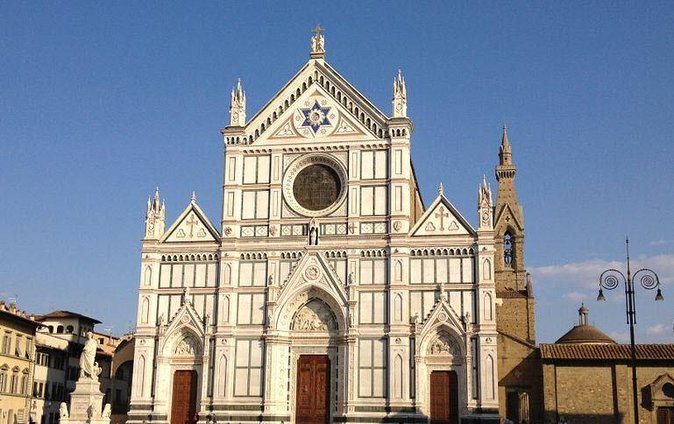
Santa Croce is one of those Florentine buildings that can look fairly restrained from the outside, then open into a much larger and more dramatic space once you enter. The basilica contains major art, grand memorials, religious chapels, and the remains of people who shaped Italian culture.
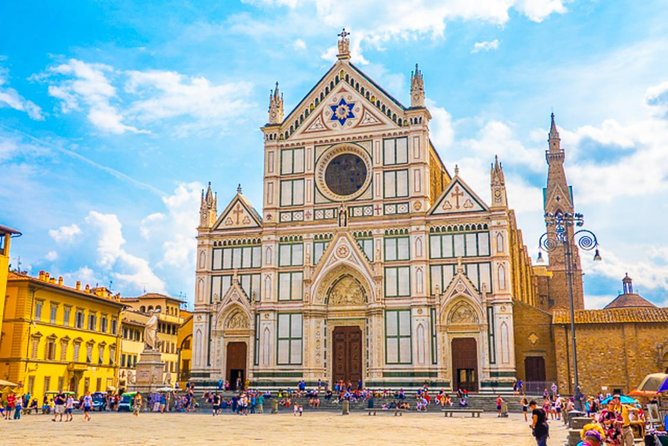
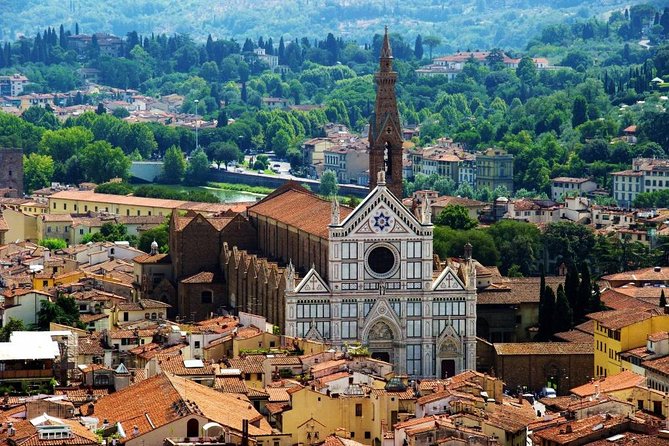
The setting matters, too. The tour begins at the Monument to Dante Alighieri in Piazza di Santa Croce, a broad square with a strong local identity. Each June, the square hosts Calcio Storico Florentino, Florence’s rough medieval-style football match played in historic costume.
That opening stop gives your guide a chance to explain the neighborhood before you enter the church. It also helps you understand why Santa Croce has long been more than a place of worship. It is a civic monument, an artistic center, and a burial place for some of Italy’s most celebrated figures.
You should expect a fast-moving introduction rather than a quiet, unstructured visit. The radio system lets you hear the guide while looking around, and the group can include as many as 20 people. That is not a private tour, but the size remains manageable for an organized visit.
More Architecture and Landmark Tours in Italy
- Historical Guided Tour of Florence’s Iconic Cathedral
★ 3.5 · 88 reviews - Private Guided Visit Florence’s Santa Croce Basilica and Ancient Leather School
★ 5.0 · 19 reviews - Venice: St. Mark’s Basilica Guided Tour & VR History Intro
★ 3.9 · 4,880 reviews
The famous names inside Santa Croce
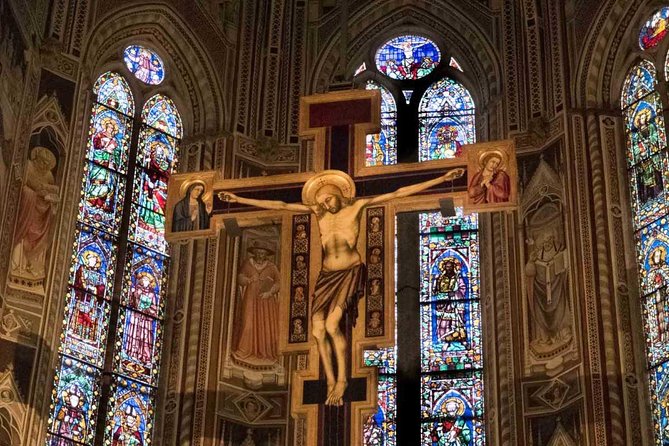
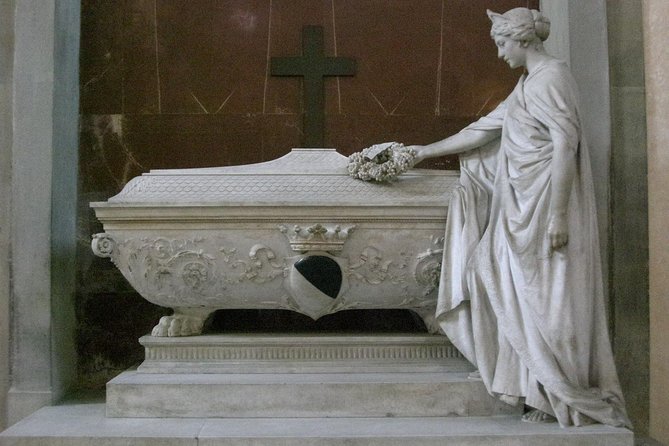
The tombs are one of the clearest reasons to choose a guided visit. Michelangelo, Galileo, Machiavelli, and Rossini are all connected with Santa Croce, and each memorial carries a different kind of meaning.
Michelangelo’s tomb brings art and biography together. Galileo’s memorial recalls the scientist’s place in Italian history. Machiavelli adds the world of politics and political writing, while Rossini represents opera and music. The effect is almost a Florentine roll call, but the church is not merely a hall of fame.
Your guide can explain how these memorials fit into the church and into the city’s changing view of national figures. Without that context, you may see impressive monuments but miss why they were placed there and what they were meant to communicate.
The 19th-century memorial to playwright Giovanni Battista Niccolini is another easy-to-miss detail. It was built as an inspiration for the Statue of Liberty, a curious connection that gives the entrance area an extra layer of interest.
I would pay close attention during this opening portion. A short tour can pass quickly, and the guide’s explanation may be more useful than trying to photograph every monument. You can always return to favorite sections after the formal tour ends.
Giotto’s chapels and Gaddi’s frescoes
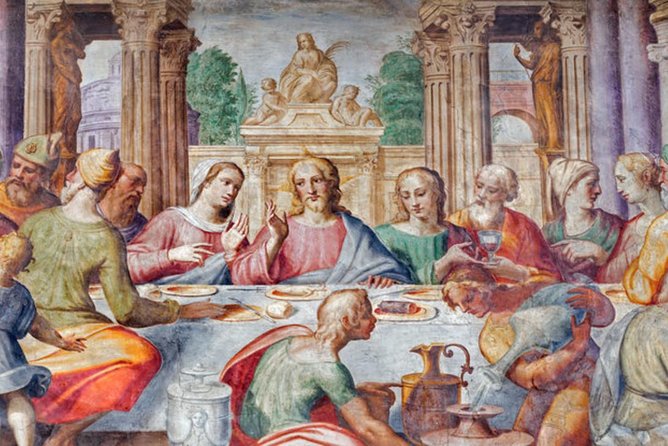
The strongest art stops include the Bardi and Peruzzi Chapels, where frescoes by Giotto show scenes from the lives of St. Francis and St. John the Evangelist. These chapels reward patient looking, but their details are easy to overlook when you are simply moving through a large church.
A guide helps you read the images as stories rather than as decoration. You can expect attention to the scenes, the people depicted, and the role of the chapels within the basilica. The point is not only to identify the artist, but to understand how religious art worked for the people who came here centuries ago.
In the Cappella Maggiore, frescoes by Gaddi date from 1380 and tell the story of Santa Croce. This gives the tour a useful contrast. Giotto’s chapels focus on the lives of saints, while Gaddi’s work presents the story and identity of the church itself.
The basilica rewards a guide who can keep the art connected to the building. Several of the praised guides, including Matteo, Chiara Conti, Elena, Jenny, and Marcello, have been described as clear, warm, and willing to answer questions. You cannot request a particular guide with certainty from the details provided, but the guide’s quality is central to how much value you get from the hour.
One critical note is worth keeping in mind. An isolated account described poor English and difficulty understanding the guide. That appears to be an exception among the supplied feedback, but language clarity matters greatly on a one-hour art tour. If your guide speaks too quickly or unclearly, ask politely for a repeat early in the visit.
Donatello, Brunelleschi, and the architecture of the church
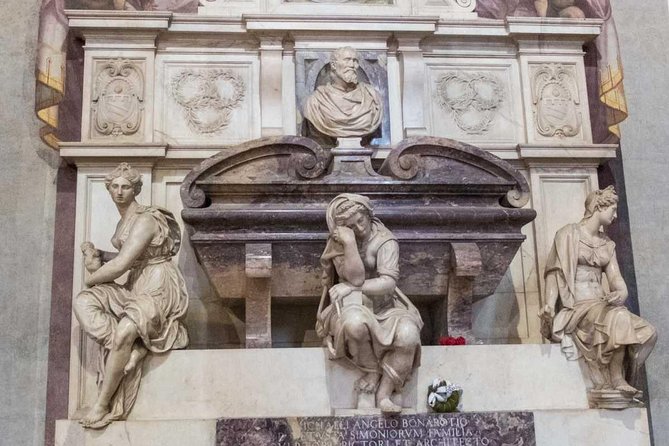
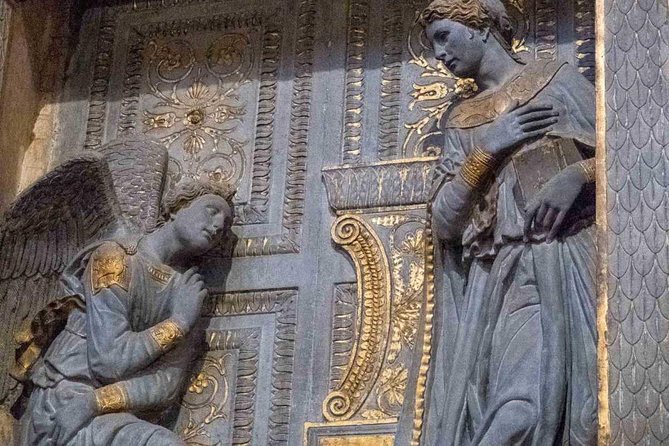
Donatello’s crucifix is another key sight. It is presented as one of the important Renaissance works in the basilica, and it offers a chance to compare sculpture with the painted scenes in the chapels.
You will also hear about Brunelleschi and the chapel associated with his work. The emphasis here is architectural harmony, not just decoration. Look at how the space is organized, how the lines relate to one another, and how the chapel’s design differs from the more crowded visual language elsewhere in the church.
This is where the tour can become more useful than a guidebook paragraph. Santa Croce contains so many artists and memorials that it is easy to collect names without seeing how the parts relate. A good guide slows the story enough to show how sculpture, fresco, architecture, and burial monuments share the same building.
The one-hour format means you will not receive a full art-history lecture on every work. That is a benefit if you want a focused introduction before visiting other sights in Florence. It is a limitation if you already know the basilica well or want extended time with individual paintings.
More History Walking Tours in Italy
- Florence: Fashion History Guided Walking Tour & Museum Visit
★ 4.2 · 72 reviews - Florence Highlights: Guided Walking Tour of the Historic Center
★ 5.0 · 27 reviews - Art and History in Florence: Small Group Walking Tour
★ 5.0 · 25 reviews - Essential Florence Walking Tour to discover its history
★ 5.0 · 21 reviews
The flood of 1966 and the work of restoration
The 1966 flood is an important part of Santa Croce’s modern story. Paintings were damaged, and some were destroyed. Restoration followed, and the tour points out the effects of the flood along with the work done afterward.
This adds a practical layer to the visit. You are not looking only at old masterpieces in a perfect, untouched setting. You are also seeing a building that has faced serious damage and required long efforts to preserve its art.
I find this part especially useful because it changes the way you look at the paintings. Marks of age and repair become part of the building’s story, not simply flaws to ignore. The guide can point out what happened and explain why preservation in a historic church is such a demanding task.
The flood section may also be one of the places where the guide’s pace varies. One account noted that the tour ran longer than expected and that the final part was especially interesting. That can be good news if you enjoy detail, but you should avoid scheduling an immediate appointment afterward.
Crypt, cemetery, bell tower, and the 16 chapels
After the main interior, the route continues through additional parts of the complex. These include the crypt, monumental cemetery, bell tower, and 16 chapels.
The cemetery adds a different mood from the grand tombs inside. The crypt offers another view of the basilica’s religious and architectural layers. The bell tower gives the guide a chance to explain the church as a complete complex rather than a single decorated hall.
The tour also discusses the exterior, including the polychrome marble façade. This is important because many people focus so heavily on the interior that they miss the building’s public face. The contrast between the exterior façade and the artworks inside helps make the visit feel complete.
Descriptions of the exact route through these areas are limited, so you should expect a guided overview rather than unlimited time in each section. The tour includes admission, and you can return to anything you want to examine again after the formal hour ends. That ability to stay and look on your own improves the value, especially if you are willing to spend extra time in the church.
Is $58.05 a fair price?
At $58.05 per person, this is not a cheap admission-and-audio-guide visit. You are paying for reserved entrance, an official certified guide, a radio system, and a structured explanation of a large and complicated site.
The value depends on your habits. If you enjoy art but feel lost in large churches, the guide can make the price worthwhile. Santa Croce has enough major names, chapel programs, tombs, restoration details, and architectural changes to justify help.
If you prefer to move slowly and read at your own pace, the price may feel steep. You could prefer entering independently and spending your money on a longer guided visit elsewhere. One positive point is that the tour often receives very strong marks, with a 4.9 rating from 107 ratings and 98 percent recommendation. Those figures do not guarantee your exact guide, but they suggest the format usually works well.
The fact that the experience is often booked 42 days ahead also tells you to plan early, especially for a fixed Florence schedule. It does not mean you must book that far ahead, but waiting until the last minute may reduce your options.
Meeting point, timing, and what to wear
You meet at the Monument to Dante Alighieri in Piazza di Santa Croce. The activity ends back at the same meeting point, so you do not need to arrange a separate pickup or find your way to another neighborhood afterward.
Hotel pickup, transportation, food, and drinks are not included. You need to make your own way to the square. Build in extra time, since arriving late means you cannot join, receive a refund, or reschedule.
The tour lasts about one hour and operates in all weather. Since the opening section takes place in the square, dress for the forecast. You should also wear clothing suitable for a place of worship. Shorts and sleeveless tops are not allowed, and both men and women must cover their knees and shoulders.
The group requires at least two people to operate and can include up to 20. If the minimum is not met, the operator may cancel after confirmation and offer another option or a full refund.
Free cancellation is available up to 24 hours before the start time. Cancellations made within 24 hours are not refunded, and changes in that same period are not accepted.
Who will enjoy this Santa Croce tour most
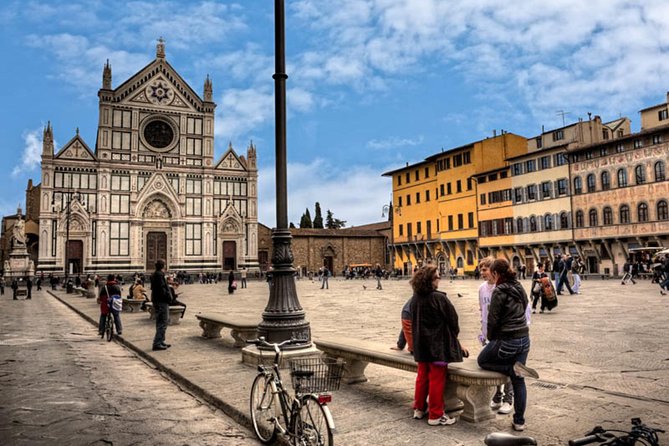
I would choose this experience if you want a short, guided introduction to Florence’s art and famous citizens. It suits first-time visitors who want context without committing to a half-day museum tour.
It also works well for families and mixed-interest groups. Someone interested in Michelangelo or Galileo can focus on the tombs, while an art lover can pay closer attention to Giotto, Gaddi, Donatello, and Brunelleschi.
The tour is particularly useful if you have limited time in Florence. One hour leaves room for another museum, a meal, or a walk through the historic center. Just remember that a short visit gives you highlights, not a full study of every chapel.
You may want to skip the guided option if you dislike fixed pacing, already know Santa Croce well, or want to spend long stretches in silence. The radio system helps you hear the guide, but the experience remains a group tour rather than a private conversation.
Should you book it?
Book this tour if you want Santa Croce to become more than a pretty church with famous graves. The guide connects the tombs, frescoes, sculpture, architecture, flood damage, and square into one clear story.
I would book it early if your Florence dates are fixed, and I would arrive well before the meeting time with shoulders and knees covered. Ask questions during the tour, then use the chance to return to your favorite chapel or memorial afterward.
The strongest reason to go is the art and setting. The strongest reason to hesitate is the price for only an hour. For a first visit, the explanation is likely worth paying for. For a repeat visit or a slow art study, independent entry may suit you better.
FAQ
How long does the Santa Croce tour last?
The tour lasts approximately one hour.
What language is the tour offered in?
The tour is offered in English.
Where does the tour begin?
It begins at the Monument to Dante Alighieri in Piazza di Santa Croce, Florence.
Where does the activity end?
The activity ends back at the meeting point.
Is admission included?
Yes. Entrance tickets with reservations are included.
What parts of Santa Croce are included?
The experience includes Santa Croce Square, the church interior, the crypt, cemetery, bell tower, and 16 chapels. It also covers the exterior polychrome marble façade.
Are food, drinks, or hotel transportation included?
No. Food, drinks, hotel pickup, drop-off, and transportation to and from the attraction are not included.
What should I wear?
You must cover your knees and shoulders. Shorts and sleeveless tops are not allowed for entry.
Can I cancel for a full refund?
Yes, if you cancel at least 24 hours before the experience start time. Cancellations or changes made less than 24 hours before the start are not refunded or accepted.
More History Walking Tours in Florence
- History and Hauntings of Salem Guided Walking Tour
★ 5.0 · 14,564 reviews - Lisbon: History, Stories and Lifestyle Walking Tour
★ 4.8 · 10,902 reviews - Boston: Freedom Trail History Small Group Walking Tour
★ 5.0 · 6,450 reviews - Historic Charleston Guided Sightseeing Walking Tour
★ 5.0 · 6,216 reviews
More Architecture and Landmark Tours in Florence
- Venice’s Best: Basilica, Doge’s Palace, Gondola & History Gallery
★ 4.5 · 2,478 reviews - Córdoba: Skip-the-Line Great Mosque-Cathedral History Tour
★ 4.7 · 1,690 reviews - Pantheon Elite Guided Tour – Rome’s Iconic Ancient Temple
★ 5.0 · 1,447 reviews - Dubai: Abu Dhabi Grand Mosque, Palace, and Heritage Village
★ 4.8 · 1,265 reviews
Newest history tours we have reviewed in Florence
- Florence tour of the historic center. Stories, legends and gossip★ 5.0 · 27 reviews
- The History of Florence: The Renaissance Era Private Tour★ 5.0 · 49 reviews
- Private Tour of the Historic Center of Florence by Golf Car★ 4.5 · 40 reviews
- Florence Highlights: Guided Walking Tour of the Historic Center★ 5.0 · 27 reviews
- Private Chianti Classico Tour with wine and food tasting in a Historic Estate★ 4.5 · 23 reviews
- Private Guided Visit Florence’s Santa Croce Basilica and Ancient Leather School★ 5.0 · 19 reviews
- EXCLUSIVE – Wine Tasting near Florence with Castle and Ancient Cellars Tour★ 5.0 · 34 reviews
- The History of Florence: Famous Medici Family Private Tour★ 5.0 · 40 reviews
Architecture & Landmark Tours, compared.
St. Mark’s Basilica Guided Tour & VR History Intro
Read our review →
Venice’s Best: Basilica, Doge’s Palace, Gondola & History Gallery
Read our review →
Córdoba: Skip-the-Line Great Mosque-Cathedral History Tour
Read our review →
Pantheon Elite Guided Tour – Rome’s Iconic Ancient Temple
Read our review →
Abu Dhabi Grand Mosque, Palace, and Heritage Village
Read our review →
Chicago in a Day: Food, History & Architecture Walking Tour
Read our review →
Colosseum Special Access Tour, with Ancient Temples & Tombs
Read our review →Browse the lists this tour appears in