
Review · BUCHAREST HISTORY TOURS
Private Tour – Food, Culture, History & Traditions
Bucharest makes the most sense when you connect its food, buildings, and political past. This private walk does that well, moving from the trading lanes of Old Town to the 1989 Revolution, grand villas, old neighborhoods, and a traditional Romanian meal with Bianca, a former journalist who explains the city in a clear, personal way.
I like two things here: the route shows you parts of Bucharest you might skip on your own, especially the Armenian Quarter and Dacia Boulevard, and the private format lets you slow down for photos or adjust the pace. The main consideration is the 6-kilometer walk, which can feel long over four to five hours, especially if city noise makes the guide harder to hear.
Key points to know
- A food-and-history walk: You learn about Romanian dishes, including the Bucharest connection to mici, then finish with a two-course meal.
- A private experience: Only your group takes part, so Bianca can adjust the pace, start time, and focus.
- A broad look at Bucharest: The route covers Old Town, Calea Victoriei, the Royal Palace, Revolution Square, Armenian streets, and more.
- A useful first-day tour: The mix of orientation, architecture, and national history helps you get your bearings early in a stay.
- A serious walking commitment: The route is approximately 6 km and requires a reasonable level of fitness.
- A well-rated guide: Bianca’s journalism background adds context, while her calm manner suits a relaxed walking pace.
Why this private Bucharest walk works so well
The best feature of this experience is its range. In one half-day, you move from a medieval-era trading area to an 18th-century monastery, 19th-century banks, royal buildings, communist-era landmarks, and neighborhoods where local stories still shape the streets.
That matters because Bucharest can feel scattered at first. Its grand avenues, old houses, restored facades, empty buildings, and Communist-era scars do not always fit together at a glance. Bianca gives you a thread to follow. She links what you see to the people, businesses, rulers, and political changes that shaped the city.
I would consider booking this near the start of your visit. One outing can help you understand the center, identify streets worth revisiting, and put later visits to museums or churches into context.
The private format is another real advantage. You are not trying to keep up with a large group, and you can stop for photographs or ask about a building that catches your eye. The pace has been adjusted for families, including a group with a four-year-old, and for people who prefer a leisurely morning.
More Local Culture and Traditions Tours in Romania:
- Roma Culture, Realities and Slavery History, Walking tour
★ 4.9 · 52 reviews - Private Bucharest: History & Food with Traditional Meal
★ 5.0 · 34 reviews - Amsterdam Food and Cultural Tour with Tastings
★ 5.0 · 4,315 reviews
Starting among Old Town traders and local food
The walk begins at Bulevardul Ion C. Brătianu 36, near the center of Bucharest. Old Town is the right place to start because it brings together commerce, food, old streets, and the remains of the city’s early urban life.
Here you learn about the trading business that once flourished in the area. One particularly fun food connection is the story of mici, the small grilled meat rolls found across Romania. Bucharest claims a role in their creation, and this stop gives the dish a local setting rather than treating it as just another item on a menu.
The Old Town stop lasts about 30 minutes. That is enough time to get oriented without spending the whole morning among the same streets. You should expect history and explanation rather than a formal museum visit. Admission is free, and the value comes from Bianca’s interpretation of what you are seeing.
Stavropoleos, CEC, and Bucharest’s compact old center
From Old Town, the route makes several short stops that show how much architectural variety is packed into central Bucharest.
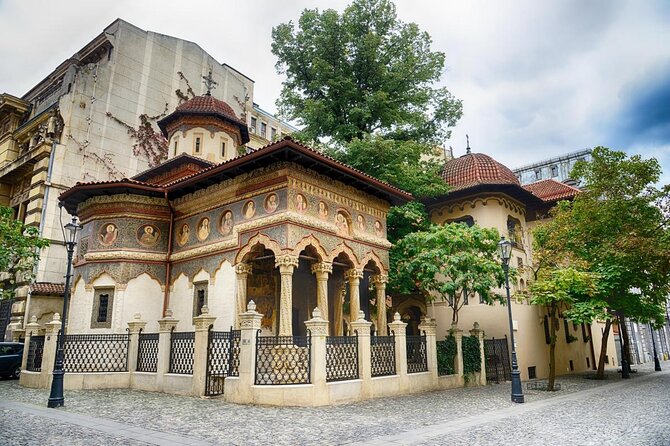
Stavropoleos Monastery is an 18th-century example of Romanian Renaissance architecture. The stop is listed at about three minutes, so think of it as a focused look rather than a long religious visit. Its importance is visual and historical: it gives you a smaller, more intimate counterpoint to the large civic buildings that come later.
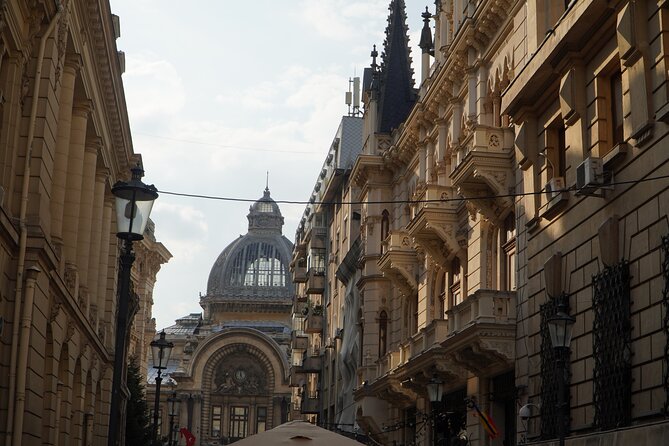
Palatul CEC, the palace of CEC Bank, brings a different mood. Built at the end of the 19th century, it uses an eclectic style that reflects Bucharest’s changing ambitions at the time. The exterior is the main attraction on this short stop.
Macca Villacrosse Passage is one of the prettiest covered passages in Bucharest. The five-minute visit gives you a quick look at a more decorative side of the city, with a sense of the old commercial center rather than the wide boulevards and monuments.
These stops are brief, but they work as a group. You see how religious, banking, commercial, and civic buildings sit close together. If you enjoy architecture, ask Bianca to explain how the styles differ. One of the strongest parts of this tour is its attention to design, not just dates and names.
The National Bank and Calea Victoriei
The next section moves toward the BNR Palace, home of Romania’s national bank. You also see the former Marmorsch Blank Bank building, now used as a hotel. The stop lasts about five minutes and helps explain Bucharest’s financial past.
Calea Victoriei then gives you the main avenue of the tour. It has been the heart of Bucharest since the 19th century, and the route uses it to show how the city’s public life developed. This is a 30-minute stop, so there is more time for Bianca to discuss buildings, streets, and the changes that took place along the avenue.
I like this part because it shifts the tour from isolated sights to an urban story. You are no longer looking at one church or one bank. You are seeing the avenue as a stage for wealth, politics, movement, and public display.
The city can be noisy here. One person specifically found Bianca soft-spoken at times, which made her harder to hear beside traffic. Audio devices are provided when a group has more than four people, but a private group of four or fewer may not receive them. If hearing every word matters to you, mention this when arranging the tour and stay close to the guide.
More Private History Tours in Romania:
- Bucharest Jewish Heritage | Holocaust Memorial | Private Car Tour
★ 5.0 · 38 reviews - Private Historical Walking Tour of York
★ 5.0 · 1,324 reviews - Private Guided Historic Electric Cart Tour of St. Augustine
★ 5.0 · 1,194 reviews - Istanbul: Acemoglu Historical Turkish Bath w/Private Options
★ 4.6 · 1,190 reviews
Pasajul Victoriei and the less polished side of the main avenue
Pasajul Victoriei adds a more colorful and slightly scandalous chapter. Together with Pasajul Englez, it recalls a former brothel located on Bucharest’s main avenue, with a back entrance that allowed wealthy patrons, including the king and members of high society, to come and go discreetly.
This five-minute stop is not a grand monument. Its value lies in showing that Bucharest’s public image and private behavior did not always match. The city’s old avenues held respectable facades, hidden entrances, nightlife, and private deals side by side.
Bianca’s approach appears suited to this kind of material. She does not simply point at a building and give you a date. She uses places to explain how people lived and behaved. That makes the walk more memorable than a list of architectural labels.
Revolution Square and the fall of Ceausescu

At Revolution Square, the tone changes. This is where Nicolae Ceausescu gave his last speech as the 1989 revolution began. The stop lasts about ten minutes, and it is one of the most important historical moments on the route.
For anyone interested in modern European history, this location gives the story a physical setting. You can think about the crowd, the speech, the collapse of authority, and the violence that followed while standing in the same central part of Bucharest where those events unfolded.
The tour does not appear to enter a museum here, so the experience depends on the guide’s explanation and the public space around you. That is useful for a first introduction, but you may want a separate museum visit if you want a long, detailed study of Communist Romania and the 1989 revolution.
The Athenaeum and the former Royal Palace

The Romanian Athenaeum is one of Bucharest’s most beautiful buildings. The stop is short, around five minutes, but it gives you a chance to admire the exterior and ask about its place in the city.
A little farther along, the former Royal Palace now houses the National Art Museum. The visit here is also brief, about three minutes, and focuses on the building rather than a full museum entry. Keep that distinction in mind when comparing this tour with a dedicated art or palace visit.
Together, these stops show the city’s royal and cultural ambitions. The Athenaeum represents music and public culture, while the former Royal Palace points to the monarchy and the way national institutions changed over time.
The short timing is both useful and limiting. You can see many landmarks in one morning, but you will not have time to explore each interior. I see this as an orientation walk first, with a good list of places to return to later.
Dacia Boulevard and Bucharest’s villa districts
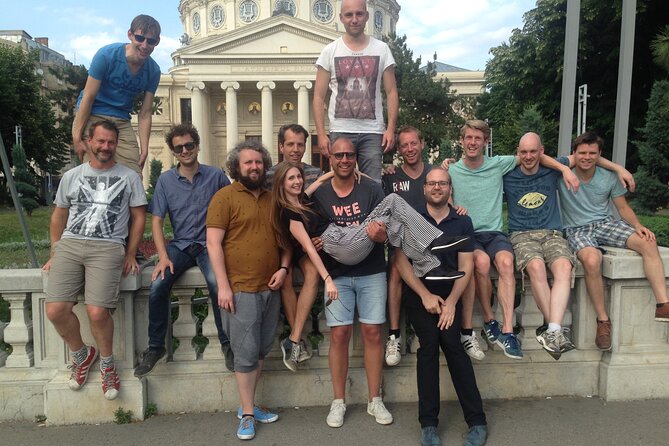
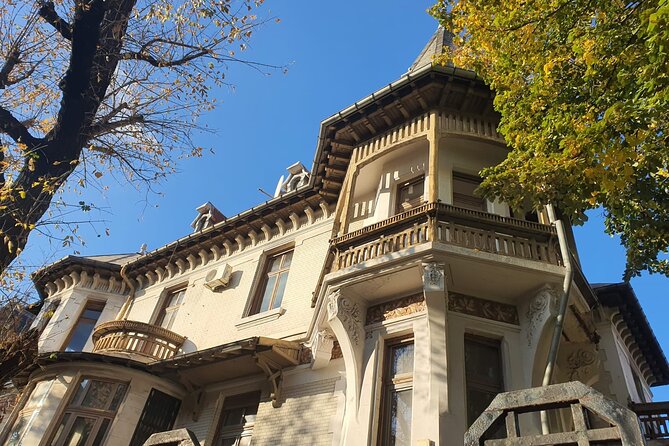
The route then turns toward Bulevardul Dacia, where you see grand villas and examples of the neo-Romanian architectural style. The stop lasts about 20 minutes.
This is one of the places where the private walk offers more than a standard central-city circuit. Many people focus on Old Town and Calea Victoriei, then miss the residential streets that reveal how Bucharest’s wealthy families and architects expressed national identity.
The villas also help explain why Bucharest is often called a city of contrasts. Alongside grand designs, you may see wear, repairs, closed buildings, or layers of later construction. I would not expect a polished parade of perfect facades. The interest is in the mixture and in the way Bianca explains the styles.
Central School and the Armenian Quarter
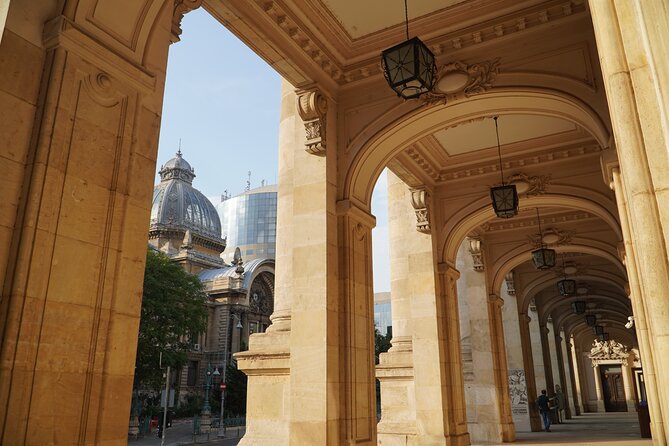
Colegiul Național Școala Centrală is a 19th-century boarding school for girls. The stop lasts about five minutes, with attention to the eerie stories linked to the building. This is a lighter, more atmospheric moment after the political weight of Revolution Square.
The Armenian Quarter receives a longer visit, about 30 minutes. Here you explore a part of Bucharest filled with history, local character, and lesser-known stories. The route is not limited to the major monuments that appear in guidebooks. It takes you into a neighborhood where the city’s cultural layers become easier to notice.
This is a strong reason to choose a private guide. Without local direction, you could walk through the area and see only attractive houses or quiet streets. Bianca helps connect the Armenian presence to the city and points out details you might pass without noticing.
The neighborhood also gives the walk a change of pace. After major avenues and official buildings, you spend time in a district with a more local feel. If you like architecture, old communities, and stories that do not fit neatly into a standard sightseeing route, this section may be your favorite.
Icoanei Garden and stories of witches
The final stop is Gradina Icoanei, or Icoanei Garden. You hear about the belief that witches cast spells in the area not so long ago.
This story adds folklore to a route otherwise grounded in banks, royal buildings, schools, and revolution. It also reminds you that a city’s identity is made from more than official history. Rumors, fears, religious ideas, and neighborhood stories all leave a mark.
The tour finishes at University Square on Bulevardul Regina Elisabeta, the point known as Kilometer 0 of Bucharest. Ending there is practical. You are left in a central location with a clear sense of where the city’s main areas fit together.
The Romanian meal and what the price includes
The price is $114.14 per person. That is not the cheapest way to see central Bucharest, but it includes a private guide for four to five hours, a roughly 6-kilometer walking route, all fees and taxes, and a full two-course meal.
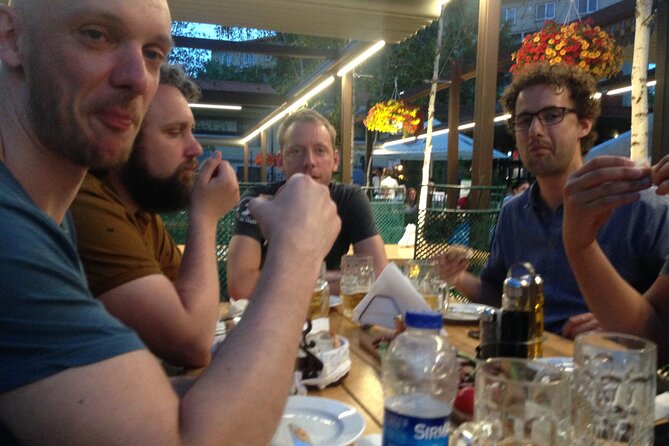
The food is a major part of the value. Lunch or dinner includes a platter of Romanian cheeses, charcuterie, and other starters, followed by a main course. Drinks are not included, so budget separately for alcohol, soda, or other beverages.
The meal turns the food theme into something practical. You do not just hear about Romanian cooking at the start and then move on. You sit down to eat after seeing the places and stories that give the cuisine a setting.
Past outings have also included pastries, coffee, and a traditional Romanian meal, but the confirmed package specifically lists the two-course lunch or dinner. Treat those extra items as possible additions rather than guaranteed inclusions.
For a solo visitor or a couple, the cost can make sense if you value a private guide and want both sightseeing and food in one booking. Group discounts may improve the price for a larger private party. If you mainly want a quick walk through Old Town, this is more time and money than you need.
Timing, pace, and practical planning
The experience lasts about four to five hours, including the walking route and meal. You should wear comfortable shoes and be ready to walk approximately 6 km. The tour requires a minimum level of physical fitness, even though the pace can be adapted.
The starting point is Bulevardul Ion C. Brătianu 36. The route ends at University Square, not back at the start, so plan your next stop from there. Both locations are near public transportation.
A private booking also allows some flexibility with the start time. Bianca has adjusted schedules for groups and changed the pace when people wanted more time for photographs or conversation. That does not mean every request is guaranteed, but it is worth asking when you book.
Service animals are allowed, and most people can participate. The experience depends on good weather. If conditions force cancellation, you can receive another date or a full refund. You can cancel for a full refund up to 24 hours before the start time. Changes or cancellations inside that window are not refunded or accepted.
Who should book this Bucharest experience
I would choose this tour for a first full day in Bucharest, especially if you want help making sense of the city before exploring alone. It suits couples, families, and small groups who prefer conversation over a fixed large-group schedule.
It is also a good match for people who care about architecture and modern history. You get churches, banks, passages, villas, royal buildings, the Athenaeum, the Armenian Quarter, and the 1989 revolution in one route.
Food-focused visitors will appreciate the meal, but this is not a cooking class or a food crawl with many tastings. The food element is one substantial Romanian meal, supported by stories about local dishes.
I would think twice if you dislike long walks, need a fully seated sightseeing experience, or want extensive interior visits. Several stops last only three to five minutes, and the route spends much of its time outdoors. For a detailed museum tour, choose a different activity or use this one as your introduction before returning to the National Art Museum and other interiors.
Should you book it?
Book it if you want a private, story-led introduction to Bucharest with food included and enough flexibility to ask questions, stop for photos, and adjust the pace. Bianca’s journalism background, calm style, and ability to connect architecture with Romanian history are central to the experience.
The strongest value comes from the combination: Old Town food stories, Calea Victoriei, the Revolution Square, royal landmarks, neo-Romanian villas, the Armenian Quarter, and a full meal. The main tradeoff is the 6-kilometer route, plus extra charges for drinks and limited time inside the major buildings.
For most first-time visitors who can comfortably walk for several hours, I would book it early in the stay. It gives you a useful map of Bucharest, a meal you do not have to arrange yourself, and several places worth revisiting at your own pace.
FAQ
How long does the Bucharest private tour last?
The experience lasts approximately four to five hours.
How far do you walk?
The route is approximately 6 km, so a minimum level of physical fitness is required.
What food is included?
The included meal is lunch or dinner with two courses. It includes a platter of cheeses, charcuterie, and/or other Romanian starters, followed by a main course.
Are drinks included?
No. Alcoholic beverages, soda, and other drinks are not included.
Is the tour private?
Yes. Only your group participates in the private tour.
Who is the guide?
The guide is Bianca. She is described as a former journalist and leads the walking route in English.
Where does the tour start?
The meeting point is Bulevardul Ion C. Brătianu 36, 030167 Bucharest, Romania.
Where does the tour finish?
The tour ends at University Square on Bulevardul Regina Elisabeta, Bucharest, also known as Kilometer 0 of Bucharest.
Are audio devices provided?
Audio devices are provided if the group exceeds four people, allowing everyone to hear the guide while keeping a comfortable distance.
Can I cancel for a refund?
Yes. You can cancel at least 24 hours before the start time for a full refund. Cancellations or changes made less than 24 hours before the start time are not accepted or refunded.
Newest history tours we have reviewed in Romania
- Half-Day Jewish Heritage Walking Tour in Bucharest★ 5.0 · 20 reviews
- Bucharest Historical Food Tour in Old Center★ 5.0 · 21 reviews
- Bucharest Heritage City Tour – The Last Days of Communism★ 5.0 · 20 reviews
- Bucharest Jewish Heritage | Holocaust Memorial | Private Car Tour★ 5.0 · 38 reviews
- Experience the History of Bran Castle and Saxon Fortifications in Burzenland★ 5.0 · 19 reviews
- Roma Culture, Realities and Slavery History, Walking tour★ 4.9 · 52 reviews
- Private Bucharest: History & Food with Traditional Meal★ 5.0 · 34 reviews
- Discover Romania’s Wine Heritage in Brasov’s Historic Center★ 4.6 · 19 reviews
Local Culture & Traditions Tours, compared.
Amsterdam Food and Cultural Tour with Tastings
Read our review →
Sevilla Food Tour: Tapas, Wine, History & Traditions
Read our review →
Tromsø: Reindeer Camp and Sami Cultural Tour with Lunch
Read our review →
Half Day Dominican Republic Cultural Tour : Small Group
Read our review →
Ultimate Melbourne Walking Tour: History, Laneways & Culture
Read our review →
Tromsø: Sámi Reindeer Sledding and Sami Cultural Tour
Read our review →
Kyoto Gion: 2-Hour Geisha Culture & History Walking Tour
Read our review →
Marrakech Historical and Cultural Tour – Half Day City Tour
Read our review →Browse the lists this tour appears in