Review · BARCELONA HISTORY TOURS
Barcelona: Cemetery Tour – Gothic Graves & Local History
Montjuïc Cemetery is not a quick stop beside a famous church. It is a hillside city of the dead, filled with churchlike mausoleums, carved angels, obelisks, skeletons, and sea views. Guide Onno leads you through the parts that are hardest to find on your own, linking the monuments to Barcelona’s writers, politicians, artists, anarchists, and civic leaders. I like the quiet atmosphere and the way the tour connects funeral art with the city’s past. I also like that roundtrip transport is arranged, since reaching this huge cemetery is not as simple as wandering in from the old center.
The main drawback is physical: you will walk uphill and downhill, use stairs, and cross uneven cemetery paths. It is not a nonstop workout, but it is a poor match for wheelchair users, people with mobility limits, recent surgery, serious knee trouble, or pregnancy. At $28, the tour is good value if you want context and company in a place that is easy to miss, less so if you prefer a short, self-guided cemetery visit.
Key points to know before booking
- A rare quiet Barcelona outing: You may see very few other people, especially outside the busiest travel periods.
- Onno guides the walk in English: His style is relaxed and story-led, with details about the people buried here and the art around them.
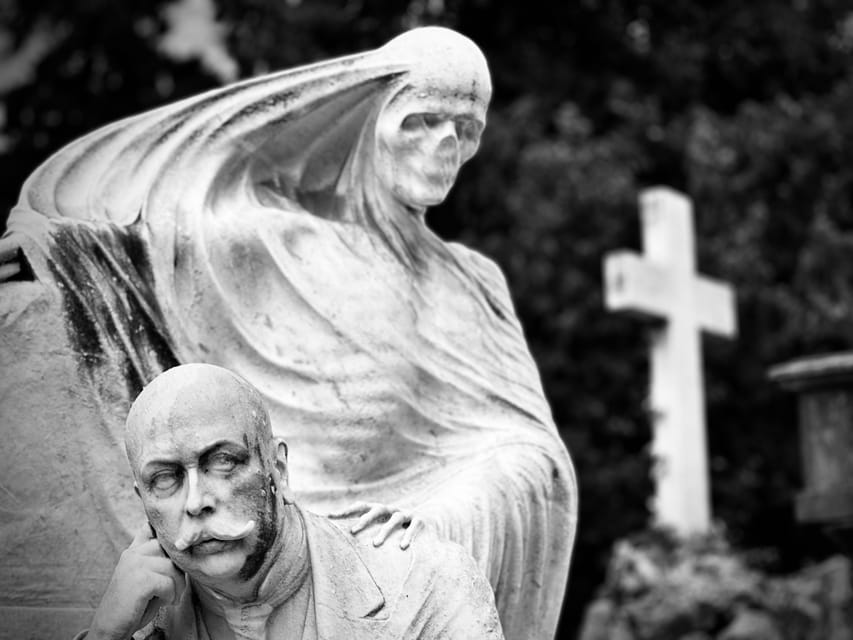
- The cemetery is an outdoor museum: Expect Gothic tombs, monumental family vaults, sculptures, a pyramid, obelisks, and views toward the sea.
- Transport saves time and confusion: The tour begins at Portal de Santa Madrona and includes city transport to and from Montjuïc.
- The route includes famous names: Stops include the Fossar de la Pedrera, Buenaventura Durruti, and Joan Miró’s tomb.
- Comfortable shoes matter: The route involves repeated stairs and changes in elevation, even though it is broken up with stops.
Why Montjuïc Cemetery feels different from most Barcelona sights
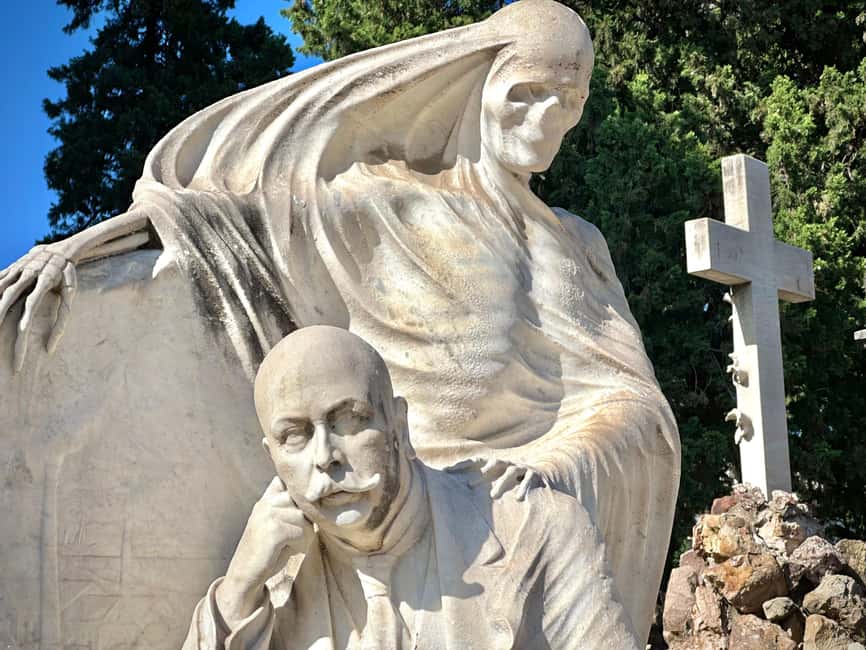
Barcelona is famous for Gaudí, markets, beaches, and packed medieval lanes. Montjuïc Cemetery gives you a very different city. It is quiet, solemn, and spread across a steep hillside above the water. The setting alone makes it memorable, but the real reward is the mix of public history and private grief.
The cemetery is also a record of social change. Wealthy families commissioned elaborate memorials that resemble chapels or small churches. Other graves are much simpler, yet still tell a story through the name, date, inscription, or political background attached to them. You are not just looking at old stone. You are seeing how Barcelona remembered its powerful, creative, controversial, and ordinary citizens.
That is why a guide matters here. The cemetery is large enough to turn a self-guided visit into a hunt for impressive statues without much meaning attached to them. Onno’s job is to point out the important sections and explain why particular people and tombs matter. You get the visual drama, but also the human thread connecting the graves to the city.
One unusual feature is how little foot traffic the cemetery receives. You might spend long stretches with only the group and the tombs around you. That quiet can feel almost eerie, but it is also the reason the visit works so well. This is not a performance staged for crowds. It feels like a real place that happens to contain an extraordinary collection of funerary art.
More Dark History and Haunted Tours in Barcelona
- Barcelona: Dark History Night Walking Tour
★ 4.8 · 344 reviews - Barcelona’s Dark History Night Tour
★ 5.0 · 181 reviews - Barcelona Dark History Night Walking Tour With Drinks
★ 5.0 · 153 reviews
Meeting at Portal de Santa Madrona
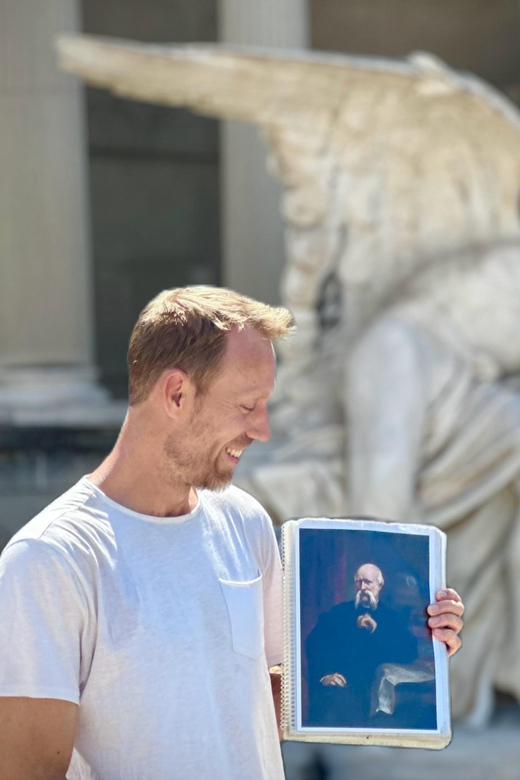
The tour starts at Portal de Santa Madrona, a practical meeting point near the old city wall. Look for the guide with a white umbrella in front of the wooden doors or gate. That detail is useful in a busy city, where a precise landmark is much better than a vague instruction to meet near a plaza.
From there, you travel toward Montjuïc using city transport. The route information describes the transfer as about 10 minutes, with black cab segments shown in the schedule, while the activity details describe transport by city bus. The sensible way to read this is that transport to and from the cemetery is included, with the exact vehicle depending on the operating arrangements for your departure.
The transport is a small but important part of the value. Montjuïc Cemetery is not the sort of place you casually reach while sightseeing in the Gothic Quarter. Having the guide handle the transfer keeps the outing tidy and prevents you from spending part of your morning or afternoon figuring out the approach.
The tour finishes back at Portal de Santa Madrona. That makes it easy to continue exploring the old city afterward, although you should leave yourself enough energy for the return walk and stairs.
Entering the huge hillside cemetery
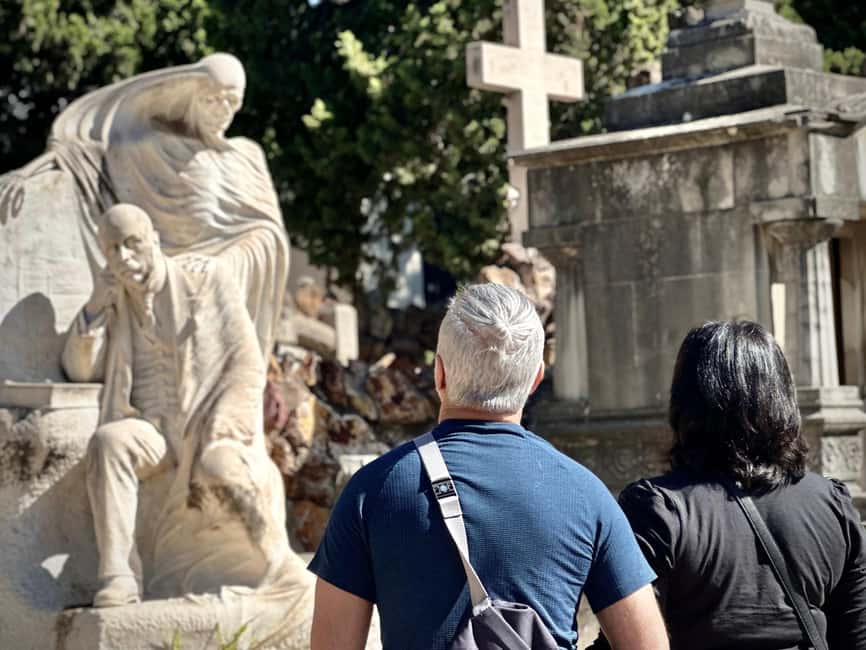
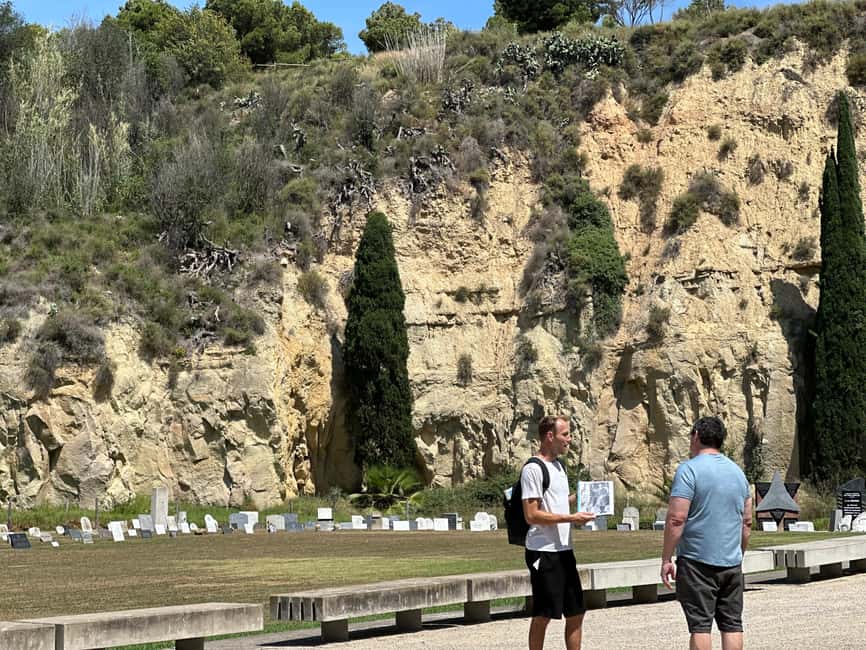
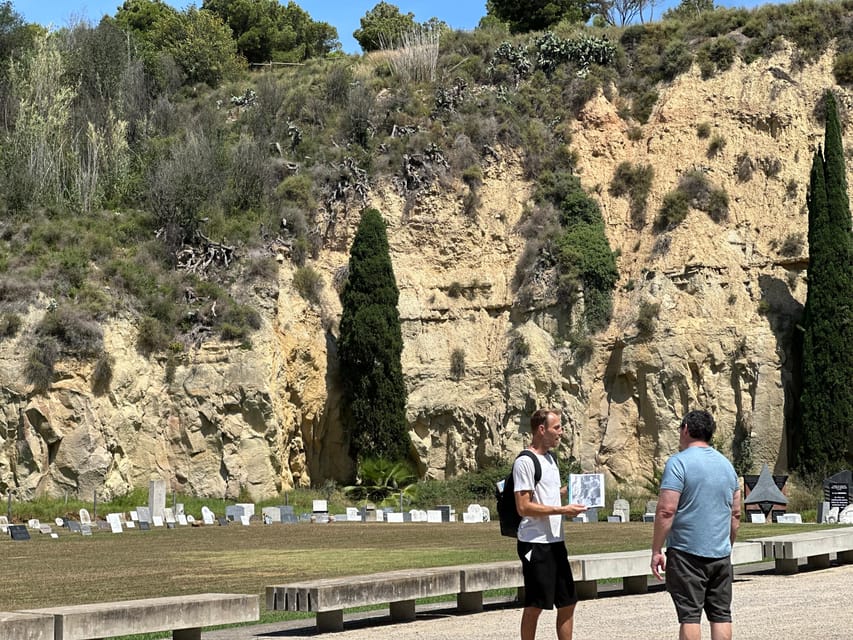
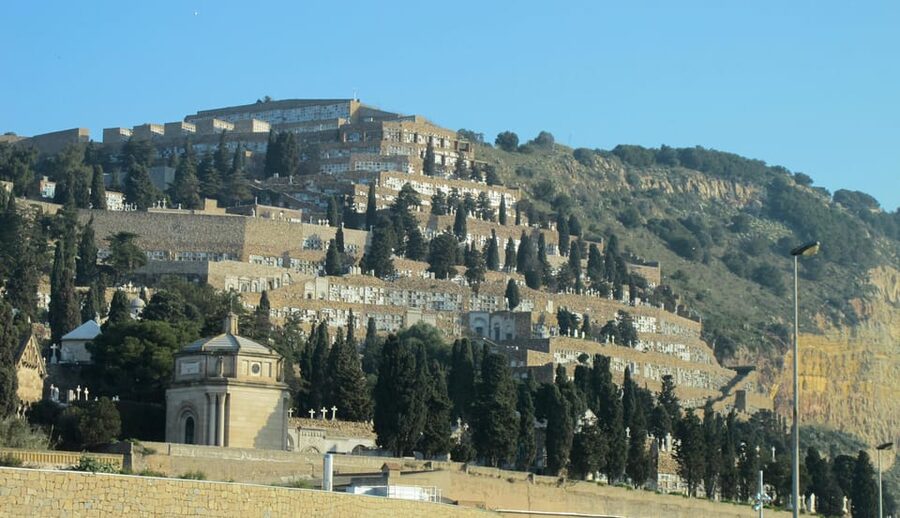
Once you arrive, the scale becomes clear. Montjuïc Cemetery covers a broad hillside, so the route is not a single flat row of graves. You move through different sections, stopping for monuments and stories along the way. The walk is broken up by frequent points of interest, but you should still expect a lot of time on your feet.
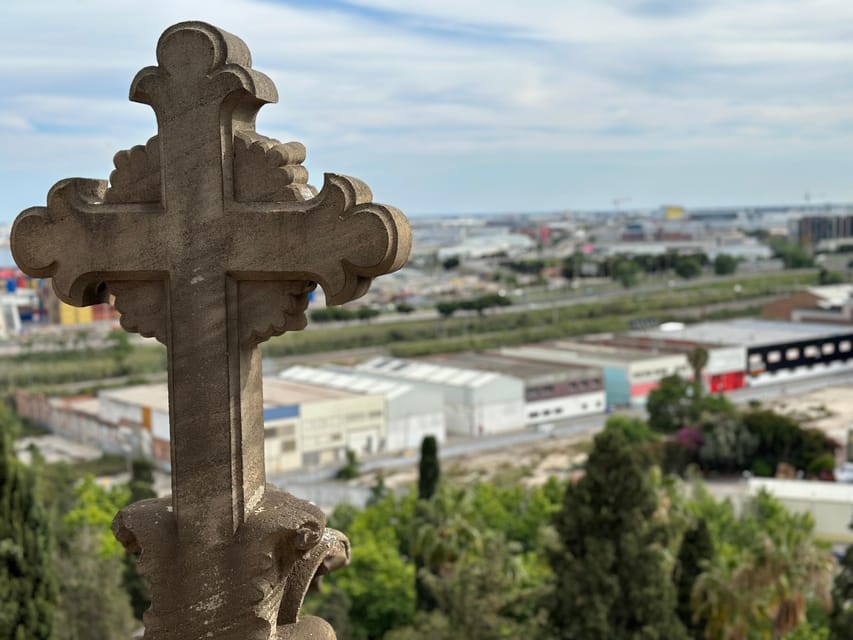
The setting gives the cemetery much of its character. Some paths open toward views of the sea, while others are enclosed by walls, mausoleums, and dense rows of tombs. The changing elevation also creates different views of the architecture. A structure that looks modest from below can become surprisingly grand as you approach it.
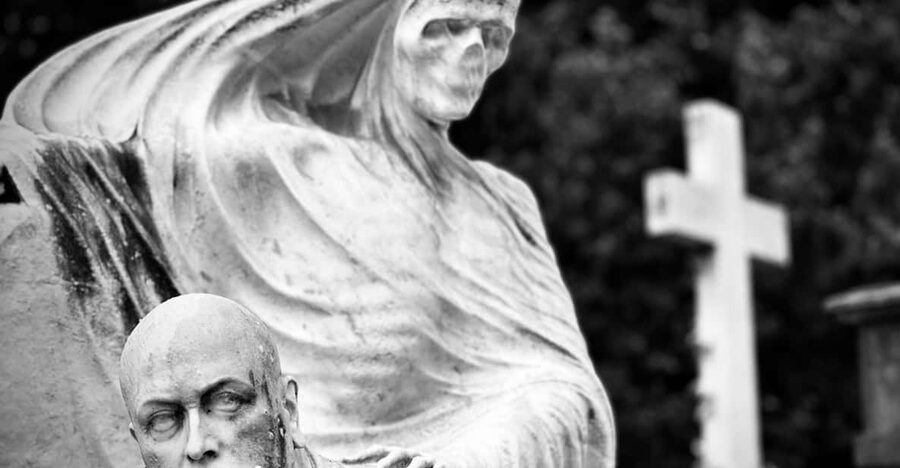
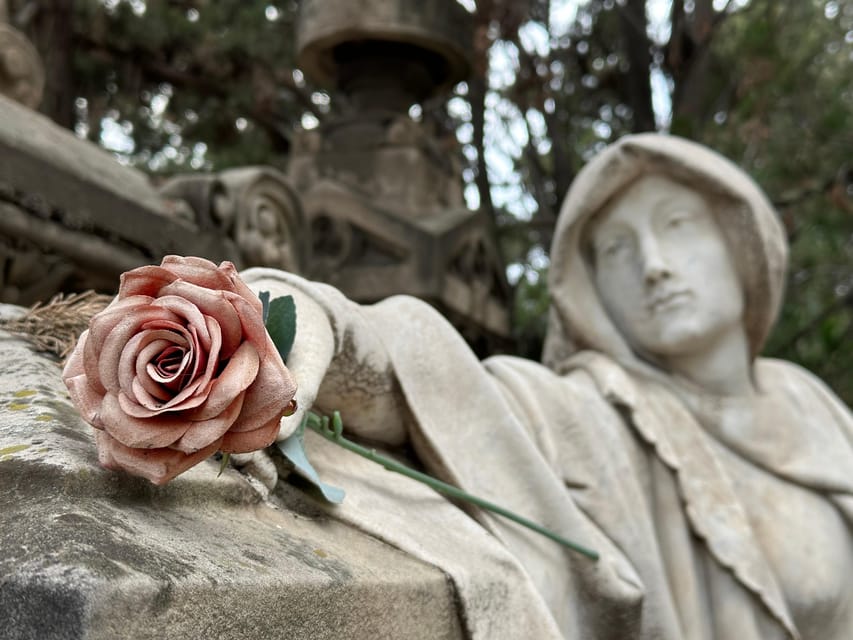
The most striking graves are built on a scale that can feel almost theatrical. You may see family mausoleums shaped like churches, tall obelisks, pyramids, angels with elaborate wings, and sculptures featuring skeletons or other reminders of death. The effect is Gothic without being a theme-park version of Gothic. These are permanent memorials made for real families, and that gives the visual drama some weight.
Photography is a natural part of the visit. The cemetery offers strong subjects at close range, from carved figures to doorways and stone details, as well as wider views over the water. Still, the atmosphere calls for restraint. This remains an active place of remembrance, so the best approach is to photograph architecture and scenery respectfully and follow the guide’s lead around individual graves.
The stories behind Barcelona’s citizens
The tour’s strongest feature is the link between the monuments and the people buried there. You hear about local writers, politicians, artists, and other figures who shaped Barcelona. The information is not limited to names and dates. The point is to understand the kind of city they belonged to and why their final memorial looks the way it does.
One especially interesting thread is the contrast between grand memorials and less ornate graves. A spectacular mausoleum may belong to an influential family, while a plain tomb may mark someone whose life mattered for political or cultural reasons. That contrast keeps the walk from becoming a simple parade of expensive stonework.
The city planner Ildefons Cerdà is one notable name connected with the cemetery. His importance to Barcelona gives the visit an urban-planning angle, linking the cemetery to the shape of the city outside its walls. You can also hear about civil-war and anarchist history, a part of the tour that adds political depth to what might otherwise be treated as an art walk.
Guide Onno is repeatedly praised for adding unusual details and keeping the tone relaxed. That matters in a cemetery. A guide who only recites dates could make the experience dry, while one who treats the place as a spooky attraction could miss its dignity. The useful balance here is conversational storytelling, art, local politics, and the occasional darker detail.
More Medieval History Tours in Barcelona
- Barcelona 1.5h Private Old Town, Gothic & Ramblas Walking Tour
★ 5.0 · 318 reviews - Barcelona: Tipsy Tapas & History Tour in the Gothic Quarter
★ 4.8 · 227 reviews - Barcelona Historical Walking Tour: Gothic Quarter and El Born
★ 5.0 · 217 reviews - Barcelona: Gothic Quarter Tour Dark History & Ghosts Tour
★ 4.8 · 64 reviews
The Fossar de la Pedrera and the political side of the visit
The route includes the Fossar de la Pedrera, where you stop for about 15 minutes with time for explanation and photographs. This section brings a different emotional tone from the ornate family tombs. It connects the cemetery to Barcelona’s wartime and political past, including the civil-war and anarchist stories that make this tour more than a study of funerary sculpture.
You should not expect the entire tour to feel light or decorative. Some subjects are difficult, and the cemetery’s memorials can bring violence, loss, and political division into view. That is part of the value, especially if you want to understand Barcelona beyond its postcard attractions.
The stop is relatively short, but it helps broaden the visit. The grand mausoleums show wealth, taste, and status. The Fossar de la Pedrera points toward collective memory and political struggle. Together, they give you a fuller sense of how the city has chosen to remember different parts of its past.
Buenaventura Durruti and Joan Miró
Two later stops focus on individual graves: Buenaventura Durruti and Joan Miró. Each receives about five minutes, including a visit, explanation, and time for photographs.
Durruti’s grave brings the anarchist and civil-war material into sharper focus. It is a useful stop for anyone interested in the political conflicts that shaped modern Barcelona. The brief time allocation means you get a focused introduction rather than a long lecture, so the larger cemetery walk remains the main event.
Joan Miró’s tomb adds a major artistic name to the route. His presence fits the cemetery’s wider connection to Barcelona’s cultural life, but the tour does not turn into a general art-history lesson. Instead, his grave is one carefully chosen point within a wider collection of people and memorial styles.
These short stops are best understood as anchors. They give you recognizable names, while the rest of the walk fills in less familiar figures and overlooked monuments. That mix is one reason a guided route works better here than simply searching for famous graves on a map.
How much walking and what to wear
The tour lasts 2.5 hours and includes plenty of walking, stairs, and changes in elevation. The route is not continuously strenuous, since you stop often for stories and photographs, but the cemetery’s hillside layout cannot be avoided.
Wear comfortable shoes with a firm sole. Sandals or fashion footwear may be fine for a flat city stroll, but they are not the smart choice here. You should also be prepared for a slower pace than a normal neighborhood walk, since you will pause at monuments and move carefully through the grounds.
The activity is not suitable for children under 12, pregnant women, wheelchair users, people with mobility impairments, people recovering from recent surgery, or people over 70 according to the stated restrictions. Those limits are unusually specific, so take them seriously rather than treating them as boilerplate. If stairs, balance, or prolonged walking are concerns, choose a flatter Barcelona activity.
The cemetery can feel especially atmospheric in damp or rainy weather, but wet stone and stairs may make the route harder. Bring sensible footwear and dress for exposure on the hillside. The exact weather advice is simple: you are outside for most of the experience.
Is $28 a fair price?
At $28 per person, the tour is priced well for a 2.5-hour guided outing with roundtrip transport. The cemetery itself may not require a major admission cost, but the value comes from saving time, finding the important sections, and hearing the stories that are easy to miss alone.
The guide also solves a practical problem. Montjuïc Cemetery is too large for a casual visit if you want to see the highlights without wandering at random. You could spend hours locating a few notable graves and still miss the architectural details, political memorials, and less famous tombs that give the place its character.
This is not the best value for someone who only wants a quick photograph of Joan Miró’s grave. It is stronger value for someone who likes history, architecture, cemeteries, photography, or unusual city walks. The small-group feel is another advantage. The experience is designed to remain quiet rather than becoming a large procession through a solemn place.
You can reserve now and pay later, and cancellation is free up to 24 hours before the activity for a full refund. Those terms help if your Barcelona schedule is still shifting.
Who will enjoy this tour most
I would choose this for an adult who has already seen some of Barcelona’s major sights and wants a less familiar side of the city. It also suits anyone drawn to Gothic art, memorial sculpture, urban history, civil-war stories, or unusual photography locations.
It is particularly good for curious solo visitors and couples who prefer a thoughtful walk to another crowded attraction. On quieter departures, the tour may feel almost private, which makes the guide’s storytelling easier to follow and the setting more peaceful.
I would not choose it for young children, anyone seeking a relaxed flat stroll, or someone uncomfortable with death-related subjects. The sculptures can be beautiful, but some are deliberately eerie, and the stories include war, politics, and loss.
Should you book the Montjuïc Cemetery tour?
Book it if you want Barcelona away from the usual crowd, enjoy stories attached to places, and can manage stairs and uneven walking. The combination of Gothic mausoleums, sea views, famous names, civil-war history, and a small-group atmosphere is hard to find elsewhere in the city.
Skip it if you want a short, easy attraction or if mobility is an issue. For the right visitor, though, $28 buys more than transport and a walk. It gives you a guide through one of Barcelona’s largest and least familiar historic spaces, with enough context to make the stone, sculpture, and silence mean something.
FAQ
Where does the tour start?
It starts at Portal de Santa Madrona. The guide waits with a white umbrella in front of the wooden doors or gate of the old city wall.
Where does the tour finish?
The activity ends back at Portal de Santa Madrona.
How long does the tour last?
The tour lasts 2.5 hours, including the cemetery visit and transport segments.
What language is the tour in?
The live tour guide speaks English.
Is transport included?
Yes. Roundtrip transport between the city meeting point and Montjuïc Cemetery is included. The activity information describes city bus transport, and the route schedule shows approximately 10-minute transfer segments.
What places are included on the route?
The route includes Montjuïc Cemetery, the Fossar de la Pedrera, Buenaventura Durruti’s tomb, and Joan Miró’s tomb.
Is the tour suitable for people with mobility issues?
No. The route includes walking up and down stairs and is not suitable for wheelchair users or people with mobility impairments. People with knee problems may struggle.
Can children join the tour?
The activity is not suitable for children under 12.
Can I cancel the booking?
Yes. You can cancel up to 24 hours in advance for a full refund.
What does the tour cost?
The price is $28 per person.
Newest history tours we have reviewed in Barcelona
- Barcelona Tapas Tour, Taverns, History & Local Culture★ 5.0 · 25 reviews
- Barcelona Historical 3-Hour Bike Tour★ 4.7 · 222 reviews
- Barcelona: Market, Tasty Tapas/Food and Gothic History Tour★ 4.7 · 48 reviews
- Barcelona & Chocolate Amatller History and Culture + Activity and Tasting★ 4.9 · 173 reviews
- Barcelona: The Spanish Civil War Historical Walking Tour★ 4.9 · 239 reviews
- Barcelona: 3-Hour Esoteric, Spiritual & Historical Tour★ 5.0 · 34 reviews
- Barcelona: 3-Hour Sips, Sites & Bites Food & History Tour★ 4.8 · 33 reviews
- Tarragona and Sitges Small Group Tour – Roman History & Culture★ 4.5 · 339 reviews
Medieval History Tours, compared.
Oldtown, Medieval Underground & Dungeon History Tour
Read our review →
Prague Old Town, Medieval Underground and Dungeon Historical Tour
Read our review →
Templar Tour Convent of Christ & Almourol Castle from Lisbon
Read our review →
Barcelona 1.5h Private Old Town, Gothic & Ramblas Walking Tour
Read our review →
Tipsy Tapas & History Tour in the Gothic Quarter
Read our review →
Barcelona Historical Walking Tour: Gothic Quarter and El Born
Read our review →