Review · ATHENS HISTORY TOURS
Ancient Athens Segway Tour with Agora and Kerameikos
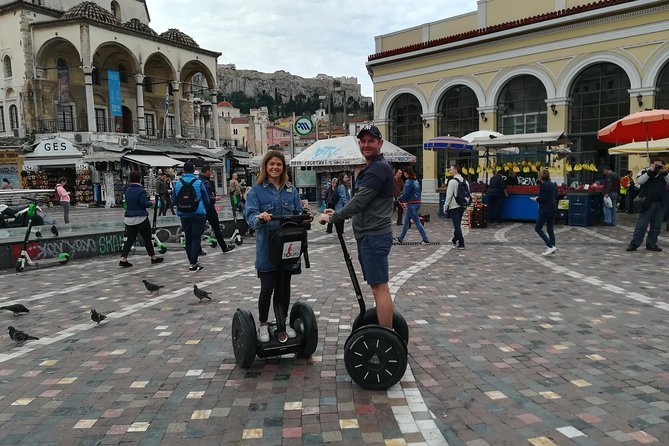
The best thing about this tour is how quickly it gives you a sense of Athens. In about two hours, you glide from Acropolis viewpoints to the Agora, Roman Agora, Kerameikos, and Mars Hill without spending the whole morning climbing streets on foot. I especially like the views from Pnyx and the easy, friendly Segway instruction. You also get useful Athens tips from guides such as Gina, Kostas, Alex, and Akrivi.
The main catch is simple: this is an outdoor orientation tour, not an archaeological-site visit. You stop outside the monuments for photos, but entrance tickets are not included and you do not go inside. Riding near crowds can feel a little unnerving at first, so take the practice session seriously and choose an early departure if you prefer quieter streets.
Key points at a glance

- Pnyx delivers the star view: You get a fine photo angle toward the Acropolis and Parthenon from a hill tied to ancient Athenian public life.
- The Segway saves your legs: You cover several historic areas in two hours, including places that would take much longer to connect on foot.
- The route mixes famous and less obvious stops: Along with the Acropolis area, you visit Kerameikos and Mars Hill.
- Guides are a major part of the experience: Guides including Menelaos, Demie, Sergio, Gina, Yota, and Stellios are praised for safety coaching, local tips, and humor.
- You stay outside the monuments: This tour is best for orientation and photographs. Plan separate visits if you want to enter the Agora or other archaeological sites.
- The rules matter: Riders must be at least 12, weigh between 100 and 250 pounds, and manage stairs without assistance.
Why a Segway works well in central Athens
Athens is easy to explore in pieces, but the historic center can be tiring. The Acropolis rises above the surrounding streets, and several major sites sit close together without feeling close when you are walking in the heat. A Segway gives you a practical middle ground: you move farther than you would on foot, but you remain at street level and can pause for views.
You begin with instruction before heading out. That matters, especially if this is your first ride. The guides take time to check that everyone can control the machine, and several guides are praised for being patient with nervous beginners. One guide even helped an 83-year-old rider learn the basics, while another first-time rider in the same group was given steady encouragement.
The controls are generally easy to learn, but the first few minutes can feel strange. You lean to move and shift your weight to control the Segway, so you need enough balance and confidence to react calmly. I would not book this as a passive sightseeing ride. You are operating a vehicle in public spaces, and you need to pay attention.
The maximum group size is 20, though some departures may be much smaller. A small group makes it easier to hear the guide and get help with the Segway. It also helps at photo stops, where a large crowd could make the experience feel rushed.
More Ancient History Tours in Athens
- Athens: Ancient Greek Theater Performance
★ 4.7 · 2,481 reviews - Historical Delphi One Day Tour with Arachova Stop & Expert Guide
★ 4.5 · 1,247 reviews - From Athens: Ancient Corinth Day Trip with Canal & VR Guide
★ 4.6 · 1,073 reviews
Pnyx and the best Acropolis photo stop
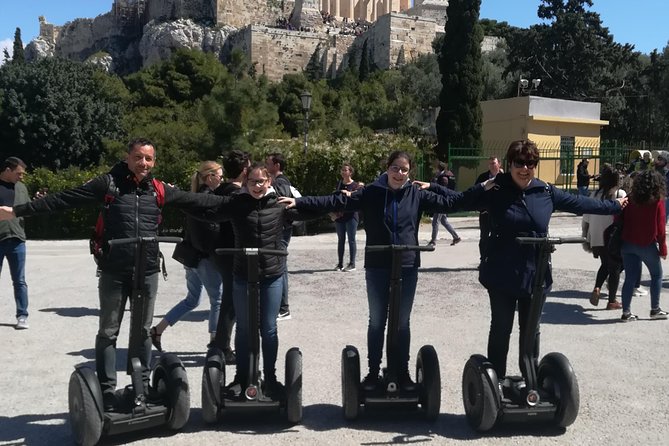
Pnyx is the first major stop, and it sets the tone. From this hill, you get a broad view toward the Acropolis and Parthenon. It is an especially useful place to take photographs because you can see the famous hill as part of the city rather than only from its base.
The stop lasts about 10 minutes. That is enough for pictures and a short explanation, but not enough for a long historical talk. The value here is the viewpoint and the quick orientation. You can begin to understand how the Acropolis relates to the surrounding neighborhoods and hills.
Pnyx also gives the tour a little more substance than a simple photo circuit. This is connected with the civic life of ancient Athens, so the guide can link the view to the city’s political past. You will not be visiting an enclosed museum or archaeological exhibit here. Instead, you get a clear outdoor introduction before moving on.
If photography matters to you, this is one of the stops to remember. Ask the guide about the best angle and take your time within the allotted pause. The tour also reaches Areopagus later, giving you another strong view from a different position.
Ancient Agora and the Stoa of Attalos
The stop at the Ancient Agora focuses on the Stoa of Attalos. You pause outside and take photographs with the long reconstructed building as a backdrop. The stop is short, around five minutes, so think of it as a visual introduction rather than a full visit.
That distinction is important. The Agora is one of the places many people want to explore in detail, but admission is not included here and the group does not enter the archaeological grounds. If you want to walk among the ruins, see the Temple of Hephaestus, or spend time inside the Stoa museum, plan a separate visit.
Still, the Segway stop has real value. You see where the Agora sits in relation to the Acropolis, and you can mark the area for a later return. I like this approach for a first morning in Athens because it helps you decide which sites deserve more of your limited sightseeing time.
The guide may add historical context and point out details you could miss while walking past. Keep your expectations clear: you get a short outdoor stop, not a substitute for an Agora ticket.
Roman Agora and the city’s ancient street plan
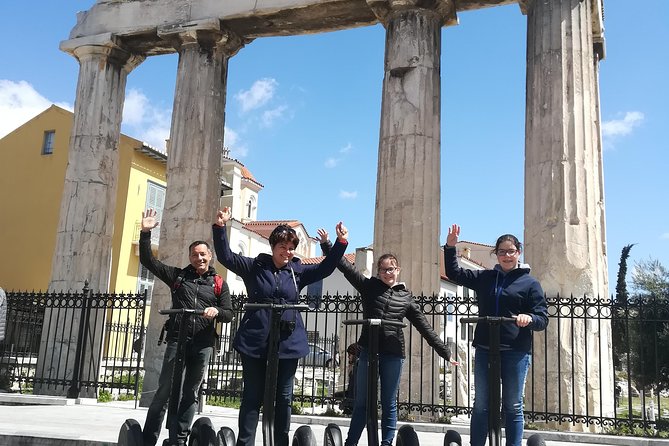
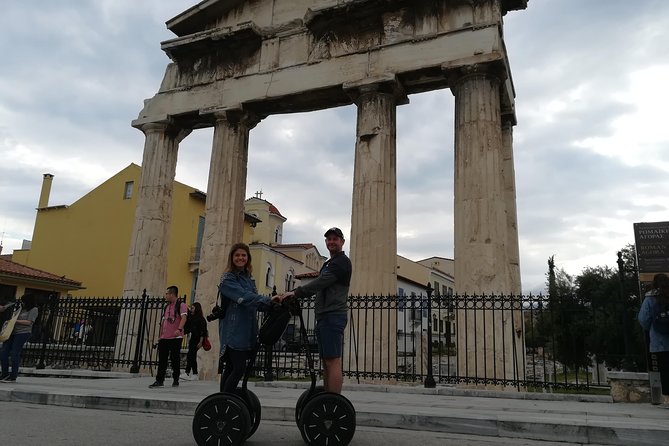
The Roman Agora is another brief photo stop, this time in front of the entrance gate. The stop lasts about five minutes. It works as part of the larger route because you see another layer of Athens without committing to a long indoor or archaeological visit.
This is where the tour’s pace becomes clear. You are not lingering at every monument. Instead, you are building a mental map of the old center, moving between sites with a guide who can explain how the pieces fit together.
For some people, five minutes will feel too short. If you want detailed architecture or quiet time at each site, a walking tour or individual visit will suit you better. If your priority is to see several important locations in one outing, the short stop keeps the route moving.
The Roman Agora also makes a useful marker for exploring later. It sits in an area where you can continue on foot after the tour, and the guide may offer suggestions for food, drinks, or nearby places worth returning to.
More Ancient History Tours in Greece
- Acropolis, Parthenon & Athens Old City Heritage Walking Tour
★ 4.5 · 876 reviews - Private Biblical Tour Ancient Corinth & Isthmus Canal from Athens
★ 5.0 · 762 reviews - Athens: Ancient Corinth & Nafplio Full Day Trip with Swim
★ 4.8 · 531 reviews - Athens Skip the Line: Open Air Ancient Greek Theatre Performance
★ 4.5 · 520 reviews
Odeon of Herod Atticus and the Acropolis approach

The route pauses outside the Odeon of Herod Atticus, the stone theater connected with the Athens Festival each summer. You take photographs from outside, with the Acropolis area rising nearby.
Again, no admission is included and the group does not go inside. The attraction here is the exterior setting and the chance to see one of Athens’ most recognizable performance spaces as part of the Acropolis approach.
This is a good example of why the tour suits first-time visitors. You get a series of landmarks that can otherwise blur together during a busy day. The guide can connect the Odeon to modern Athens while also explaining its ancient setting.
The stop is only about five minutes, so use it for a few strong photos rather than trying to absorb every detail. If you later attend an event at the Athens Festival, you will already have a sense of the venue and its location.
Kerameikos, the stop that may depend on the day
Kerameikos was the district of ancient ceramic workshops and also an important cemetery. The tour stops outside the area for photographs, with roughly five minutes set aside.
This is one of the more distinctive locations on the route. It is not simply another Acropolis viewpoint. The name connects with pottery production, and the cemetery adds a quieter, more reflective side to ancient Athens. You see a part of the city’s past that many short sightseeing routes skip.
There is one practical point to keep in mind: the route may not reach Kerameikos on every departure. A Sunday tour was unable to visit the cemetery, so you should treat this stop as subject to opening or route conditions rather than a guarantee.
As with the other archaeological locations, you do not enter. If Kerameikos is a priority, confirm the day’s plan when you arrive and schedule a separate visit if needed. The short exterior stop is useful, but it cannot replace time inside the site.
Areopagus and Mars Hill
The final listed stop is Areopagus, also called Mars Hill. You pause for about 10 minutes to photograph the hill, the entrance to the Acropolis, and the surrounding city.
This is one of the strongest stops for atmosphere. The rock and slope give you a different view from Pnyx, and the setting carries both ancient civic meaning and Christian significance. It is also associated with the account of Apostle Paul presenting the gospel to the Athenians.
The surface can be uneven, and the tour’s general requirement about managing stairs and similar movements matters here. You should wear comfortable shoes and pay attention to your footing. The guide will help with the sightseeing plan, but you remain responsible for moving safely.
Mars Hill is a fitting end because it brings together the tour’s main themes: old Athens, religious history, city views, and the Acropolis. You finish with photographs and context, then ride back to the starting point.
What the guides add to the ride
The guides are one of the strongest reasons to book this experience. The most useful part is not a long lecture. It is the combination of safety coaching, short historical explanations, and practical Athens advice.
Menelaos is praised for giving a careful briefing before leading a tour with strong views around the Acropolis. Demie and Sergio are noted for taking the group to less obvious places and keeping the two hours lively. Kostas is singled out for combining ancient and modern Athens, while Gina receives praise for clear explanations and useful recommendations.
Akrivi brings an archaeology background and is described as helpful with food, drink, and viewpoint suggestions. Stellios is especially patient with nervous riders and older participants. Alex is credited with making first-time riders comfortable before setting off, and Anastasia is noted for sharing information without overwhelming the group.
Guides can vary by departure, so you cannot choose a specific person based on the tour details alone. Still, the repeated pattern is clear: the best part of the guiding is the personal help. You can ask about local areas, where to eat, or what to do next, rather than receiving only a memorized route.
Price, timing, and practical value
At $83.45 per person, this is not the cheapest way to see the Acropolis area. You are paying for the Segway, helmet, bottled water, an escort, instruction, and a guided route through several historic neighborhoods.
I think the price makes sense if you value time and want an overview early in your stay. Walking between Pnyx, the Agora, Roman Agora, Kerameikos, the Odeon, and Mars Hill could take much longer, especially in hot weather. The ride also helps you identify places to revisit on foot.
The value drops if you want entry to archaeological sites. You will need to pay for those separately, and the tour does not provide extended time inside them. A standard walking tour with admissions may be better for someone whose main goal is detailed site visits.
Multiple departure times make it easier to fit the ride into a busy Athens schedule. An early start can help you avoid some of the heavier crowds, while a later or sunset departure may offer different light. The tour returns to Eschinou 9, the starting point, so plan your next activity from there.
The meeting point is near public transportation. Hotel pickup and drop-off are not included, and food and drinks beyond the provided bottled water are your responsibility.
Who should book this Athens tour
I would recommend it to first-time visitors who want a quick sense of the historic center. It is also a good fit for couples, families with teenagers, and older riders who want to reduce the amount of walking while still seeing several major locations.
The minimum age is 12, and anyone under 18 must be accompanied by an adult. Riders must weigh at least 100 pounds and no more than 250 pounds, and you need to be able to climb and descend stairs without assistance.
Bring comfortable shoes and avoid large bags. You need freedom of movement, and a bulky bag is awkward and unsafe on a Segway. Wear a helmet, even if you are an experienced rider. One rider found crowded streets a little intimidating, which is a useful reminder that safety matters more than looking relaxed.
This is less suitable if you dislike balancing vehicles, want a quiet scholarly tour, or expect to enter every monument. The route is active, social, and fairly quick. Its strength is coverage, not long contemplation.
Should you book it?
Book this tour if you want to get oriented, enjoy a bit of motion, and see the Acropolis area from several useful angles. The Pnyx and Mars Hill views are strong, the route covers more ground than a normal walk, and the guides put real effort into helping beginners feel comfortable.
Skip it if your main aim is to explore the Agora, Kerameikos, or Roman Agora interiors. Use the Segway tour as a first look, then return to the sites that interest you with separate admission tickets and more time.
For most first-time visitors who can ride safely, the two-hour format offers good value. It gives you history, photographs, local suggestions, and a workable map of central Athens without turning your first day into a long march.
FAQ
How long does the Ancient Athens Segway Tour last?
The tour lasts approximately two hours and ends back at the meeting point.
Where does the tour start?
It starts at Eschinou 9, Athina 105 58, Greece.
Does the tour go inside the archaeological sites?
No. The tour stops outside the sites for photographs and does not include interior visits.
Are admission tickets included?
No. Admission tickets for the Ancient Agora, Roman Agora, and other archaeological sites are not included.
What is the minimum age for the tour?
The minimum age is 12. Anyone under 18 must be accompanied by an adult.
Are there weight or mobility requirements?
Yes. Segways are not suitable for riders under 100 pounds or over 250 pounds. You must also be able to climb and descend stairs without assistance.
Can I cancel for a full refund?
Yes. You can cancel at least 24 hours before the experience starts for a full refund. Changes or cancellations made less than 24 hours before the start time are not accepted for a refund.
More History Bike, Segway and Tuk-Tuk Tours in Greece
- Athens: Bike Tour of Athens Historical Centre
★ 5.0 · 61 reviews - Ancient Athens Electric ATV Scooter Tour
★ 4.9 · 29 reviews
More History Bike, Segway and Tuk-Tuk Tours in Athens
- Historic Athens: Small Group Electric Bike Tour
★ 4.9 · 966 reviews - Athens: Small Group E-Bike Tour of Historic Highlights
★ 4.9 · 154 reviews - Athens Highlights by E-Bike: Small-Group Historic Tour
★ 5.0 · 131 reviews - Ancient Athens Segway Tour
★ 4.9 · 89 reviews
Newest history tours we have reviewed in Athens
- Athens: The History of Greek Mythology Private Tour★ 4.7 · 53 reviews
- Athens: Women in Ancient Greece★ 5.0 · 98 reviews
- Athens: Ancient Corinth & Nafplion Guided Premium Tour★ 4.7 · 237 reviews
- Athens: Be an Ancient Sculptor: Craft Your Greek Masterpiece★ 5.0 · 26 reviews
- Athens: Roman Agora & Ancient Agora E-ticket & 2 Audio Tours★ 4.1 · 107 reviews
- Athens: Ancient Greek Theatre Murder Mystery Experience★ 4.8 · 298 reviews
- Athens: Corinth Canal and Ancient Olympia Private Trip★ 4.6 · 21 reviews
- Athens: Kotsanas Ancient Greek Technology Museum Guided Tour★ 5.0 · 29 reviews
Ancient History Tours, compared.

Colosseum: Underground and Ancient Rome Tour
Read our review →
Colosseum & Ancient Rome with Arena Floor Option I Max 6 People
Read our review →
Colosseum, Ancient Rome Tour or AudioGuided Tour
Read our review →
Colosseum Underground & Ancient Rome Guided Tour
Read our review →

Taormina: Ancient Theater Skip-the-Line Ticket & Audio Guide
Read our review →
Discover the Ancient Ruins of Pompeii: Day Trip from Rome
Read our review →