
Review · ATHENS HISTORY TOURS
Ancient Athens E-Bike Tour
Athens packs ancient theaters, democratic meeting grounds, Roman monuments, and lively neighborhoods into a compact center. This standing e-bike tour lets you cover that ground quickly, without pedaling or spending two hours trudging over hot pavement. The motorized tricycle is the unusual part, and it gives you a quick look at several places you may want to revisit on foot.
I like the small group limit of 12 and the way guides such as Dimitris adjust the route around what you have already seen. I also like the practical mix of big sights and less obvious stops, especially the Pnyx and the hill by the National Observatory. The main drawback is time: two hours gives you an excellent introduction, but only brief stops and no full Acropolis visit.
Key points to know before you book
- The Trikke needs no pedaling, making it useful in Athens heat and on a packed sightseeing day.
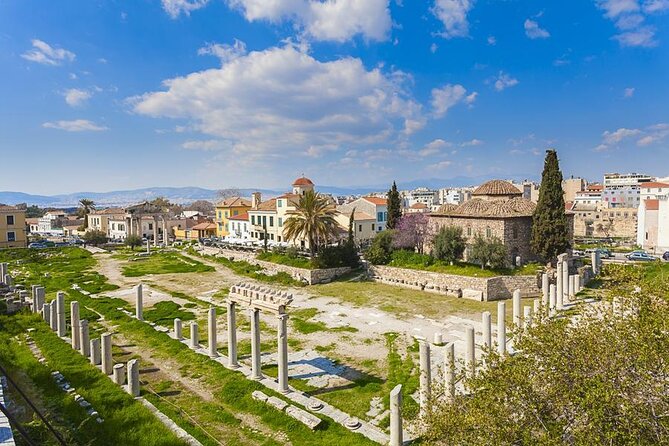
- You see nine major areas in about two hours, including the Acropolis, Pnyx, Ancient Agora, Kerameikos, Monastiraki, Roman Agora, and Plaka.
- The tour stays near the sights rather than replacing ticketed visits, so plan separate time and money for the Acropolis and archaeological sites.
- Dimitris is one of the named guides, and the route can be adjusted around sights you have already visited.
- The group is capped at 12 people, which keeps the experience more personal than a large coach tour.
- The tour starts and ends at Leof. Andrea Siggrou 22, runs Monday through Saturday from 10 a.m. to 4 p.m., and depends on good weather.
Why a standing e-bike works well in Athens
Athens is easy to understand on a map, but less easy on foot. The Acropolis area rises above the center, the ancient sites spread across several neighborhoods, and summer heat can make even a short walk feel longer than expected.
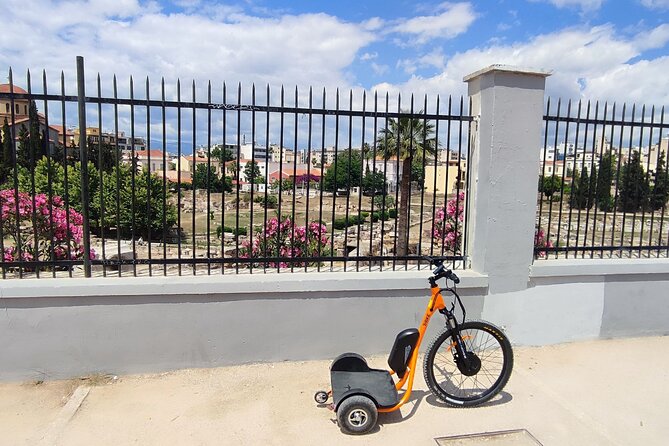
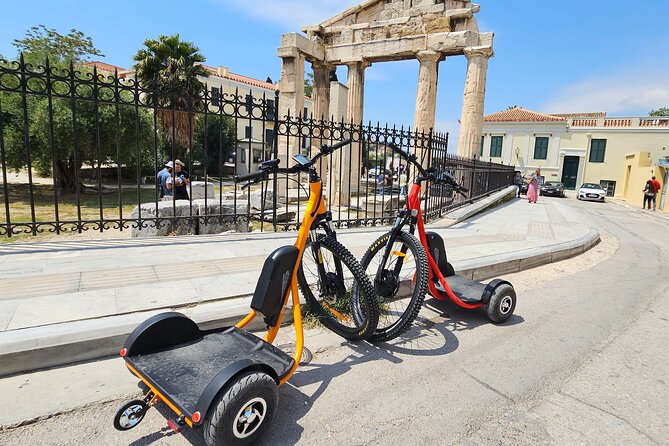
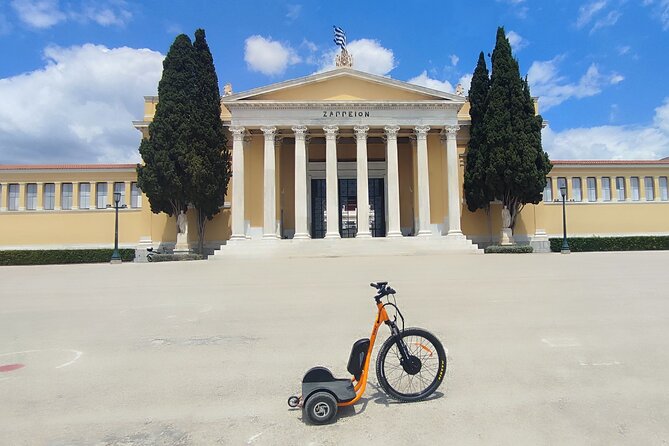
The Trikke solves part of that problem. You stand on the vehicle, hold the handlebars, and let the motor do the work. It is closer to a quiet motorized tricycle than a normal bicycle, so you do not need to pedal from stop to stop.
That matters most when you want a first look at Athens rather than a slow archaeological study. You can move from the Acropolis slopes to the Pnyx, then onward to the Agora and Plaka, without burning your best sightseeing hours on transport between them.
You still need to pay attention to the guide and the road. This is a moving city tour, not a private vehicle with a door between you and Athens. The helmet and customer insurance are included, and the small group helps the guide keep an eye on everyone.
The route is also useful after arrival. A two-hour circuit can show you which areas deserve a longer return visit. You may decide that the Acropolis needs a full morning, Plaka deserves an evening walk, or the Ancient Agora is worth entering when you have more time.
More Ancient History Tours in Athens
- Athens: Ancient Greek Theater Performance
★ 4.7 · 2,481 reviews - Historical Delphi One Day Tour with Arachova Stop & Expert Guide
★ 4.5 · 1,247 reviews - From Athens: Ancient Corinth Day Trip with Canal & VR Guide
★ 4.6 · 1,073 reviews
The Acropolis area begins with ancient theater
The tour’s Acropolis section starts near the Theatre of Dionysus, the place linked with the beginnings of Western theater. This was not simply a performance venue. It was part of the civic and religious life of ancient Athens, and its connection with drama gives the Acropolis hillside a different feel from the famous Parthenon view above.
The route also includes the Odeon of Herodes Atticus. This Roman-era theater was built in the second century A.D. as a memorial for the wife of Herodes Atticus. It remains a performance venue, which makes it one of those rare ancient structures that still has a role in modern city life.
You should set your expectations carefully. The listed stop is about 10 minutes, and the tour does not give you the time needed for a full visit to the Acropolis Hill. You get a close view and useful orientation, then continue.
The Acropolis Hill ticket is listed at €20, and archaeological admission is not generally included in the tour price. The itinerary also gives €20 for the Odeon and Theatre area, though access rules and combined ticket arrangements can change. If entering the monuments matters to you, check the current ticket details and set aside another visit rather than trying to squeeze it into this short circuit.
Pnyx gives the tour its best civic-history stop
The Pnyx is one of the most meaningful stops because it shifts attention away from temples and toward public life. This hill is associated with the early development of democracy, and the guide uses the setting to explain how citizens gathered and took part in civic decisions.
The stop lasts about 15 minutes. That is enough to hear the main story and take in the view, but not enough for a long walk through the archaeological area. The Pnyx is also a park-like archaeological space, so the setting offers a welcome change from the stone streets and traffic around the main monuments.
This is where a good guide matters. Dimitris has been singled out for explaining the place where regular meetings were held and for making the idea of Athenian democracy easy to grasp. You are not just ticking off another ancient site. You are seeing one of the locations that helps explain how Athens became so influential.
The nearby National Observatory of Athens adds another layer. The observatory was the first in Athens, and the Hill of the Nymphs is also part of an archaeological area with green public space. The stop lasts about 15 minutes and is included in the tour. It is a smart pairing with the Pnyx because both hills offer a wider view of Athens and a little breathing room.
Ancient Agora connects daily life with big ideas

The Ancient Agora was the main market and civic center of ancient Athens. It is a more grounded stop than the Acropolis. Here, the story is about ordinary commerce, public business, meetings, and the daily work of an ancient city.
The tour allows about 20 minutes at the Agora, the longest stop on the route. That extra time makes sense. The site is larger than the quick photo stops, and a guide can help you understand why it mattered beyond the simple label of ancient marketplace.
Admission is listed at €4, but archaeological entry is not included in the tour price. The itinerary describes the Ancient Agora stop as included in one place and lists separate admission costs elsewhere, so you should confirm the current entry arrangement before booking. At minimum, budget for the possibility of buying a ticket if you want to go inside.
If you plan a separate return visit, the Agora is a strong candidate. The quick tour gives you the layout and historical setting. A later visit lets you slow down, examine the ruins, and spend more time with the buildings that survive within the site.
More Ancient History Tours in Greece
- Acropolis, Parthenon & Athens Old City Heritage Walking Tour
★ 4.5 · 876 reviews - Private Biblical Tour Ancient Corinth & Isthmus Canal from Athens
★ 5.0 · 762 reviews - Athens: Ancient Corinth & Nafplio Full Day Trip with Swim
★ 4.8 · 531 reviews - Athens Skip the Line: Open Air Ancient Greek Theatre Performance
★ 4.5 · 520 reviews
Kerameikos adds a quieter archaeological pause
Kerameikos is close to the Ancient Agora, but it offers a different mood. The name comes from the area’s pottery production, and the neighborhood was connected with ceramic work in ancient Athens.
The stop lasts about 10 minutes and is listed as free. It is not the most famous name on the route, which is exactly why it helps balance the itinerary. You get a glimpse of a working district rather than only the monuments that appear on every postcard.
Do not expect a long archaeological visit here. The value is in the guide’s explanation and in seeing how the ancient city was divided into areas with different purposes. The short stop works well as part of a larger circuit, but anyone with a serious interest in Kerameikos should return separately.
Monastiraki and the Roman Agora show another Athens
Monastiraki is described as one of the city’s busiest squares and a central meeting point for bars, restaurants, and other choices. The tour gives you about 10 minutes here, enough to get your bearings and see why the square feels like a crossroads between ancient sites and modern Athens.
This is a useful contrast after the Agora. In one direction, you have the remains of the ancient city. In another, you have a busy public square and the everyday energy of central Athens. The tour does not give you time to shop, eat, or settle into a café, but it can help you decide where to return later.
The Roman Agora follows the model of the Greek Agora, but it was built by the Romans in the second century A.D. The Tower of the Winds is the key feature inside. The stop is about 10 minutes, and the listed admission price is €4, with archaeological tickets not included.
Again, think of this as an introduction rather than a complete site visit. The Roman Agora deserves more time if you want to examine the architecture and understand its place in the city. On this tour, you get the main idea and a close look at the area before moving on.
Plaka finishes the route with a neighborhood walk-by
Plaka is Athens’ traditional neighborhood, known for its picturesque streets and an appearance often compared with a Greek island. The 10-minute stop gives the tour a softer ending after the ancient hills, ruins, and crowded squares.
You will not have time for a relaxed meal or a long wander. Instead, you get a quick sense of the neighborhood’s character and a useful location for an evening return. I would treat Plaka as a recommendation for later, not as a completed neighborhood visit.
That pattern runs through the whole experience. You see a lot, but you rarely linger. For a first afternoon in Athens, that is a strength. For someone who has already explored the center, it may feel rushed unless the guide changes the route to focus on places you have missed.
What the two-hour schedule really gives you
The listed stops add up to more than two hours if you count every stated minute, and city traffic, explanations, and getting on and off the Trikke also take time. Think of the schedule as a fast-moving overview, not a precise museum-style timetable.
The benefit is range. In a single outing, you can see:
- Theaters tied to ancient Greek and Roman performance
- The Acropolis from close by
- The Pnyx, linked with the development of democracy
- The first observatory in Athens
- The Ancient Agora and Roman Agora
- Kerameikos, Monastiraki, and Plaka
The cost is depth. You will not get a full Acropolis tour, a long archaeological visit, or much free time in the neighborhoods. I would book this near the start of your Athens stay, then use what you learn to plan your longer visits.
The route also works well at the end of a hot day. Several people have used it as a sunset outing, and the motorized vehicle helps you cover hills and distances without pedaling. The available operating hours are 10 a.m. to 4 p.m., though, so confirm the exact departure time when booking if you want particular light or weather.
Price, group size, and who gets good value
At $72.09 per person, this is not the cheapest way to move around Athens. You are paying for a guide, the Trikke, helmet, insurance, and a compact route through several important parts of the center. You are not paying for archaeological admission.
The value is strongest for three types of visitors:
- First-time visitors who want a clear overview before choosing longer visits
- Families and mixed-age groups who may not want a long walk in the heat
- Short-stay visitors who need to cover several central areas quickly
The experience has also worked well for families with children aged 9, 12, 13, and 15. The Trikkes are easy to use once explained, but each participant still needs to follow the guide’s instructions and stay alert.
It may be less useful for you if your main goal is a detailed Acropolis visit. In that case, spend the money on a dedicated Acropolis experience and explore the nearby sites on foot. It may also be less appealing if you dislike standing, motorized sightseeing vehicles, or a brisk route through busy central streets.
The maximum group size of 12 is a good middle ground. You do not get the intimacy of a private tour, but you have a better chance to hear the guide and ask a question than on a large group outing.
Guides can make the fast pace worthwhile
The tour depends heavily on the guide. The strongest named guide in the available comments is Dimitris, who is described as friendly, adaptable, and good at explaining the city without making the ride feel like a lecture.
That flexibility matters. The guide can ask what you have already seen and adjust the stops toward other interesting places. If you have already visited the Acropolis, say so at the start. You may get more useful context from the Pnyx, Agora, Kerameikos, or the neighborhoods.
Kevin is also mentioned in connection with the tour team. Since guide assignments can change, you should not assume a particular person will lead your departure, but the experience clearly depends on personable local guidance rather than a recorded narration.
The high rating, 4.8 out of 5 from 48 ratings, and 96 percent recommendation figure point to a consistently well-received experience. Still, those numbers do not change the basic tradeoff: the tour is fun and efficient because it moves quickly, not because it gives long visits at every stop.
Meeting point, timing, and practical planning
The tour begins and ends at Leof. Andrea Siggrou 22, Athens 117 42. The meeting point is near public transportation, which helps if you are staying outside the historic center.
It operates Monday through Saturday from 10 a.m. to 4 p.m. The activity is offered in English, and confirmation is provided at booking. Most people can participate, according to the supplied details, but the experience is conducted on a standing motorized tricycle, so you should consider your own comfort with that format.
Wear shoes you can stand in and bring water, especially in warm weather. Those are simple choices, but the route includes open hills and outdoor archaeological areas. A helmet is provided.
Weather matters. The activity requires good conditions, and a cancellation for poor weather brings the option of another date or a full refund. If your schedule is tight, avoid placing this tour on the last possible day of your stay.
Free cancellation is available up to 24 hours before the start time. Cancellations or changes made inside that window are not refunded or accepted.
Should you book the Ancient Athens E-Bike Tour?
Book it if you want a fast, entertaining orientation to central Athens and like the idea of covering hills without pedaling. It is especially useful on your first day, for a family group, or during a short visit when every hour matters.
Do not book it expecting a full Acropolis experience or detailed time inside every archaeological site. The better plan is to use this tour as your city introduction, then return to the Acropolis, Ancient Agora, Roman Agora, or Plaka on your own.
At $72.09, the price makes sense when you value the guide, the unusual Trikke, and the amount of ground covered. It is less compelling if you are happy walking slowly and already know which sites you want to visit. For most first-time visitors who want history, views, and a little fun without a hard two-hour walk, this is a practical choice.
FAQ
How long does the Ancient Athens E-Bike Tour last?
The tour lasts approximately two hours.
Where does the tour start and end?
It starts at Leof. Andrea Siggrou 22, Athina 117 42, Greece, and returns to the same meeting point.
What vehicle do I ride?
You ride a standing Trikke, a motorized tricycle that does not require pedaling.
Is a helmet included?
Yes. Helmet use is included, along with customer insurance and use of the Trikke.
Does the tour enter the Acropolis?
The tour takes you close to the Acropolis and provides views of the hill. The Acropolis Hill admission ticket is not included, and the visit is not a full Acropolis tour.
Are archaeological admission tickets included?
The general tour information says archaeological tickets are not included. Listed prices include €20 for the Acropolis Hill, €20 for the Odeon of Herodes Atticus area, and €4 for the Ancient Agora and Roman Agora, but you should confirm current prices and access details.
How many people can join the tour?
The maximum group size is 12 travelers.
What happens if the weather is poor?
The activity requires good weather. If it is canceled because of poor conditions, you can choose another date or receive a full refund. Free cancellation is also available up to 24 hours before the start time.
More History Bike, Segway and Tuk-Tuk Tours in Greece
- Ancient Athens Segway Tour
★ 4.9 · 89 reviews - Segway Journey: Athens Tour From The Ancient Past To The Present
★ 5.0 · 62 reviews - Athens: Bike Tour of Athens Historical Centre
★ 5.0 · 61 reviews - Semi-private Historical & Contemporary Segway Tour in Athens
★ 5.0 · 56 reviews
More History Bike, Segway and Tuk-Tuk Tours in Athens
- Historic Athens: Small Group Electric Bike Tour
★ 4.9 · 966 reviews - Athens: Small Group E-Bike Tour of Historic Highlights
★ 4.9 · 154 reviews - Athens Highlights by E-Bike: Small-Group Historic Tour
★ 5.0 · 131 reviews - Ancient Athens Segway Tour with Agora and Kerameikos
★ 5.0 · 94 reviews
Newest history tours we have reviewed in Athens
- The original Christian tour on Paul’s footsteps in Athens and ancient Corinth★ 4.5 · 25 reviews
- Ancient Sparta & Mystras Private Day Tour from Athens★ 5.0 · 52 reviews
- Athens: Combo Ticket for Acropolis & 6 ancient sites★ 3.0 · 21 reviews
- Small-Group Women History in Ancient Greece Walking Tour★ 5.0 · 38 reviews
- Ancient Corinth, Sanctuary of Hera, Blue Lake & Canal from Athens★ 5.0 · 26 reviews
- Half Day Historical Athens City Private Taxi Service Tour★ 5.0 · 79 reviews
- Private Luxury Tour: Marathon – Battle & Run That Changed History★ 5.0 · 30 reviews
- Ancient Olympia & Ancient Corinth Private LuxuryTour from Athens★ 5.0 · 25 reviews
Ancient History Tours, compared.
Colosseum: Underground and Ancient Rome Tour
Read our review →
Colosseum & Ancient Rome with Arena Floor Option I Max 6 People
Read our review →
Colosseum, Ancient Rome Tour or AudioGuided Tour
Read our review →
Colosseum Underground & Ancient Rome Guided Tour
Read our review →

Taormina: Ancient Theater Skip-the-Line Ticket & Audio Guide
Read our review →
Discover the Ancient Ruins of Pompeii: Day Trip from Rome
Read our review →