
Review · BUCHAREST HISTORY TOURS
Private Bucharest: History & Food with Traditional Meal
Bucharest makes the most sense when you taste it. This private four-hour tour links the city’s royal, communist, Ottoman, and French-influenced past to everyday food, beginning with a salty covrig at Revolution Square and ending with a three-course Romanian meal at a traditional inn.
I like two things right away: the private format, which lets your guide slow down for questions and children, and the way food gives the history a practical hook. You are not just looking at a church or palace. You are learning why Romanian cooking borrows from the Balkans, Ottoman kitchens, Russia, and Austria-Hungary.
The main consideration is the food portion before lunch. The tour includes a covrig and a full meal, but the description may suggest more small tastings than you actually receive. If you want a market-style food crawl with many stops, this is not quite that. If you want a city introduction with one substantial meal, it is a strong choice.
Key points to know before booking

- Revolution Square begins the story: See the former Royal Palace, Romanian Athenaeum, Athenee Palace, and the site of Ceausescu’s final public speech.
- A covrig adds a local first taste: This everyday salted snack opens the food history in a simple, useful way.
- Victory Street links several eras: Look for the Telephone Palace, Military Circle, Kretzulescu Church, and other interwar landmarks.
- Old Town is the strongest food-history section: Ottoman, Balkan, Russian, and Austro-Hungarian influences all appear in the stories and dishes.
- The meal is the tour’s anchor: Finish at a handsome traditional hanu with three courses and house beer, wine, or a soft drink.
- Private and family-friendly: Children under six join free, and past guides such as Elaina, Andra, Mara, Ioanna, Monica, Andrei, and Dana have been praised for a warm, flexible approach.
Why this Bucharest food tour works
Bucharest can be hard to read at first. One block may show elegant nineteenth-century architecture, while the next reveals a church, a communist-era scar, or a modern bar. This tour gives you a framework before the city’s contrasts blur together.
The food helps. Romanian cooking is not a sealed-off national style. It reflects centuries of trade, invasion, empire, migration, and regional difference. On this route, you hear how Balkan mici, Ottoman sarmale, Russian borscht and ciorba, and Austro-Hungarian schnitzel found a place in Romanian food culture.
The $140 per-person price is easier to justify for a small private group than for a standard shared walk. It covers four hours with an English-speaking guide, a three-course meal, and one house beer, wine, or soft drink. You are also paying for a guide who can adjust the pace, answer personal questions, and explain details that a fixed group script might skip.
Still, this is not a bargain meal tour. Additional food and drinks cost extra, and the value depends on how much you want the history and personal attention. For a first day in Bucharest, I see it as a city orientation with lunch included, not simply a four-hour eating tour.
More Local Culture and Traditions Tours in Romania:
- Roma Culture, Realities and Slavery History, Walking tour
★ 4.9 · 52 reviews - Private Tour – Food, Culture, History & Traditions
★ 5.0 · 18 reviews - Amsterdam Food and Cultural Tour with Tastings
★ 5.0 · 4,315 reviews
Revolution Square and the final speech of communism
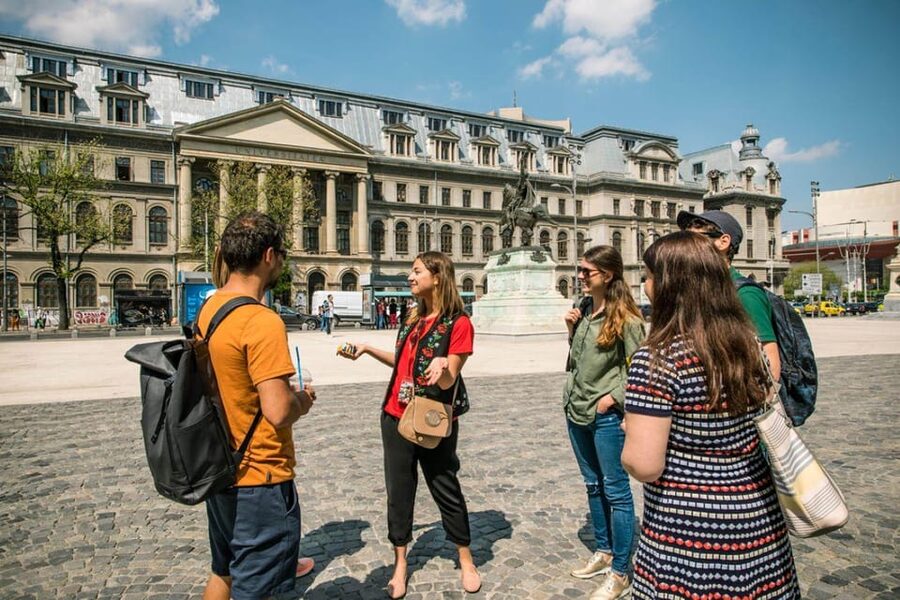
Meet at the Equestrian Statue of Carol I in Sector 1, beside Revolution Square. The square was once called Palace Square, a name that points to the royal buildings around it.
This is the right place to begin because several layers of modern Romanian history meet here. The former Royal Palace reflects the monarchy. The Romanian Athenaeum brings music and cultural life into the picture. Athenee Palace recalls the interwar years, when Bucharest was a center of diplomatic maneuvering, espionage, and political intrigue.
Then comes the harder story. In December 1989, Nicolae Ceausescu gave a rallying speech from this area, expecting the crowd to support him. Instead, the gathering turned against him, helping trigger the Romanian Revolution.
Your first food sample is a covrig, a salted ring-shaped snack eaten daily by many Romanians. Its roots are often linked to Habsburg or German merchants in the medieval period. That small bite makes a good opening because it shows how an ordinary street food can carry a piece of Central European history.
I like this start because it gets you oriented without throwing every date at you. You have a square, a palace, a concert hall, a hotel, and a snack, all tied to a story about who shaped Bucharest and how power changed hands.
Victory Street and Bucharest’s French-facing side
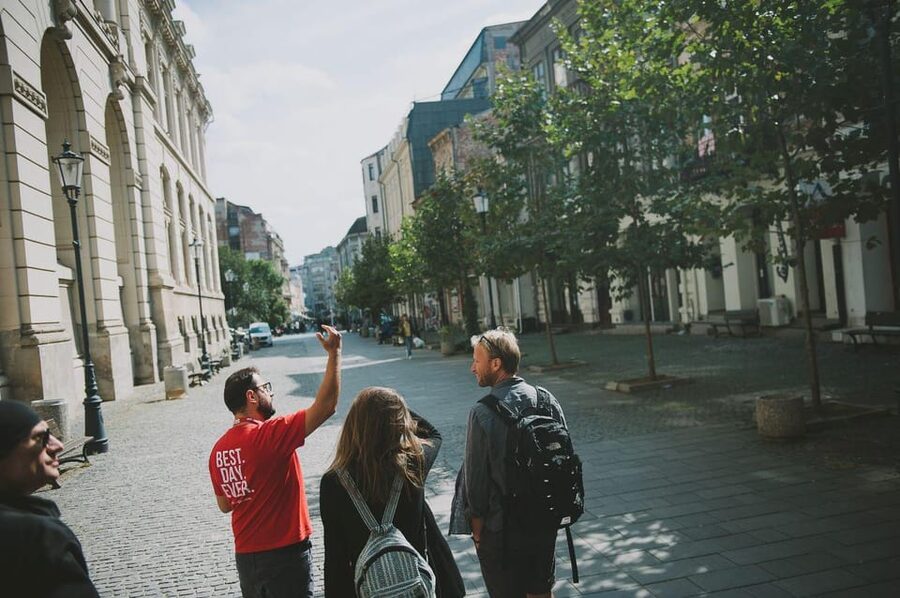
From Revolution Square, the route continues south along Victory Street, or Calea Victoriei. Its name refers to Romania’s victory in the 1871 War of Independence.
The name needs a little care. Romania’s three principalities did not fully unite until 1918, so the country’s regions kept strong local identities. The tour uses this point to explain why Moldovan food can lean sweet, Transylvanian cooking earthy, and Muntenian food spicy.
That regional comparison is useful for you as a diner. Romanian food is not one fixed menu. The same broad national cuisine can change in flavor and technique depending on the region behind it.
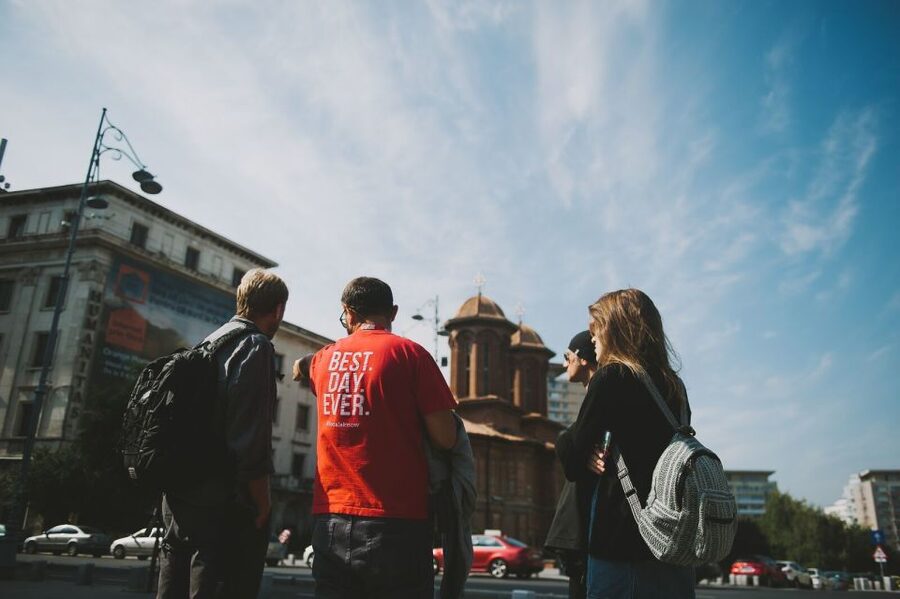
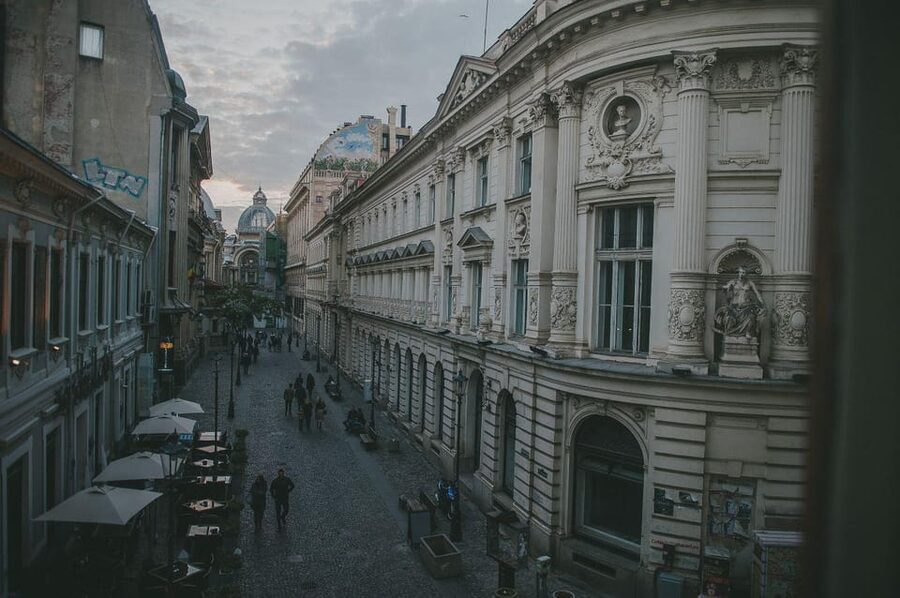
Victory Street also gives you a concentrated look at Bucharest’s interwar architecture. The Telephone Palace, Military Circle, and former National Theatre are among the landmarks along this stretch. Kretzulescu Church adds a different scale and mood, with its ornate Orthodox design set against the city street.
A guide matters here because these buildings can be easy to pass without context. The route is not only about identifying façades. It shows how Bucharest looked toward Western Europe while keeping older Orthodox and regional traditions close at hand.
Old Town, where East meets West
The Old Town section is the heart of the food story. This was medieval Bucharest, positioned at a crossroads between eastern and western worlds. Ottoman pashas, Transylvanian princes, merchants, innkeepers, and religious communities all left traces here.
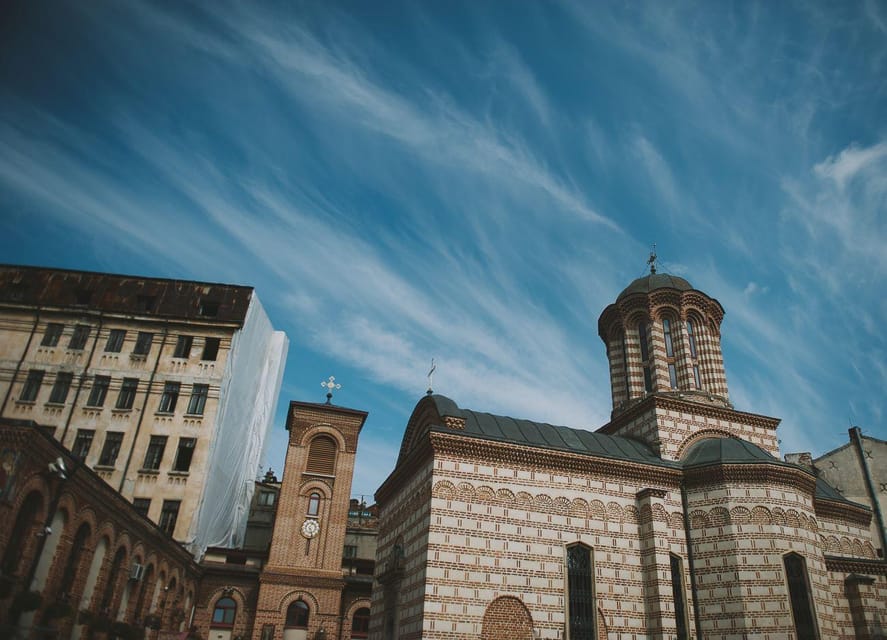
The route takes you through older paths and passageways rather than sticking only to the biggest streets. You might see lavish interiors, former princely courts, an Orthodox monastery, and Hanul lui Manuc, the great wooden inn associated with Bucharest’s trading past.
This is also where the food influences become easiest to understand. Mici are skinless Balkan sausages. Sarmale, stuffed cabbage leaves, reflect Ottoman influence. Borscht and ciorba point toward eastern European sour-soup traditions, while schnitzel connects to Austro-Hungarian cooking.
Do not expect every one of these foods to appear as a separate tasting. The route explains them as part of the city’s culinary story, while the included meal provides the main chance to eat traditional dishes. One past booking found the meal good but wished for more sampling along the way, so set your expectations accordingly.
The Old Town can be lively, especially at night, but the tour’s focus is older than the bar scene. You hear how medieval trade, foreign rule, princely wealth, and later nightlife all overlap in the same small area. That contrast is one of Bucharest’s defining features.
More Private History Tours in Romania:
- Bucharest Jewish Heritage | Holocaust Memorial | Private Car Tour
★ 5.0 · 38 reviews - Private Historical Walking Tour of York
★ 5.0 · 1,324 reviews - Private Guided Historic Electric Cart Tour of St. Augustine
★ 5.0 · 1,194 reviews - Istanbul: Acemoglu Historical Turkish Bath w/Private Options
★ 4.6 · 1,190 reviews
The People’s Palace and the cost of Ceausescu’s vision
At some point before the final meal, you get a look at the People’s Palace, now associated with Romania’s Parliament. The building was the centerpiece of Ceausescu’s attempt to reshape Bucharest according to his grand plans.
It is often described as the second-largest building in the world, after the Pentagon. Its size is the point. The building and the broad avenues around it show how communist power could erase older neighborhoods and replace them with monumental scale.
This stop is mainly about seeing the building and understanding what it represents. The tour information does not promise an interior visit, so do not book this experience expecting a guided tour inside the palace.
The People’s Palace also gives the earlier Revolution Square story a larger setting. You see the relationship between the leader’s public image, the city’s forced redesign, and the political collapse of 1989. A good guide can connect those pieces without turning the afternoon into a lecture.
The traditional hanu meal
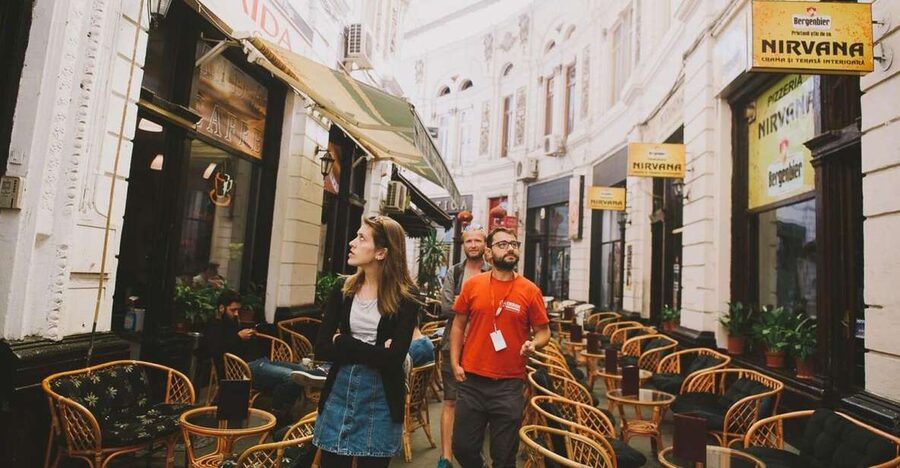
The tour ends at a traditional hanu, or inn, described as one of Bucharest’s most beautiful. This is more than a convenient restaurant stop. Historic inns are part of the city’s commercial past, when merchants and visitors needed a place to eat, sleep, and conduct business.
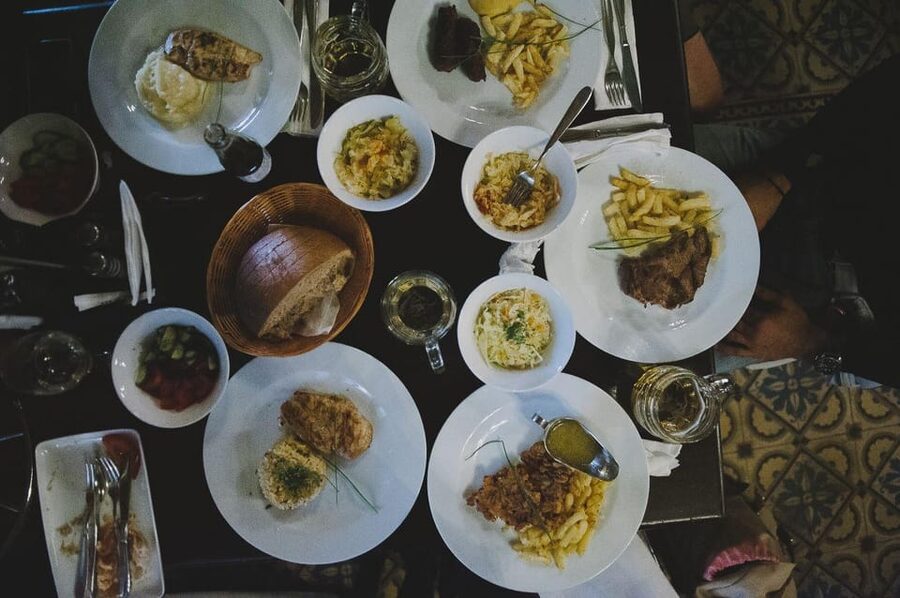
You receive a three-course Romanian meal with platters of local delicacies. The exact dishes are not fixed in the information provided, so you should not assume that every named specialty appears on your table. What is clear is that the meal is intended as a taste of the region’s history and geography, not as a generic restaurant lunch.
Your included drink is house beer, wine, or a soft drink. The tour adds a playful Dacian drinking story: the ancient Dacian leader Burebista is said to have banned wine production because his people drank so much of it. The resourceful Dacians supposedly turned to beer instead.
That gives the meal a memorable final link to ancient Romania. You can choose the included drink, while any extra food or alcohol is at your own cost.
The meal has been a major strength for past bookings. It has been described as delicious, plentiful, and served in a calm restaurant away from the Old Town’s evening noise. For me, this is an important distinction: you are not rushed through a string of tiny bites. You get time to sit down and eat properly after the city walk.
What the private format changes

A private group is the main reason to choose this tour over a cheaper shared walk. Your guide can spend more time on your interests, explain architecture at your pace, and stop for questions without holding up a large group.
The format is also useful for families. Children under six can join free, and the tour is child-friendly. An eight-year-old has previously been included in the conversation with photo breaks and a pace that did not turn the history into a chore.
That said, the tour still covers a lot in four hours. You move from Revolution Square to Victory Street, through Old Town, past the People’s Palace, and on to lunch. If you want long museum visits or time inside every church, this route is too broad. It works best as an overview.
English is the stated language, and the tour is led by a live English-speaking guide. Guides have included Elaina, Andra, Mara, Ioanna, Monica, Andrei, and Dana on past departures. The individual guide will vary, but the consistent qualities you should want are clear: good local context, patience with questions, and the ability to explain food without treating it as a separate subject.
The walking and comfort factor
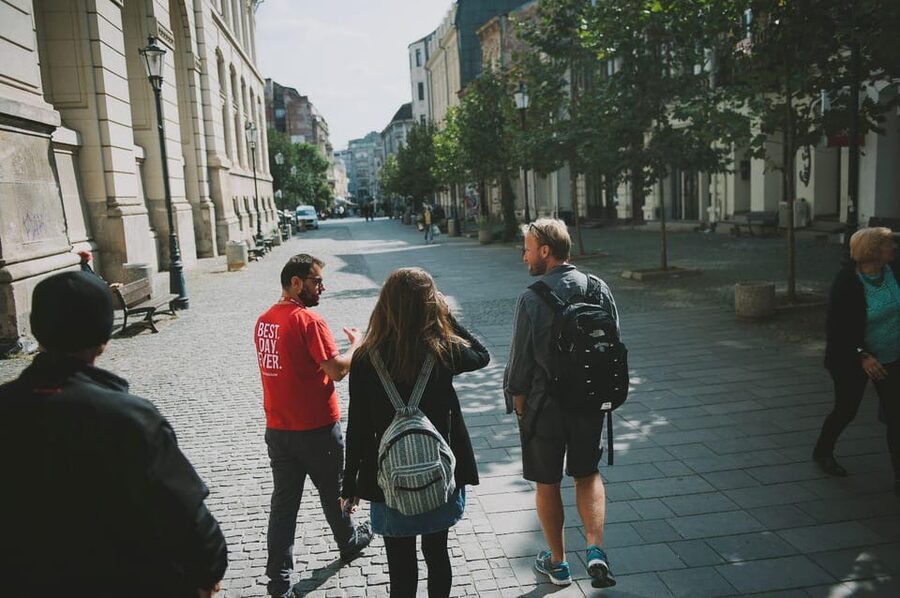
The experience is built around seeing central Bucharest on foot, including Old Town lanes and passageways. Wear casual clothes and comfortable shoes. The provided information does not give an exact walking distance, so anyone concerned about mobility should ask the operator for current route details before booking.
There are no transport details promising a private vehicle or hotel pickup. The meeting point is the Equestrian Statue of Carol I, and the itinerary connects central sights with the final restaurant. Plan to arrive ready for a city walk rather than a ride-based sightseeing trip.
The pace should suit most people who can manage several hours of urban walking, though the tour combines sightseeing with a substantial meal. You can expect some standing outdoors, street crossings, and uneven or narrow areas in the older parts of the city.
Environmental policy and practical value
The operator describes this as a carbon-neutral tour run by a B Corp certified company. That will not change the sights or the meal, but it matters if you want your booking to support a company that has made environmental and social responsibility part of its business model.
The tour offers free cancellation up to 24 hours before the start time, and you can reserve now and pay later. Starting times depend on availability. These are useful protections for a city break, especially when your arrival day is still shifting.
The included meal and drink give the price some real substance. You are not paying $140 only for a guide and a few viewpoints. But the price is still high for a four-hour city tour, so I would choose it for the private attention and food-history connection, not because it is the cheapest way to see Bucharest.
Who should book this experience?
I would choose this tour for a first visit, especially on your first or second day in Bucharest. It gives you a map of the city’s central story, introduces several major sights, and helps you recognize Romanian dishes for the rest of your trip.
It also suits couples, families, and small groups who prefer conversation over a large tour crowd. The private setup is especially helpful if your group has children or if you want to ask detailed questions about architecture, communism, regional food, or daily life.
Food-focused visitors should book with a clear understanding of the format. You get a covrig and a three-course meal, but not necessarily a long series of food samples. If your top priority is tasting many small portions in markets and bakeries, choose a dedicated food crawl instead.
History-minded visitors get the best value. The route moves from monarchy to interwar Bucharest, from Ottoman and regional connections to communist reconstruction, and finally to the post-1989 city. Food gives each chapter a human scale.
Should you book the Bucharest History and Food tour?
Book it if you want a private introduction to Bucharest that mixes major sights, difficult history, and a proper Romanian meal. The guides have been praised for warmth, patience, and strong city knowledge, and the meal gives the four-hour route a satisfying finish.
Skip it if you want a low-cost group walk, a museum-heavy itinerary, or constant food sampling. At $140 per person, the tour earns its price through the private guide, the carefully linked history, and the included three-course meal. For a first-time visitor who wants to understand what Bucharest is showing you, that combination makes a solid start.
FAQ
How long is the Bucharest history and food tour?
The tour lasts four hours.
What language is the tour conducted in?
The tour is conducted in English with a live English-speaking guide.
Is the tour private?
Yes. It is organized for a private group.
Where does the tour meet?
The meeting point is the Equestrian Statue of Carol I in Sector 1, Bucharest, postal code 030167.
What food and drink are included?
The tour includes a three-course Romanian meal and one house beer, wine, or soft drink. A covrig is also included during the route.
Are additional food and drinks included?
No. Additional food and drink, along with souvenirs and personal items, are not included.
Can children join the tour?
Yes. The tour is child-friendly, and children under six may join free of charge. You need to tell the supplier when booking if you are bringing a child under six.
Can I cancel the booking?
You can cancel up to 24 hours in advance for a full refund. The reserve-now, pay-later option lets you keep your plans flexible.
Newest history tours we have reviewed in Romania
- Half-Day Jewish Heritage Walking Tour in Bucharest★ 5.0 · 20 reviews
- Bucharest Historical Food Tour in Old Center★ 5.0 · 21 reviews
- Private Tour – Food, Culture, History & Traditions★ 5.0 · 18 reviews
- Bucharest Heritage City Tour – The Last Days of Communism★ 5.0 · 20 reviews
- Bucharest Jewish Heritage | Holocaust Memorial | Private Car Tour★ 5.0 · 38 reviews
- Experience the History of Bran Castle and Saxon Fortifications in Burzenland★ 5.0 · 19 reviews
- Roma Culture, Realities and Slavery History, Walking tour★ 4.9 · 52 reviews
- Discover Romania’s Wine Heritage in Brasov’s Historic Center★ 4.6 · 19 reviews
Local Culture & Traditions Tours, compared.
Amsterdam Food and Cultural Tour with Tastings
Read our review →
Sevilla Food Tour: Tapas, Wine, History & Traditions
Read our review →
Tromsø: Reindeer Camp and Sami Cultural Tour with Lunch
Read our review →
Half Day Dominican Republic Cultural Tour : Small Group
Read our review →
Ultimate Melbourne Walking Tour: History, Laneways & Culture
Read our review →
Tromsø: Sámi Reindeer Sledding and Sami Cultural Tour
Read our review →
Kyoto Gion: 2-Hour Geisha Culture & History Walking Tour
Read our review →
Marrakech Historical and Cultural Tour – Half Day City Tour
Read our review →Browse the lists this tour appears in