Review · PORTO HISTORY TOURS
Porto: Historical Center Walking Tour
Porto’s old center makes the most sense when you walk it as one connected place, not as a checklist of isolated sights. This tour begins at the Sé Cathedral, drops through steep lanes to Ribeira, then loops back past the city’s grand churches, civic buildings, viewpoints, and railway station. I like the full-city layout and the way the route ties Porto’s religious, commercial, and trading past together. I also like that Lucas, one of the regular guides, adapts his explanations to your interests and adds useful local suggestions, including where to try port from smaller producers.
The main drawback is the terrain. You will tackle alleys, stairs, slopes, and cobbled streets, including the walk toward Ribeira and the climb toward the old Jewish quarter of Juderia do Olival. This tour is not suitable for people with mobility impairments, and even able walkers should bring good shoes.
Five things to know before booking
- The route covers Porto’s main historic spine: You see the cathedral, Ribeira, Bolsa Palace, Clérigos, Lello Bookshop, Aliados, São Bento Station, and the Bishop’s Palace.
- The tour lasts 2.5 hours: That is enough time for orientation and history without turning the outing into an all-day march.
- Lucas is a frequently praised guide: He is known for clear explanations, lively anecdotes, steady pacing, and practical advice beyond the tour.
- The route includes real hills and stairs: Porto is easier to understand on foot, but the same slopes that create its character can be tiring.
- The $32 price is strongest on a first day: You are paying for a local guide who links many sights into one story, not for admission to each attraction.
Starting beside Porto Cathedral
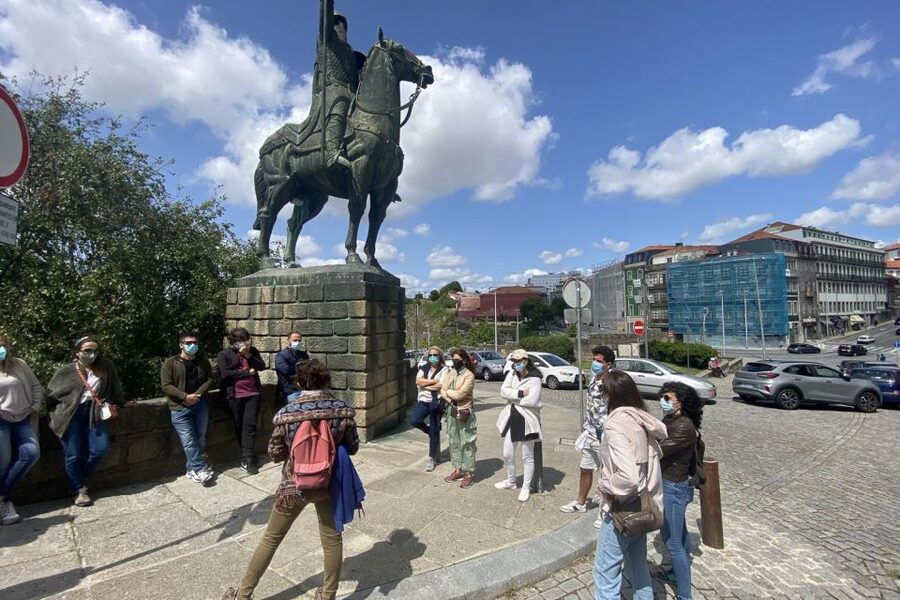
Meet beside the Estátua de Vímara Peres, near the Sé Cathedral. This is a sensible starting point because you begin high above the old center, with the city’s tangled streets spread below you.
The cathedral gives the walk its first major theme: religion and power. You learn how a strong Judeo-Christian framework shaped Portugal and how Porto’s religious buildings helped define the city’s public life. The guided portion here lasts about 15 minutes, enough to set the scene before you move into the streets.
The nearby Bishop’s Palace adds another layer. Its position beside the cathedral makes the relationship between church authority and civic life easy to see. You will return to the Paço Episcopal near the end of the route, so the tour gives you a second look at this part of the city rather than treating it as a quick photo stop.
The starting point can be busy, so take a moment to identify the statue and confirm your guide before the group moves off. One useful practical point comes from the experience itself: Lucas has been praised for his warmth and flexibility, but one person had trouble finding him because he had no sign. Arriving a little early is wise.
More History Walking Tours in Portugal
- Porto: Historic City Center Walking Tour
★ 4.7 · 1,172 reviews - Porto: Historical Center Walking Tour
★ 4.8 · 898 reviews - 3-Hour Porto Jewish Heritage Walking Tour with Local Guide
★ 4.5 · 396 reviews
Down through the lanes to Ribeira
From the cathedral, the route heads down toward Ribeira, Porto’s old riverside trading neighborhood. This is where the city’s shape becomes clear. You leave the high religious district and follow the narrow passages and stairways that connect it with the river.
The walk is more than a transfer between stops. The steep descent shows why Porto has always felt like several cities stacked on top of one another. You get a better sense of the old defensive line and how people, goods, and information once moved through the center.
The Ribeira stop lasts about 15 minutes. Expect an introduction to the neighborhood rather than a long free period. That is useful early in a stay because it helps you decide where to return for a slower meal or an evening walk.
Ribeira is also where you need to watch your footing. Porto’s old streets can be uneven, and the route’s charm depends partly on its original shape. Wear comfortable shoes, not sandals with a slippery sole or anything you would avoid on a steep cobbled street.
St. Francis Church and the Bolsa Palace
The route then follows the line of the fourteenth-century defensive wall and brings you toward two of Porto’s best-known monuments: St. Francis Church and the Palácio da Bolsa, or Stock Exchange Palace.
The church represents Porto’s religious wealth and the dramatic decoration that developed inside its historic places of worship. The Bolsa Palace shifts the story from religion to trade, business, and the city’s outward-looking commercial life. Seeing both in the same walk helps you understand that Porto was shaped by merchants as much as by bishops.
The guided stop at the Bolsa Palace is planned for roughly 15 minutes. That timing matters. You should expect context from outside and around the monument rather than a long interior visit or a full admission tour. The same general rule applies to the other major sights: this is an orientation walk with guided explanations, not a package of entry tickets.
If the Bolsa Palace or St. Francis Church is high on your personal list, save time for a separate visit. The walking tour tells you why they matter, but it does not replace a detailed interior visit.
Vitória, the old Jewish quarter, and the climb back up
After the lower city, the route turns toward Vitória and the area associated with Juderia do Olival, Porto’s old Jewish quarter. The walk up is one of the more revealing parts of the outing because it shows Porto’s layers without needing a museum display.
You will hear about the city’s Jewish, Christian, and commercial influences as the route climbs back toward the upper center. The history is presented as part of the streets around you, which makes the explanation easier to remember than a list of dates.
This section also confirms the tour’s physical demands. You are not simply strolling along a flat avenue. The route uses slopes and stairways, and your pace may feel different here from the opening stretch near the cathedral. The guide has been praised for keeping a steady pace and adjusting to the group, but the tour still requires you to manage Porto’s hills under your own power.
More Old Town and Historic Centre Walks in Portugal
- Porto Guided Tour to the Historical Center on a Tuk Tuk
★ 4.5 · 418 reviews - Porto: Private Tour to the Historic Center in a Classic Car
★ 4.9 · 268 reviews - Porto: Historic Center Tuk-Tuk Tour
★ 4.5 · 244 reviews - Porto: Private & Flexible Walking Tour in Historic Center
★ 4.5 · 35 reviews
Clérigos Church and the Lello Bookshop
The Cordoaria area brings several famous Porto sights together. The guided route includes Clérigos Church and the Livraria Lello, commonly called the Lello Bookshop, with about 15 minutes at each.
Clérigos is one of the city’s most recognizable landmarks, and its tower helps explain why Porto’s upper center is so easy to identify from different points around town. The church and tower also give the tour a useful shift in mood: you move from older defensive and religious districts into an area filled with monumental architecture and public institutions.
The Lello Bookshop is a major draw, but keep your expectations practical. The tour provides an introduction and local context, not a long browsing session. If you want to examine the interior at leisure, you will need separate time and should check the current entry arrangements yourself.
This is one reason I value the walk as a first-day activity. It shows you where the famous places are and helps you decide which ones deserve a return visit. Instead of spending your whole day trying to find them, you get a working map of the center.
Avenida dos Aliados and São Bento Station
From Cordoaria, the route continues to Avenida dos Aliados, Porto’s grand central avenue. The broad space contrasts sharply with the narrow lanes around the cathedral and Ribeira. That change helps you read the city’s growth from medieval streets to later civic planning.
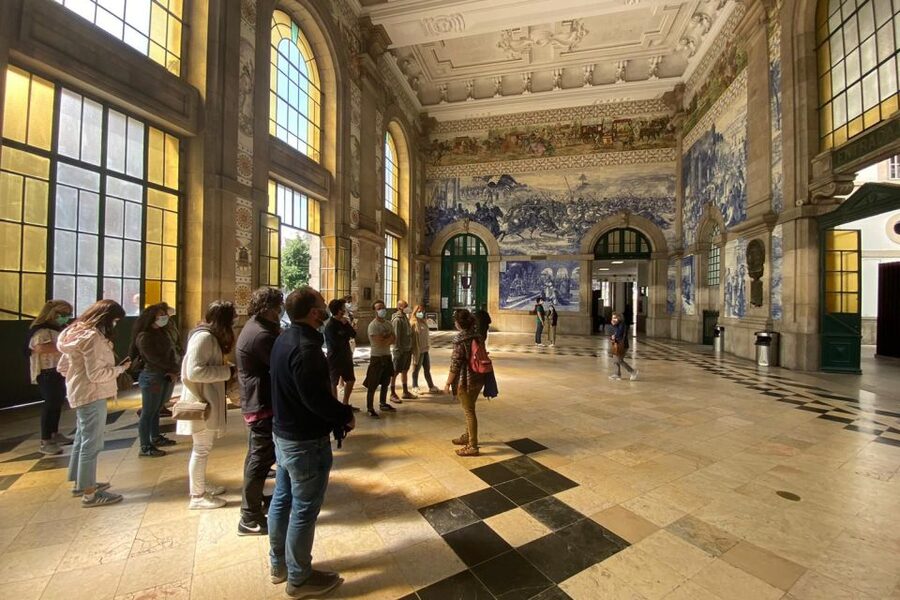
The walk then reaches São Bento Station, where the guided visit lasts about 30 minutes, the longest stop on the route. That extra time is well used because the station is not just a transport hub. Its interior is one of the city’s best-known public spaces, and the guide can place it within Porto’s wider story of travel, trade, and national identity.
For me, São Bento is a particularly useful stop because it is easy to revisit independently. You can return later before a train journey or while exploring the center, and you will already know what details to look for.
The station also makes a good orientation point for the rest of your stay. From here, you are close to several central streets and monuments. The tour does not provide transportation, since the entire experience is on foot, but the route leaves you better prepared to navigate Porto on your own.
Returning to the Bishop’s Palace
The final section returns toward the Paço Episcopal and the cathedral area before ending where you began. That loop is more useful than finishing somewhere random. You can walk straight to another central sight, return to your accommodation, or use the cathedral as a fixed reference point.
The Bishop’s Palace provides a fitting final note because it connects back to the religious power introduced at the start. By this point, you have seen the city’s main themes in sequence: cathedral authority, riverside trade, defensive walls, Jewish heritage, church wealth, civic architecture, books, rail travel, and the role of the upper center.
The route’s design gives you a broad understanding of Porto without asking you to spend a full day on one subject. It is especially useful if you have only a short stay or if Porto is your first stop in Portugal and you want historical context before exploring alone.
What the $32 price actually buys you
At $32 per person, this is not the cheapest way to walk around Porto, since you could follow many of the streets without a guide. The value comes from the connections. A local guide turns the cathedral, Ribeira, Bolsa Palace, Clérigos, Lello, Aliados, São Bento, and the Bishop’s Palace into one readable story.
The price includes the walking tour and a local guide, but not admission tickets to attractions. That distinction matters. You are paying for explanation, route planning, and local perspective rather than bundled entry.
I would consider the price fair for a first visit, particularly if you want to avoid spending your opening morning stopping constantly to check a map. It is less compelling if you already know Porto well or prefer to explore at your own speed with no fixed route.
The guide’s contribution is central. Lucas is repeatedly described as personable, passionate about Porto, and good at answering questions. He also gives restaurant and local activity suggestions, and one particularly useful tip concerned smaller port producers. Andreia is also named as a guide, so the exact guide may vary.
Pace, language, and practical comfort
The tour runs for 2.5 hours and is offered in English or Spanish. That is a good length for a city introduction. You cover a lot, but the schedule does not try to turn every monument into a full lecture.
The itinerary gives most stops about 15 minutes, with 30 minutes at São Bento Station. This means you should expect a moving tour with short explanations, not long periods inside each building. If you like to take many photographs or read every plaque, you may want to return afterward.
Wear comfortable clothes and sturdy walking shoes. Porto’s slopes, stairs, and cobbles are the main practical issue. Intoxication, littering, and nudity are not allowed, which is hardly surprising but useful to know for a walking activity in a historic district.
Free cancellation is available up to 24 hours before the start for a full refund, and you can reserve now and pay later. Check the available starting times when booking, since the schedule is not fixed in the information provided.
Who will enjoy this walk most
I would choose this tour for a first visit, a short stay, or the first morning of a longer trip. It gives you a useful mental map and leaves you with plenty of ideas for independent exploring.
It also suits you if you like history explained in plain language rather than delivered as a formal lecture. Lucas has been praised for adapting to interests, answering questions, keeping a steady pace, and adding anecdotes that bring Porto’s past to life.
The tour is less suitable if you need step-free access, dislike hills, or want extensive time inside individual attractions. It is also not the best fit if you prefer a completely unstructured walk. The route is thoughtfully planned, but you follow its rhythm.
Should you book the Porto Historical Center Walking Tour?
Book it if you want to understand how Porto fits together before you explore its monuments alone. The mix of cathedral, riverside lanes, defensive walls, Jewish quarter, churches, civic buildings, Lello, Aliados, and São Bento gives you a strong first look at the city.
Skip it if your priority is entering every major attraction or avoiding stairs. For most first-time visitors who can manage Porto’s hills, the $32 fee is a sensible investment in orientation, context, and local advice. Arrive early at the Vímara Peres statue, wear proper shoes, and treat the tour as your city map in human form.
FAQ
How long does the Porto Historical Center Walking Tour last?
The tour lasts 2.5 hours.
How much does the tour cost?
The price is $32 per person.
Where does the tour start?
It starts beside the Estátua de Vímara Peres near Porto Cathedral.
Where does the tour finish?
The route returns to the Estátua de Vímara Peres near the cathedral.
Which languages are available?
The live guide is available in English and Spanish.
What does the price include?
The price includes the walking tour and a local tour guide. Attraction admission tickets are not listed as included.
Is the tour suitable for people with mobility impairments?
No. The tour is not suitable for people with mobility impairments because the route includes hills, alleys, stairways, and uneven historic streets.
More History Walking Tours in Porto
- Porto: Jewish Heritage Walking Tour
★ 4.7 · 266 reviews - PORTO: Historical Walking Tour
★ 4.8 · 92 reviews - Porto: History & Lengends walking tour
★ 5.0 · 31 reviews - Porto: Walking Tour Through History, Culture & Amazing Views
★ 4.5 · 20 reviews
More Old Town and Historic Centre Walks in Porto
- Madrid Essential: Historic Center, Plaza Mayor & Royal Palace
★ 5.0 · 6,416 reviews - Lisbon: Live Fado Show with Port Wine in Historic Center
★ 4.7 · 4,166 reviews - Valencia Old Town Tour with Wine & Tapas in 11th Century Historic Monument
★ 5.0 · 3,234 reviews - Prague Old Town, Medieval Underground and Dungeon Historical Tour
★ 4.5 · 3,227 reviews
Newest history tours we have reviewed in Porto
- Porto: Walking Tour Through History, Culture & Amazing Views★ 4.5 · 20 reviews
- Porto Region Museum: a Thousand Years Of History★ 4.2 · 22 reviews
- Porto: Private Tour to the Historic Center in a Classic Car★ 4.9 · 268 reviews
- PORTO: Historical Walking Tour★ 4.8 · 92 reviews
- Porto: Private & Flexible Walking Tour in Historic Center★ 4.5 · 35 reviews
- Porto: History & Lengends walking tour★ 5.0 · 31 reviews
- Porto: Historic Center Tuk-Tuk Tour★ 4.5 · 244 reviews
- From Porto: Full-Day Douro Historical Tour★ 4.6 · 120 reviews
Old Town & Historic Centre Walks, compared.
Madrid Essential: Historic Center, Plaza Mayor & Royal Palace
Read our review →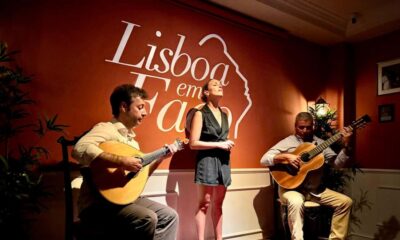
Live Fado Show with Port Wine in Historic Center
Read our review →
Valencia Old Town Tour with Wine & Tapas in 11th Century Historic Monument
Read our review →
Prague Old Town, Medieval Underground and Dungeon Historical Tour
Read our review →
Cartagena: Historic Center and Getsemaní Shared Walking Tour
Read our review →
Old Town Walking Tour History and Tales in Edinburgh
Read our review →