
Review · FRANCE HISTORY TOURS
Strasbourg on Foot: Historic Center and Petite France with a Local Guide
Strasbourg’s best introduction is on foot, and this tour links its grandest sights with its most atmospheric lanes. In two hours, you move from the enormous Gothic cathedral and princely Rohan Palace to the canals and half-timbered houses of La Petite France, with the city’s medieval defenses connecting the story.
I like the logical route, which helps you understand how Strasbourg fits together rather than seeing isolated monuments. I also like the personal touches: guides such as Leila, Stefania, and Stef explain the city with energy, answer questions, and share food tips, restaurant suggestions, and a small Alsatian sweet tasting.
The main thing to keep in mind is time. Two hours is enough for a strong overview, but not for a careful visit inside every landmark. The cathedral experience may be mainly exterior, so check exactly what your booked option includes if entering the church or seeing the astronomical clock is important to you.
Key points to know before you book
- The route covers Strasbourg’s essential old town: Place Kléber, the cathedral, Rohan Palace, Gutenberg Square, Saint-Thomas Church, the Covered Bridges, and Petite France.
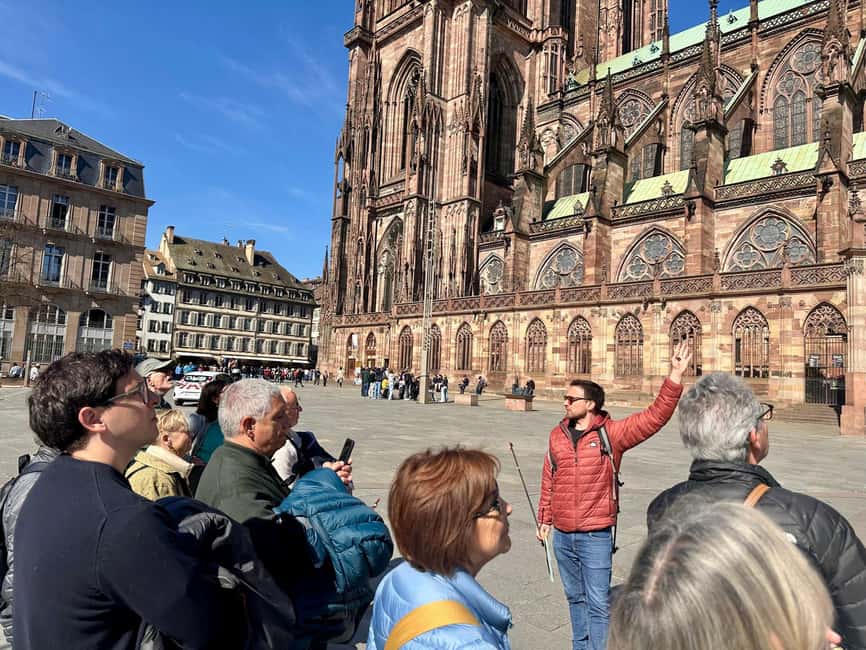
- The cathedral is a highlight from the outside: Its 142-meter tower dominates the city, but interior entry is not clearly guaranteed.
- Guides add practical help: Leila, Stefania, Stef, Maya, and Javier are among the guides named in recent tour experiences.
- The walk ends in Petite France: You finish beside canals, old mills, traditional houses, and the former Tanners’ Quarter.
- The pace is made for sightseeing: The walk lasts two hours, with short explanations at each main stop rather than long museum visits.
- The $34 price is fair for a first look: You receive a live guide, local recommendations, a map, and a typical Alsatian sweet tasting.
Starting in Place Kléber, Strasbourg’s open-air living room
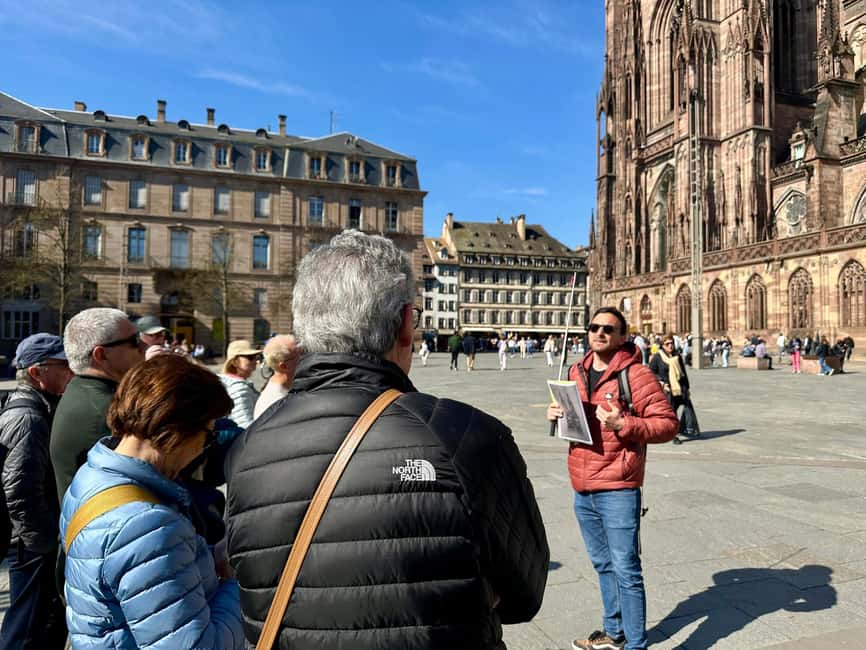
The tour begins at Place Kléber, the broad central square and a useful meeting point in the old city. It is Strasbourg’s social heart, with shops, cafés, and room to get oriented before the streets narrow around the cathedral.
At Christmas, this square takes on a different mood. A huge decorated tree becomes the center of the city’s festive display, and the surrounding lights make the opening minutes especially appealing in December. If you visit outside the holiday season, the square still works well as a starting point because it gives you a clear sense of direction.
The tour may have more than one meeting-point option, including 14 Rue Mercière, so check your booking details carefully. Arrive with a little time to spare. The old center is easy to explore on foot, but a wrong turn around the cathedral streets can cost you the start of a short tour.
The guide uses this opening stop to set up Strasbourg’s story. That matters because the city can look like a collection of handsome buildings at first. A good explanation helps you connect the commercial center, religious quarter, waterways, defensive walls, and craft districts into one city.
More History Walking Tours in France
- Paris: Dark History and Ghostly Guided Walking Tour
★ 4.7 · 1,000 reviews - Vieux Lyon Cultural & Historical Walking Guided Tour (English)
★ 5.0 · 942 reviews - Strasbourg: Guided Historical Neighborhoods Walking Tour
★ 4.9 · 275 reviews
The cathedral and its 142-meter Gothic tower
Notre-Dame de Strasbourg is the visual anchor of the walk. Its single finished tower rises 142 meters above the old center, and the pink sandstone facade changes color with the light. Even if you have seen Gothic churches elsewhere in France, the scale and vertical reach here make it a powerful first major stop.
The guide explains the cathedral’s place in Strasbourg’s history and points out architectural details that are easy to miss when you are simply taking photographs. You can expect about 15 minutes of guided attention here, enough to understand the building and its role in the city without turning the walk into a full architectural lecture.
The description of the experience refers to the interior, medieval stained glass, and astronomical clock. At the same time, the inclusions specify the outside of Notre-Dame, so you should not assume that interior admission is part of the $34 fee. If the church is open and you want to enter, ask the guide what is possible on the day. The famous astronomical clock has set display times, so a two-hour walking tour cannot promise that you will see its moving figures or mechanisms in action.
That limitation is not a deal breaker for me. The cathedral exterior is one of Strasbourg’s essential sights, and the tour gives you context before you return on your own. If you want a quiet interior visit, stained-glass study, or clock viewing, set aside extra time after the walk.
Rohan Palace and the city’s grander side
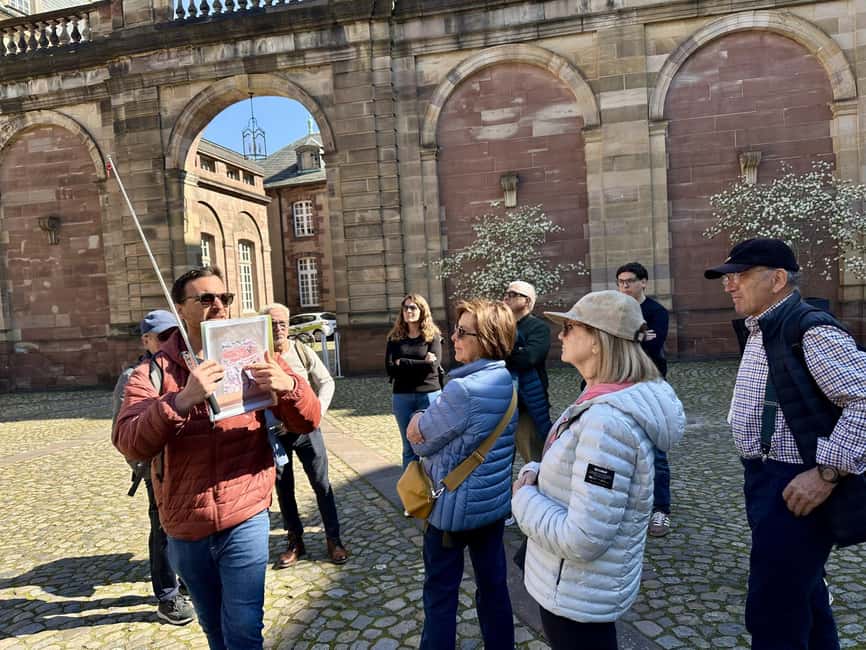
From the cathedral, the route continues to Rohan Palace, a large 18th-century residence built for Strasbourg’s princes and cardinals. This stop shows a different side of the city. Petite France feels medieval and working-class, while the palace represents wealth, church power, and formal European politics.
The palace now houses museums including Fine Arts and Decorative Arts. The walk provides an introduction rather than a museum visit, so you will hear about the building and its former residents without spending time inside the collections. Stories linked to Marie Antoinette and Napoleon give the palace a human scale and help explain why this handsome building mattered beyond its facade.
I find this contrast useful. The tour is not only a procession of pretty streets. It shows you how Strasbourg moved between religious authority, political power, commerce, and craft. You also get a chance to note the museum for a later visit if art or decorative interiors interest you.
Expect roughly 10 minutes here. That is enough for an overview, but not for the palace’s full architectural details. If you prefer museums to walking, treat this as a preview and return later with a separate admission.
From the old customs house to Gutenberg Square
The route then passes L’Ancienne Douane, the former customs house, and Place des Tripiers. These stops bring the city’s working past into view. Strasbourg grew around movement: goods came along the waterways, traders crossed the old center, and local crafts shaped the neighborhoods.
Place Gutenberg adds a civic and cultural layer. Named for Johannes Gutenberg, who lived in Strasbourg for a period before his work in printing transformed Europe, the square is a natural place to discuss ideas, commerce, and the city’s links beyond Alsace. It also helps you understand the old center as more than a preserved medieval setting. It was a place where people worked, traded, worshiped, and argued.
The guide spends about 10 minutes at each of these points. That rhythm keeps the walk moving, though it also means the level of detail depends on the guide and the questions asked. Leila and Stefania are noted for making room for questions and remembering names, while Maya is praised for food suggestions and places to eat. Those personal exchanges can be more useful than another long list of dates.
More Old Town and Historic Centre Walks in France
- Bordeaux: Historic Center & Chartrons District Bike Tour
★ 4.8 · 709 reviews - Rouen: Guided Tour of the Historic Center
★ 4.8 · 145 reviews - Strasbourg: Private Walking Tour of the Historical Center
★ 4.2 · 107 reviews - Avignon: Historic District Guided Food & Wine Walking Tour
★ 4.8 · 84 reviews
Saint-Thomas Church and Strasbourg’s religious mix
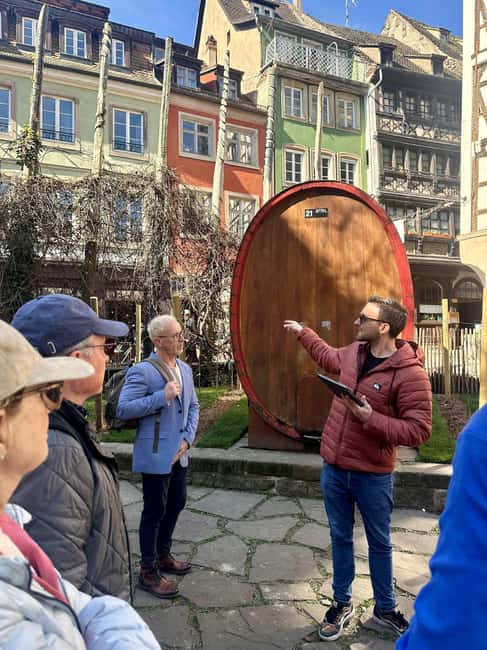
Église Saint-Thomas is another important stop on the way toward the western side of the old center. The church helps broaden the religious story beyond Notre-Dame and the Catholic cathedral quarter. Strasbourg’s past includes changing political control and different Christian traditions, and Saint-Thomas gives the guide a place to explain that layered identity.
The stop is brief, around 10 minutes. You should think of it as a historical marker rather than a full church tour. If the church interior is open and you are interested, note it for a return visit, since the walking schedule does not leave much time for extended exploration.
This is one reason I recommend taking the tour early in your stay. The guide can point out places you may want to revisit at a slower pace. Several guides also share recommendations for restaurants and activities, which gives you a useful list for the rest of your time in Strasbourg.
The Covered Bridges and medieval defenses
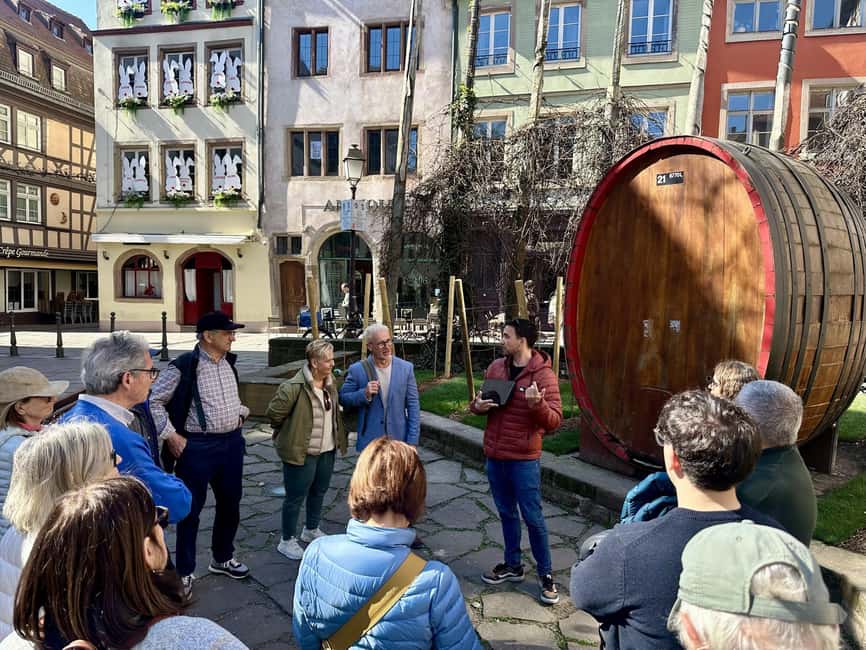
The walk becomes especially atmospheric at the Covered Bridges. These medieval structures once had wooden roofs and formed part of Strasbourg’s defensive system. Today, the roofs are gone, but the bridges, canals, and defensive towers still make this one of the city’s most memorable views.
Here you get a clear sense of how water shaped Strasbourg. The canals were not just scenic decoration. They helped move goods, supported mills and workshops, and formed part of the city’s defenses. The towers show how the old town protected its edges before modern military systems changed the way cities were defended.
The guide’s job here is to connect the view in front of you with the city’s growth. Look for the relationship between the water, stone towers, bridge crossings, and dense old buildings. This is a good photography stop, but it is also one of the places where a short explanation adds real value. Without context, you may see only a picturesque canal. With context, you can read it as part of Strasbourg’s working infrastructure.
The route is still on foot, with no transport between stops. Wear comfortable shoes and expect cobbled or uneven surfaces in parts of the old center. The pace is generally described as manageable, including for people who prefer not to hurry, but the walk remains active from beginning to end.
Petite France and the former Tanners’ Quarter
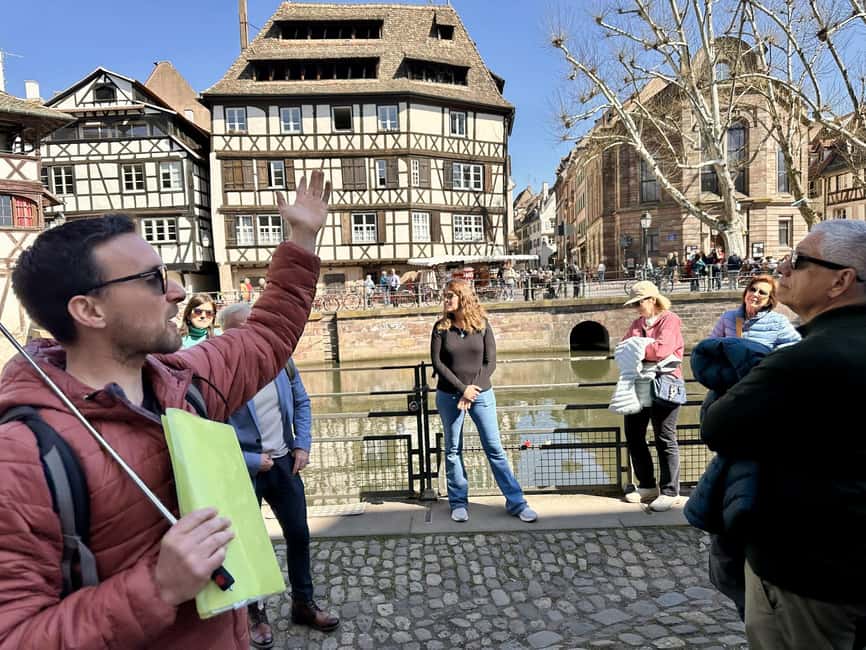
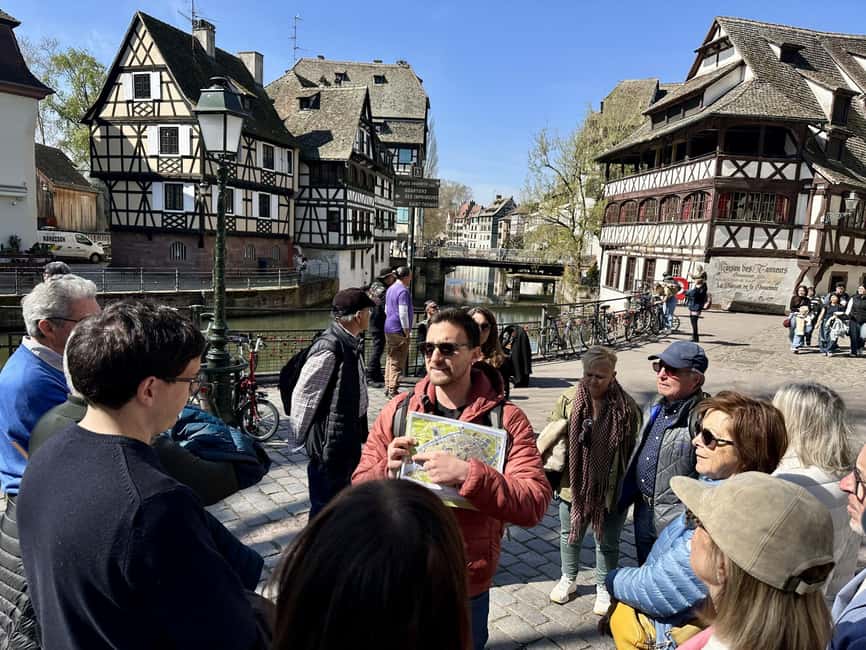
The final section leads into Petite France, the part of Strasbourg that appears on countless postcards for good reason. Half-timbered houses line narrow streets, canals reflect the old facades, and the area preserves the feel of a district shaped by fishermen, tanners, millers, and other trades.
The Tanners’ Quarter is especially useful for understanding the neighborhood. Those tall, traditional houses were connected to practical work, not built simply for decoration. Water was essential to tanning and milling, and the canals explain why these trades developed here. The setting is beautiful now, but the guide helps you see its rougher, busier working past.
This is where the route earns its name. You are not merely walking through a postcard scene. You are seeing the artisanal origin of the old city and the way waterways shaped daily life. The walk ends in the heart of Petite France, giving you time to look around, take photographs, or stop for food after the guide departs.
Keep in mind that Petite France is often the most crowded and photographed part of the route. The guide can help you understand the main lanes and viewpoints, but you may want to return early or later in the day for a quieter look.
What the guides add to the walk
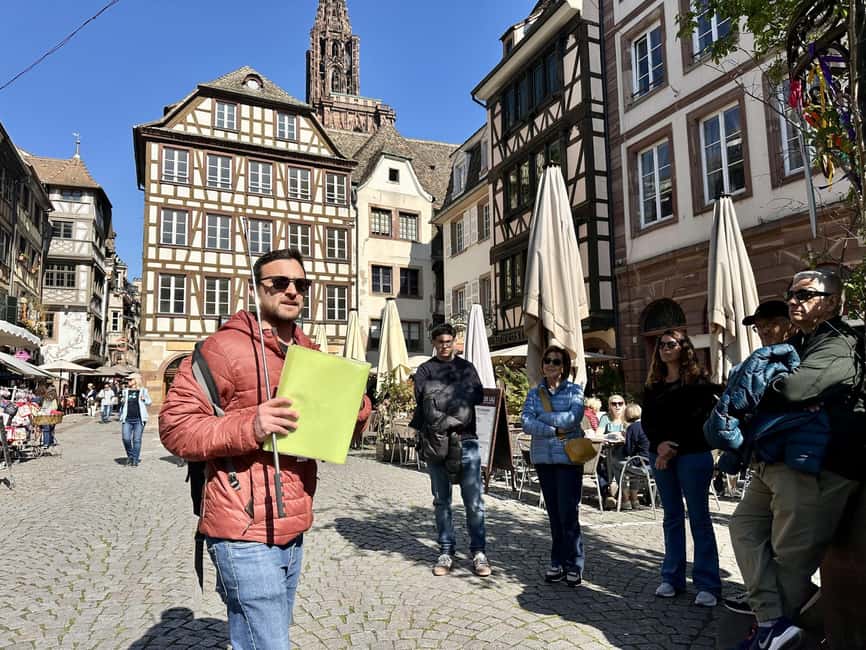
The guide is the biggest variable in any short city tour, and the named guides associated with this experience bring different strengths. Leila is described as warm, engaging, well prepared, and good at linking major historical periods into one story. Stefania is praised for remembering names, answering questions, and keeping the group involved.
Stef is presented as energetic and passionate about Alsace, with useful local suggestions and a comfortable pace. Maya is noted for restaurant advice and practical ideas for what to do next. Javier is described as friendly and well informed. Your guide will vary, and the language option is either English or Spanish.
The best part of this style of tour is the conversation. You can ask why a street looks the way it does, where to eat local food, or which museum deserves your time. The tour also includes a city map and recommendations, so the advice does not end at the final stop.
Some departures use headphones, which can make the guide easier to hear in busy squares. That is a practical advantage, especially when the group spreads out around a monument. Group size is not provided, so you should not book expecting either a private walk or a guaranteed small group.
Is $34 a good value for two hours?
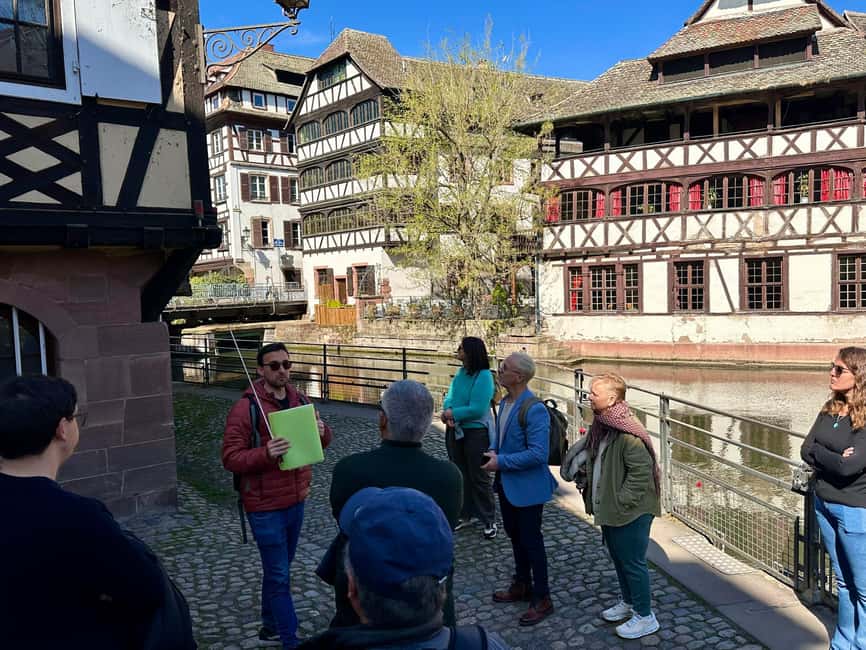
At $34 per person, this is a reasonable price for a first orientation to Strasbourg. You are paying for a live guide, a structured two-hour route, historical explanations, a map, local recommendations, and a small tasting of a typical Alsatian sweet.
The value is strongest if this is your first day in the city. You see the major historic areas without spending time working out the route yourself, then you can return to the cathedral, palace, or Petite France with a better sense of what deserves extra attention.
The value is weaker if you already know Strasbourg well or prefer slow independent exploration. Two hours moves quickly, and the tour does not replace museum entry or a full cathedral visit. You will still need to pay for anything outside the walking experience, including any optional admissions and your guide’s tip, which is based on your satisfaction.
Free cancellation up to 24 hours before the start and reserve-now, pay-later booking add flexibility. Starting times depend on availability, so check the selected option rather than assuming every departure runs at the same hour.
Who should book this Strasbourg walk?
I would recommend it to first-time visitors, couples who want a gentle introduction, families with older children, and anyone arriving by train or spending only a short time in Strasbourg. It is also useful if you want a quick cultural framework before choosing restaurants, museums, and later walks.
The tour suits you if you enjoy stories, architecture, and local orientation more than formal museum visits. The guides are praised for keeping the mood friendly and answering questions, so it works well for a mixed group with different ages and interests.
You may prefer to skip it if you want a private experience, extensive time inside the cathedral, or a specialist architectural tour. You should also allow extra time after the finish if you want to explore Petite France slowly, enter the museums at Rohan Palace, or wait for the cathedral clock display.
My verdict: a smart first walk in Strasbourg
I would book this tour early in a Strasbourg stay. Its strongest feature is the way it connects the cathedral, palace, commercial squares, defenses, canals, and craft quarter into one walk. The city feels easier to read afterward.
Book it for the guide’s local stories and practical advice, not for long interior visits. At $34, it offers good value when you want a clear introduction in two hours, with the option to return later to the places that catch your eye.
FAQ
How long does the Strasbourg walking tour last?
The guided tour lasts two hours.
What languages are available?
The live tour guide is available in English or Spanish. Some content may be presented in its original language.
Where does the tour start?
The meeting point can vary by the option booked. One listed starting point is 14 Rue Mercière, and the route begins around Place Kléber.
Where does the tour finish?
The walk finishes in Petite France.
Is entry inside Notre-Dame Cathedral included?
The included details specify a visit outside Notre-Dame Cathedral. Check your selected option if entering the cathedral is important to you.
Does the tour visit Rohan Palace?
Rohan Palace is included as a guided stop. The experience introduces the palace and its history, but a separate museum visit may be needed for extended time inside.
What does the price include?
The price includes the two-hour guided walk, the Petite France tour, historical and cultural explanations, a city map, recommendations, and a tasting of a typical Alsatian sweet.
Can I cancel the booking?
You can cancel up to 24 hours in advance for a full refund. Reserve-now, pay-later booking is also available.
Newest history tours we have reviewed in France
- Avignon: History and Legend Walking Tour★ 4.8 · 122 reviews
- Avignon: Private Walking Tour – Discover History & Heritage★ 4.3 · 45 reviews
- Avignon: Historic District Guided Food & Wine Walking Tour★ 4.8 · 84 reviews
- Arc de Triomphe Rooftop: Unveil History & Breathtaking Views★ 3.1 · 23 reviews
- Arles: Private Guide Tour – Explore History & Culture★ 4.3 · 22 reviews
- Aix-en-Provence: Between History and City Charm★ 4.9 · 30 reviews
- The History of Paris: Historical Le Marais Private Tour★ 4.5 · 47 reviews
- Private Half Day Historic Tour★ 5.0 · 58 reviews
Old Town & Historic Centre Walks, compared.

Madrid Essential: Historic Center, Plaza Mayor & Royal Palace
Read our review →
Live Fado Show with Port Wine in Historic Center
Read our review →
Valencia Old Town Tour with Wine & Tapas in 11th Century Historic Monument
Read our review →
Prague Old Town, Medieval Underground and Dungeon Historical Tour
Read our review →
Cartagena: Historic Center and Getsemaní Shared Walking Tour
Read our review →
Old Town Walking Tour History and Tales in Edinburgh
Read our review →
Philadelphia Old City Historic Walking Tour with 10+ Top Sites
Read our review →Browse the lists this tour appears in