
Review · ITALY HISTORY TOURS
Discover Herculaneum: A guided tour of the ancient Roman city
Herculaneum gives you something Pompeii cannot quite match: a close look at Roman homes where wooden doors, partitions, and household objects survived the eruption of Vesuvius in 79 AD. The site is smaller and usually less crowded, so your guide can focus on how people actually lived, not just on dates and ruins.
I especially like the skip-the-line entry and the two-hour format. You get a clear route through the grand houses, including the House of the Deer and the Houses of Neptune and Amphitrite, then you can stay inside and continue alone. The main thing to consider is that transport is not included in the standard option, and the site is not suitable for wheelchair users.
Guides such as Danilo and Celestina have earned praise for their humor, warmth, and ability to explain daily Roman life in plain language. If you choose the Vesuvius combination, the day becomes much longer, with fixed bus departures and about two hours at the volcano, so check the timetable before booking.
Key points at a glance

- Roman homes with surviving wood: See the House of the Wooden Partition and other rare timber remains preserved by the eruption.
- A focused two-hour visit: The guide covers the key houses and mosaics without turning the tour into an all-day history lesson.
- Less crowded than Pompeii: Herculaneum offers a more intimate look at domestic life in a compact archaeological site.
- Standout decorated rooms: The Houses of Neptune and Amphitrite contain refined mosaics and colorful decoration.
- Strong guiding style: Danilo and Celestina are among the guides praised for clear explanations, humor, and enthusiasm.
- Optional Vesuvius day: Add national park entry and bus service from Naples, with set departure times and a return to Naples.
Why Herculaneum feels different from Pompeii
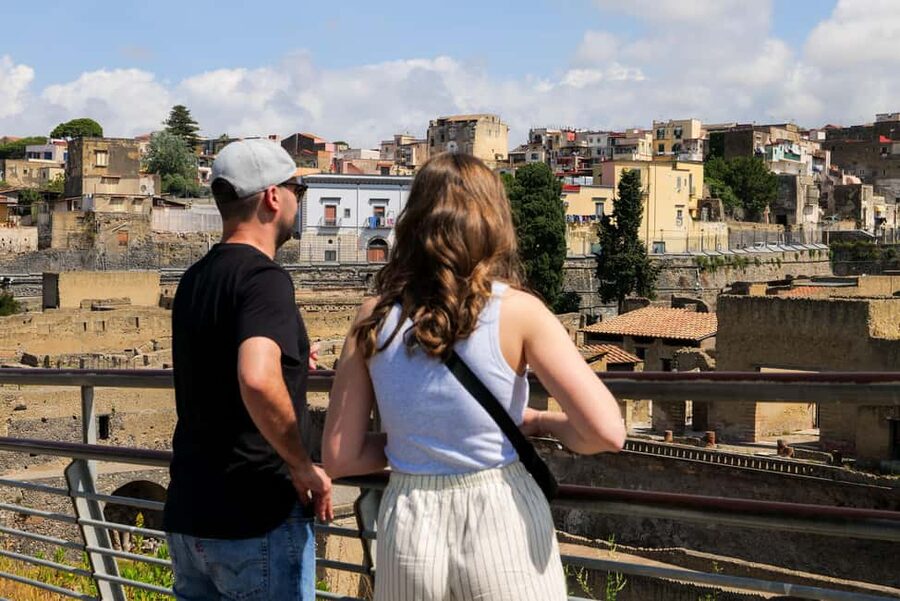
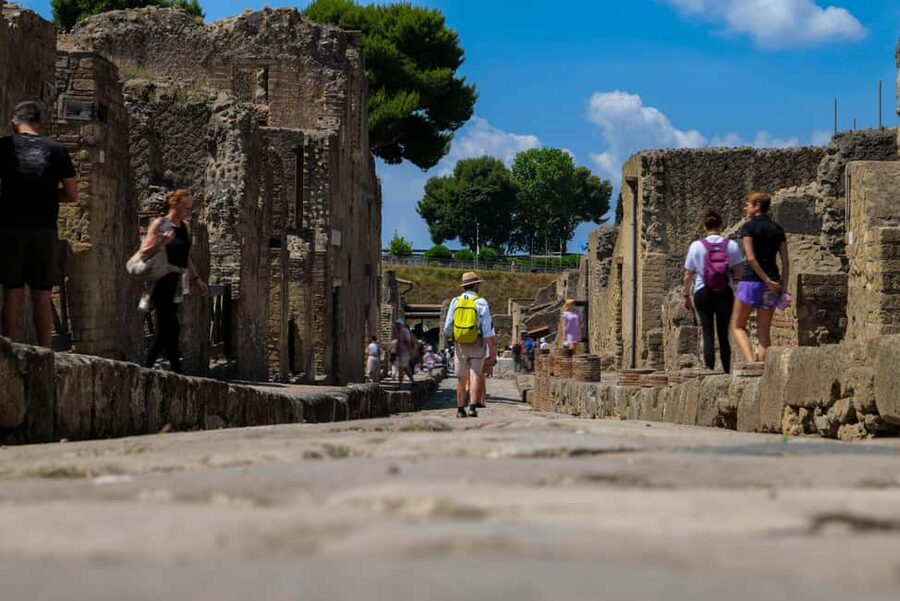
Herculaneum was a Roman seaside town, and its remains often feel more personal than monumental. Pompeii gives you a huge city spread across a broad area. Herculaneum gives you the feeling of walking through a neighborhood, with houses, rooms, mosaics, wall paintings, and objects close enough to study.
The eruption preserved the town in unusual ways. Hot volcanic material covered buildings and sealed away items that normally disappear over time. That includes charred wood, household fittings, and architectural details that help you picture Roman interiors rather than just Roman walls.
This is the real strength of the visit. Your guide can point out how rooms were arranged, where decoration mattered, and what certain objects reveal about ordinary life. The tour is not only about the disaster. It is about the people who lived in these houses before Vesuvius changed everything.
The smaller scale also matters. You are less likely to feel lost than at Pompeii, especially if this is your first ancient site. Two hours is enough to see the key areas with context, though it is not enough to examine every corner at a slow pace.
More Ancient History Tours in Italy
- Colosseum: Underground and Ancient Rome Tour
★ 4.7 · 12,691 reviews - Colosseum & Ancient Rome with Arena Floor Option I Max 6 People
★ 5.0 · 3,306 reviews - Rome: Colosseum, Ancient Rome Tour or AudioGuided Tour
★ 4.4 · 2,879 reviews
Meeting your guide and getting through the gate
Your meeting point depends on the option you book. Look for the inStazione logo and make sure you read the instructions sent before your visit. The operator provides assistance and handles the entry ticket, which takes away some of the usual uncertainty at a major archaeological site.
The ticket includes skip-the-line access. That does not mean you can ignore the meeting time. A guided group still needs to gather and enter together, so arrive with enough time to find the correct meeting point.
Live guiding is available in French, English, and Italian. The standard tour is described as a two-hour guided visit in French, while the activity also lists English and Italian guide availability. Check the language and start time shown for your chosen date before paying.
Wear comfortable shoes. Ancient paving can be uneven, and you will spend the visit on foot. A sun hat is useful, especially in warm weather, since you will be outdoors for much of the archaeological visit.
The two-hour route through Herculaneum
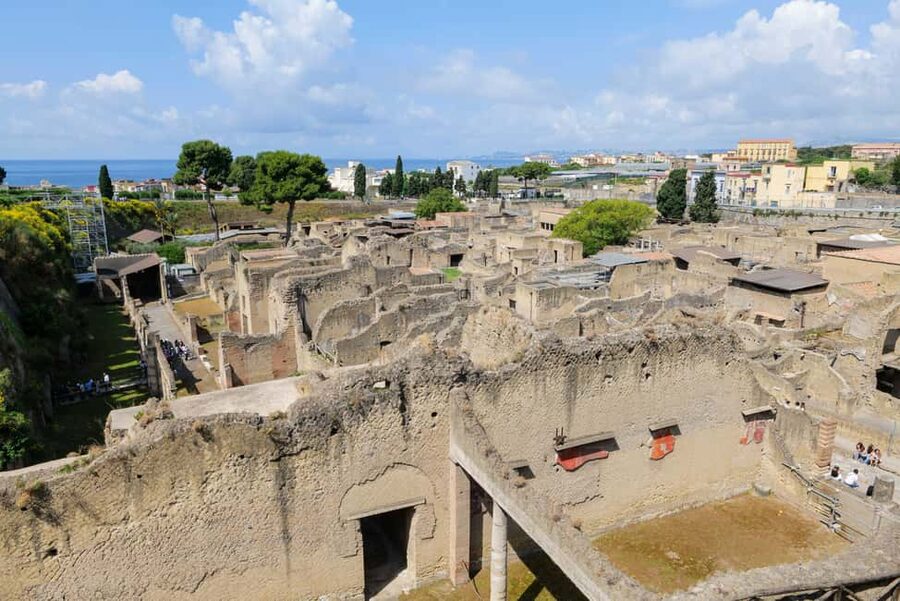
The tour is built around the parts of Herculaneum that best explain domestic Roman life. Your guide will connect the buildings rather than simply point at them, helping you understand why one house looks grander than another and what the surviving decoration tells you.
You should expect a steady walk through the site, with stops for explanation. The exact order can vary, but the advertised highlights include several luxurious homes and the decorated Houses of Neptune and Amphitrite.
Two hours is a sensible length for this kind of visit. It is long enough to gain a working understanding of the town, but short enough for most people to stay alert. The danger with ancient sites is information overload. A good guide keeps the story moving and gives you a useful framework for exploring more on your own.
The strongest part of the experience is the translation from stone to daily life. A bare room can be easy to overlook. With an explanation of its layout, decoration, or surviving fittings, it becomes a dining room, courtyard, reception space, or private part of a Roman home.
House of the Deer and the grand Roman home
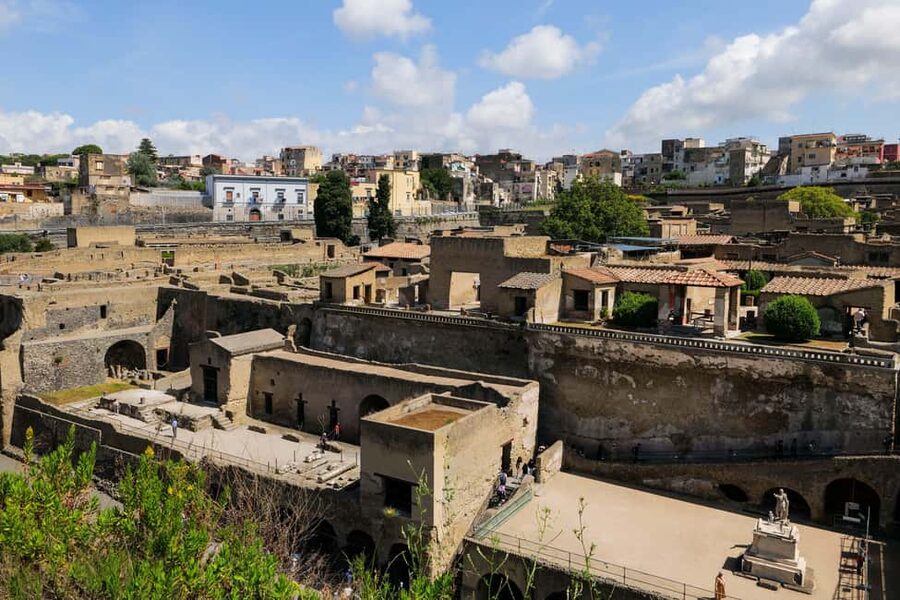
The House of the Deer is one of the clearest examples of Herculaneum’s wealthier domestic architecture. Its name comes from sculptures of deer, and the house is associated with elegant spaces and views toward the ancient shoreline.
You will not simply be seeing a large empty building. The value comes from the way the rooms, decoration, and surviving remains work together. Your guide can explain how a wealthy Roman family used its home to display status, host people, and separate public life from private life.
This is also a good place to listen for social context. A luxurious house tells you about the upper end of Roman society, not the whole population. That makes it useful, but it should not be mistaken for a typical home. The tour gains balance by placing these grand residences alongside the evidence of everyday life found elsewhere on the site.
More Pompeii and Vesuvius History Tours in Italy:
- Discover the Ancient Ruins of Pompeii: Day Trip from Rome
★ 3.5 · 2,247 reviews - Small-Group Rome to Pompeii & Amalfi: Day of History & Sea
★ 5.0 · 239 reviews - Ancient Pompeii Private Tour: Skip the Line & Kid-Friendly Option
★ 5.0 · 167 reviews - Skip-the-Line Half-Day Private Tour Ancient Pompeii Highlights with Native Guide
★ 5.0 · 146 reviews
House of the Bicentennial and House of the Wooden Partition
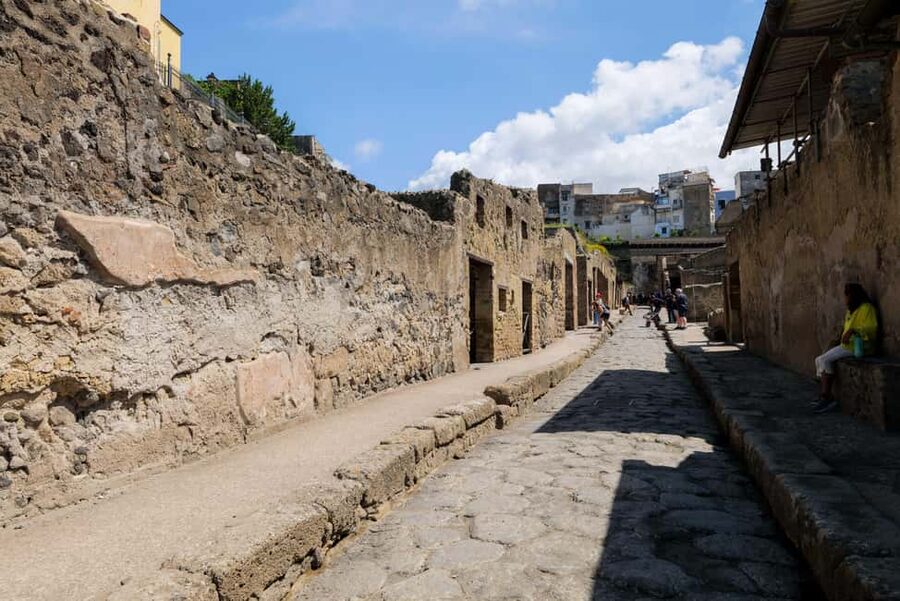
The House of the Bicentennial is another major stop. Its decorated rooms and careful construction show the taste and resources of a prosperous household. Pay attention to the wall surfaces and layout, since Roman houses used architecture and decoration to guide how people moved through the home.
The House of the Wooden Partition is especially valuable because timber rarely survives at ancient sites. Here, the eruption preserved wooden elements that give the building a more human scale. You can better imagine doors, dividers, and furnishings instead of picturing Roman life as a world made only of marble and stone.
These details are easy to miss if you walk through alone. A guide can tell you why a blackened beam or wooden fitting matters. The charred appearance is not decorative damage. It is evidence of the intense conditions that sealed the town and preserved material that would normally have rotted away.
This is one reason Herculaneum can feel more immediate than a larger ruin field. A wall tells you that a building existed. A preserved wooden partition suggests how someone used the room.
Mosaics at the Houses of Neptune and Amphitrite
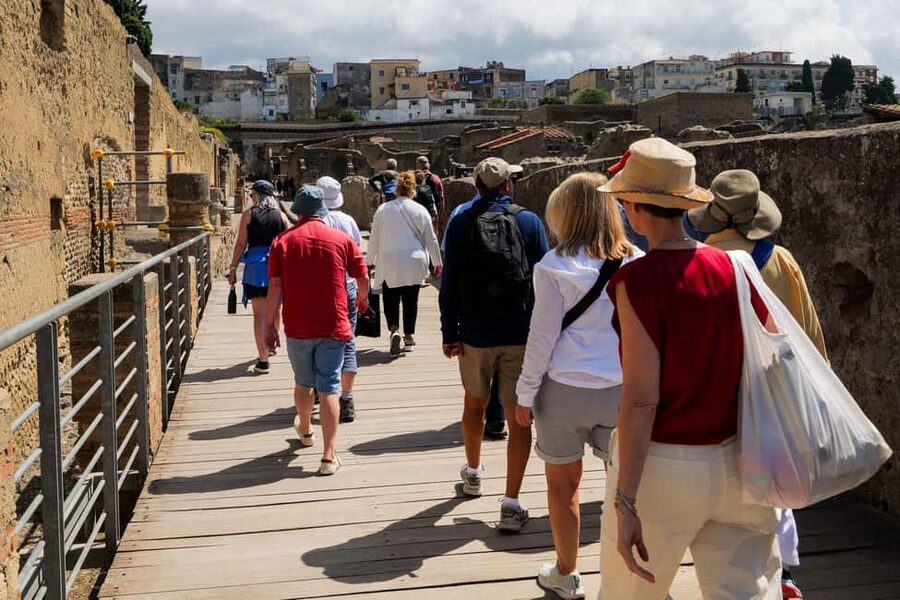
The Houses of Neptune and Amphitrite are among the most visually rewarding stops. Their mosaics show the care Roman homeowners gave to interior decoration, with detailed patterns and marine imagery associated with Neptune and Amphitrite.
The mosaics are not just pretty surfaces. They help explain how rooms were designed to impress. Flooring, walls, fountains, and color worked together to create a controlled visual experience for residents and visitors.
Allow yourself time to look closely at the small details rather than taking only a quick photograph. Your guide can explain what you are seeing and place the decoration within the wider Roman habit of displaying wealth through the home.
This section also breaks up the heavier archaeological material. After hearing about the eruption, preserved wood, and daily routines, the mosaics remind you that Herculaneum was a living town with taste, money, and ambition before it became an archaeological site.
What the guide adds to the experience

The guide is the main reason to choose this tour instead of simply buying entry and walking through alone. The site contains plenty of information, but signs cannot always explain how the rooms relate to Roman customs or why a particular feature matters.
The best guiding style here is practical and visual. You want someone who can take a surviving object and connect it to the people who used it. Feedback about Danilo highlights his patience, humor, enthusiasm, and ability to make Roman history feel immediate. Celestina is also praised for clear and interesting explanations.
Guide assignments can change, so you should not book on the assumption that one specific person will lead your group. Still, the repeated praise for warm, engaging guides is useful. This is not a silent walk with a guide holding a flag. The experience depends on questions, explanations, and a willingness to look closely.
The tour is also a good fit for people who found a previous ancient-site visit confusing or flat. A guide gives you a route and a story. You can then return to the details that caught your eye after the formal part ends.
Staying after the guided visit
When the two-hour tour ends, you can remain inside the archaeological site and continue independently. This is a useful feature because two hours may be enough for the main route but not enough if you enjoy reading every panel or studying every visible room.
Plan your priorities before you arrive. During the guided portion, listen for the areas you want to revisit. You might return to the mosaics, spend longer with the wooden remains, or look again at the grand homes after you understand their layout.
There is one firm rule: once you leave the site, you cannot re-enter. Make sure you have finished your independent visit before heading to the exit. This matters most if you are using public transport, meeting someone, or trying to catch the optional bus connection.
The archaeological visit can also be paired with the antiquarium, according to the information provided for the experience. If you want a fuller understanding of the finds and the town, allow enough time for that addition rather than rushing straight away after the tour.
The Vesuvius combination from Naples
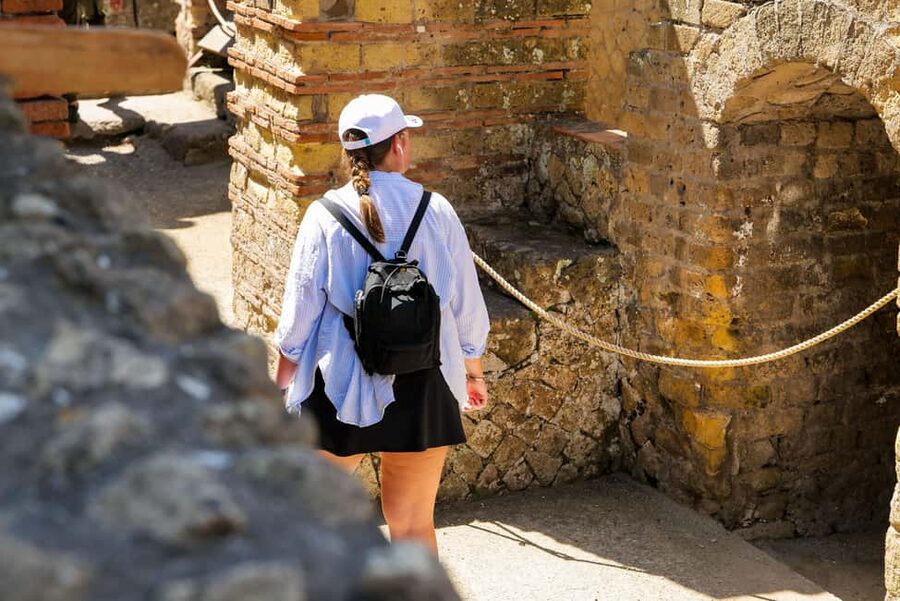
The longer option combines the guided Herculaneum visit with entry to Vesuvius National Park and bus transportation from Naples Central Station. This changes the outing from a short archaeological visit into a full day with fixed movements.
The bus picks you up outside Naples Central Station and takes you to Vesuvius. You receive the volcano entry ticket and have roughly two hours to explore at your own pace before continuing to Herculaneum.
The published schedule includes one departure from Naples at 9:00 AM, Vesuvius at 11:40 AM, Herculaneum to Naples at 4:45 PM. Another schedule lists a 10:15 AM departure, a 1:30 PM departure from Vesuvius, and the same 4:45 PM return from Herculaneum.
Because the times differ, check the exact schedule attached to your selected option. Do not assume you can choose a later bus on the day. The fixed timetable is convenient if you want one organized day, but it leaves less room for delays or a spontaneous change of plan.
The combination offers good practical value when you already want to see both Vesuvius and Herculaneum. You avoid arranging separate transport and entry tickets. It is less appealing if you prefer long, slow visits or want to decide your return time yourself.
At Vesuvius, you have about two hours to explore independently. At Herculaneum, the guided tour begins after the bus transfer. Afterward, the same service takes you back to Naples. Food and drinks are not included, so bring what you need or plan around the stops available during the day.
Value, group pace, and practical limits
No price is provided here, so I cannot judge the exact cost. I can judge the structure: the standard option bundles site entry, assistance, and a two-hour guide, while the longer option adds Vesuvius entry and bus transfers.
That bundle is most useful if you value clear explanations and do not want to manage ticket details yourself. The guide is the part that changes the visit from a walk among ruins into a readable story about Roman homes and the eruption.
You should also weigh the limits. Transport is excluded from the standard tour, food and drinks are excluded from both options, and the meeting point can vary. The site is not suitable for wheelchair users, and comfortable footwear is important.
The activity has a 4.9 rating from 34 reviews, with especially strong praise for the guides’ clarity, humor, and ability to make the past feel understandable. That does not remove the need to check the language, meeting point, timetable, and mobility requirements for your booking.
Free cancellation is available up to 24 hours before the activity for a full refund. You can also reserve and pay later, which helps if your Naples plans are still shifting.
Who should book this Herculaneum tour?
I would choose it if you want historical context without committing to a full day at the ruins. The two-hour format works well for a first visit, a family schedule, or a day when you also have plans elsewhere in Campania.
It suits you especially well if Roman houses interest you more than grand monuments. The preserved wood, mosaics, frescoes, and household details are the stars here.
The Vesuvius version suits you if you want both sights in one organized day and are comfortable following fixed bus times. It is less suitable if you want to linger, travel independently, or avoid a long day on foot.
I would think twice if you need step-free access, dislike scheduled group visits, or want to explore every room at your own pace. In that case, the guide may feel too fast, even though you can stay after the tour to continue on your own.
Should you book it?
Book this tour if you want Herculaneum to make sense, not just look old. The guide-led route brings out the human details: the decorated rooms, the surviving timber, the houses built to impress, and the disaster that preserved them.
Choose the standard two-hour option for a focused visit. Choose the Vesuvius combination if coordinated transport and a full day from Naples are worth more to you than flexibility. Either way, wear good shoes, check your meeting point and language, and save time to look again at the details that catch your eye.
FAQ
How long is the guided Herculaneum tour?
The guided visit lasts two hours. The activity options range from two to eight hours because the longer choice includes Vesuvius National Park and bus transportation.
Which languages are available?
Live guides are available in French, English, and Italian. The tour information specifies a two-hour guided tour in French for the standard experience, so check the selected option for the exact language.
Is entry to Herculaneum included?
Yes. Entry tickets are included, along with assistance during the visit and skip-the-line access.
Can I stay inside Herculaneum after the tour?
Yes. You can continue exploring independently after the guided visit. Once you leave the archaeological site, the exit is final and you cannot re-enter.
Is transport included in the standard tour?
No. Transport is not included in the standard Herculaneum option. The combined Vesuvius choice includes bus transportation from Naples Central Station, travel to Vesuvius, travel to Herculaneum, and the return to Naples.
What does the Vesuvius combination include?
It includes entry to Vesuvius National Park, bus transportation, and the guided Herculaneum visit. You have about two hours to explore Vesuvius independently before the bus continues to Herculaneum.
Where is the meeting point?
The meeting point can vary depending on the option booked. Look for the inStazione logo and follow the instructions provided before your visit.
What should I bring?
Bring comfortable shoes and a sun hat. Food and drinks are not included.
Is the tour suitable for wheelchair users?
No. The activity is not suitable for wheelchair users.
Newest history tours we have reviewed in Italy
- Guided Cultural Tour of the Godfather Film in Messina★ 5.0 · 31 reviews
- SU NURAXI BARUMINI Unesco World Heritage Site★ 5.0 · 129 reviews
- Picnic aperitif in the vineyard of an ancient trullo in Martina Franca★ 5.0 · 21 reviews
- Brescia the Unexpected: History, Local Stories & a drink★ 5.0 · 31 reviews
- Bologna historical art walking tour with hidden gems and tastings★ 5.0 · 108 reviews
- Bolognese Cooking Class with Margherita in the Historic Center★ 5.0 · 26 reviews
- Best of Bologna in one day : Food, architecture, art and history★ 5.0 · 27 reviews
- Private or semi-private tour of the historic center of Bologna★ 5.0 · 34 reviews
Pompeii & Vesuvius History Tours, compared.
Discover the Ancient Ruins of Pompeii: Day Trip from Rome
Read our review →
Small-Group Rome to Pompeii & Amalfi: Day of History & Sea
Read our review →
Ancient Pompeii Private Tour: Skip the Line & Kid-Friendly Option
Read our review →
Skip-the-Line Half-Day Private Tour Ancient Pompeii Highlights with Native Guide
Read our review →Browse the lists this tour appears in