Review · THAILAND HISTORY TOURS
Colors of Ayutthaya: UNESCO Heritage 6 hour Bicycle Tour
Ayutthaya is easiest to understand from a bicycle seat. This six-hour ride links the old capital’s famous ruins with rice paddies, village roads, a local school, a market, and a riverside meal. You get the grand monuments, but also the ordinary places between them. That contrast is the real pleasure.
I like the small group of no more than nine and the way the route mixes major sights with local life. I also like the practical inclusions: a bike, helmet, drinking water, lunch, temple admission, and the boat ride back are all covered. The main caution is the heat, traffic, and the occasional difficulty following a guide’s English, a concern one recent participant specifically raised.
Key points at a glance
- Temple ruins by bicycle: Visit Wat Mahathat, Wat Phra Si Sanphet, Wat Lokayasutharam, and Wat Chaiwatthanaram in one well-filled day.
- Countryside before the monuments: Ride beside rice paddies and through villages instead of spending the whole tour among tour buses.
- A riverside Thai lunch: Stop around 12:30 at a local restaurant, with food and drinking water included.
- Useful local context: Learn about Ayutthaya’s kings, temples, elephant round-ups, and everyday Thai life.
- A small, supported group: Up to nine people ride with a guide, and some departures use two staff members for added road support.
- A complete return route: Finish with a boat crossing back toward the city, rather than retracing the entire ride.
Starting near Ayutthaya train station
The meeting point is the operator’s office close to PomPhet Fort on Uthong Road, a short walk from Ayutthaya train station. That is handy if you arrive by train and want to begin exploring without arranging a separate transfer.
The tour starts at 10:00, though you should check the available date when booking. First comes a bike fitting and helmet check. This matters more than it sounds. A poorly adjusted saddle can make six hours of riding needlessly uncomfortable, so tell the guide at once if the bike does not feel right.
The route is designed as a full outing rather than a quick cycle between two ruins. You will spend time on roads outside the central archaeological zone, then work your way through the old capital before crossing the river by boat at the end.
The minimum age is 12. You should be comfortable riding for much of the day, but the supplied information does not describe the route as a race or a high-speed ride. A recent participant found the pace well judged, and another family found the guide willing to adapt to its needs. Still, this is not the right pick if you want a short, effortless sightseeing loop.
More History Bike, Segway and Tuk-Tuk Tours in Thailand
- Sukhothai: Historical Park & Countryside Cycling Tour
★ 5.0 · 276 reviews - Chiang Mai: Historic Old City Bike Tour – Morning or Night
★ 4.7 · 263 reviews - Chiang Mai: Historic Old City Bike Tour – Morning or Night
★ 5.0 · 202 reviews
Rice paddies, villages, and a glimpse of local life
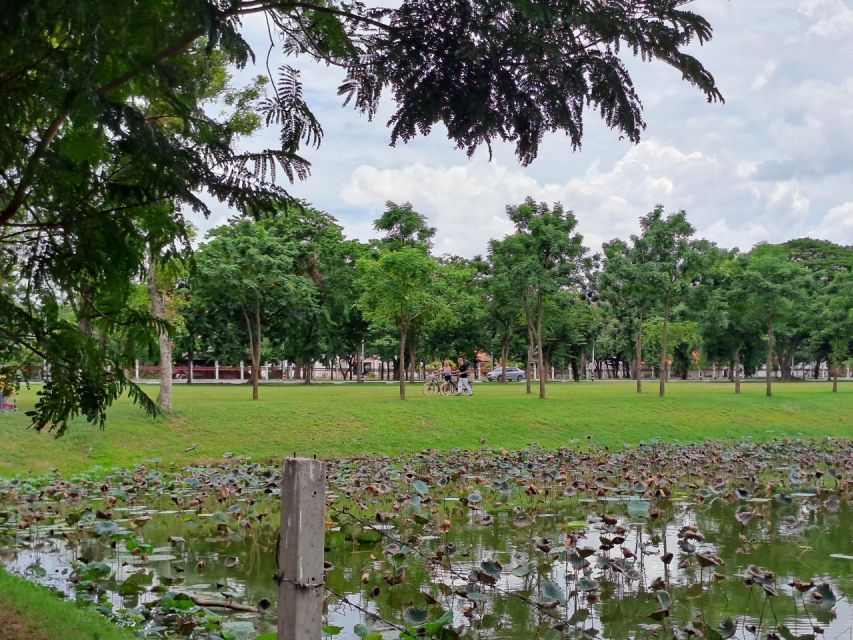
The opening ride heads north through quiet villages and alongside rice paddies. This part gives you a useful sense of Ayutthaya beyond its famous brick towers. You see the old capital as part of a living province, not only as an archaeological site.
The roads also provide a gradual start before the day’s main temples. You can settle into the bicycle, watch the scenery change, and hear the guide explain how the area works. The route is one reason I prefer this experience to a purely vehicle-based temple circuit.
If the local elementary school is open, you stop there and interact with the children. This visit is conditional, so it should not be treated as guaranteed. It is also worth approaching with good manners. You are entering a working school, not a staged attraction, and the stop depends on local circumstances.
The small group helps here. With no more than nine participants, the guide can explain what you are seeing without shouting across a large crowd. Some departures have included two staff members, which helps the group stay together on roads and at junctions.
The Elephant Kraal and Ayutthaya’s royal power
As you continue, the route passes Phaniat Royal Elephant Kraal. During Ayutthaya’s peak, this structure was used to trap wild elephants driven down from the north. Royal elephant round-ups were overseen by the kings, who selected strong animals for war and labor.
This is a useful stop because it adds political and military context to the temples ahead. Ayutthaya was not simply a city of religious buildings. It was a powerful royal capital, and elephants were tied to warfare, transport, labor, and royal ceremony.
The Kraal is also a good example of the tour’s wider approach. You are not just checking off the four headline temples. You are given smaller pieces of the old kingdom that make those grand ruins easier to understand.
Lunch beside the river around 12:30
Around midday, you stop for Thai lunch at a riverside restaurant. The setting is one of the most appealing pauses in a day that could otherwise become a long sequence of hot rides and stone ruins.
Food quality has been a strong point. Recent participants described the meal as delicious, and one said it was the best food they had eaten in Thailand up to that point. Cold drinks were also especially welcome during the ride.
You should keep your expectations sensible about quantity. One person found the portion rather small, even while rating the food as good. If you eat a large lunch or need frequent snacks, bring a little extra money for the market stop later.
Lunch is included in the $70 price, along with water. That helps the overall value, especially since the admission fees at Wat Mahathat, Wat Phra Si Sanphet, and Wat Chaiwatthanaram are also covered.
More UNESCO World Heritage Tours in Thailand
- UNESCO’s Ayutthaya Historical Park: Full-Day Tour from Bangkok
★ 4.5 · 1,559 reviews - Historical City of Ayutthaya – Unesco Full Day Tour From Bangkok
★ 5.0 · 847 reviews - Private Excursion to Floating Market and Ayutthaya World Heritage
★ 5.0 · 515 reviews - Private Excursion to Ayutthaya, UNESCO World Heritage site with Boat Tour
★ 5.0 · 460 reviews
Wat Mahathat and the Buddha in the tree roots
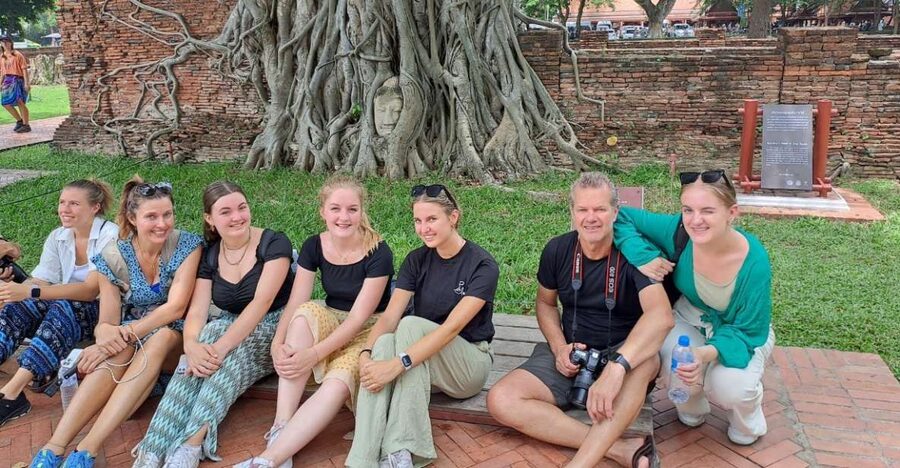
After lunch, you enter the old capital and visit Wat Mahathat. The temple is best known for the stone Buddha head held among the roots of a tree. It is one of Ayutthaya’s most recognizable images, but the surrounding ruins deserve your attention too.
The broken prang, brick walls, and scattered Buddha figures show the scale of the former temple complex. Your guide provides the background on Ayutthaya’s kings and religious buildings, giving the site more meaning than a quick photograph would.
This is usually one of the busiest and most famous places on the route, so the small group is helpful when you need to pause for an explanation or find your way through the ruins. You should also remember that the tree-root Buddha is a religious image, not just a photo prop. Follow the guide’s instructions about respectful viewing and photography.
The three pagodas of Wat Phra Si Sanphet
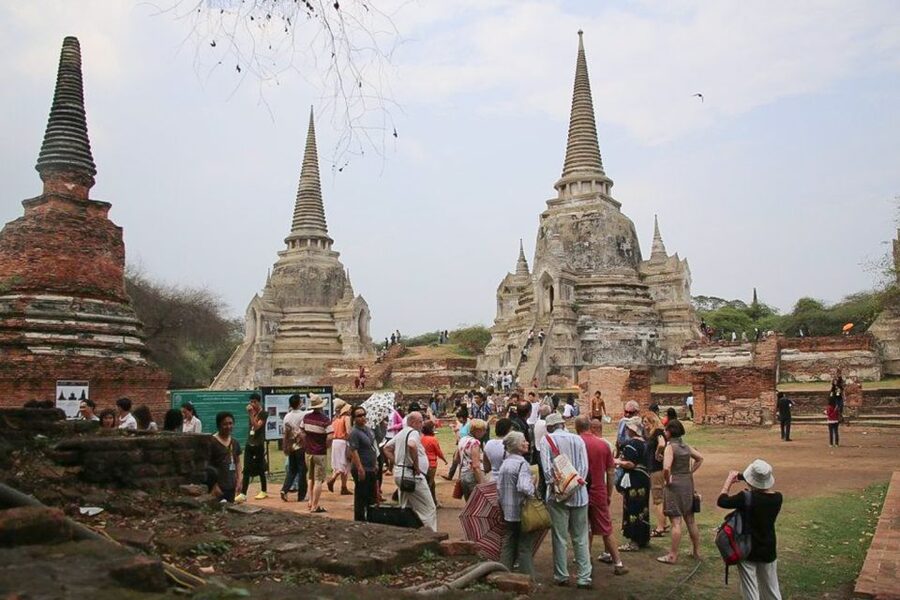
Next comes Wat Phra Si Sanphet, the former royal temple, known for its three distinctive pagodas. Their repeated shape gives the site a strong visual rhythm, and the scale helps you picture the importance of the royal compound before Ayutthaya was destroyed.
This stop works well after Wat Mahathat because the two temples show different sides of the old capital. Wat Mahathat feels like a major religious complex with famous surviving details. Wat Phra Si Sanphet feels more closely tied to royal authority and ceremony.
Admission to both temples is included. That saves you from keeping small amounts of cash ready at each gate and makes the $70 price easier to assess. The guide’s explanations are important here, since the surviving walls alone do not always reveal which buildings served religious, royal, or practical purposes.
Recent departures have been led by guides including Bung, Beam, and Spike. Beam received particular praise for explaining Thai traditions, history, and daily life, while Spike was noted for adapting to family needs. Your guide will depend on the date, and English clarity may vary.
Market snacks and the reclining Buddha
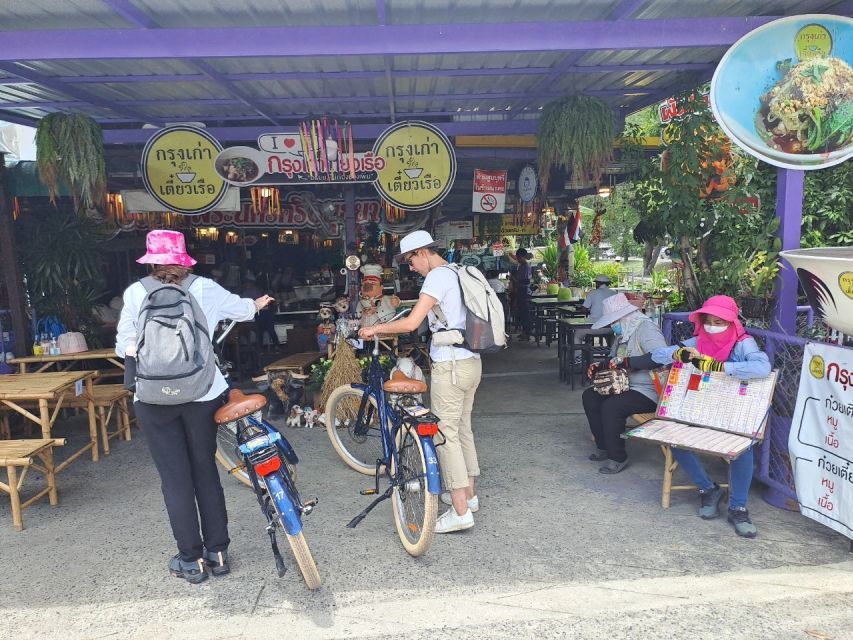
The route then takes you to a local market, where you can see typical baked and fried Thai treats. This is a short stop, but it breaks up the temple visits and gives you a look at everyday food rather than only formal restaurant dishes.
You may find something worth trying, but the available information does not promise a set tasting or a specific snack. Think of it as a chance to observe, browse, and perhaps buy an extra bite if lunch did not fill you.
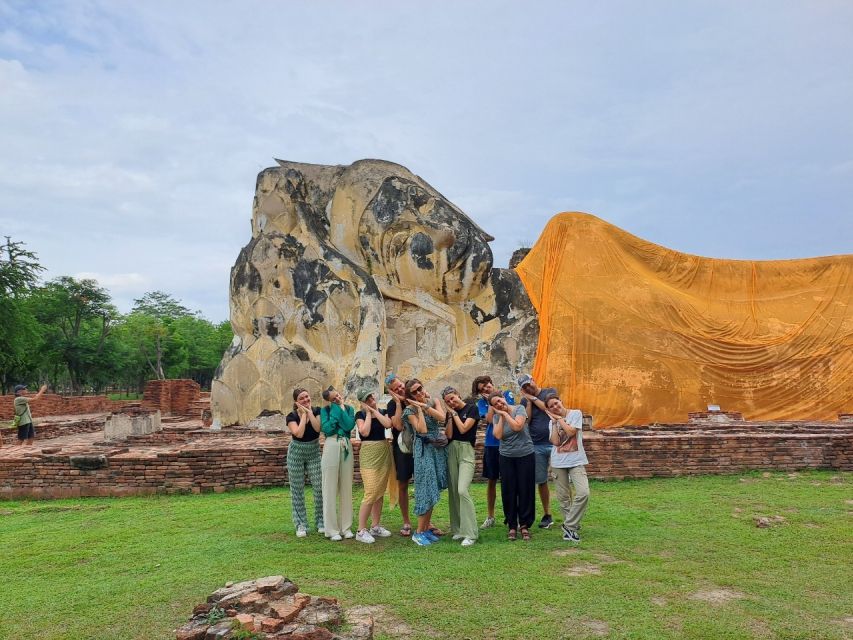
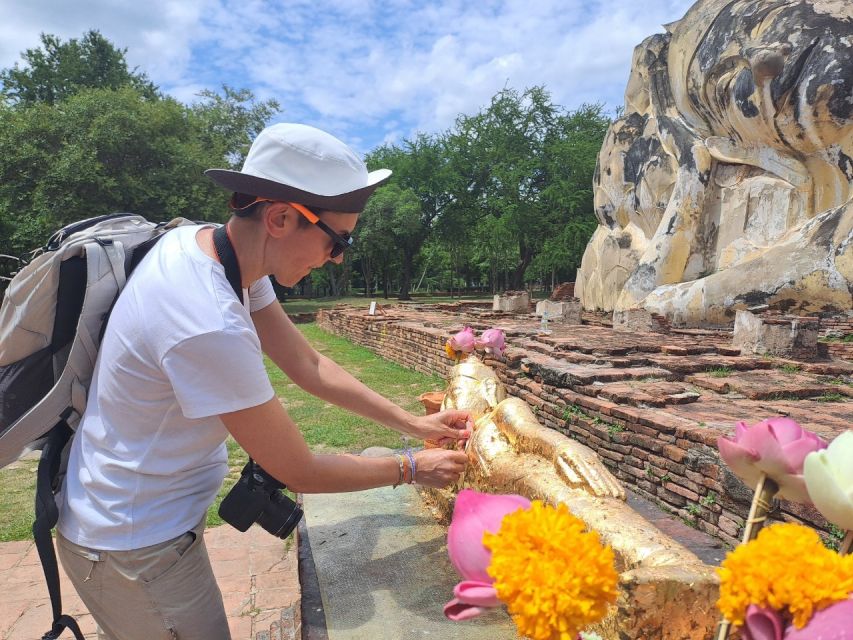
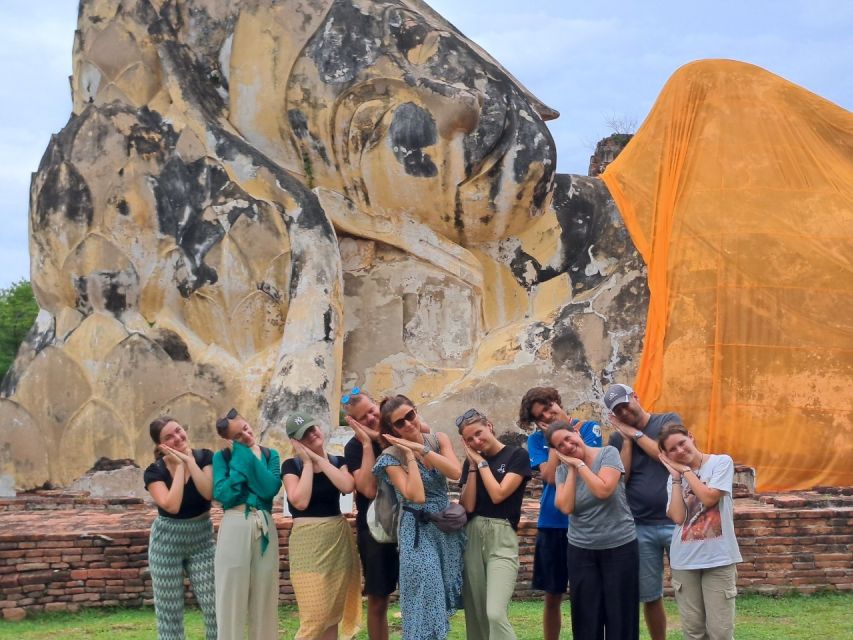
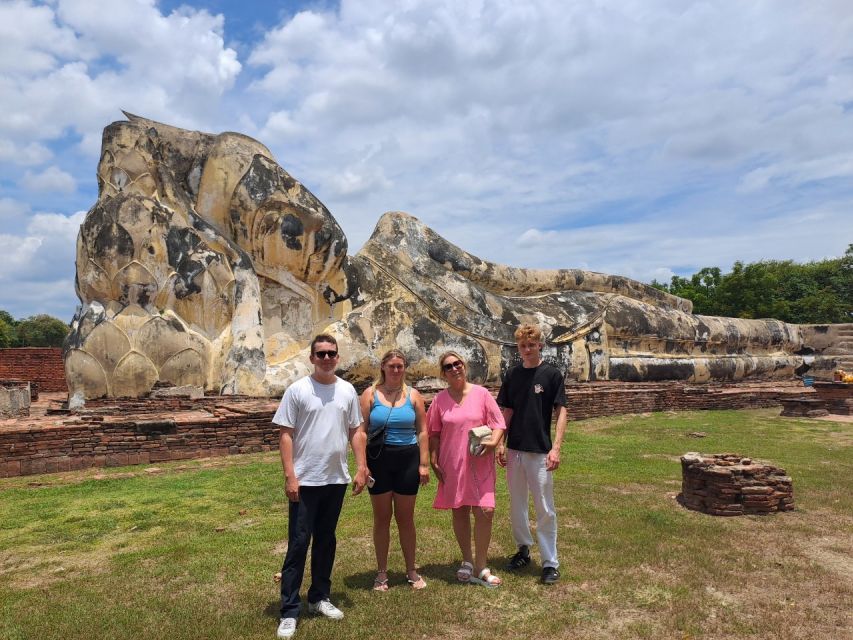
From the market, you pedal to Luang Phor Lokayasuttha at Wat Lokayasutharam. The huge reclining Buddha is one of Ayutthaya’s most striking large-scale images. Its size changes the mood of the day: after examining compact ruins and carved details, you are suddenly facing a figure designed to be seen from a distance.
The stop is called out as the largest Buddha statue in Ayutthaya. Your guide can help connect the statue to the wider religious setting, rather than leaving you to view it as an isolated monument.
Wat Chaiwatthanaram on the Chao Phraya
The final major temple is Wat Chaiwatthanaram, on the west bank of the Chao Phraya River. It was built in 1630 by King Prasat Thong as a memorial to his mother’s residence in the area.
This is one of Ayutthaya’s most impressive temple complexes, with a central prang and surrounding towers that create a memorable outline beside the river. It is a strong finale because the setting opens up after the tighter spaces of the inner ruins.
The temple also gives your guide another chance to explain how royal memory, religion, and architecture overlapped. Knowing why the complex was built makes the visit more meaningful than simply admiring its silhouette.
Entrance is included, so you can spend your time looking at the structure rather than worrying about another ticket. The ride here can feel long if the heat is intense, but the changing scenery and the river setting keep the afternoon from becoming repetitive.
The boat crossing completes the loop
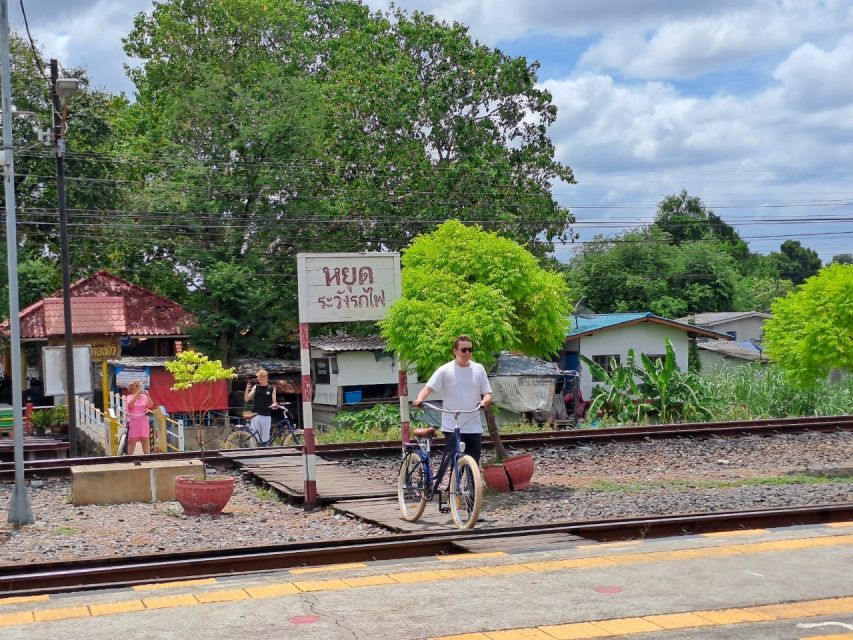
After Wat Chaiwatthanaram, you continue along the west bank of the Chao Phraya to the pier. A boat carries you across the river, and you return toward the city by bicycle.
I like this ending because it gives the day a sense of movement. You do not simply turn around and repeat the same road. The crossing also provides a final change of view after hours on two wheels.
The bike rental, helmet, drinking water, and return boat crossing are included. Those details matter when comparing the tour with a cheaper temple-only visit, since several costs that can add up are already folded into the price.
How the $70 price holds up
At $70 per person, this is not the cheapest way to see Ayutthaya. It is also not just a bicycle rental. The price includes a guide, bike, helmet, water, a Thai lunch, three temple entrance fees, and the boat crossing.
You also get a six-hour route that links countryside and major ruins without needing to organize each transfer yourself. For a first visit, I think the package offers solid value, particularly if you want historical explanation and local context rather than only independent sightseeing.
The value depends on how you like to travel. If you are happy renting a bicycle, buying your own tickets, and reading about the temples as you go, you can probably spend less. If you want someone to set the route, manage the stops, provide lunch, and explain the sites, the price is easier to justify.
The lunch portion may not satisfy every appetite, and the quality of English explanation can depend on the guide. Those are the two points I would weigh most carefully before booking.
Who should choose this Ayutthaya ride?
I would choose this tour if you want to combine the famous ruins with ordinary provincial life. It suits active adults, families with children aged 12 or older, and visitors who prefer a small group to a large coach.
It is especially good for people arriving by train, since the meeting point is close to Ayutthaya station. It also suits anyone who wants a clear route through the main sights without spending time arranging bikes, tickets, lunch, and the river crossing separately.
You should think twice if you dislike riding in hot weather, need a very slow sightseeing pace, or want to spend long, quiet periods at each temple. The itinerary covers a lot in 330 minutes. That is its strength, but also its limit.
Book with realistic expectations about the school visit, since it only happens if the school is open. Also confirm the cancellation terms at checkout. The supplied information gives two versions, one allowing a full refund up to 24 hours ahead and another listing a 48-hour cutoff with a 50 percent fee between 24 and 48 hours. Check the exact policy attached to your booking.
Should you book it?
Book this bicycle tour if you want a well-rounded first look at Ayutthaya, with temples, rice fields, market food, royal history, a riverside lunch, and a boat ride in one day. The strongest features are the small group, the varied route, and guides such as Bung, Beam, and Spike who have brought useful local detail to recent departures.
Skip it if you want the lowest possible price, cannot comfortably cycle for much of a day, or need guaranteed school access and a large lunch. For most active visitors who want more than a string of famous photographs, the combination of included costs and local context makes this a worthwhile choice.
FAQ
Where does the Ayutthaya bicycle tour meet?
The meeting point is the operator’s office near PomPhet Fort on Uthong Road, a short walk from Ayutthaya train station.
How long does the tour last?
The tour lasts 330 minutes, or five and a half hours. Tours run daily from 10:00, with starting times subject to availability.
What is included in the price?
The $70 price includes bicycle rental, a helmet, a guide, drinking water, Thai lunch at a local restaurant, the boat crossing, and entrance fees for Wat Mahathat, Wat Phra Si Sanphet, and Wat Chaiwatthanaram.
What languages are available?
The live guide service is available in English and Thai.
What is the minimum age?
The minimum age to join the tour is 12 years old.
Is the visit to the elementary school guaranteed?
No. The school visit takes place only if the school is open.
Newest history tours we have reviewed in Thailand
- 1 Day Sukhothai Historical Park from Chiang Mai Private Tour★ 5.0 · 29 reviews
- Full Day Cycling tour to Sukhothai Historical Park★ 5.0 · 163 reviews
- Full Day Sukhothai Historical Park Tour★ 5.0 · 96 reviews
- Full-Day Historical Park and Countryside Tour in Sukhothai★ 5.0 · 27 reviews
- Private tour to Ayutthaya and Boat Tour Heritage Site★ 5.0 · 28 reviews
- Bangkok Heritage Highlights: Grand Palace & Three Temples Tour★ 4.5 · 52 reviews
- Private Tour to Ayutthaya, World Heritage Site with Boat Tour★ 5.0 · 55 reviews
- River Kwai Day Tour from Bangkok: History, Scenic Views & Culture★ 4.5 · 36 reviews
UNESCO World Heritage Tours, compared.
World Heritage Shirakawa-go and Experience Tours from Kanazawa
Read our review →
Bali: Tanah Lot UNESCO World Heritage Sites Full-Day Tour
Read our review →
World Heritage Kyoto & Nara Uji Authentic Matcha Experience
Read our review →
UNESCO’s Ayutthaya Historical Park: Full-Day Tour from Bangkok
Read our review →
Rotterdam: Kinderdijk UNESCO World Heritage Entry Ticket
Read our review →