
Review · BOSTON HISTORY TOURS
Boston: Freedom Trail History and Architecture Walking Tour
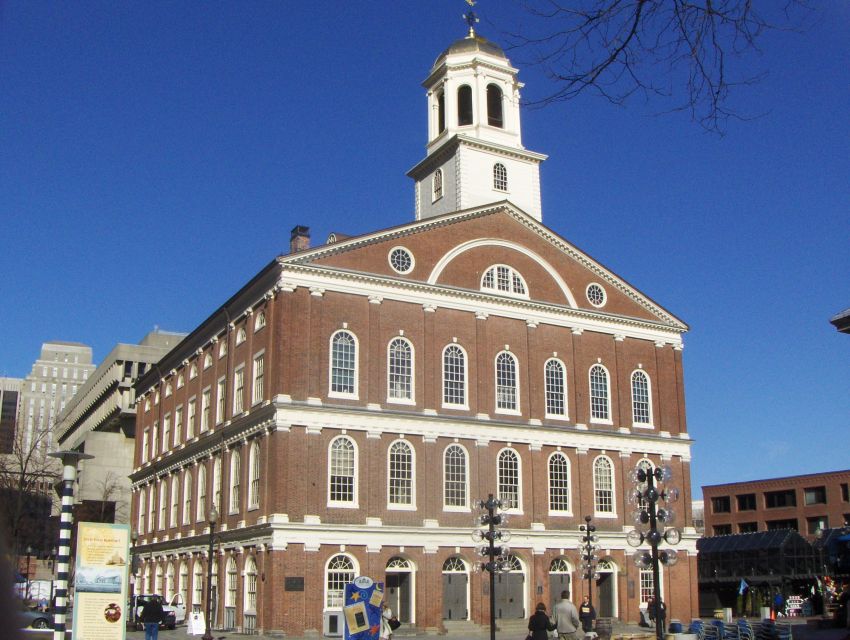
Boston’s Freedom Trail works best when someone explains the pieces as you walk. This 70-minute tour links Faneuil Hall, the Old State House, the Boston Massacre Site, and Boston Common, turning a string of old buildings into a clear story about how Boston grew from a colonial settlement into a modern city.
I like the compact route and the focus on architecture as well as events. I also like that the guide handles questions patiently. Allan, one guide named in the feedback, was praised for being personable and well informed, and a family with teenagers found the tour engaging for different ages. The main consideration is language: the tour is in English, and you need strong English skills to keep up with the historical detail.
Key points to know before you book
- Follows a useful downtown route: You walk from Faneuil Hall toward Boston Common, covering several major Freedom Trail sites without needing transport between them.
- Mixes buildings with big events: The route includes the Old and New State Houses, the Boston Massacre Site, meeting houses, churches, cemeteries, and civic landmarks.
- Adds architectural context: You learn how Boston’s streets and buildings changed from the city’s earliest settlement through today.
- Takes only 70 minutes: It fits neatly into a morning and works well as an introduction before exploring more sites on your own.
- Uses an English-speaking local guide: Allan received especially warm comments for his patience, personality, and ability to answer questions.
- Costs $30 per person: That is fair if you want a guided overview, especially on a first visit, but it is less useful if you prefer a slow, self-guided walk.
Why this short Freedom Trail walk works

The Freedom Trail can look simple on a map: follow a marked route through central Boston and stop at historic places. In practice, the sights make more sense when you know how they connect. A cemetery, church, meeting house, and government building each tell a different part of the city’s story.
This tour gives you that framework in just 70 minutes. You do not spend half a day inside one museum or wait for transport between neighborhoods. Instead, you move through downtown on foot, seeing how the city’s streets, public buildings, religious institutions, and commercial spaces sit beside one another.
I see this as an orientation walk rather than a full historical course. You get a brisk introduction, a local guide’s explanation, and a list of places worth returning to. The pace also means the guide must choose which stories to emphasize. One piece of feedback noted that many possible subjects require the guide to set priorities, so you should not expect every site to receive equal treatment.
More History Walking Tours in Boston
- Boston: Freedom Trail History Small Group Walking Tour
★ 5.0 · 6,450 reviews - Boston: Freedom Trail History Small Group Walking Tour
★ 4.9 · 1,590 reviews - Boston Pizza Lovers Food and History Walking Food Tour
★ 4.5 · 1,082 reviews
Starting at State and Congress Streets
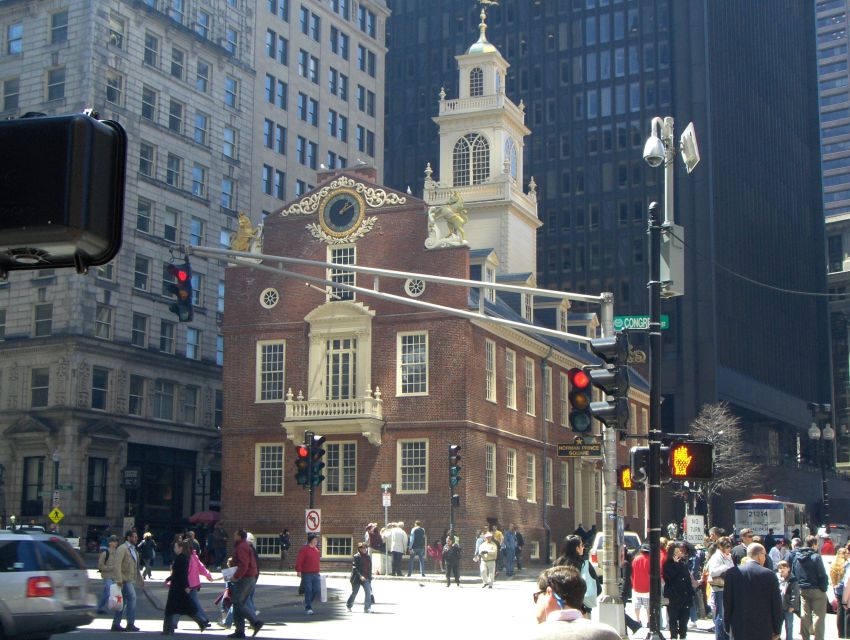
The meeting point is the northwest corner of State and Congress Streets, outside 28 State Street, next to Citizens Bank and across from the Old State House. That location matters because you begin in the middle of Boston’s historic core, not at a distant visitor center.
Give yourself enough time to identify the exact corner. The Old State House is a clear reference point, but busy downtown streets can make a last-minute meeting awkward. The tour’s starting position also gives you an immediate look at the contrast that defines central Boston: old masonry and narrow historic streets beside offices, banks, traffic, and modern city life.
Because the guide meets you in an active downtown area, listen for the group and watch the time. The supplied details do not state a required arrival time, so check your booking information for the precise start time you choose.
From Faneuil Hall to the Old State House
Faneuil Hall is one of the route’s strongest opening subjects. It connects Boston’s commercial life with its political traditions, and it helps explain why this part of the city became such a busy public center.
The walk then brings you toward the Old State House and New State House. Seeing both on the same tour helps you compare different periods of Boston’s civic architecture. The Old State House belongs to the city’s colonial and revolutionary story, while the New State House represents a later stage in the development of Massachusetts government.
The value here is not just looking at façades. Your guide explains how Boston changed over time, so the buildings become evidence of that change. You can look at the route as a series of layers: early settlement, revolutionary politics, expanding government, and the modern city built around them.
The tour does not promise interior visits to every landmark. Treat this portion as an outdoor introduction, with the guide’s explanation providing context for places you may choose to enter later.
The Boston Massacre Site and the city’s revolutionary story
The Boston Massacre Site is one of the route’s most important stops because it shows how a small urban space can carry major political meaning. Here, the guide can place the event within the crowded streets and tense relationship between local residents and British authority.
This is also where a guide adds real value. A plaque or printed map can tell you what happened, but it cannot easily explain why the event mattered so much to people at the time, or how public memory shaped the story later. The tour’s larger aim is to put these places in context rather than treat them as disconnected points.
You will hear stories about Boston from its earliest settlement through the present day. That broad range is useful, but it also explains why the walk moves briskly. If you want a long discussion of the American Revolution at each stop, this will feel short. If you want a clean first pass through the city’s key sites, the pace should suit you.
More History Walking Tours in the USA
- Boston History Tour: Scenic Walk Through Time & Landmarks
★ 5.0 · 627 reviews - Boston’s North End Food and History Walking Tour
★ 5.0 · 459 reviews - Beacon Hill Boston History + Photo Walking Tour (SMALL Group)
★ 5.0 · 163 reviews - Boston: 2-Hour Historic Walking Tour
★ 4.7 · 88 reviews
Churches, meeting houses, and places of public debate
The route includes King’s Chapel, Park Street Church, and the Old South Meeting House. Together, these places show that Boston’s past was shaped not only by government and military conflict, but also by religion, public speaking, and community debate.
King’s Chapel adds an important religious and architectural contrast to the walk. Park Street Church brings another layer of Boston’s civic and social story. The Old South Meeting House is especially useful for understanding how religious buildings could also serve as places where residents gathered, argued, and organized.
I like this part of the route because it broadens the usual revolutionary checklist. You are not only looking at famous names and dates. You are seeing the buildings where ordinary public life took place, and how those buildings helped shape the city’s identity.
The guide may move quickly between these sites. The available comments suggest that the tour includes selected highlights rather than every possible detail. Ask questions when the group stops, especially if architecture matters to you. One strength of the tour is the guide’s willingness to answer questions, including questions from teenagers and families.
Cemeteries and the Old Granary’s quiet pause
The Old Granary Cemetery offers a change of mood. After the public energy of meeting houses and government buildings, a cemetery asks you to slow down and consider the people behind Boston’s famous events.
The site also shows how tightly packed the old city once was. Historic burial grounds sit close to streets, offices, churches, and commercial buildings. That closeness is part of what makes walking Boston rewarding: major civic events, private lives, religion, business, and government all occupy a small area.
The tour also includes the Old City Hall and the First Schoolhouse Site. These stops widen the story beyond the Revolution. Old City Hall points to later civic growth, while the schoolhouse location brings attention to education and the daily structures of city life.
You should think of these places as pieces of a timeline. The guide’s job is to connect them, not simply name them. If you are taking notes or photographs, do so quickly and keep listening, since the walk continues through active downtown streets.
The Old Corner Bookstore and Boston’s changing streets
The Old Corner Bookstore adds a commercial and literary note to the walk. It helps show that Boston’s old buildings were not only used for politics, worship, or government. They also supported the city’s business and intellectual life.
This is one of the places where the tour’s architecture focus becomes especially helpful. Boston’s downtown is not uniform. You can see different building types and periods close together, with historic structures adapted to modern uses. The guide explains how the city evolved, helping you read the streets instead of simply passing through them.
The route also includes the Irish Famine Memorial. That stop brings a later chapter of Boston’s story into a walk that often focuses heavily on colonial and revolutionary events. It reminds you that Boston’s identity continued to change as new communities arrived and shaped the city.
This broader coverage is one of the tour’s best features. You are not left with the idea that Boston ended in 1776. The walk connects the early settlement, revolutionary era, later immigration, civic growth, and present-day downtown.
Finishing at Boston Common
The tour ends at Boston Common, a natural place to stop after moving through the older downtown streets. The Common gives you room to reflect on the route and decide what deserves a longer visit.
By the end, you will have encountered or discussed the Old and New State Houses, Faneuil Hall, the Boston Massacre Site, Park Street Church, King’s Chapel, the Old South Meeting House, the Old Granary Cemetery, Old City Hall, the First Schoolhouse Site, the Old Corner Bookstore, the Irish Famine Memorial, and Boston Common.
That is a lot for 70 minutes. You should not expect long interior visits or extended time at every landmark. The payoff is the overall picture: Boston’s history is not confined to one museum or one monument. It is built into the streets you walk across and the buildings you pass on the way to lunch.
The finish at Boston Common also makes the tour practical for the rest of your day. You can continue exploring from there, revisit a site that caught your attention, or simply use the Common as a break after the guided walk.
The guide makes the difference
A walking tour succeeds or fails largely through its guide. The clearest positive feedback centers on the guides’ personalities, preparation, and patience. Allan was singled out for being personable and well informed, while another family appreciated a guide who answered every question and stayed polite even when the questions became less focused.
That matters if you are traveling with teenagers. The route contains serious subjects, but a guide who welcomes questions can make the material easier for younger visitors to follow. The comments indicate that the tour worked well for a family group, not only for adults already interested in Boston history.
The tour is offered in English only. One German-speaking participant found that strong English skills were needed to stay with the content. That is an important practical point. The issue is not simply understanding directions. The guide will be explaining names, events, architecture, and connections while you walk, so limited English can make the experience frustrating.
If English is comfortable for you, ask questions. The guide’s patience is one of the experience’s strongest assets, and questions can help you focus on the subjects that matter most to you.
Is $30 a fair price?
At $30 per person, this sits in the reasonable range for a short guided city walk. You are paying for a professional local guide and a carefully chosen route through Boston’s historic center. There is no indication that admission to interiors is included, so the price is mainly for interpretation and company on the walk.
I think the value is strongest on a first visit. Without context, you can see the Old State House, Faneuil Hall, and Boston Common on your own, but you may miss how the sites relate to one another. A guide saves you research time and helps you build a mental map quickly.
The value is weaker if you have already studied the Freedom Trail or prefer to stop for long periods at each landmark. Seventy minutes allows breadth, not depth. You may still want to pay separately for entry to historic buildings or return for a slower look after the tour.
The booking terms also reduce the risk. You can reserve now and pay later, and cancellation is free up to 24 hours before the activity for a full refund. Those terms are useful if your Boston schedule is still changing.
Who should book this walk?
I would choose this tour if you have one morning in downtown Boston and want a clear introduction before exploring alone. It also suits families, including those with teenagers, because the route is short and the guide can respond to questions.
It is a good match for visitors who enjoy architecture but do not want a lecture detached from the city streets. You will see how different periods sit side by side and hear how Boston developed from its first settlement to the present.
I would be more cautious if you need a tour in another language, want extensive time inside the buildings, or hope for a slow photographic walk. The tour is in English, covers many sites quickly, and focuses on the connected story of downtown rather than one landmark in great depth.
Should you book the Boston Freedom Trail tour?
Book it if you want a brisk, well-organized introduction to Boston’s historic center, especially on your first morning in the city. The route covers the essential downtown landmarks, the guide adds context that signs cannot provide, and the $30 price is fair for a professional 70-minute walk.
Skip it if you already know the Freedom Trail well or want to explore at your own pace. For most first-time visitors with comfortable English, though, this is a practical way to get oriented, understand the city’s layers, and decide which historic places deserve a longer visit.
FAQ
How long is the Boston Freedom Trail walking tour?
The tour lasts 70 minutes.
How much does the tour cost?
The price is $30 per person.
Where does the tour meet?
Meet at the northwest corner of State and Congress Streets, outside 28 State Street at Citizens Bank, across the street from the Old State House.
Where does the walking route go?
The route follows the Freedom Trail through downtown, from the Faneuil Hall area toward Boston Common.
Which historic sites are included?
The route includes the Old and New State Houses, Faneuil Hall, the Boston Massacre Site, Park Street Church, King’s Chapel, the Old South Meeting House, the Old Granary Cemetery, Old City Hall, the First Schoolhouse Site, the Old Corner Bookstore, Boston Common, and the Irish Famine Memorial, among other sites.
Is the tour offered in English?
Yes. The tour has a live English-speaking guide, and English is the listed tour language.
Is a guide included?
Yes. A professional local guide is included.
Can I cancel for a full refund?
Yes. You can cancel up to 24 hours in advance for a full refund. You can also reserve now and pay later.
More Architecture and Landmark Tours in Boston
- Venice: St. Mark’s Basilica Guided Tour & VR History Intro
★ 3.9 · 4,880 reviews - Venice’s Best: Basilica, Doge’s Palace, Gondola & History Gallery
★ 4.5 · 2,478 reviews - Córdoba: Skip-the-Line Great Mosque-Cathedral History Tour
★ 4.7 · 1,690 reviews - Pantheon Elite Guided Tour – Rome’s Iconic Ancient Temple
★ 5.0 · 1,447 reviews
Newest history tours we have reviewed in Boston
- Boston: Seafood Tasting & Historical Walking Tour★ 5.0 · 28 reviews
- Boston: Underground Railroad History Tour of Beacon Hill★ 4.9 · 38 reviews
- Boston: Ultimate Historic Food & Drink Tour★ 4.7 · 20 reviews
- Boston: History & Haunts Guided Ghost Tour★ 4.3 · 154 reviews
- Boston: Historic Pubs Walking & Ferry, Food & Drink Tour★ 4.9 · 56 reviews
- Boston History & Highlights Tour: From Revolution to Today★ 4.8 · 178 reviews
- Boston: Tour of The Freedom Trail with Historic North End★ 4.5 · 154 reviews
- Boston: Haunted Pub Crawl of Historic Pubs and Taverns★ 4.6 · 127 reviews
Architecture & Landmark Tours, compared.

St. Mark’s Basilica Guided Tour & VR History Intro
Read our review →
Venice’s Best: Basilica, Doge’s Palace, Gondola & History Gallery
Read our review →
Córdoba: Skip-the-Line Great Mosque-Cathedral History Tour
Read our review →
Pantheon Elite Guided Tour – Rome’s Iconic Ancient Temple
Read our review →
Abu Dhabi Grand Mosque, Palace, and Heritage Village
Read our review →
Chicago in a Day: Food, History & Architecture Walking Tour
Read our review →

Colosseum Special Access Tour, with Ancient Temples & Tombs
Read our review →Browse the lists this tour appears in