
Review · ATHENS HISTORY TOURS
Ancient Corinth Half Day Tour
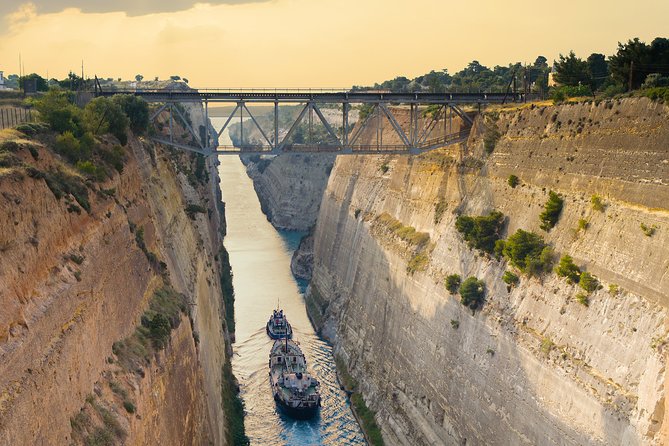
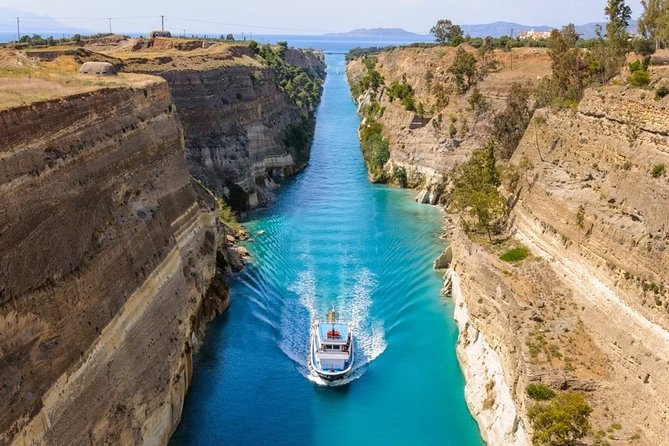
The Corinth Canal is the quick visual jolt that starts this tour. Ships once had to circle the Peloponnese, adding about 185 nautical miles to their route. Here, you see the narrow cut that turned a 2,000-year-old idea into a working waterway.
I like the efficient route and the private car. You get four very different places in about five hours, with no unknown passengers and pickup from an Athens hotel or Piraeus cruise terminal. I also like the range: Roman ruins, a medieval fortress, a small ancient harbor, and a major engineering project.
The main consideration is that your driver cannot legally guide you inside the archaeological sites. The driver can explain the history on the road, but a licensed English-speaking guide costs an additional €260, payable in cash, and site admission is extra.
Key points to know before booking
- Four major stops in five hours: The route covers the Corinth Canal, Ancient Corinth, Acrocorinth, and Kechries.
- Private transport for up to two people: The $363.71 price is per group, not per person, and includes round-trip transport.
- A driver, not an on-site guide: English-speaking drivers explain the monuments and history but cannot accompany you into the ruins.
- Acrocorinth adds the big view: The medieval castle sits on a monolithic rock above Ancient Corinth and gives the outing a dramatic finish.
- Piraeus pickup is arranged by terminal: If your ship docks at Terminal B or C and the gate is closed, take the three-minute shuttle to Terminal A.
- Budget for extras: Ancient Corinth admission is €15 per adult. Lunch, snacks, and a licensed guide are not included.
Why this Corinth trip works well from Athens
Corinth is about 45 miles from Athens by highway, so the drive takes a meaningful share of a five-hour outing. That makes a private tour useful. You do not spend time changing buses or waiting for a larger group, and the driver can explain the area as you go.
The trip also gives you a clear story about the Isthmus of Corinth. This narrow strip joins mainland Greece with the Peloponnese. Its position made Corinth wealthy, powerful, and often caught in the middle of Greek and Roman conflicts.
For two people, $363.71 works out to about $181.86 each before entrance fees and optional guiding. That is not a bargain bus trip, but it can be fair if you value door-to-door service, a private vehicle, and the ability to start from a hotel or cruise port. For one person, the price is much harder to justify.
The vehicle is air-conditioned and includes WiFi and bottled water. Those are small comforts, but they matter on a warm Greek day, especially after walking around open ruins and climbing around the fortress area.
More Ancient History Tours in Athens
- Athens: Ancient Greek Theater Performance
★ 4.7 · 2,481 reviews - Historical Delphi One Day Tour with Arachova Stop & Expert Guide
★ 4.5 · 1,247 reviews - From Athens: Ancient Corinth Day Trip with Canal & VR Guide
★ 4.6 · 1,073 reviews
The Corinth Canal turns an old dream into a short stop
The first stop lasts about 20 minutes. That is enough to see the canal, take photographs, and hear why it matters, but not enough for a long visit.
The canal links the Saronic Sea with the Corinthian Gulf. Its modern construction ended in the late 19th century, yet the idea goes back much further. Periander, the ruler of Corinth in the early 6th century BC, is said to have considered cutting through the isthmus.
Ancient engineers took a less ambitious route. The diolkos was a stone road used to move ships on wheeled platforms across the isthmus. Emperor Nero later began canal work in AD 67 with 6,000 slaves, but the project ended before it could be finished.
You will probably find the canal’s scale more impressive from above than the short stop suggests. Still, this is a viewing point, not a full canal excursion. If you want a boat ride or extended time beside the water, this tour does not provide it.
Ancient Corinth reveals a city built on trade
Ancient Corinth receives about an hour, with the entrance fee of €15 per adult paid separately. This is the historical center of the trip, and I would give it your closest attention.
Corinth grew wealthy because it controlled movement across the isthmus. Goods traveling between the mainland and the Peloponnese passed through its territory, while its ports connected it to routes across the Aegean and beyond.
The city founded colonies as far away as Corfu and Syracuse. It produced black-figured pottery and took part in major Greek conflicts, including the Persian Wars and the Peloponnesian War. Corinth also hosted the Isthmian Games, an athletic festival linked with the city’s position on the isthmus.
The site you see today reflects several different periods. Ancient Corinth was destroyed by the Romans in 146 BC, then rebuilt as a Roman colony by Julius Caesar in 44 BC. It later served as the administrative center of the Roman province of Achaea.
That long sequence of destruction and rebuilding explains why the ruins feel layered rather than uniform. You are not looking at one frozen Greek city. You are walking through a place reshaped by Greek rulers, Roman colonists, Byzantine authorities, Crusaders, Venetians, and Ottomans.
The Temple of Apollo gives the ruins their signature view
The Temple of Apollo is the most recognizable monument at Ancient Corinth. Built in the middle of the 6th century BC, it once formed part of a city that rivaled Athens and Thebes in wealth and influence.
Seven monolithic columns remain. Unlike temples built with stacked column drums, these columns were made from single blocks of stone. That detail is easy to miss unless someone points it out, so listen closely to the driver’s explanation before entering or consider hiring the licensed guide.
The temple is only part of the site. The agora, or central marketplace, helps you picture the city as a place of trade, government, and daily business. Near it is the bema, a platform used for political and legal announcements.
The bema is often linked with the Apostle Paul’s appearance before Gallio, the Roman governor of Achaea. The supplied historical notes point out that this claim is not secure. That is a useful reminder to treat famous associations carefully rather than accepting every traditional identification as proven fact.
More Ancient History Tours in Greece
- Acropolis, Parthenon & Athens Old City Heritage Walking Tour
★ 4.5 · 876 reviews - Private Biblical Tour Ancient Corinth & Isthmus Canal from Athens
★ 5.0 · 762 reviews - Athens: Ancient Corinth & Nafplio Full Day Trip with Swim
★ 4.8 · 531 reviews - Athens Skip the Line: Open Air Ancient Greek Theatre Performance
★ 4.5 · 520 reviews
Walk the Lechaion Road and find the Peirene Fountain
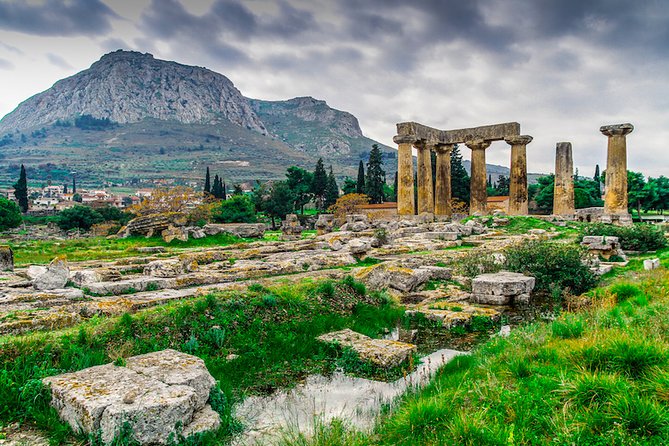
The Lechaion Road is one of the most enjoyable parts of the site because it makes ancient Corinth feel like a functioning town. The paved route once led toward the port of Lechaion and was lined with shops beneath covered galleries.
As you walk, look for the remains of the public spaces that framed everyday life. There is also a well-preserved latrine, a plain but useful reminder that archaeology is not only about temples and heroic stories.
The Fountain of Peirene sits near the gateway to the Lechaion Road. Its water was famous, and ancient poets linked the spring with Pegasus. The fountain house was once decorated with statues and arcades.
You can also see remains of the Roman Odeion and the Greek theater. The Odeion was later enlarged by Herodes Attikos, the same patron associated with Athens’ Odeon. The theater began in the 4th century BC and was altered under Roman rule, including changes that allowed arena events and even staged naval displays.
An hour passes quickly here. The driver can give you context before you enter, but cannot walk the ruins with you. If ancient sites are difficult for you to read without help, the extra €260 guide fee may be worthwhile, particularly if you are sharing it with another person.
Acrocorinth adds a fortress and a wide view
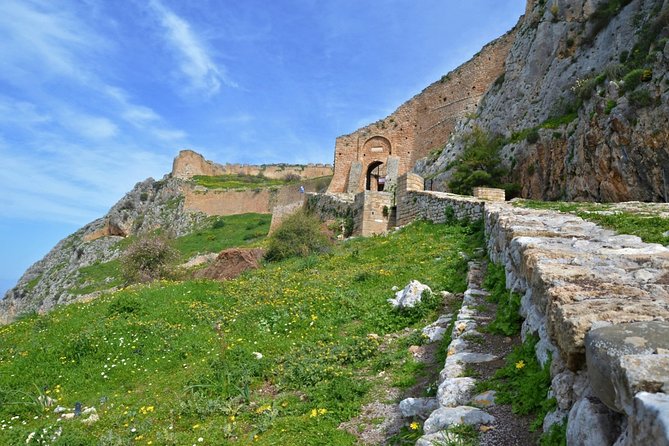
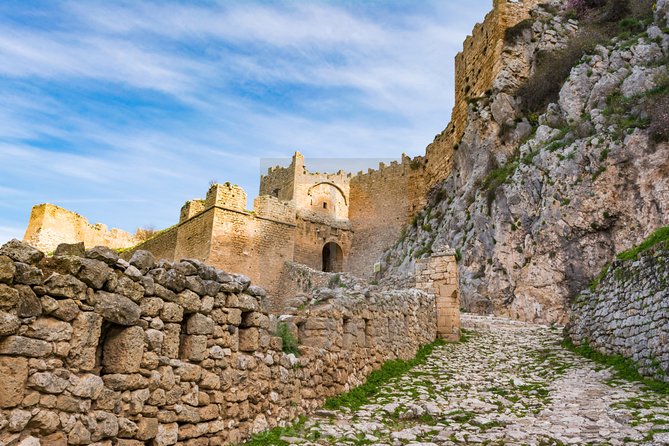
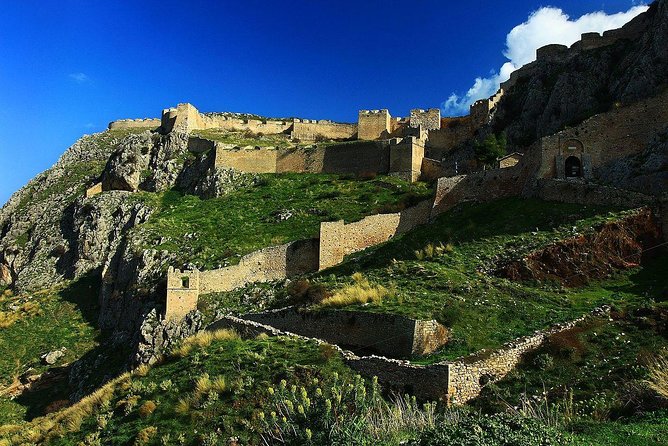
Acrocorinth is about an hour. It is the ancient acropolis of Corinth, a large rock rising above the lower city. The site was occupied from archaic times through the early 19th century and is now one of Greece’s major medieval castle sites.
This stop changes the mood. Ancient Corinth is about streets, temples, fountains, and civic life. Acrocorinth is about height, walls, defense, and control. From here, you can understand why the rock mattered to every power that wanted to rule the isthmus.
The castle has been shaped by many periods, so the site is not just a Greek sanctuary. Its long use includes Byzantine, Frankish, Venetian, and Ottoman chapters. The remains give you a sense of how valuable this position was even after the ancient city lost its power.
The tour description does not specify the exact walking conditions or how far the vehicle goes toward the upper areas. You should expect a site that requires walking and may include uneven ground. Wear shoes suited to stone surfaces, and use the hour with care if you prefer not to hurry.
For many people, Acrocorinth is the emotional high point of the outing. It supplies the broad view and the strongest sense of place. If you are deciding between this tour and one that visits Ancient Corinth alone, the fortress is a strong reason to choose this route.
Kechries is a brief stop with a biblical connection
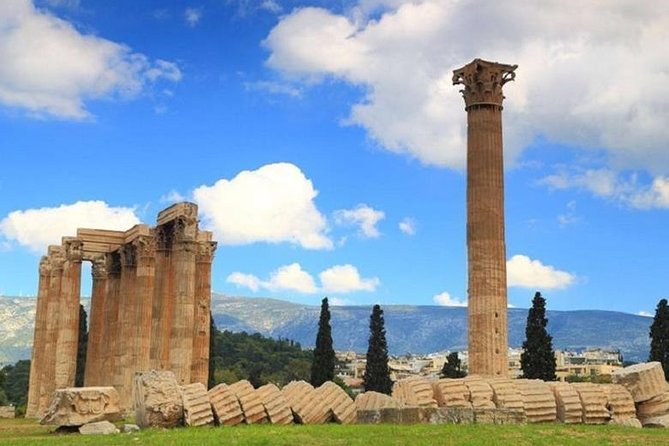
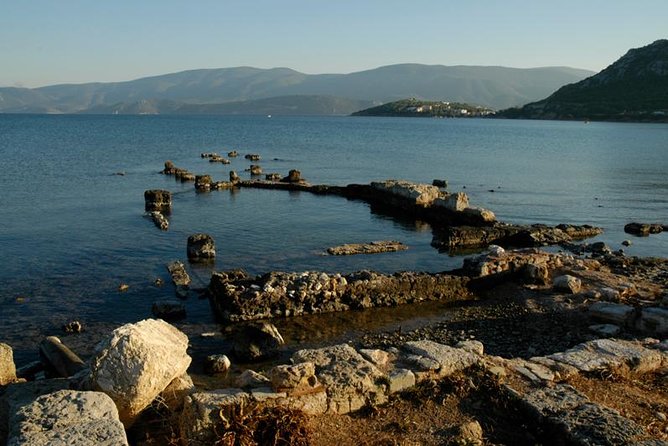
The final stop is Kechries, one of Corinth’s two ancient ports. It served trade routes through the Saronic Gulf and was linked to the eastern side of Corinth’s commercial world.
The stop lasts about 15 minutes, so think of it as a short look rather than a full archaeological visit. You see the remains of the harbor area and hear about its role in Corinth’s trade.
Kechries is also connected with the Apostle Paul, who is said to have arrived there during his second missionary journey. The historical notes describe the site as a place where Paul arrived, but the short visit leaves little time for a detailed biblical study.
This stop works best as a quiet counterpoint to the larger ruins. Ancient Corinth shows the city’s center, while Kechries points to the ports that helped make Corinth wealthy. If your interests lie mainly in major monuments, you may find the stop modest. If you like connecting ancient cities with their trade routes, it adds useful context.
What your driver can and cannot do
Your English-speaking driver explains the ancient monuments, Greek history, myths, and selected facts about modern Greece during the drive. Names associated with the service include Frank, the owner, and Planos, who has been praised for explaining the sites and stories about Greek gods.
The driver is not a licensed guide and cannot accompany you inside Ancient Corinth or Acrocorinth. This distinction matters. You receive historical background and practical help, but you will explore the archaeological grounds on your own unless you arrange the licensed guide.
The optional guide costs €260 in cash and is subject to availability. Shared between two people, that adds €130 per person before entrance fees. I would consider it if you want detailed interpretation, have limited background in Greek history, or care about understanding the site beyond the main photo stops.
If you prefer to walk independently and have already read about Corinth, the driver’s road commentary may be enough. The private format gives you more freedom than a group excursion, but it does not turn the driver into a site guide.
Pickup is practical for hotels and cruise passengers
Pickup and drop-off are included from Athens hotels and Piraeus Port. Airport pickup is available on request for an additional fee, which varies by vehicle type.
Cruise passengers should pay attention to the terminal instructions. Piraeus has Terminals A, B, and C, and the driver waits at the exit for the terminal where your ship docks. If you arrive at Terminal B or C and the exit gate is closed, take the shuttle bus to Terminal A. The ride is listed as three minutes, and the driver waits there.
This arrangement is useful for a port day because the tour is private and timed around your group rather than a large bus. Still, a five-hour trip from Piraeus leaves less spare time than a hotel pickup in central Athens. Confirm the pickup details and allow room for port delays.
The experience is offered in English and includes a mobile ticket. Most people can participate, but the information does not promise step-free access or describe the walking surfaces in detail. Ask the operator about your specific mobility needs before booking.
What is included, and what you still pay
Included:
- Private round-trip transportation
- Air-conditioned vehicle
- Bottled water
- WiFi onboard
- Hotel or Piraeus Port pickup and drop-off
- English-speaking professional driver
Not included:
- €15 Ancient Corinth admission per adult
- Lunch and snacks
- Licensed English-speaking guide
- Airport pickup, if requested
The phrase after lunch appears in the Kechries description, but lunch itself is not included. Plan for that cost and timing yourself. Since the total outing lasts about five hours, you should also avoid assuming there will be a long restaurant break.
The price covers the entire private vehicle for up to two people. That makes the tour a better deal for a couple or two friends than for a solo visitor. It also gives you a quieter day than a shared coach, with no unknown passengers and no need to match a group’s pace.
Who should book this Ancient Corinth tour?
I would choose this trip if you have limited time in Athens but want more than the city’s central monuments. It works especially well for two people who want private transport, cruise passengers with a suitable port window, and history lovers who want Greek, Roman, Byzantine, and medieval layers in one outing.
It is also a good fit if Acrocorinth matters to you. Many shorter Corinth visits focus only on the canal and Ancient Corinth. This route adds the castle and the old port, giving you a broader picture of the region.
I would think twice if you want an in-depth archaeological lesson at every stop, since the driver cannot enter the sites. Add the licensed guide if that depth matters. I would also think twice if you dislike brisk visits, since Ancient Corinth and Acrocorinth each receive about an hour, while Kechries gets only 15 minutes.
The tour has free cancellation up to 24 hours before the start time. Cancellations or changes inside that window are not accepted for a refund.
Should you book it?
Book this Ancient Corinth half-day tour if you want private, efficient transportation and four distinct stops without arranging the route yourself. The canal explains the geography, Ancient Corinth supplies the major ruins, Acrocorinth brings the fortress and views, and Kechries completes the story with an ancient port.
The best value comes when two people share the $363.71 group price and are happy exploring the sites without an included guide. Add the €260 licensed guide only if you want full interpretation inside the ruins. For a short Athens stay or a well-planned cruise day, this is a useful way to reach Corinth without losing a full day.
FAQ
How long does the Ancient Corinth tour last?
The tour lasts approximately five hours, including transportation from Athens and the scheduled visits to the Corinth Canal, Ancient Corinth, Acrocorinth, and Kechries.
What is the price of the private tour?
The price is $363.71 per group of up to two people. Entrance fees, lunch, snacks, and an optional licensed guide cost extra.
Is pickup from Piraeus Port included?
Yes. Pickup and drop-off from Piraeus Port are included. The driver meets you at the exit of the terminal where your ship docks. If Terminal B or C has a closed exit gate, take the shuttle to Terminal A.
Is an English-speaking guide included?
An English-speaking driver is included, but the driver cannot accompany you inside the archaeological sites. A licensed English-speaking guide can be arranged for an additional €260, payable in cash, subject to availability.
How much is admission to Ancient Corinth?
Admission to Ancient Corinth is €15 per adult. The entrance fee is not included in the tour price.
Can the tour pick me up at Athens International Airport?
Airport pickup is available on request for an additional fee. The amount varies according to the vehicle type.
Newest history tours we have reviewed in Athens
- The original Christian tour on Paul’s footsteps in Athens and ancient Corinth★ 4.5 · 25 reviews
- Ancient Sparta & Mystras Private Day Tour from Athens★ 5.0 · 52 reviews
- Athens: Combo Ticket for Acropolis & 6 ancient sites★ 3.0 · 21 reviews
- Small-Group Women History in Ancient Greece Walking Tour★ 5.0 · 38 reviews
- Ancient Corinth, Sanctuary of Hera, Blue Lake & Canal from Athens★ 5.0 · 26 reviews
- Half Day Historical Athens City Private Taxi Service Tour★ 5.0 · 79 reviews
- Private Luxury Tour: Marathon – Battle & Run That Changed History★ 5.0 · 30 reviews
- Ancient Olympia & Ancient Corinth Private LuxuryTour from Athens★ 5.0 · 25 reviews
Ancient History Tours, compared.
Colosseum: Underground and Ancient Rome Tour
Read our review →
Colosseum & Ancient Rome with Arena Floor Option I Max 6 People
Read our review →
Colosseum, Ancient Rome Tour or AudioGuided Tour
Read our review →
Colosseum Underground & Ancient Rome Guided Tour
Read our review →
Taormina: Ancient Theater Skip-the-Line Ticket & Audio Guide
Read our review →
Discover the Ancient Ruins of Pompeii: Day Trip from Rome
Read our review →
Discover Matera, the ancient city – English tour
Read our review →Browse the lists this tour appears in