
Review · ATHENS HISTORY TOURS
The original Christian tour on Paul’s footsteps in Athens and ancient Corinth
Paul’s Athens comes alive on the rocky Areopagus, where the apostle is said to have preached about the unknown god. From there, this private day continues to the Acropolis, Ancient Agora, Corinth Canal, and the ruins of Ancient Corinth, linking major Greek monuments with an important Christian journey.
I like the private car and flexible pace, especially for a small group, a family, or a cruise passenger working within a tight port schedule. I also like the mix of grand sights and biblical places: the Parthenon gives you ancient Athens at its peak, while Corinth connects directly with Paul’s ministry.
The main catch is simple: the driver does not accompany you inside the archaeological sites. You get explanations during the drive and before each stop, but a licensed guide costs extra. If close, on-site interpretation matters to you, add one in advance.
Key points to know before booking
- Paul’s Athens and Corinth in one day: Visit the Areopagus, Ancient Agora, and Ancient Corinth alongside the Acropolis and Corinth Canal.
- Private transport for up to three: Your group travels in an air-conditioned vehicle, with hotel or Piraeus pickup and return.
- Driver-led, not fully guided: The English-speaking driver explains the places but cannot guide you inside sites or museums.
- Site tickets cost extra: Acropolis, Ancient Agora, and Ancient Corinth admission are not included.
- A long but worthwhile day: The drive to Corinth adds a major biblical stop, but the schedule leaves little room for a slow, unplanned visit.
- Strong small-group value: At $445.77 per group, the cost is shared by as many as three people, before entrance fees, lunch, and any added guide.
From Piraeus along the Saronic Gulf
The day starts with pickup at your Athens hotel or at the Piraeus cruise port. At a hotel, meet the driver at the main entrance. At the port, walk outside the terminal exit, where the driver will wait with a sign bearing your name.
The first drive follows the coastal road beside the Saronic Gulf. This gives you a quick look at the Piraeus and Athens Riviera before the ancient sights begin. For a cruise passenger, the private pickup is especially useful because you do not need to find a taxi or navigate public transport after leaving the ship.
You must provide your ship name, docking time, disembarkation time, and re-boarding time when booking. The operator can arrange airport transfers for an extra charge, but airport pickup is not part of the listed price.
More Ancient History Tours in Athens
- Athens: Ancient Greek Theater Performance
★ 4.7 · 2,481 reviews - Historical Delphi One Day Tour with Arachova Stop & Expert Guide
★ 4.5 · 1,247 reviews - From Athens: Ancient Corinth Day Trip with Canal & VR Guide
★ 4.6 · 1,073 reviews
The Acropolis, from the Propylaea to the Parthenon
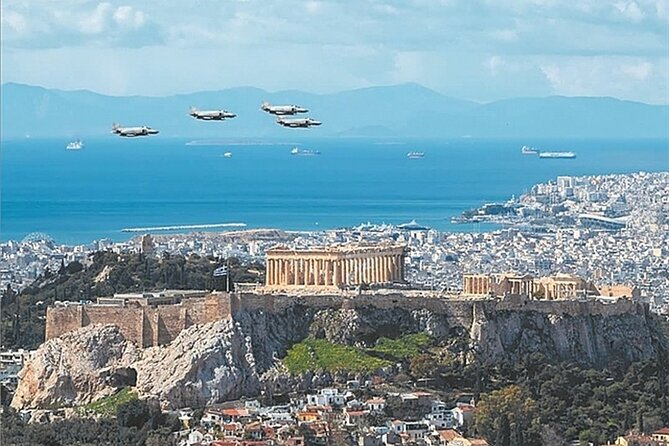
The Acropolis is the visual center of the day. This rocky sanctuary was dedicated mainly to Athena, Athens’ patron goddess, and its monuments reflect the city’s power during the fifth century BC, the age of Pericles.
Your driver takes you to the entrance area and explains what you are about to see. Once inside, you explore on your own unless you have paid for a licensed guide. That arrangement is worth understanding before you arrive, since the Acropolis is not a place where a few quick facts always do justice to the setting.
You pass through the Propylaea, the monumental gateway built during the great Periclean building program. Construction began in 437 BC under the architect Mnesikles, but the design was never completed. The gateway replaced earlier entrances and had already been shaped by the Persian destruction and later rebuilding of the Acropolis.
Nearby is the small Temple of Athena Nike, perched on a bastion at the southwestern edge of the hill. Its Ionic design and reliefs celebrated Greek victories, including the battle of Marathon. The stop is brief, but the temple’s position gives it a strong visual presence.
The Parthenon receives about 45 minutes. Built in the mid-fifth century BC for Athena Parthenos, it is the great centerpiece of the Acropolis. Look beyond the familiar columns. The building also served as a treasury for the Delian League, the alliance led by Athens, so it represents both religious devotion and political power.
The Erechtheion offers a different mood. Its south porch is carried by six carved female figures known as caryatids. Five originals were moved to the Acropolis Museum in 1978 and replaced by replicas. One was taken by Lord Elgin and is now in the British Museum. The removal of the Acropolis sculptures remains part of the story you will encounter as you look across the hill.
The Acropolis requires a moderate level of fitness. You will be walking over uneven archaeological ground, and the site is exposed to the sun. Comfortable shoes, water, and sensible clothing matter. The listed dress code is formal, so avoid treating this as a beach day, even in hot weather.
Mars Hill and Paul’s sermon on the unknown god
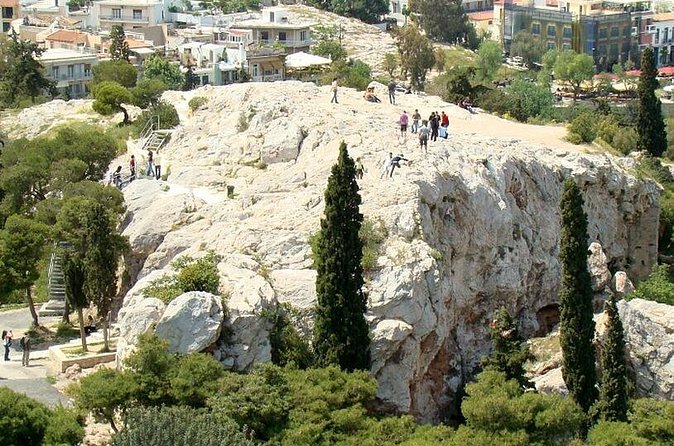
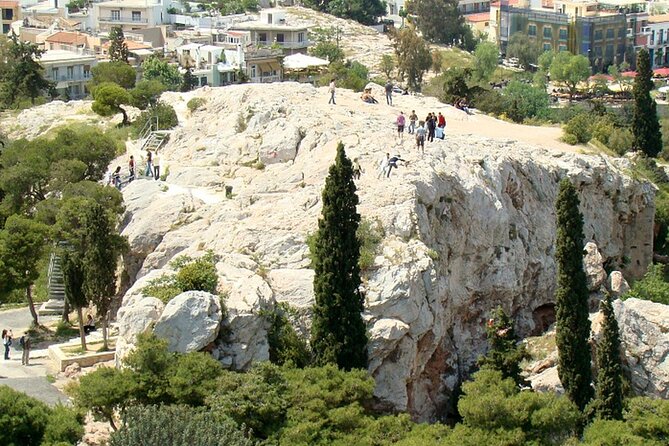
Just outside the Acropolis exit is the Areopagus, also called Mars Hill. In classical Athens, it served as a council and court, especially for homicide cases. Ancient myths connect the rock with the trial of Ares, and later stories associate it with Orestes.
For Christian visitors, the key moment is Paul’s sermon. The Acts of the Apostles describes Paul addressing Athenians here after seeing an altar dedicated to an unknown god. A bronze plaque at the foot of the rock commemorates the speech.
This is one of the most meaningful stops for anyone following Paul, but it is also one of the least elaborate. You will not find a large museum or a staged religious presentation. The value lies in the setting, the view, and the chance to connect a short biblical passage with a real place in the city.
The rock can be slippery and uneven. Take care, especially if you are traveling with a young child. One past booking included a toddler, and the driver was praised for being flexible, but the terrain itself still calls for attention.
The Ancient Agora and the civic life of Athens
After the Acropolis, the tour continues to the Ancient Agora. The drive is listed at about 20 minutes, followed by roughly 1 hour and 20 minutes at the site.
The Agora was the center of public life for about 5,000 years. It served at different times as a meeting place, market, residential area, and civic center. Excavation has exposed layers from the Archaic, Greek, Roman, Byzantine, and later periods.
This stop helps explain how Athens worked beyond its temples. The Acropolis shows the city’s religious and political ambition from above. The Agora shows people conducting business, debating public matters, and carrying out daily life below.
Again, the driver does not enter as a licensed guide. You will get background before being dropped off, then explore independently. If you want the statues, buildings, and excavated foundations explained as you see them, this is one of the strongest reasons to add the extra guide.
More Ancient History Tours in Greece
- Acropolis, Parthenon & Athens Old City Heritage Walking Tour
★ 4.5 · 876 reviews - Private Biblical Tour Ancient Corinth & Isthmus Canal from Athens
★ 5.0 · 762 reviews - Athens: Ancient Corinth & Nafplio Full Day Trip with Swim
★ 4.8 · 531 reviews - Athens Skip the Line: Open Air Ancient Greek Theatre Performance
★ 4.5 · 520 reviews
Crossing to the Peloponnese and the Corinth Canal
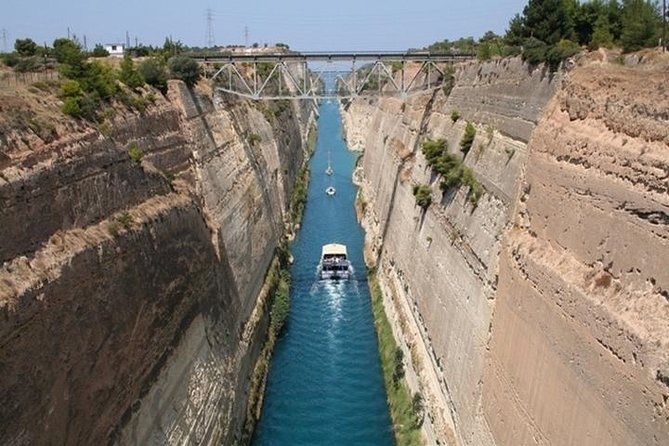
The trip to Corinth follows the coastal road toward the Peloponnese. The peninsula is separated from mainland Greece by the Isthmus of Corinth, where the canal cuts through the narrow land bridge.
The Corinth Canal is only about 6.4 kilometers long and roughly 25 meters wide, but it changed the route between the Saronic Gulf and the Gulf of Corinth. Before the canal was completed in the late 19th century, ships had to sail around the Peloponnese, adding about 185 nautical miles.
The idea is much older than the modern waterway. Periander, the tyrant of Corinth, is said to have considered cutting a canal around 602 BC. Instead, ships and cargo used the diolkos, a stone track that allowed vessels to be moved across the isthmus on wheeled platforms.
You spend about 15 minutes at the canal. That is enough for a look and photographs, but not a long visit. The stop works well as a visual break during the drive and as a reminder of why Corinth became so important.
Lunch in Ancient Corinth
Lunch is not included, and you have about an hour of free time at a traditional restaurant in Ancient Corinth. This is a chance to eat Greek food locally rather than rely on a hurried meal near Athens.
The price and restaurant choice are not specified, so bring a payment method and allow room in your budget. Since the day is already long, use lunch to slow down. The next stop is the main event for the Christian side of the tour.
Ancient Corinth and Paul’s wider mission
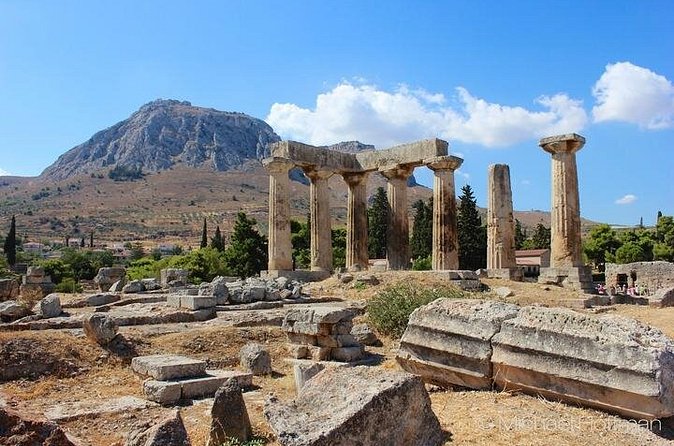
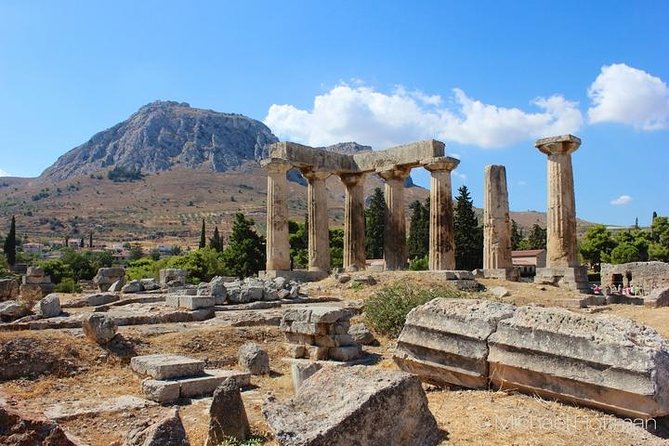
Ancient Corinth was occupied as early as the Neolithic period and prospered because of its position between mainland Greece and the Peloponnese. It also linked routes between the eastern and western Mediterranean. That location made Corinth a major center for trade, communication, and cultural exchange.
The city’s influence grew early. Corinth founded colonies including Corfu and Syracuse, and its agricultural output supported a wide trading network. At the site, you will see why Paul’s time in Corinth mattered within the larger story of the ancient Mediterranean.
The visit lasts about 1 hour and 20 minutes. The driver gives background before you enter, then you explore the ruins independently unless you have arranged a licensed guide. The site is not simply a Christian pilgrimage stop. It is also an ancient commercial city with Greek and Roman layers, so a guide can help you connect the remains to both Paul’s world and Corinth’s older civic life.
A full guide is particularly valuable here because the connection between the surviving stones and Paul’s ministry is not always obvious on a self-guided walk. One past visitor found the driver’s explanations useful but wanted more facts and stories while standing at the sites. That is a fair warning for anyone booking this mainly as a religious history experience.
What the private format is really worth
The price is $445.77 per group of up to three, not per person. Split three ways, that is about $148.59 each before admission fees, lunch, and an optional licensed guide. For two people, the per-person cost is higher, but you still get private transport and a day built around your own group.
The vehicle is air-conditioned and sized for the party. This matters in Athens, where summer heat can make a long day tiring. One past booking took place during weather above 100 degrees Fahrenheit, and the driver kept the car cool between stops. Another driver, Spyros, was praised for keeping water available. Those details are not guaranteed, but they show the practical value of having a dedicated car.
Drivers named Michael and David have also been associated with past bookings. Michael was praised for comfort, flexibility, and clear explanations before site visits. Danai, an archeologist who served as an added guide on one booking, received strong praise for bringing Greek and Christian history together. Ask if a preferred driver or guide is available, but do not assume a specific person is guaranteed.
The tour has a 96 percent recommendation rate and a 4.7 rating from 25 ratings. That points to a generally strong experience, while the lower rating highlights the central tradeoff: this is private transportation with historical commentary, not a fully escorted archaeological tour.
Who should book this day
I would choose this tour if you want to combine the Acropolis with Corinth and prefer a private car over a group coach. It is a good fit for:
- Couples or families sharing the cost among up to three people
- Cruise passengers with a confirmed port schedule
- Christian visitors who want the Areopagus and Ancient Corinth included
- People who value a private vehicle and hotel pickup
- Those willing to explore sites independently after a briefing
I would look elsewhere, or budget for the added guide, if you want continuous commentary inside every monument. The driver cannot accompany you into archaeological sites or museums under the stated arrangement.
Free cancellation is available up to 24 hours before the start time. Changes or cancellations made within 24 hours are not accepted for a refund. Admission tickets should be arranged early because availability can be limited, and the operator can buy them in advance for a small service fee.
Should you book this Athens to Corinth tour?
Book it if your priority is covering a lot of ground privately and seeing both the major monuments of Athens and the places tied to Paul. The Acropolis, Areopagus, Agora, canal, and Ancient Corinth make a strong full-day route.
Before paying, decide what kind of guiding you need. If you are happy to receive explanations in the car and at each entrance, the base price offers good value for a small group. If you want stories and interpretation while standing inside the sites, add the licensed guide. That one choice will determine whether this feels like a well-planned private day or simply an efficient ride between famous ruins.
FAQ
How long does the tour last?
The experience lasts about eight hours, although the route includes several long drives and multiple archaeological stops.
Where can pickup take place?
Pickup is available from your accommodation in Athens or from your cruise ship pier at Piraeus.
How many people can join the private tour?
The price covers one private group of up to three people.
Is the Acropolis entrance fee included?
No. Entrance fees to the Acropolis and other archaeological sites are not included.
Does the driver guide me inside the archaeological sites?
No. The English-speaking driver explains the sites before you enter, but drivers are not licensed to accompany visitors inside archaeological sites and museums.
Can I add a licensed tour guide?
Yes. A licensed English-speaking guide can be arranged for an additional cost, subject to availability.
Is lunch included?
No. You have free time for lunch at a traditional restaurant in Ancient Corinth, but food and drinks are extra.
Can cruise passengers book this tour?
Yes. Pickup and return are available at the Piraeus cruise port. You must provide your ship and port timing details when booking.
What happens if I need to cancel?
You can receive a full refund if you cancel at least 24 hours before the experience begins. Cancellations made less than 24 hours in advance are not refunded.
Newest history tours we have reviewed in Athens
- Ancient Sparta & Mystras Private Day Tour from Athens★ 5.0 · 52 reviews
- Athens: Combo Ticket for Acropolis & 6 ancient sites★ 3.0 · 21 reviews
- Small-Group Women History in Ancient Greece Walking Tour★ 5.0 · 38 reviews
- Ancient Corinth, Sanctuary of Hera, Blue Lake & Canal from Athens★ 5.0 · 26 reviews
- Half Day Historical Athens City Private Taxi Service Tour★ 5.0 · 79 reviews
- Private Luxury Tour: Marathon – Battle & Run That Changed History★ 5.0 · 30 reviews
- Ancient Olympia & Ancient Corinth Private LuxuryTour from Athens★ 5.0 · 25 reviews
- Ancient Agora & Temple of Hephaestus Entrance Ticket★ 3.5 · 22 reviews
Ancient History Tours, compared.
Colosseum: Underground and Ancient Rome Tour
Read our review →
Colosseum & Ancient Rome with Arena Floor Option I Max 6 People
Read our review →
Colosseum, Ancient Rome Tour or AudioGuided Tour
Read our review →
Colosseum Underground & Ancient Rome Guided Tour
Read our review →

Taormina: Ancient Theater Skip-the-Line Ticket & Audio Guide
Read our review →
Discover the Ancient Ruins of Pompeii: Day Trip from Rome
Read our review →
Discover Matera, the ancient city – English tour
Read our review →Browse the lists this tour appears in