

Review · ATHENS HISTORY TOURS
Biblical Corinth Taste Faith & History with wine & Oil Tasting
The most memorable part of this outing is the way Corinth’s ancient trade routes and Christian story come together. You see the canal that cuts through the isthmus, the ancient road that moved ships overland, the city linked with Saint Paul, and Acrocorinth’s fortress above it all. I like the private door-to-door transport and the freedom to pause for photos, food, or a changed plan. The main caution is timing: five hours is tight for every stop, and Ancient Corinth or its museum may occasionally be closed.
I also like that this is a small private group, not a bus tour. Drivers such as Nikos, Panos, Periklis, Andreas, and Christos have been praised for clear explanations, good local suggestions, and flexible routing. The price is substantial at $190.46 per person, and wine, oil tasting, lunch, and several entrance fees can add more.
Key points at a glance
- A private Athens pickup: Your driver collects you at a hotel, apartment entrance, port, or arranged meeting point in a sedan or mini van.
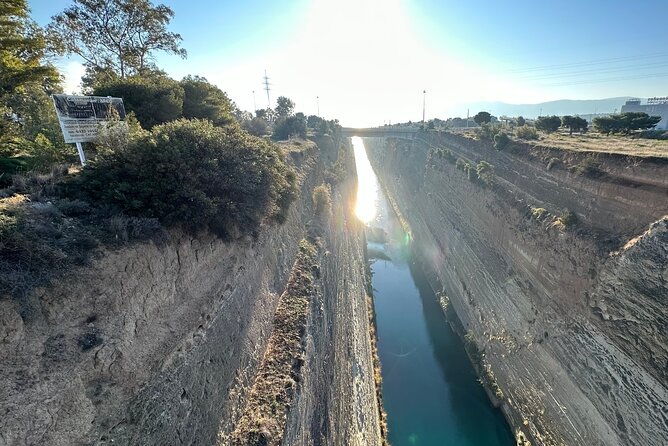
- The Corinth Canal in person: You get a short photo stop at the 19th-century waterway built across an isthmus that ancient rulers dreamed of cutting.
- Ancient ship transport: The Diolkos explains how boats and cargo once crossed the land instead of sailing around the Peloponnese.
- Paul, Poseidon, and Corinth: Isthmia and Ancient Corinth connect Greek sport, Roman power, and the journeys of Saint Paul.
- The high point is Acrocorinth: The fortress rock gives you the broadest view and is often the emotional finish of the day.
- Tastings cost extra: Wine is listed at €15 per person, while oil tasting with finger food is listed at €80 per person.
Why Corinth makes a strong half-day from Athens
Corinth sits on the narrow isthmus joining mainland Greece to the Peloponnese. That position made it a natural gatekeeper. Goods, armies, sailors, athletes, and religious ideas all passed through here.
The ancient city was already a major Greek center by 400 BC, with a population given as about 90,000. Rome destroyed Corinth in 146 BC, then rebuilt it in 44 BC. The new Roman city later became the provincial capital of Greece.
That sequence gives you more than a pile of old stones. At Corinth, Greek and Roman eras overlap, while the New Testament adds another layer. Saint Paul spent time in the area and wrote the letters known as First and Second Corinthians. The tour is a good fit if you want your ancient sites tied to real trade, politics, religion, and daily movement.
The outing lasts about five hours, so you should think of it as a focused introduction rather than a full archaeological study. You get a useful sweep of the region, but some stops are short. If you want every museum label, a long meal, and a serious climb around Acrocorinth, a full-day version would give you more breathing room.
More Ancient History Tours in Athens
- Athens: Ancient Greek Theater Performance
★ 4.7 · 2,481 reviews - Historical Delphi One Day Tour with Arachova Stop & Expert Guide
★ 4.5 · 1,247 reviews - From Athens: Ancient Corinth Day Trip with Canal & VR Guide
★ 4.6 · 1,073 reviews
A private ride that keeps the day simple
Pickup is offered from an Athens hotel, Airbnb residence, or port. At a hotel, the driver waits in the lobby. At an apartment, the meeting point is the building entrance. Port pickup takes place at the gate, with a name sign. Airport pickup is available for an additional charge of €60 per person.
Groups of one to three use a luxury sedan. Groups of four to seven use a mini van. The vehicles have air conditioning, WiFi, and bottled water, and fuel and tolls are included.
This matters because Corinth is not a quick walk from central Athens. A private car removes the need to coordinate public transport and lets your group keep the day at its own pace. You can also return to your original pickup point or another preferred point.
The driver is not automatically a licensed archaeological guide. The English-speaking driver provides history and local commentary, but a licensed guide is optional and costs an additional €140 per person, subject to availability. That distinction is important. If you want detailed interpretation inside the archaeological sites, ask for the licensed guide when booking.
The drivers named in the feedback include Nikos, Panos, Periklis, Andreas, and Christos. Periklis was praised for adding a lesson about the Battle of Marathon, while Andreas helped adjust a route for a bungee jump. Those examples show the practical value of a private outing: the day can sometimes be shaped around your interests.
Corinth Canal: a short stop with a big idea
The first stop is the Corinth Canal, usually about 15 minutes. Admission is free.
The canal cuts across the Corinth Isthmus and links the Gulf of Corinth with the Saronic Gulf. In practical terms, it separates the Greek mainland from the Peloponnese, making the southern peninsula an island.
The modern canal was completed in the late 19th century, but the idea is much older. Periander, the tyrant of Corinth, is said to have considered cutting through the isthmus around 602 BC. The technology was not available, so the ancient solution was the Diolkos, a paved route for moving boats over land.
You will not spend long here, but the stop gives the rest of the tour a clear purpose. Look down into the narrow cut and consider the 185 nautical miles ships once had to add by sailing around the Peloponnese. It is a quick photo stop, not a detailed canal visit, so do not expect a boat ride or an extended walk.
The Diolkos and Isthmia: where ships and athletes crossed paths
The Diolkos stop lasts about 20 minutes and is also free. This paved trackway ran roughly 6 to 8.5 kilometers across the isthmus. From about 600 BC to the middle of the first century AD, it allowed boats and cargo to move overland.
The concept sounds startling today. The route combined overland transport with an early form of railway, letting ships avoid the dangerous trip around the peninsula. It was used for trade and, during war, to move naval forces faster.
The next stop, Isthmia, lasts about 30 minutes. The site hosted the Isthmian Games, the second most important athletic contests in the ancient Greek world after the Olympics at Olympia. Its position between the mainland and Peloponnese made it a natural gathering point.
Isthmia also connects to Saint Paul. The area is associated with his time in Corinth, where he worked as a tent maker and preached among the people arriving for the games. For anyone interested in early Christianity, this is a useful stop because it places Paul in a working, commercial, athletic setting rather than in an abstract religious story.
More Ancient History Tours in Greece
- Acropolis, Parthenon & Athens Old City Heritage Walking Tour
★ 4.5 · 876 reviews - Private Biblical Tour Ancient Corinth & Isthmus Canal from Athens
★ 5.0 · 762 reviews - Athens: Ancient Corinth & Nafplio Full Day Trip with Swim
★ 4.8 · 531 reviews - Athens Skip the Line: Open Air Ancient Greek Theatre Performance
★ 4.5 · 520 reviews
Isthmia Museum: small objects, wide connections
The Archaeological Museum of Isthmia is scheduled for about 20 minutes, with admission not included.
The collection covers several periods and helps fill in details that the open-air ruins cannot. You might see an Archaic marble pediment from the first Temple of Poseidon, commercial amphorae from Isthmia, Rachi, and Kechrees, and offerings connected with worship and warfare.
Some of the more unusual pieces include colored glass panels from the Temple of Isis at the harbor of Kechreai. They show harbor views, exotic scenery, animals, plants, ships, geometric designs, and full-length figures identified as philosophers such as Homer and Plato.
There is also an imperial statue in the type of Zeus, an Epinician stele with a portrait of the Corinthian musician Lefkios Cornelius, and small animal figures, including a golden bull dated to the sixth century BC. Finds from Mycenaean and Roman cemeteries add another layer to the story.
Twenty minutes is enough for a brisk look, but not for careful study of every object. If museums are your main reason for coming, you may find the time too short.
Ancient Corinth: the tour’s central chapter
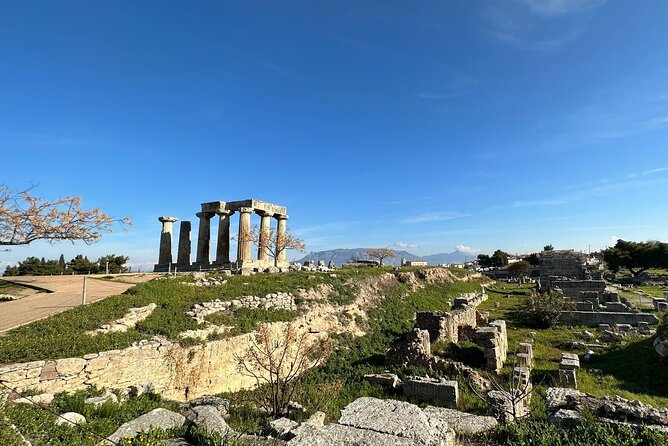
Ancient Corinth receives about one hour, with admission not included. This is the main archaeological stop and the place where the tour’s Greek, Roman, and Christian threads meet.
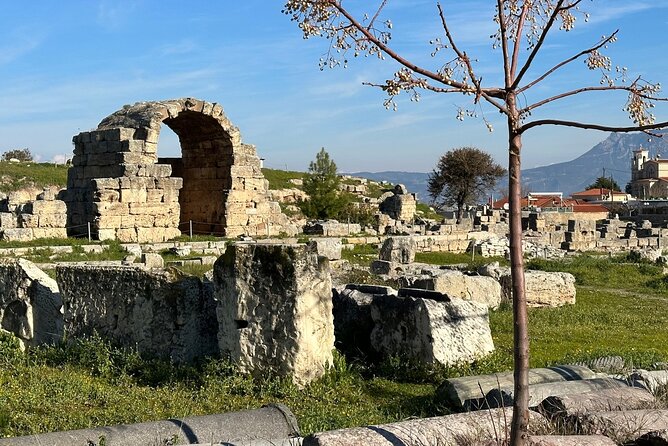
The site lies about five kilometers from the modern city. You can expect a broad ancient setting with remains connected to the agora, the Lechaion Road, fountains, a basilica, a stoa, and an odeon. The Archaeological Museum of Corinth is within the archaeological area.
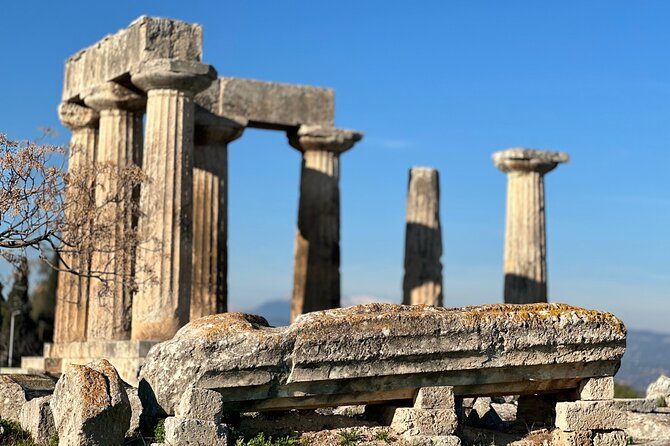
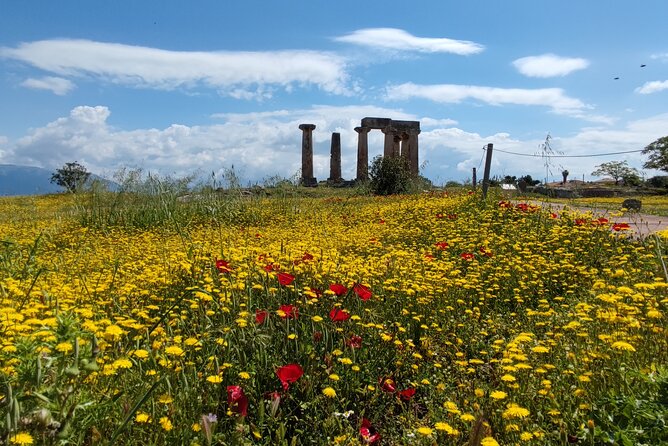
The Temple of Apollo is one of the clearest sights. Built around 550 BC, it is among the earliest Doric temples in the Peloponnese and mainland Greece. Its monolithic columns are especially notable because each column was made from a single piece of stone.
The museum and site also include the Fountain of Peirene, Hadgimoustafa Spring, the agora, basilica, stoa, and odeon. These names can blur together if you rush, so listen closely to your driver or licensed guide and decide which features matter most to you.
This stop has one practical risk. The site can close for special reasons, including filming or safety arrangements, and one scheduled visit found Ancient Corinth and its museum closed on a Tuesday. The operator explained that the closure was linked to filming of Nolan’s film The Odyssey and that the exact timing was not known in advance. Before paying for the trip, ask specifically about the planned opening status of Ancient Corinth and the museum on your date.
Lunch and free time in the village
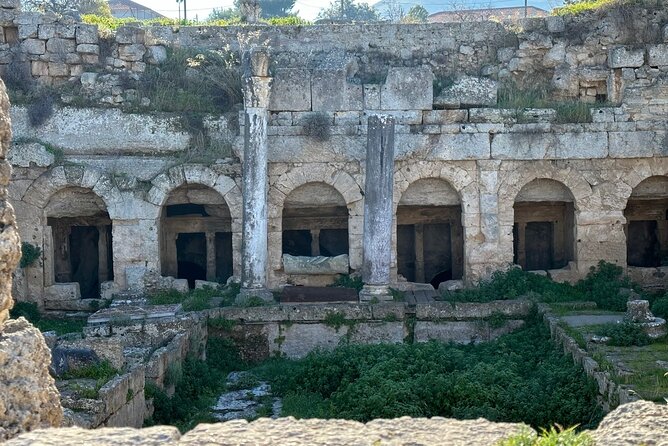
You get about 45 minutes for lunch and shopping in Ancient Corinth. Food is not included.
That pause is useful after the ruins, but it is not a long Greek meal. You will need to keep an eye on the clock if you want to eat, browse, and still reach Acrocorinth on schedule.
Several drivers have suggested lunch spots and made extra stops for food. That local help can be valuable, especially if you prefer a simple meal rather than choosing at random. Still, ask how much time remains before ordering. The five-hour schedule has several moving parts.
Acrocorinth: the best view of the day
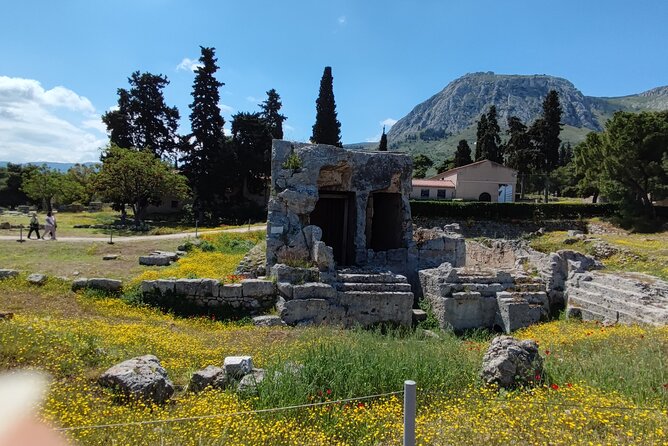
Acrocorinth is the upper citadel of ancient Corinth, built on a large rock above the city. The planned visit lasts about 30 minutes, and admission is not included.
This is often the most striking part of the outing. The rock commands the Corinth Isthmus, which explains why the fortress mattered for so long. With its secure water supply and commanding position, Acrocorinth served repeatedly as a final defensive point in southern Greece.
You come here for both the ruins and the view. From above, the geography that shaped Corinth becomes clear: the narrow isthmus, the ancient city below, and the routes linking the mainland with the Peloponnese.
Thirty minutes gives you a taste, not a full exploration of the castle. Wear shoes suitable for uneven ground and follow the driver’s timing advice. If Acrocorinth is your main reason for booking, consider asking if a longer stop or full-day plan is possible. One person who altered the itinerary for a bungee jump still made time for Acrocorinth, which shows the route can sometimes be adjusted, but every change reduces time elsewhere.
Wine and oil tasting: know what you are buying
The title presents wine and oil tasting as part of the experience, but the pricing details list them separately from the base tour.
Wine tasting is listed at €15 per person. Oil tasting with finger food is listed at €80 per person. Those are very different charges, so ask exactly what is included before confirming. The supplied information does not specify the number of wines, the amount of olive oil, the venue, or the finger food menu.
This tasting can add a pleasant food element to a history-focused day, especially if you want more than ruins and driving. But it changes the value calculation. At $190.46 per person, the base price already covers private transport, pickup, the English-speaking driver, WiFi, air conditioning, water, fuel, and tolls. Add entrance fees, lunch, and tastings, and the final cost can rise quickly.
The price makes the most sense for a small group that values a private vehicle, flexible stops, and door-to-door service. It makes less sense if you only want to see the canal and one ruin at the lowest possible cost.
What is included, and what is extra
The base experience includes:
- Private transport in a sedan or mini van
- Pickup and return service from an Athens hotel, apartment, port, or arranged point
- An English-speaking driver with Greek history knowledge
- Air conditioning, WiFi, and bottled water
- Fuel and tolls
- A private group of up to seven people
You should budget separately for:
- Entrance fees, listed as €15 per person for all attractions
- The Archaeological Site of Ancient Corinth, also listed separately at €15 per person
- A licensed guide, €140 per person if requested and available
- Wine tasting, €15 per person
- Oil tasting with finger food, €80 per person
- Lunch
- Gratuities
- Airport pickup, €60 per person
Because the fee descriptions overlap, I would ask the operator for one written total before booking. Specifically ask if the general €15 attraction fee includes Ancient Corinth or if the site fee is added separately.
Who should book this Corinth tour?
I would choose this tour if you want to cover several Corinth sites without arranging a car, and if you care about having a driver who can explain the region along the way. It suits couples, families, and small groups who prefer a private schedule to a large coach.
It is also a good match for people interested in Saint Paul, ancient Greek sport, Roman Corinth, or the practical side of ancient trade. The Diolkos and canal make the visit more than a standard temple stop.
I would hesitate if you need long, quiet time at every archaeological site. The schedule is brisk, and the five-hour limit means the museum, lunch, Ancient Corinth, and Acrocorinth all compete for attention. I would also postpone booking until you confirm opening dates, especially for Ancient Corinth.
Should you book it?
Book it if private transport, flexible routing, and a broad introduction to Corinth are worth the cost. The strongest parts are the driver-led context, the easy Athens pickup, the canal and Diolkos connection, and the final view from Acrocorinth.
Before you pay, confirm three things: the exact entrance-fee total, whether wine and oil tasting are optional add-ons, and whether Ancient Corinth will be open on your date. If those details are clear, this is a practical way to see a major Greek crossroads without renting a car or joining a bus.
FAQ
How long does the Corinth experience last?
The tour lasts approximately five hours and ends back at the meeting point or another preferred return point.
Is pickup from Athens included?
Pickup is offered from an Athens hotel, Airbnb residence, or port. Airport pickup is available for an additional €60 per person.
How many people can join the private tour?
The private mini van can carry up to seven people. Groups of one to three use a luxury sedan, while groups of four to seven use a mini van.
Is a licensed guide included?
No. The tour includes an English-speaking driver who provides historical information. A licensed guide can be requested for an additional €140 per person, subject to availability.
Are entrance fees included?
No. Entrance fees are not included. The pricing information lists €15 per person for attractions and also lists Ancient Corinth’s archaeological site at €15 per person, so you should confirm the exact total before booking.
Are lunch and tastings included?
Lunch is not included. Wine tasting is listed at €15 per person, while oil tasting with finger food is listed at €80 per person.
Can I cancel the tour for a full refund?
You can cancel at least 24 hours before the local start time for a full refund. Changes or cancellations made less than 24 hours before the start are not accepted or refunded. If poor weather causes cancellation, you are offered another date or a full refund.
Newest history tours we have reviewed in Athens
- The original Christian tour on Paul’s footsteps in Athens and ancient Corinth★ 4.5 · 25 reviews
- Ancient Sparta & Mystras Private Day Tour from Athens★ 5.0 · 52 reviews
- Athens: Combo Ticket for Acropolis & 6 ancient sites★ 3.0 · 21 reviews
- Small-Group Women History in Ancient Greece Walking Tour★ 5.0 · 38 reviews
- Ancient Corinth, Sanctuary of Hera, Blue Lake & Canal from Athens★ 5.0 · 26 reviews
- Half Day Historical Athens City Private Taxi Service Tour★ 5.0 · 79 reviews
- Private Luxury Tour: Marathon – Battle & Run That Changed History★ 5.0 · 30 reviews
- Ancient Olympia & Ancient Corinth Private LuxuryTour from Athens★ 5.0 · 25 reviews
Ancient History Tours, compared.
Colosseum: Underground and Ancient Rome Tour
Read our review →
Colosseum & Ancient Rome with Arena Floor Option I Max 6 People
Read our review →
Colosseum, Ancient Rome Tour or AudioGuided Tour
Read our review →
Colosseum Underground & Ancient Rome Guided Tour
Read our review →
Taormina: Ancient Theater Skip-the-Line Ticket & Audio Guide
Read our review →
Discover the Ancient Ruins of Pompeii: Day Trip from Rome
Read our review →
Discover Matera, the ancient city – English tour
Read our review →Browse the lists this tour appears in