
Review · ATHENS HISTORY TOURS
Full Day Biblical Ancient Corinth Canal Mycenae Epidauvro Nafplio
The best part of this long day is the sweep of it: from the Corinth Canal and Saint Paul’s Corinth to the Bronze Age citadel of Mycenae, then on to elegant Nafplio. You move through several very different chapters of Greek history without changing hotels or figuring out buses.
I like the private transport and the freedom to adjust the pickup time or spend longer at a favorite stop. I also like the personal touch reported from drivers such as Chris, Michael, Costas, Ioannis, and Yiannes, who handled questions, offered choices, and kept the day comfortable. The drawback is simple: this is a packed 9 to 10 hours, and entrance fees, lunch, and a licensed archaeological guide are not included.
Key points to know before booking
- The Corinth Canal is a quick but worthwhile first stop: You get a clear view of the narrow cut linking the Gulf of Corinth with the Saronic Gulf.
- Ancient Corinth connects directly to Saint Paul: The Bema, forum, Temple of Apollo, and museum give the biblical theme real physical context.
- Mycenae is the strongest archaeological stop: The Lion Gate, Cyclopean walls, and Treasury of Atreus are powerful even with limited time.
- Nafplio adds a welcome change of pace: Its old town, waterfront, fortresses, and squares feel more relaxed after several ancient sites.
- Palamidi is physically demanding: The famous route is often described as 999 steps, and the schedule allows only about 30 minutes.
- This is a driver-led private tour, not a fully guided archaeological tour: Your English-speaking driver provides historical background, but a licensed guide inside the sites costs extra.
From Athens to the Corinth Canal
The day begins with pickup at your Athens hotel, apartment, or port. For groups of one to three, transport is by a luxury sedan, described as a Mercedes vehicle or similar first-class car. Groups of four to seven use a comfortable minivan. Air conditioning, WiFi, and bottled water are included.
The first stop is the Corinth Canal, about 15 minutes. It is not a long visit, but it gives you one of the clearest geographical moments of the day. The canal cuts across the narrow Isthmus of Corinth, separating the mainland from the Peloponnese in practical terms and linking the Gulf of Corinth with the Saronic Gulf.
The canal was completed in the late 19th century, but the idea is much older. Ancient ships had to circle the Peloponnese, adding roughly 185 nautical miles to some journeys. Periander, the ruler of Corinth in the 7th century BC, is credited with considering a canal, but ancient engineers could not carry out the full project. Instead, ships and cargo could be moved across the diolkos, a stone route using wheeled platforms.
You only have around 15 minutes here, so think of it as a photo and orientation stop rather than a full visit. The attraction is free, but crowds and traffic can affect how quickly you get to the best viewing point.
More Ancient History Tours in Athens
- Athens: Ancient Greek Theater Performance
★ 4.7 · 2,481 reviews - Historical Delphi One Day Tour with Arachova Stop & Expert Guide
★ 4.5 · 1,247 reviews - From Athens: Ancient Corinth Day Trip with Canal & VR Guide
★ 4.6 · 1,073 reviews
Saint Paul in Corinthia
The itinerary includes another short stop at Kechries, the modern village associated with the ancient port of Cenchreae. Allow about 15 minutes.
This is the biblical thread of the trip. According to the Acts of the Apostles, Paul stopped at Cenchreae during his second missionary journey and cut his hair after completing a vow. In his Letter to the Romans, he also mentions Phoebe, associated with the local Christian community.
The site itself is less immediately impressive than Ancient Corinth or Mycenae. Its value comes from the connection between the modern place and the ancient port. If your interest is biblical geography, this stop gives the day a useful human link. If you are mainly interested in monuments, you may prefer to keep this brief and preserve time for the major archaeological areas.
Ancient Corinth and the Bema of Saint Paul
Ancient Corinth receives about 45 minutes, followed by another half hour at the archaeological museum. The site admission is extra, so budget for that separately.
Corinth was a major commercial city, helped by its position between the Aegean and Adriatic worlds. The central area includes the Agora, the Lechaion Road, the Fountain of Peirene, stoas, basilicas, shops, and small temples. This is not a single isolated monument. It is a city plan, and the arrangement of roads and public buildings helps you picture how Corinth worked.
The most important stop for the biblical focus is the Bema, the raised platform in the Roman Forum. Tradition identifies it as the place where Paul faced the Roman proconsul Gallio around AD 52. Gallio treated the dispute as a religious matter rather than a Roman legal case. The Bema was later converted into a Christian church during the Byzantine period, probably because of its connection with Paul.
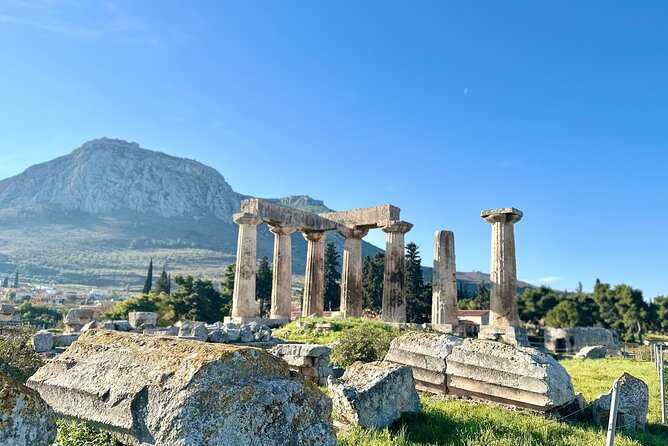
The nearby Temple of Apollo is another highlight. Built around 550 BC, it is among the early Doric temples of the Greek mainland and Peloponnese. Its large monolithic columns are especially striking because they belong to an early phase of Greek temple architecture.
The itinerary also lists Acrocorinth, the fortified upper city on a massive rock above Ancient Corinth, for about 15 minutes. This is mainly a viewpoint stop unless you have more time. The fortress controlled the Isthmus and served as a defensive position for centuries. The short schedule will not allow a serious exploration of the walls, so treat it as a quick look and photo opportunity.
A practical point: the driver can explain the setting and history, but the tour does not include a licensed guide accompanying you inside the archaeological sites. If you want detailed interpretation of the ruins, arrange a licensed guide separately or use the driver’s introduction to decide where to focus.
The Ancient Corinth Museum
The museum visit is scheduled for around 30 minutes. That is enough for a focused look, but not a slow examination of every room.
The museum was built in the early 1930s to display material uncovered in excavations at Corinth. It sits within the archaeological site, which makes the visit efficient. You can move from the objects indoors to the ruins outside without adding another transfer.
I would use the museum to support what you have just seen rather than treating it as a separate major attraction. Look for the connection between ordinary city life, public buildings, religious practice, and the Roman period. The combination of museum and ruins is one reason Ancient Corinth works well as the first substantial stop.
More Ancient History Tours in Greece
- Acropolis, Parthenon & Athens Old City Heritage Walking Tour
★ 4.5 · 876 reviews - Private Biblical Tour Ancient Corinth & Isthmus Canal from Athens
★ 5.0 · 762 reviews - Athens: Ancient Corinth & Nafplio Full Day Trip with Swim
★ 4.8 · 531 reviews - Athens Skip the Line: Open Air Ancient Greek Theatre Performance
★ 4.5 · 520 reviews
Mycenae and the World of Agamemnon
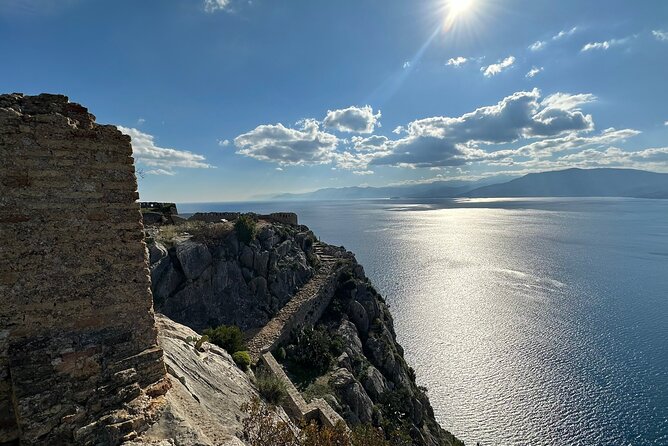
The drive continues to Mycenae, the fortified citadel linked to the mythical King Agamemnon. The scheduled visit to the wider site is about one hour, with additional short stops at the Lion Gate, museum, and Treasury of Atreus.
Mycenae gave its name to the Mycenaean civilization, which flourished roughly from 1600 to 1100 BC. At its height around 1350 BC, the citadel and lower town covered about 32 hectares and may have held 30,000 people. That scale helps explain why the site feels more like a fortified center than a simple palace ruin.
The Cyclopean walls are the first great visual impression. Later Greeks believed stones this large could only have been placed by the Cyclopes, the one-eyed builders of myth. The walls surround an almost triangular acropolis, entered from the northwest through the famous Lion Gate.
The Lion Gate dates to around 1250 BC. Two lions or lionesses face one another above the entrance in a heraldic relief. It is the only surviving monumental sculpture of Mycenaean Greece and the largest known sculpture from the prehistoric Aegean. Take a moment before walking through. The gateway is not just decorative. It announces power, control, and the ability to move through a heavily protected entrance.
The museum is scheduled for about 15 minutes. Again, this is a short visit, but it can help you understand the buildings and burial customs before or after walking the citadel. The visible remains are mainly from Mycenae’s peak between about 1350 and 1200 BC.
The Treasury of Atreus, also called the Tomb of Agamemnon, is outside the main citadel area. This large tholos tomb has a beehive-shaped interior and was built around 1250 BC. The lintel above the entrance weighs about 120 tons, an astonishing engineering achievement even before you consider the age of the structure.
The schedule gives the Treasury of Atreus about 15 minutes. That is enough to enter, look up at the corbelled stonework, and understand the scale. It is not enough for a leisurely archaeological study. Wear shoes suitable for uneven ground, and remember that the site involves walking and some exposed areas.
The Long Transfer to Nafplio
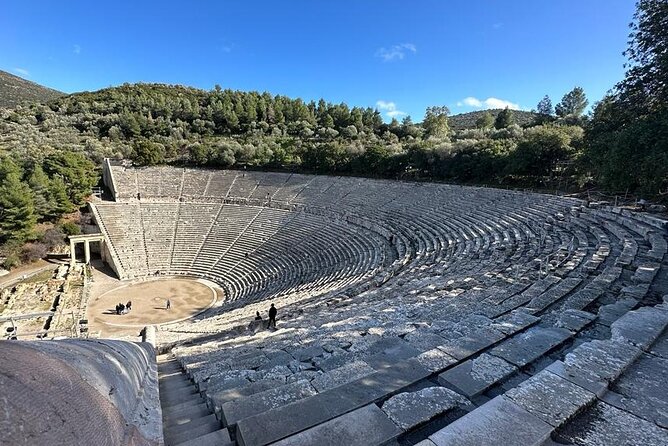
Nafplio changes the mood. After the open ruins and heavy stonework of Mycenae, you reach a port town with neoclassical buildings, Venetian influence, narrow streets, flowered balconies, and an easy waterfront setting.
The old town visit is scheduled for about two hours and includes time for lunch at a traditional seaside tavern. The meal is not included, so ask your driver about the planned restaurant and menu before ordering if you are watching costs.
Nafplio was the capital of the newly formed Greek state until 1834. Its history is visible in layers: Venetian fortresses, Ottoman-era references, neoclassical buildings, and the political institutions of early modern Greece. Syntagma Square is the town’s natural center. The former Parliament building, associated with the early Greek state, now includes the Municipal Gallery on the ground floor.
I like having this longer block in Nafplio because you can finally slow down. You can walk without racing from one monument to the next, eat by the water, and enjoy the town as a living place rather than only an archaeological site.
Palamidi and the 999 Steps
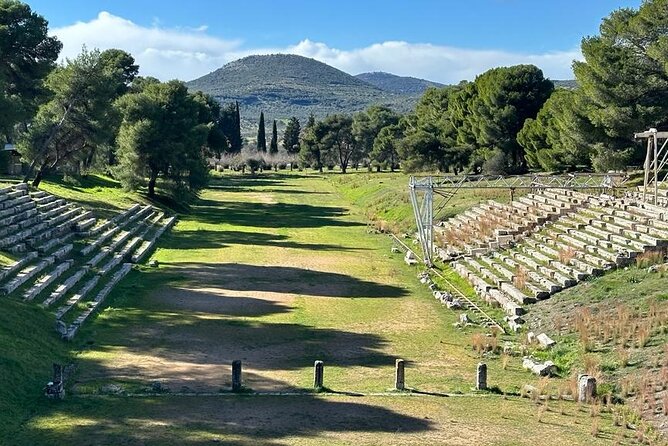
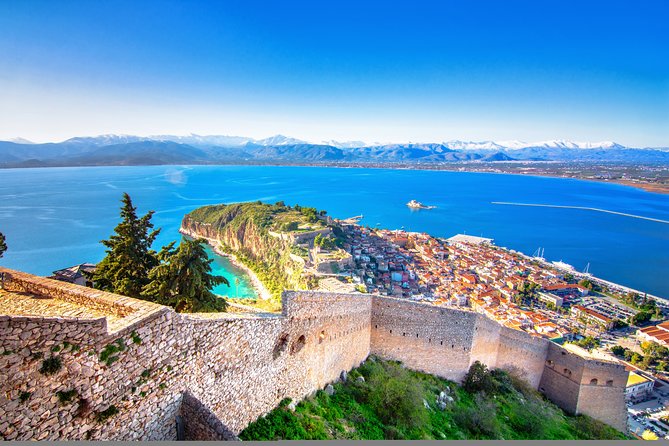
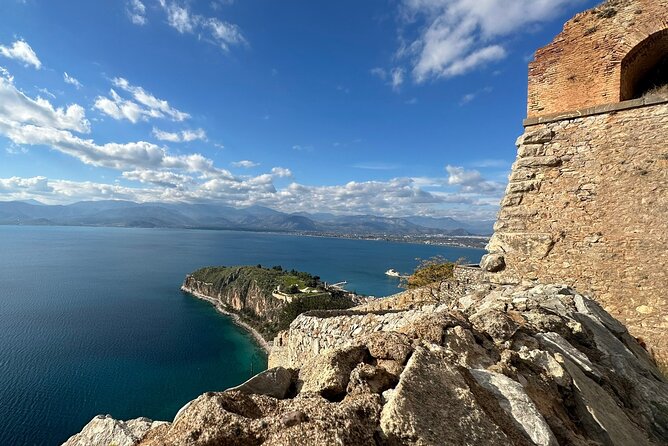
Palamidi Castle sits on a 216-meter hill above Nafplio. The Venetian fortress was built during the second Venetian occupation from 1686 to 1715, and it commands broad views over the town and Argolic Gulf.
The famous stairway from town is commonly described as having 999 steps, though different counts are used depending on the route and starting point. The itinerary allocates about 30 minutes here. That creates a practical problem: a full climb from the old town, a proper exploration of the fortress, and a return to the vehicle cannot all fit comfortably into that time.
You should clarify the plan before departure. The vehicle may take you close to the entrance, but the exact arrangement is not spelled out. If your main goal is the castle interior and the views, prioritize the fortress itself. If you want the full stairway experience, you will need to give up time elsewhere.
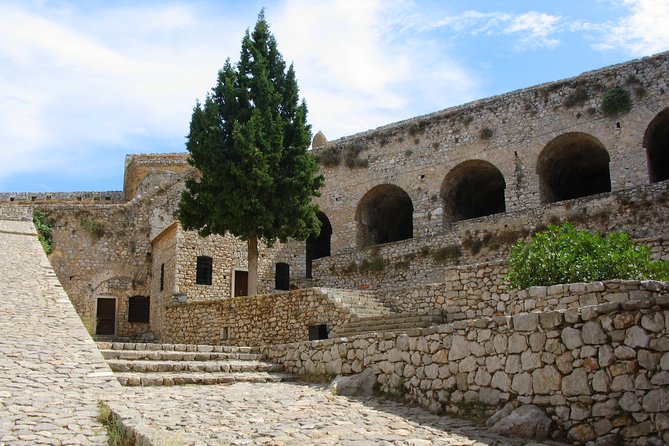
Palamidi includes defensive walls, interior paths, loopholes, and the prison associated with Kolokotronis. The terrain can feel exposed, and the steps are not a casual stroll. This is the most physically demanding part of the day, especially after several hours of walking around Corinth and Mycenae.
Bourtzi, Akronafplia, and the Lion of the Bavarians
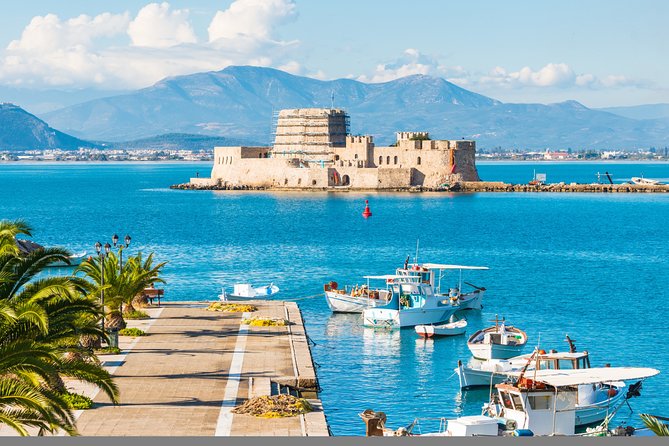
The small fortress of Bourtzi sits on the islet of Agioi Theodoroi in Nafplio’s harbor. The Venetians built it in 1473 and called it Castello dello Soglio. The Ottoman name Bourtzi, meaning fortress, became the name used today.
The schedule allows about an hour, but getting to the islet requires a boat, described as taking less than 10 minutes. The boat ride and any admission costs are not included in the tour price. Confirm operating arrangements before counting on this stop, especially if your day is already running late.
Back on land, Akronafplia is the oldest part of Nafplio. It was once a separate town, then became part of the city’s fortifications under Frankish and Venetian rule. The site was later used partly as a prison, and its high position gives you another way to view the town.
The Lion of the Bavarians is a very different monument. Carved into the rock above Michael Iatrou Street, the sleeping lion commemorates Bavarian soldiers who died in Nafplio in 1833 during a typhoid epidemic. It was commissioned by King Louis, father of King Otto. The monument takes about 30 minutes in the schedule, though the actual viewing time is likely short.
These final stops show why Nafplio deserves more than a rushed photo break. The town combines military history, early Greek politics, public squares, waterfront views, and everyday streets.
Price, Private Transport, and Real Value
At $277.09 per person, the price is significant, but the value depends heavily on group size. The tour is private, so a couple pays far more per person than a group of six or seven sharing the vehicle. For a full private vehicle, pickup and drop-off from Athens, WiFi, bottled water, and a long route into the Peloponnese, the price can make sense if comfort and flexibility matter to you.
The cost does not cover entrance fees, lunch, a licensed guide, or optional airport pickup. Add those expenses before comparing this with a group excursion. A private driver also does not mean a private guide inside every monument.
The strongest practical benefit is control. Pickup time is adjustable on request, and the driver can return you to the original meeting point or another preferred location. The service is designed for one group only, with hotel, apartment, and port pickup available. Airport pickup costs extra.
Several drivers receive especially warm praise for being careful, punctual, flexible, and attentive. Chris is described as particularly good at adjusting the day to match priorities. Costas sent arrival texts, arrived early, carried water, and offered choices. Michael was praised for patience when the group ran late and for allowing more time at favorite stops. These details matter on a long private day because a considerate driver can make the schedule feel less rigid.
Who Should Book This Day
I would choose this tour if you want to see a large section of the Peloponnese without renting a car. It suits couples, families, and small groups who value door-to-door transport and want a driver who can explain the setting along the way.
It is also a good fit for first-time visitors with only one free day. Corinth, Mycenae, and Nafplio each offer something different, and the route covers biblical, Bronze Age, classical, Venetian, Ottoman, and early modern Greek themes.
I would hesitate if you want a slow archaeological study. Ancient Corinth and Mycenae receive limited time, and the full list of stops makes the day ambitious. I would also hesitate if climbing Palamidi’s steps is your main aim, because the time allowance is short and the day already includes substantial walking.
Book early if your dates are fixed. This experience is commonly reserved well ahead, with an average booking lead time of about 64 days. You can cancel for a full refund up to 24 hours before the start time, subject to the stated weather policy.
Final Recommendation
Book this tour if you want maximum coverage with minimum transport hassle. The private vehicle, adjustable pickup, and personal driver are its best features, and the combination of Ancient Corinth, Mycenae, and Nafplio gives you a memorable cross-section of the region.
Before paying, confirm three points: which attractions you will enter, how Palamidi will be handled, and whether the planned Bourtzi visit includes the boat. Also note that the title refers to Epidaurus, but the detailed route provided here does not include a stop there. If the ancient theater is important to you, ask the operator whether the itinerary can be changed and what must be removed.
FAQ
How long does the tour last?
The experience lasts approximately 9 to 10 hours.
Where does pickup take place?
Pickup is offered from an Athens hotel, Airbnb residence, or port. Airport pickup is available for an additional cost.
Is this a private tour?
Yes. Only your own group participates. The pickup time can be adjusted on request, and drop-off can be at the original location or another preferred point.
What type of vehicle is used?
Groups of one to three people use a luxurious sedan. Groups of four to seven use a comfortable minivan. Vehicles include air conditioning, WiFi, and bottled water.
Are entrance fees included?
No. Entrance fees for the attractions are not included in the tour price.
Is a licensed archaeological guide included?
No. The tour includes an English-speaking driver with historical knowledge. A licensed guide to accompany you inside archaeological sites costs extra.
Is lunch included in Nafplio?
No. A lunch stop at a traditional seaside tavern is scheduled, but the meal cost is not included.
Can I cancel the booking?
You can cancel for a full refund up to 24 hours before the experience begins. Cancellations or changes made less than 24 hours before the start time are not accepted for a refund.
More Full-Day Tours in Athens
- Ancient Corinth, Epidaurus, Nafplio full day private tour from Athens
★ 5.0 · 206 reviews - Ancient Corinth, Mycenae, Epidaurus, Nafplio full day private tour from Athens
★ 5.0 · 130 reviews - Ancient Olympia full day private tour from Athens
★ 5.0 · 83 reviews - Athens Highlights & Ancient Corinth Full Day Private Tour
★ 5.0 · 54 reviews
Newest history tours we have reviewed in Athens
- The original Christian tour on Paul’s footsteps in Athens and ancient Corinth★ 4.5 · 25 reviews
- Ancient Sparta & Mystras Private Day Tour from Athens★ 5.0 · 52 reviews
- Athens: Combo Ticket for Acropolis & 6 ancient sites★ 3.0 · 21 reviews
- Small-Group Women History in Ancient Greece Walking Tour★ 5.0 · 38 reviews
- Ancient Corinth, Sanctuary of Hera, Blue Lake & Canal from Athens★ 5.0 · 26 reviews
- Half Day Historical Athens City Private Taxi Service Tour★ 5.0 · 79 reviews
- Private Luxury Tour: Marathon – Battle & Run That Changed History★ 5.0 · 30 reviews
- Ancient Olympia & Ancient Corinth Private LuxuryTour from Athens★ 5.0 · 25 reviews
Ancient History Tours, compared.
Colosseum: Underground and Ancient Rome Tour
Read our review →
Colosseum & Ancient Rome with Arena Floor Option I Max 6 People
Read our review →
Colosseum, Ancient Rome Tour or AudioGuided Tour
Read our review →
Colosseum Underground & Ancient Rome Guided Tour
Read our review →
Taormina: Ancient Theater Skip-the-Line Ticket & Audio Guide
Read our review →
Discover the Ancient Ruins of Pompeii: Day Trip from Rome
Read our review →
Discover Matera, the ancient city – English tour
Read our review →Browse the lists this tour appears in