Review · ATHENS HISTORY TOURS
Ancient Olympia full day private tour from Athens
Ancient Olympia is one of Greece’s great day trips, but it is also a serious drive. This private outing takes you across the Corinth Canal and deep into the Peloponnese, then gives you time to walk through the birthplace of the Olympic Games. The ruins and stadium are the main event, while the Archaeological Museum helps put the broken columns and fallen stones into focus.
I like the direct pickup and the freedom of a private car. You avoid the stress of Athens traffic, can set a pickup time that suits your group, and get useful stops along the way. I also like the included Greek lunch, bottled water, air-conditioning, and onboard Wi-Fi.
The catch is simple: this is a long day, with roughly three and a half hours of driving each way. Your driver is not a licensed site guide and will not accompany you inside the monuments, so you should book this for comfortable private transport and flexibility, not for a fully guided archaeological lesson.
Key points to know before booking
- Expect a 12-hour day: The drive from Athens to Olympia is long, but the private vehicle makes it far easier than arranging buses or driving yourself.
- Stop at the Corinth Canal: You get about 20 minutes to look down at the narrow waterway and its steep limestone walls.
- Explore at your own pace: The ruins, Archaeological Museum, and Museum of the History of the Olympic Games are visited independently.
- Drivers add value on the road: Past drivers have included Nick, Panos, George, Greg, Antony, and Nikos, with especially strong praise for safe driving and historical commentary.
- Budget for admission: Entry to Ancient Olympia and the two museums costs €20 per person and is not included.
- A licensed guide is extra: Ask for one if you want detailed explanations inside the archaeological site and museums.
The long road from Athens to Olympia
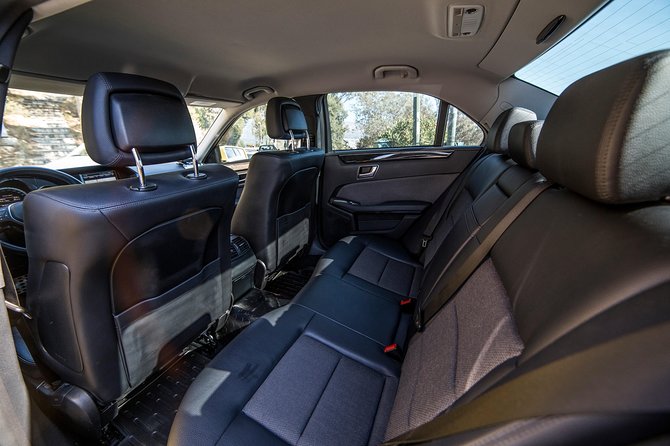
The appeal of this trip is that it makes a difficult independent journey easy. Your driver collects you at your hotel, apartment, airport, or port, then takes you west in a private, air-conditioned vehicle. For airport pickup, the driver waits in the arrival hall with your name. At a hotel, the meeting point is the lobby. The pickup time can be adjusted to suit your group.
That flexibility matters because the route is not a quick hop. The drive to Olympia takes about three and a half hours each way, depending on traffic and stops. The full outing lasts around 12 hours, so you should think of it as a full expedition rather than a casual side trip.
I would choose this setup over a rental car if you do not want to deal with Athens traffic, unfamiliar roads, or a very long return drive after walking around an archaeological site. The driver handles the road while you rest, talk, use the Wi-Fi, or watch the scenery pass.
Past drivers named in the feedback include Nick, Panos, George, Greg, Antony, Notis, and Nikos. Their strengths varied, but the most consistent praise went to safe driving, patience, punctuality, and useful commentary during the journey. Panos was especially praised for making the long road feel shorter with historical stories, while George was noted for bringing the countryside and Greek history to life.
Still, keep your expectations clear. The driver is not an official guide and cannot accompany you through the site. Some drivers offer excellent context in fluent English, while others may focus mainly on transportation. If detailed interpretation matters to you, request a licensed guide and confirm the extra cost before departure.
More Ancient History Tours in Athens
- Athens: Ancient Greek Theater Performance
★ 4.7 · 2,481 reviews - Historical Delphi One Day Tour with Arachova Stop & Expert Guide
★ 4.5 · 1,247 reviews - From Athens: Ancient Corinth Day Trip with Canal & VR Guide
★ 4.6 · 1,073 reviews
Looking over the Corinth Canal
The Corinth Canal is the first major stop, usually lasting about 20 minutes. It cuts through the narrow Isthmus of Corinth and links the Gulf of Corinth with the Saronic Gulf. In practical terms, it separates the Peloponnese from mainland Greece, making the peninsula seem almost like an island.
The best view comes from above. You look down at a very narrow strip of water framed by steep limestone walls. The canal is about 6.4 kilometers long and only 21.4 meters wide at its base, so many modern ships cannot use it. If a vessel is passing, you get a fine sense of the canal’s scale, but even without one, the drop and sheer walls make this a worthwhile leg-stretching stop.
This is not a full visit to ancient Corinth. You will not have time here for a long archaeological tour, and the stop is free. Think of it as a striking viewpoint and a useful break in the long drive.
Arriving at the sacred center of Olympia
Olympia was not simply an athletic field. It was a major religious center devoted to Zeus, drawing worshipers from across the Greek world. The Olympic celebrations grew alongside the Sacred Olympic Truce, an agreement that allowed competitors and spectators to travel safely during the games.
By the fifth century BC, Olympia also functioned as a meeting place for ideas. Thinkers and influential figures came here to exchange views, so the site connects religion, politics, athletic competition, and public life.
The broad setting helps you understand why this place mattered. You are not entering a compact monument with one famous building. Olympia was a large sanctuary with more than 70 important structures, many now reduced to foundations, scattered blocks, columns, and partial walls.
The first general stop at Olympia allows about an hour to get oriented. In practice, your time is divided among the archaeological site and the museums, with the exact order shaped by opening hours and your pace. Wear comfortable shoes, carry water, and remember that the site involves outdoor walking over uneven ground.
Walking through the Olympic ruins
The archaeological site receives about an hour and a half in the planned schedule. That is enough to see the major areas, but Olympia rewards a calm pace. If you like reading signs, taking photographs, and pausing to picture the ancient ceremonies, you may want to agree on priorities with your driver before entering.
The Pelopion is one of the more unusual features. It is linked to Pelops, the semi-mythical king whose name gave the Peloponnese its name. The remains suggest how old and layered the sanctuary was, long before the familiar image of the modern Olympic Games.
The Temple of Zeus is the grandest ruin in the group. Built in the second quarter of the fifth century BC, it represented the mature Doric temple form. Earthquakes left it in fragments, but the fallen drums and scattered architectural pieces still show the former scale of the building.
Allow about 10 minutes for the temple in the basic schedule, but I would not rush this view. It is one of those places where the ruin itself is only half the story. The other half is imagining the structure as a major religious building filled with sculpture, ceremony, and visitors from across Greece.
The Stadium of Olympia lies east of the sanctuary of Zeus. This is where many athletic events took place during the ancient games. The stadium is a strong moment for anyone who wants to connect the surviving earthworks with the athletes who once ran here.
The scheduled visit is about 10 minutes, but you may find yourself lingering. The value is not in a preserved grandstand or a modern display. It is in the open track, the scale of the field, and the simple act of standing where ancient competitors raced.
More Ancient History Tours in Greece
- Acropolis, Parthenon & Athens Old City Heritage Walking Tour
★ 4.5 · 876 reviews - Private Biblical Tour Ancient Corinth & Isthmus Canal from Athens
★ 5.0 · 762 reviews - Athens: Ancient Corinth & Nafplio Full Day Trip with Swim
★ 4.8 · 531 reviews - Athens Skip the Line: Open Air Ancient Greek Theatre Performance
★ 4.5 · 520 reviews
Hera’s temple and the Olympic flame
The Temple of Hera, or Heraion, was one of Olympia’s oldest temples. It began as a joint temple for Hera and Zeus before a separate temple was built for Zeus. An earthquake destroyed it in the early fourth century AD, but its importance continues.
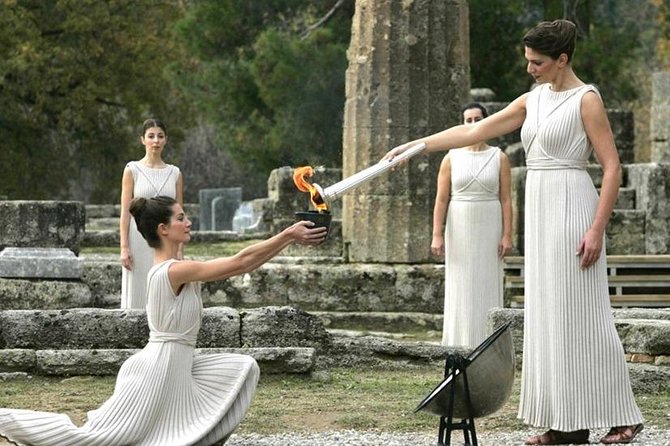
The Olympic flame is lit at the altar of Hera’s temple during the modern ceremony. The flame then travels to the host city, linking present-day celebrations with the ancient sanctuary. The ruins are modest compared with the fame of that ritual, which makes the connection especially memorable.
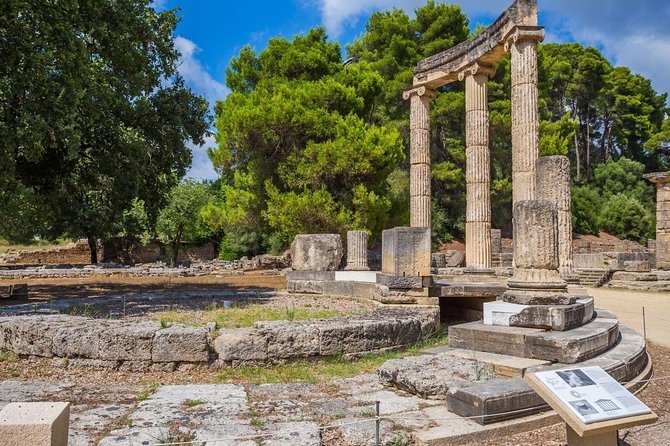
The standard stop is about 10 minutes. You can also see the Philippeion, a circular memorial built after Philip II of Macedon’s victory at Chaeronea in 338 BC. It contained gold and ivory statues of Philip’s family, including Alexander the Great.
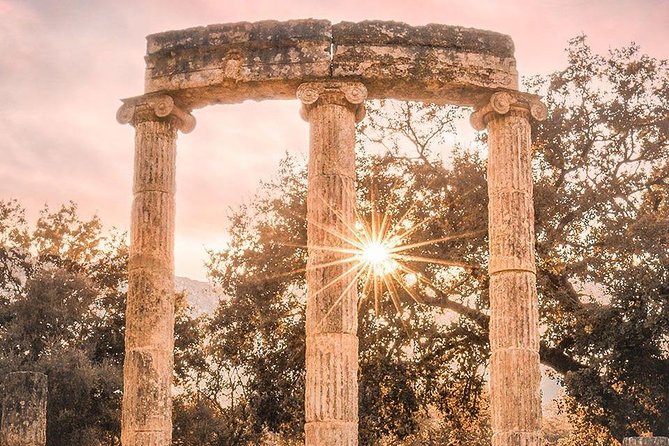
The Philippeion is unusual because it was the only structure inside the Altis dedicated to a human rather than a god. Its round form, Ionic outer columns, and Corinthian inner columns give it a different look from the nearby Doric temples. Plan around 20 minutes here if this architectural contrast interests you.
Water, wrestling, and daily life at the sanctuary
Olympia was not only temples and races. The Nymphaeum was a second-century water-distribution structure built to supply the crowds who arrived for the games. Its aqueduct, cistern, channels, statues, and drinking points show the practical systems needed to support a major festival.
This is an easy feature to overlook when you are focused on temples, but it gives the site human scale. Thousands of people needed water, shade, food, and places to gather. The Nymphaeum shows that Olympia worked as a functioning event center, not just a ceremonial backdrop.
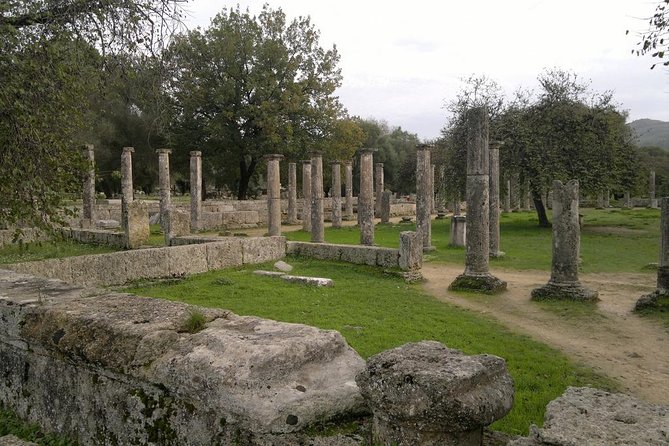
The palaestra was the wrestling school and a training ground for boxing and pankration. Pankration combined grappling, kicking, and punching, with few restrictions compared with modern combat sports. Competitors still faced judges and rules, and serious violations could lead to fines or exclusion.
These smaller areas help you picture the preparation behind the games. The stadium shows the public contest. The palaestra shows the training, discipline, and hard physical work that came first.
The Archaeological Museum of Olympia
Set aside about an hour and a half for the Archaeological Museum of Olympia. Admission is separate, and the entry fee for the archaeological site plus the two museums is €20 per person.
This museum is essential because the outdoor site can leave you with fragments and questions. Inside, you can see sculpture and objects recovered from Olympia, including works connected with the Temple of Zeus, the Nike of Paionios, and the Hermes and Infant Dionysus attributed to Praxiteles.
The bronze collection is particularly important. You get a clearer sense of the craftsmanship and religious life that the weathered ruins alone cannot show. The museum was completed in 1882 and was the first museum in Greece outside Athens, which gives it a place in the story of Greek archaeology as well as in the story of Olympia.
Because your driver does not enter the museum as a licensed guide, you will be reading displays and building the story for yourself. That suits independent visitors who like to move at their own pace. If you want the sculpture explained in depth, arrange a licensed guide.
The Museum of the History of the Olympic Games
The second museum focuses on the ancient games themselves and usually takes about 45 minutes. It covers the traditional starting date of 776 BC, the four-year Olympic cycle, the role of Zeus, and the continuation of the games under Roman rule.
The ancient contests were part of the wider Panhellenic Games, not an isolated event. Competitors represented city-states, and the games helped create a shared Greek identity despite political divisions.
The games continued into the Roman period, with the last recorded celebration in AD 393. The exact end of the tradition is less tidy than a single closing date, and the museum helps explain that long development.
I find this museum useful after the ruins because it gives structure to what you have just seen. The stadium becomes more than an empty track, and the sanctuary becomes more than a group of fallen stones.
The advertised museum schedule can change. One museum was closed during a past visit, so confirm that all three parts of the visit are open on your date. The two main museums are the Archaeological Museum and the Museum of the History of the Olympic Games. If a third museum is important to you, ask specifically before booking.
Lunch with Greek food after the ruins
Lunch is included, with a Greek traditional food option. The exact restaurant is not specified in the tour details, but the meal has been praised as a welcome part of the day, including a family-owned taverna and a meal at Ambrosia.
This is more than a small perk on a 12-hour outing. After several hours on foot, a proper meal gives you time to rest before the return drive. You can also use lunch to ask your driver about the route back, the pickup time, and any changes to the plan.
If you have dietary needs, ask the provider ahead of time. The included meal is a useful value point, but it should not be treated as a reason to book the tour by itself.
What the $342.73 price really buys
The listed price is $342.73 per person. That is a high price for a day trip, especially if you are traveling alone or as a couple. You are paying for private transport, direct pickup and drop-off, a flexible schedule, bottled water, Wi-Fi, air-conditioning, the driver’s time, and lunch.
The value improves with a larger group because the vehicle and driver cost are spread across more people. Group discounts are available, and the private format means only your party participates. A group of eight can get much better value than one or two people, provided the quoted discount is confirmed.
Admission is extra at €20 per person. The tour also does not include a licensed guide. Add that cost if you want detailed explanations inside the site and museums.
I would compare the price with a rental car only if you are comfortable driving yourself and can handle a very long day behind the wheel. A rental may cost less, but it will not include a driver, lunch, pickup service, or the same ease after a full afternoon of walking.
Small details that make the day easier
The onboard Wi-Fi is useful on a long road day, especially if you want to avoid roaming charges. Bottled water is included, and the vehicle is air-conditioned, both important during Greece’s warmer months.
The private format also gives you a better chance to adjust the pace. You can spend more time at the stadium, move quickly through a section that interests you less, or ask for a short break on the long route. The stated itinerary is detailed, but the pickup time is adjustable and the outing is not a rigid group schedule.
Keep your driver’s contact details handy. One past party had trouble reconnecting with the driver after touring Olympia, although the problem was resolved. Agree clearly on the meeting point and return time before entering the site.
Free cancellation is available up to 24 hours before the start time. Changes or cancellations inside that 24-hour window are not accepted for a refund.
Who should book this private Olympia day trip
I would choose this experience if you want to see Olympia from Athens without renting a car, changing buses, or planning the route yourself. It suits families, small groups, and anyone who values a private vehicle and a flexible pickup.
It is also a good fit if your main goal is access rather than formal guiding. You can walk through the ruins and museums independently, then rely on your driver for road commentary and practical help.
I would hesitate if you dislike long drives or want a guide beside you at every monument. The route is scenic, but the distance is real. You may also find the price hard to justify as a solo visitor.
Should you book it?
Book this tour if Ancient Olympia is high on your list and you want the least stressful way to reach it from Athens. The Corinth Canal, private car, lunch, and several hours among the ruins make the demanding drive worthwhile, especially for a group.
Before paying, confirm three things: the total price for your party, which museums will be open on your date, and the cost of adding a licensed guide. If you accept that the driver is mainly your road host and not your archaeological guide, this is a practical and comfortable way to make a very long day possible.
FAQ
How long is the Ancient Olympia tour from Athens?
The experience lasts approximately 12 hours. The drive to Olympia takes about three and a half hours each way, depending on traffic and stops.
Is pickup included?
Yes. Pickup and drop-off are included from hotels, apartments, airports, and ports. The driver returns you to the same place or another agreed location.
Is this a private tour?
Yes. Only your group participates, and the pickup time can be adjusted upon request.
Does the driver enter the archaeological sites?
No. The drivers are not licensed tour guides and do not accompany you inside the archaeological sites or museums. They can provide English commentary during the drive and answer questions about the places you visit.
Is a licensed guide included?
No. A licensed guide is not included in the listed tour price. You can ask about arranging one at an additional cost.
How much are the entrance fees?
Admission to Ancient Olympia, the Archaeological Museum of Olympia, and the Museum of the History of the Olympic Games costs €20 per person. This fee is paid separately, on site.
Is lunch included?
Yes. Lunch is included, with a Greek traditional food option. Specific restaurant arrangements may vary.
Is the Corinth Canal visit included?
Yes. The tour includes a stop of about 20 minutes at the Corinth Canal, with free admission and time to view the canal from above.
Can I cancel the booking?
You can cancel for a full refund up to 24 hours before the experience start time. Cancellations or changes made less than 24 hours before the start time are not accepted for a refund.
More Private History Tours in Greece
- Ancient Corinth and Canal half day private tour from Athens
★ 5.0 · 96 reviews - Half Day Historical Athens City Private Taxi Service Tour
★ 5.0 · 79 reviews - Ancient Athens for Kids 4-Hour Private Walking Tour
★ 5.0 · 66 reviews - Ancient Sparta Ancient Corinth Private Tour from Athens/ Nafplio
★ 5.0 · 58 reviews
More Private History Tours in Athens
- Private Tour of Apostle Paul’s Footsteps in Ancient Corinth
★ 5.0 · 275 reviews - Ancient Corinth, Epidaurus, Nafplio full day private tour from Athens
★ 5.0 · 206 reviews - The History of Athens: Greek Mythology Private Tour
★ 5.0 · 138 reviews - Ancient Corinth, Mycenae, Epidaurus, Nafplio full day private tour from Athens
★ 5.0 · 130 reviews
Newest history tours we have reviewed in Athens
- The original Christian tour on Paul’s footsteps in Athens and ancient Corinth★ 4.5 · 25 reviews
- Ancient Sparta & Mystras Private Day Tour from Athens★ 5.0 · 52 reviews
- Athens: Combo Ticket for Acropolis & 6 ancient sites★ 3.0 · 21 reviews
- Small-Group Women History in Ancient Greece Walking Tour★ 5.0 · 38 reviews
- Ancient Corinth, Sanctuary of Hera, Blue Lake & Canal from Athens★ 5.0 · 26 reviews
- Half Day Historical Athens City Private Taxi Service Tour★ 5.0 · 79 reviews
- Private Luxury Tour: Marathon – Battle & Run That Changed History★ 5.0 · 30 reviews
- Ancient Olympia & Ancient Corinth Private LuxuryTour from Athens★ 5.0 · 25 reviews
Ancient History Tours, compared.
Colosseum: Underground and Ancient Rome Tour
Read our review →
Colosseum & Ancient Rome with Arena Floor Option I Max 6 People
Read our review →
Colosseum, Ancient Rome Tour or AudioGuided Tour
Read our review →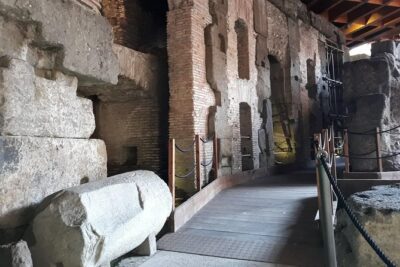
Colosseum Underground & Ancient Rome Guided Tour
Read our review →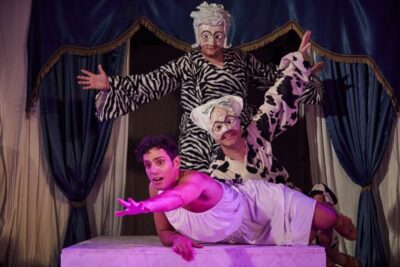
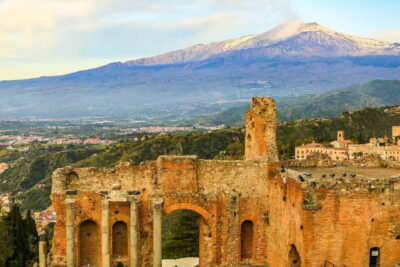
Taormina: Ancient Theater Skip-the-Line Ticket & Audio Guide
Read our review →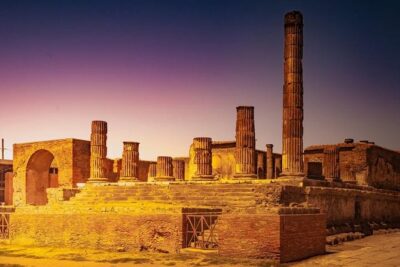
Discover the Ancient Ruins of Pompeii: Day Trip from Rome
Read our review →