Review · ATHENS HISTORY TOURS
Private Tour of Apostle Paul’s Footsteps in Ancient Corinth
Paul’s Corinth comes alive through places you can still see: the Bema where he faced trial, the Agora where he preached, and Kenchreai, the port tied to his arrival. The route also adds the Corinth Canal and Acrocorinth, so you get far more than a single archaeological stop.
I like the private format, especially for families or anyone arriving from a cruise ship. Guides such as Giannis, Nick, Ruslan, and George are praised for patient explanations, safe driving, and helping older relatives in and out of the car. I also like the mix of biblical sites, Greek engineering, ruins, and wide views.
The main thing to understand is that this is a driver-led tour, not a full licensed guide service inside the archaeological sites. Entrance fees are extra, and the biblical focus may feel lighter than expected if you want a detailed Bible study.
Key points to know before booking
- Paul’s Corinth in one half-day: Visit Kenchreai, the Agora, Bema, Temple of Apollo, the museum, Acrocorinth, and Saint Paul’s Church.
- The Corinth Canal adds variety: The steep limestone cut makes a quick but memorable stop on the drive from Athens.
- A private car changes the pace: Your group can ask questions, pause for photos, and move at a comfortable rhythm.
- Acrocorinth is the physical highlight: The old fortress rises above Corinth with broad views and layers of Greek, Byzantine, Frankish, Venetian, and Ottoman history.
- The driver is not a licensed site guide: The tour includes an English-speaking history driver, but an authorized guide to accompany you into the sites is not included.
- Best for a focused day outside Athens: It suits couples, families, cruise passengers, and Christian visitors who also want archaeology and scenery.
Why Paul’s Corinth works as a day trip from Athens
Ancient Corinth is about the meeting of roads, seas, faiths, and empires. Paul spent about 18 months with the Corinthians around 50 to 51 AD, and this tour gives you a physical sense of the city where that work took place.
You do not simply visit a church or a plaque connected with Paul. You move through the port where he arrived, the commercial center where he preached, the civic platform associated with his trial, and the wider fortress above the city. That sequence gives the day a useful shape.
The setting also helps explain why Corinth mattered. The Isthmus linked mainland Greece with the Peloponnese, while its ports connected routes across the Aegean and western seas. Corinth was a busy commercial center with old pagan traditions, Roman authority, and a growing Christian community. Those competing forces give Paul’s letters a more concrete setting.
The private format matters here. You ride in an air-conditioned vehicle with bottled water and WiFi, and groups of one to four use a sedan. Larger groups receive another vehicle arrangement, though the exact vehicle depends on group size. Travel time counts within the five to six hour tour, so this is a concentrated outing rather than a leisurely full-day expedition.
More Ancient History Tours in Athens
- Athens: Ancient Greek Theater Performance
★ 4.7 · 2,481 reviews - Historical Delphi One Day Tour with Arachova Stop & Expert Guide
★ 4.5 · 1,247 reviews - From Athens: Ancient Corinth Day Trip with Canal & VR Guide
★ 4.6 · 1,073 reviews
The Corinth Canal and the ancient shortcut
The first stop is the Isthmus of Corinth, the narrow strip of land linking mainland Greece and the Peloponnese. The modern canal cuts through the isthmus and has operated since 1893. At about 6.3 kilometers long, it turns the Peloponnese into an island and creates an immediate visual moment.
You get roughly 20 minutes here. That is enough to look down at the clear water, steep limestone walls, and passing boats if conditions allow, but not enough for a long walk or a detailed canal visit. I would treat this as a scenic introduction, not the main reason to book the tour.
The nearby Diolkos makes the engineering story older. Before the canal, ancient Greeks used a stone-paved trackway to haul ships overland across the isthmus. This saved vessels from sailing around the Peloponnese, a route that could be difficult and dangerous.
The Diolkos stop lasts about 10 minutes. The remains are modest, so your driver’s explanation adds real value. Look for the practical lesson here: ancient Corinth did not wait for modern machinery to solve a transport problem. It built a land route for ships more than two thousand years before the modern canal.
Kenchreai, the port linked to Paul and Phoebe
Kenchreai, also spelled Kechrees in the tour details, was Corinth’s eastern port. Paul is associated with arriving here during his first visit to Corinth around 51 AD, and he later sailed from this port toward Ephesus.
The physical remains are limited. Do not arrive expecting a complete harbor complex. What you get instead is a quiet place with strong historical meaning, especially if you know the Book of Acts and Paul’s Letter to the Romans.
The site is also linked with Phoebe, a prominent Christian woman and deaconess of the local church. The tour connects her with the letter to the Romans, giving the stop a wider view of the early Christian community. Paul’s work was not only about one famous preacher. It involved local people, households, ports, trade, and networks of communication.
You have about 20 minutes here. Comfortable shoes help, since the ground at several stops can be uneven. This is one of the places where a driver-guide’s context matters more than the amount of surviving stone.
Ancient Corinth, from the Agora to the Bema
Ancient Corinth is the core of the experience. Allow about 40 minutes at the archaeological site, although your actual time can feel shorter once you account for walking, photos, and orientation.
The Agora was the city’s marketplace and public center. Paul would have encountered ordinary commercial life here, along with the religious and civic institutions that shaped Corinth. Walking through the ruins gives you a better sense of Paul’s surroundings than viewing a single monument in isolation.
The Bema is the key Pauline feature. This raised platform was used for public and civic proceedings, and Paul is traditionally associated with standing before the Roman proconsul here. It is one of the strongest moments of the tour because it connects the biblical account with a visible place in the city.
Nearby, the remains of shops help you think about Paul’s working life and his association with Aquila and Priscilla. The ancient street connected with Erastus also adds a human detail, linking the site to a civil servant who became a coworker of Paul.
The Temple of Apollo gives the Christian story its necessary contrast. Corinth was not an empty stage waiting for Christianity. It had established pagan worship, public customs, and long-standing religious traditions. The temple’s surviving columns remind you that Paul’s message entered a city with its own beliefs and power structures.
The archaeological entrance fee is not included. The stated total is €15 per person for the archaeological sites and museum. Also note that a licensed guide to accompany you inside the archaeological sites is not included. Your English-speaking driver provides historical explanations and helps you understand the setting, but this is not the same arrangement as hiring an official museum or site guide.
More Ancient History Tours in Greece
- Acropolis, Parthenon & Athens Old City Heritage Walking Tour
★ 4.5 · 876 reviews - Private Biblical Tour Ancient Corinth & Isthmus Canal from Athens
★ 5.0 · 762 reviews - Athens: Ancient Corinth & Nafplio Full Day Trip with Swim
★ 4.8 · 531 reviews - Athens Skip the Line: Open Air Ancient Greek Theatre Performance
★ 4.5 · 520 reviews
The Museum of Ancient Corinth in 45 minutes
The Archaeological Museum of Corinth was built in 1932 to house finds from the excavations. I consider it an important part of the day, not an optional room to rush through.
The ruins show you the city’s layout. The museum fills in the people who used it. Its displays include prehistoric material and objects from the Sanctuary of Asklepios, along with artifacts that explain daily life, worship, and art across different periods.
You get about 45 minutes here. That is a useful amount of time for a focused visit, but you will not study every gallery in detail. If museums are your main interest, ask your driver at the beginning how the timing can be adjusted. Since this is private, the day has more flexibility than a fixed coach excursion, though the total tour still has a practical time limit.
The museum also keeps the biblical part of the visit in perspective. Paul’s Corinth was one chapter in a city that existed for centuries before and after him. That broader view makes the visit stronger for anyone interested in Greek and Roman history, not only Christian history.
Acrocorinth, the fortress above the plain
Acrocorinth is the visual high point of the route. The fortified acropolis rises above ancient Corinth, and its walls show work from Greek, Byzantine, Frankish, Venetian, and Ottoman periods.
This is not a flat, easy museum stop. You should expect uphill walking, stone surfaces, and a fortress setting that rewards sturdy footwear. The itinerary allows about 40 minutes, so you will see the main character of the site and its views rather than explore every corner.
The fortress protected Corinth for centuries. Its towers, gates, walls, and bastions show how the same high ground remained useful as rulers changed. The site also connects to the Temple of Aphrodite, which adds another layer to the religious story of Corinth.
The views are a major reason to make the climb. From above, you can better understand the city’s position between the sea, the isthmus, and the surrounding countryside. I would not judge Acrocorinth only as a Christian site. Its value comes from the whole sequence of ancient, medieval, and Ottoman history.
If anyone in your group has limited mobility, discuss the walking needs before booking. The tour is described as suitable for most people, and child seats are available on request, but no detailed accessibility plan is provided for the fortress terrain.
Saint Paul’s Church closes the story
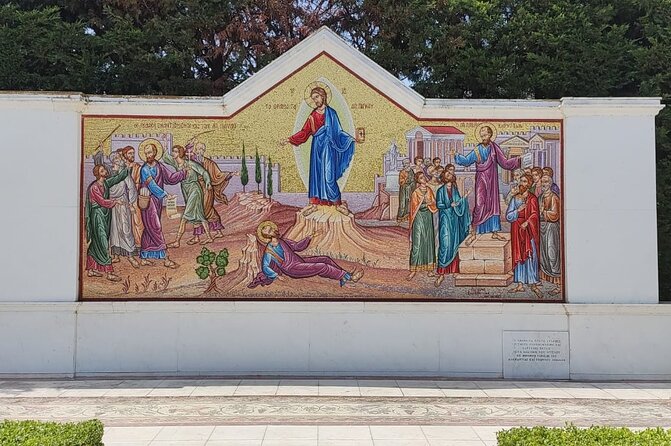
The modern Church of Saint Paul, or Apostolos Pavlos Church, provides a quiet ending. It sits in the heart of ancient Corinth and contains a large mosaic by Pastorutti and Tsotsonis showing Paul’s journey and mission in the city.
After ruins, stone roads, and fortress walls, the church shifts the focus from archaeology to memory. It connects the ancient Christian community with present-day worship and gives you a place to reflect on what you have seen.
You have about 20 minutes here. The stop is especially useful if your main reason for booking is Paul’s legacy. It is not an ancient structure from Paul’s lifetime, so keep your expectations clear. Its importance is modern and devotional rather than archaeological.
What the private format is really worth
The listed price is $169.03 per person. The value depends heavily on the size of your group. For one or two people, that is a significant price for a five to six hour outing, but it includes private transportation, hotel or port pickup and drop-off, bottled water, WiFi, and an English-speaking driver with historical knowledge.
For a family or small group, the cost becomes easier to justify. You are not waiting for strangers, following a flag through the ruins, or keeping quiet while someone else asks questions. Guides have helped older relatives in and out of the vehicle, made restroom stops, allowed extra photo time, and adjusted the rhythm to suit the group.
Cruise passengers can also get strong value from the arrangement. Pickup is available from the port, and the driver waits at the gate with a sign bearing your name. Some bookings have combined port pickup with an airport or hotel drop-off, but airport pickup itself costs an additional €50 per booking.
Lunch is not included. Guides may recommend a local restaurant, and one highly praised meal included lamb chops, Greek salad, and dessert, but you should treat food as an extra cost and ask about timing. The schedule does not list a meal stop as a fixed part of the tour.
The driver-guide difference
The strongest part of this experience is the personal attention from the driver. Giannis is repeatedly praised for patience, humor, and clear explanations of Paul’s travels. Nick is noted for a comfortable vehicle, safe driving, water stops, and thoughtful restaurant advice. Ruslan is praised for punctual communication and smooth coordination with cruise and airport transfers.
George receives especially warm praise for assisting an older mother, checking comfort, and explaining both Greek culture and Paul’s connections with Aquila, Priscilla, and Phoebe. Dennis is noted for a friendly manner, careful assistance, and useful tips beyond the basic route. Other highly rated drivers include Johnny, Fotis, and Ziannis.
Driver assignments can vary, so you cannot assume you will receive a particular person. What you can expect is a private English-speaking driver with history training or strong local knowledge, based on the stated service. The important distinction is that the driver is not a licensed guide included inside the monuments.
One review found the tour less biblical than expected. That is a fair warning. The experience uses Acts, local history, visible ruins, and the Christian tradition connected with Corinth. It does not promise a sermon, theological lesson, or detailed verse-by-verse study.
Timing, clothing, and practical planning
The tour lasts about five to six hours, including driving from Athens. Pickup is offered from hotels, apartments, and the port. At a hotel or apartment, the driver waits at the entrance. At the port, the driver waits at the gate with your name.
Wear shoes you can use on uneven archaeological ground and uphill fortress paths. Bring a hat and sunscreen. Greece can be hot and bright, and several stops offer little shade.
Bottled water is supplied, but carrying extra water is sensible, particularly in warm weather. Child seats are available if requested in advance. Most people can take part, but Acrocorinth deserves an honest check of your group’s walking ability.
The experience requires good weather. You can cancel for a full refund up to 24 hours before the start time. If poor weather cancels the tour, you are offered another date or a full refund.
Should you book the Apostle Paul Corinth tour?
Book it if you want a private, efficient route from Athens that combines Paul’s Christian story with Greek archaeology, the Corinth Canal, and Acrocorinth. It is particularly useful for families, cruise passengers, couples, and visitors who want a driver to handle the roads while they focus on the sites.
I would also recommend it to people who are curious about Paul but do not want a narrowly religious outing. The Agora, Temple of Apollo, museum, canal, and fortress give the day enough variety for anyone interested in ancient Greece.
Think twice if you want a licensed archaeologist at every stop, a long museum visit, or a highly devotional Bible tour. In that case, arrange a licensed guide separately or choose a more specialized religious program.
For most small groups, the private format, comfortable transport, and strong driver feedback make the price reasonable. Just budget for the €15 entrance fee, confirm airport transfer costs if needed, and bring the right shoes for Acrocorinth.
FAQ
How long does the private Corinth tour take?
The tour lasts approximately five to six hours, including travel time from Athens.
What is the tour price?
The listed price is $169.03 per person.
Is hotel or port pickup included?
Yes. Hotel, apartment, and port pickup and drop-off are included. At the airport, pickup and drop-off cost an additional €50 per booking.
Is the tour private?
Yes. Only your group participates in the activity.
What language is the tour offered in?
The tour is offered in English and includes an English-speaking driver with historical knowledge.
Are entrance fees included?
No. Entrance fees for the archaeological sites and museum are not included. The stated cost is €15 per person.
Is a licensed guide included at the archaeological sites?
No. A licensed guide to accompany you inside the archaeological sites is not included. The tour provides a professional English-speaking driver with history knowledge.
What should I bring?
Wear comfortable shoes for walking on archaeological ground and at Acrocorinth. A hat and sunscreen are recommended because Greek weather can be hot and sunny.
More Private History Tours in Greece
- From Athens: Ancient Sparta and Mystras Private Day Trip
★ 4.8 · 18 reviews
More Private History Tours in Athens
- Ancient Athens for Kids 4-Hour Private Walking Tour
★ 5.0 · 66 reviews - Athens: The History of Greek Mythology Private Tour
★ 4.7 · 53 reviews - Private Athens Walk: Ruins, Markets & Local Stories
★ 5.0 · 41 reviews - Athens: Corinth Canal and Ancient Olympia Private Trip
★ 4.6 · 21 reviews
Newest history tours we have reviewed in Athens
- Athens: The History of Greek Mythology Private Tour★ 4.7 · 53 reviews
- Athens: Women in Ancient Greece★ 5.0 · 98 reviews
- Athens: Ancient Corinth & Nafplion Guided Premium Tour★ 4.7 · 237 reviews
- Athens: Be an Ancient Sculptor: Craft Your Greek Masterpiece★ 5.0 · 26 reviews
- Athens: Roman Agora & Ancient Agora E-ticket & 2 Audio Tours★ 4.1 · 107 reviews
- Athens: Ancient Greek Theatre Murder Mystery Experience★ 4.8 · 298 reviews
- Athens: Corinth Canal and Ancient Olympia Private Trip★ 4.6 · 21 reviews
- Athens: Kotsanas Ancient Greek Technology Museum Guided Tour★ 5.0 · 29 reviews
Ancient History Tours, compared.
Colosseum: Underground and Ancient Rome Tour
Read our review →
Colosseum & Ancient Rome with Arena Floor Option I Max 6 People
Read our review →
Colosseum, Ancient Rome Tour or AudioGuided Tour
Read our review →
Colosseum Underground & Ancient Rome Guided Tour
Read our review →
Taormina: Ancient Theater Skip-the-Line Ticket & Audio Guide
Read our review →
Discover the Ancient Ruins of Pompeii: Day Trip from Rome
Read our review →