Review · ATHENS HISTORY TOURS
Ancient Corinth, Epidaurus, Nafplio full day private tour from Athens
The best part of this day is the mix: Saint Paul’s Corinth, the astonishing acoustics of Epidaurus, and elegant Nafplio all fit into one private outing from Athens. You cross the Corinth Canal, walk among Greek and Roman ruins, and finish by the harbor beneath Venetian fortresses.
I like the door-to-door pickup and the freedom to adjust the pace. Drivers such as Alex, George, Petros, Takis, and Panos have been praised for clear explanations, patience, and flexibility. I also like the chance to add a traditional Greek lunch in Nafplio. The catch is simple: this is mainly a private chauffeur service, not a fully guided archaeological tour.
Key things to know before booking
- Three major destinations in one day: See Ancient Corinth, Epidaurus, and Nafplio without changing hotels or renting a car.
- A driver, not automatically a site guide: Your driver can explain the places in English but will wait outside while you explore the archaeological grounds.
- The Corinth Canal is a quick but worthwhile stop: You get about 15 minutes for views from above and photographs.
- Nafplio gives the day breathing room: You have about 90 minutes for food, coffee, shopping, and the harbor.
- Expect a long road day: The tour lasts roughly 8 to 9 hours, with plenty of time spent in the vehicle.
- Budget for entrance tickets: Ancient Corinth costs €15 per person, while Epidaurus and its museum cost €20 per person.
Why this private Athens day trip works
Athens can fill several days on its own, but the Peloponnese begins just beyond the city. This tour gives you a practical way to reach important sites that are awkward to combine by public transport in one day.
The private format matters. You are picked up at your Athens hotel, apartment, airport, or port, then returned to the same place or another preferred address. Only your own party rides in the vehicle, and the departure time can be adjusted on request.
The vehicle is air-conditioned, includes Wi-Fi and bottled water, and removes the stress of driving unfamiliar roads. That convenience is the main reason to consider the price of $229.14 per person. For one person or a couple, it is not cheap. For a family or small group splitting the vehicle cost, it can compare well with renting a car, paying for fuel, and arranging separate transport.
The trade-off is the guide arrangement. Drivers have strong local knowledge and can give commentary during the drives and before stops, but they are not licensed guides and do not accompany you inside the archaeological sites. You can request a licensed guide, subject to availability and an extra charge.
That distinction should shape your expectations. If you want someone beside you to explain every column, inscription, and temple foundation, add the guide. If you mainly want reliable transport, useful background, and the freedom to explore at your own pace, the standard setup may suit you.
More Ancient History Tours in Athens
- Athens: Ancient Greek Theater Performance
★ 4.7 · 2,481 reviews - Historical Delphi One Day Tour with Arachova Stop & Expert Guide
★ 4.5 · 1,247 reviews - From Athens: Ancient Corinth Day Trip with Canal & VR Guide
★ 4.6 · 1,073 reviews
The Corinth Canal gives you the first big view
The first stop takes you to the Corinth Canal, where the modern road crosses a narrow cut in the Isthmus of Corinth. From above, you can look down at the waterway and its steep limestone walls while boats pass below.
The canal is about 6.4 kilometers long and only about 21.4 meters wide at its base. It has no locks because it was cut at sea level. That makes the engineering easy to grasp from the viewpoint, even during a short 15-minute stop.
I would treat this as a photo stop rather than a full attraction. You do not need a long visit, but it gives you a clear sense of why Corinth mattered. The isthmus links mainland Greece with the Peloponnese, and the canal cuts through the same narrow passage that shaped armies, traders, and ancient roads.
Ancient Corinth connects Greek, Roman, and Christian history
Ancient Corinth is the heart of the historical part of the day. The city occupied a key position between Athens and Sparta and grew wealthy from its control of movement across the isthmus.
The site also carries special meaning for anyone interested in early Christianity. Saint Paul spent time in Corinth, and the city appears in Acts of the Apostles as part of his missionary travels. Standing among the ruins gives you a direct connection to the setting behind the letters known as First and Second Corinthians.
The city you see today reflects several chapters. Rome destroyed Corinth in 146 BC, then rebuilt it in 44 BC. The later Roman city became the provincial capital of Greece. That mix can make the site more interesting, but it also means you need to pay attention to the different periods rather than expecting one untouched Greek city.
You have about an hour at Ancient Corinth. That is enough for a focused walk, though not enough to study every feature at leisure. The main area includes the agora, the Lechaion Road, the Fountain of Peirene, a basilica, a stoa, a theater, and other temple remains.
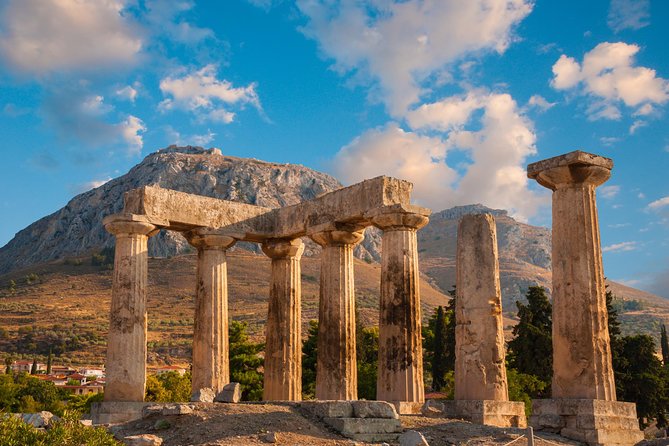
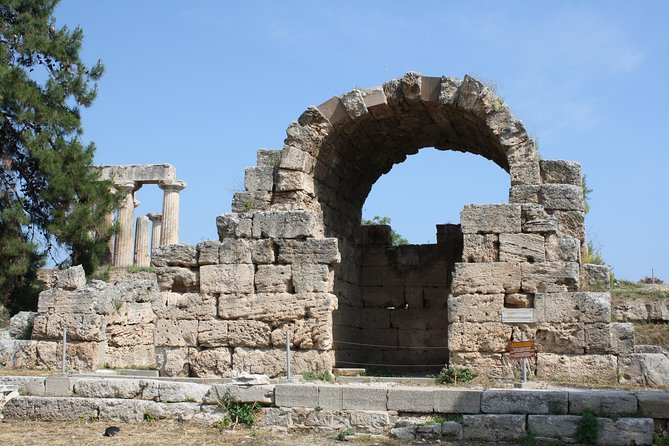
The Temple of Apollo is one of the clearest ancient features. Built around 550 BC, its remaining columns are a strong visual reminder that Corinth was a major Greek center long before the Roman rebuilding.
Admission to Ancient Corinth and its archaeological museum is not included. The combined ticket is listed as €15 per person, payable on site. Bring suitable shoes, water, and sun protection, since much of the visit involves open ground.
The Corinth Museum fills in what the ruins cannot
The Archaeological Museum of Ancient Corinth sits within the archaeological site, making it an easy addition to the visit. Allow about 30 minutes.
Museums like this are especially useful after seeing the foundations outside. Sculptures, inscriptions, architectural pieces, and everyday objects can help you understand the scale and purpose of buildings that now survive only in fragments.
The museum was built in the early 1930s to display finds from the excavations. Its position inside the site keeps the visit efficient, but you should remember that it has a separate admission cost within the Ancient Corinth ticket arrangement.
More Ancient History Tours in Greece
- Acropolis, Parthenon & Athens Old City Heritage Walking Tour
★ 4.5 · 876 reviews - Private Biblical Tour Ancient Corinth & Isthmus Canal from Athens
★ 5.0 · 762 reviews - Athens: Ancient Corinth & Nafplio Full Day Trip with Swim
★ 4.8 · 531 reviews - Athens Skip the Line: Open Air Ancient Greek Theatre Performance
★ 4.5 · 520 reviews
Acrocorinth adds a steep fortress viewpoint
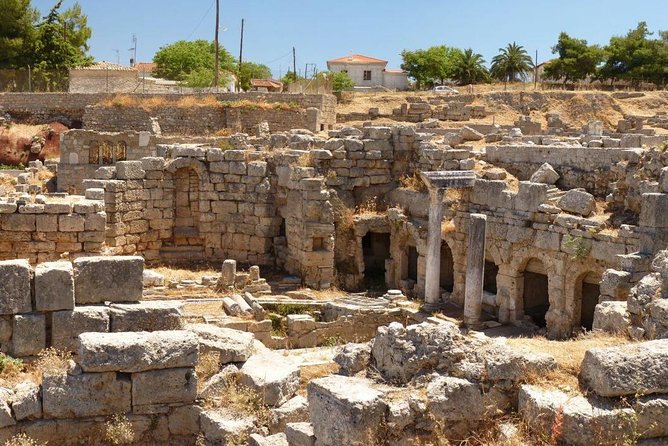
Acrocorinth, or Upper Corinth, is a massive rocky height above the ancient city. Its fortress controlled the Isthmus and served as a final defensive position for southern Greece.
The standard visit allows about 30 minutes, so do not expect a full hike through every section of the fortress. Even so, the elevated setting gives you a powerful sense of why the site mattered. The rock’s secure water supply and commanding position made it useful for successive rulers.
One important practical point: the approach and walking here can be strenuous. A solid pair of shoes is a better choice than sandals, and anyone with limited mobility should discuss the stop with the driver in advance. The views are the reward, but this is not a flat museum visit.
Epidaurus is the day’s great ancient theater
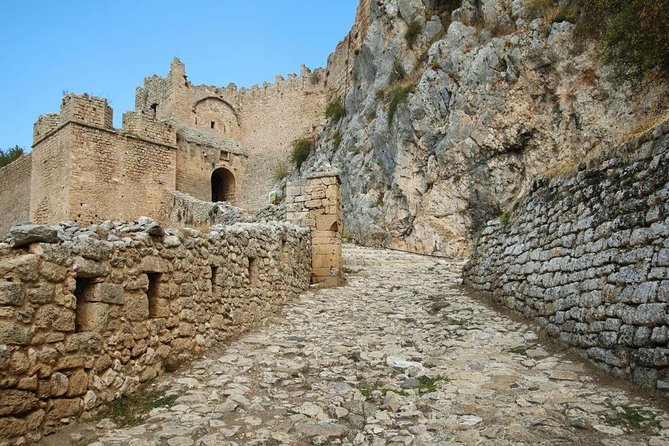
The road then continues into the Argolis region and the Sanctuary of Asclepius at Epidaurus. The archaeological museum receives about 30 minutes, followed by roughly 30 minutes at the theater and 15 minutes at the sanctuary.
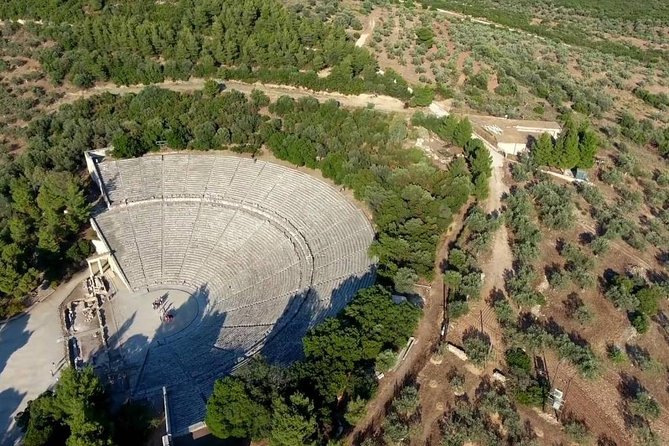
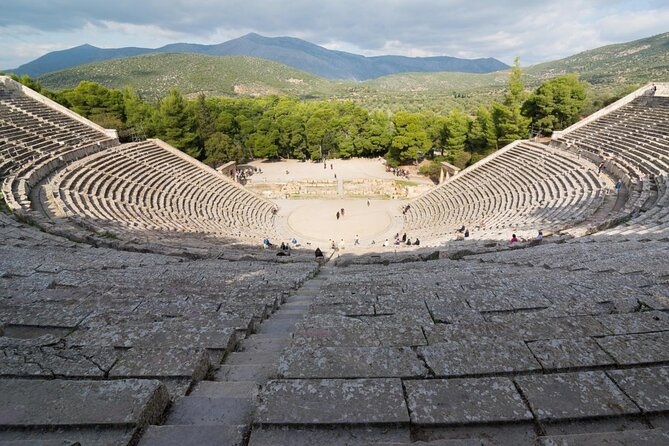
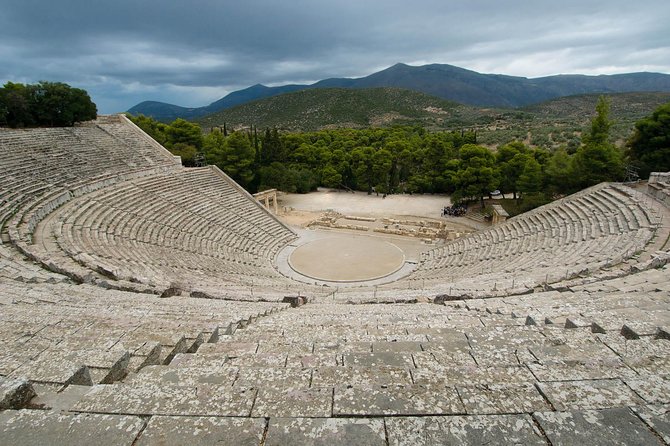
The Ancient Theatre of Epidaurus is the star. Its design includes the theatron, orchestra, and skene, the standard three-part structure of a Hellenistic theater. The remarkable feature is its acoustic design. A person speaking from the center can often be heard clearly high in the seating area, making the theater more than a beautiful shell.
The theater avoided major Roman alterations, so its original character remains unusually clear. You can take in the symmetry, the rows of stone seats, and the mountain setting without needing a long lecture to understand why the place is special.
Thirty minutes is enough to admire the structure and test the famous acoustics if conditions allow. It is not enough for a slow archaeological study of the entire sanctuary. If Epidaurus is your main reason for booking, ask for a licensed guide or consider a private day focused more narrowly on the site.
The Sanctuary of Asclepius explains why the theater was built here. Asclepius was the ancient Greek god of medicine, and Epidaurus became one of his most important healing centers, competing with major sanctuaries at Olympia and Delphi.
The Temple of Asclepius dates to the early fourth century BC. The sanctuary once served people seeking religious healing, and its remains help you see that ancient medicine was tied closely to ritual, sleep, prayer, and sacred space.
The museum contains architectural pieces, columns, inscriptions, and reconstructions from the sanctuary. It is a compact stop, but useful if you want to connect the theater with the wider religious complex.
The combined admission for Epidaurus and its archaeological museum is listed as €20 per person. This is separate from the Corinth ticket, so add €35 per person to your budget for the two paid archaeological areas.
Nafplio is the pleasant pause in the middle of the day
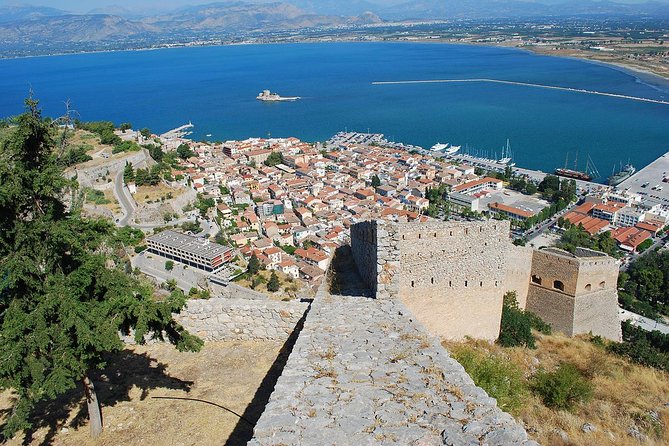
After the ancient sites, Nafplio changes the rhythm. You have about an hour and a half for lunch, coffee, shopping, or a walk beside the harbor.
Nafplio was the first capital of the modern Greek state from 1821 to 1834. Its history also includes Venetian and Ottoman rule, and the town still shows that layered past through its fortifications, stone lanes, harbor, and squares.
This is where the optional traditional Greek lunch becomes useful. The meal is not just a quick roadside stop. It gives you time to sit down, eat local food, and enjoy the town rather than spending the entire day moving between ruins. The exact restaurant and meal arrangements should be confirmed with the driver before ordering, since the lunch option can be added to the booking.
You can also simply use the time for a harbor walk or coffee. The town is a good reset after the open archaeological sites, particularly during a hot day.
From the waterfront, you can photograph Bourtzi, the small Venetian castle set in the harbor. The tour allows around 10 minutes for the view. You do not take a boat to the castle on this outing, so think of it as a scenic stop rather than a fortress visit.
Acronauplia is the oldest part of Nafplio. It once functioned as a separate town before becoming part of the larger fortification system under Frankish and Venetian rule. The area later included a prison and now offers fine views over the town and water.
Palamidi Castle finishes the day high above Nafplio
Palamidi Castle sits on a 216-meter hill above Nafplio. The Venetians built the fortress during their second period of control, from 1686 to 1715.
The fortress commands views over the town, the Argolic Gulf, and the surrounding country. The famous stairway from town is often described as having 913 steps, although local tradition rounds the number to 999. Your vehicle can save you the full climb, but walking inside the fortress still requires uneven ground and some effort.
The planned visit is about 30 minutes. That is enough for a look at the main fortifications and the views, but not a leisurely exploration of every corner. I would save a little energy for this stop, since the combination of stone paths, slopes, and heat can make it more demanding than the timetable suggests.
Drivers shape the quality of the day
The driver makes a large difference on a private road tour. Past drivers have included Alex, George, Nikos, Notis, Fotis, Petros, Kostas, Anthony, Panos, Takis, Thanos, Vassilis, and others. The strongest experiences come from drivers who explain the history before each stop, answer questions during the drive, and adjust lunch or sightseeing time when possible.
You should also understand the limits. Your driver may leave you at the entrance, give you a meeting time, and wait with the vehicle. That can feel like a guided tour if you want detailed interpretation inside every site, but it can feel like a chauffeur service if you expect a licensed archaeologist.
The optional guide is therefore not a minor extra. It changes the character of the outing. With a guide, you receive direct explanations among the ruins. Without one, you receive transport, general commentary, and independence.
How the price compares with the value
At $229.14 per person, the tour costs more than a shared coach excursion or a basic bus connection. You are paying for a private vehicle, flexible pickup, hotel or port transfers, air conditioning, Wi-Fi, bottled water, and an itinerary that would be difficult to manage independently in one day.
The value improves when several people share the vehicle. It also improves if you are staying in Athens before a cruise and want to see the Peloponnese without adding an overnight stay or arranging several separate transfers.
Remember to add the €35 in site admissions per person. Lunch is included only with the Greek traditional food option, so clarify that choice when booking. A licensed guide is also extra and depends on availability.
The provider allows free cancellation up to 24 hours before the start time. Changes or cancellations inside that window are not accepted for a refund.
Who should book this Corinth and Nafplio tour
I would choose this for a first visit to Greece when you want more than Athens but have only one spare day. It suits families, small groups, cruise passengers, and anyone who prefers a private car to a large coach.
It is also a good choice if Saint Paul’s connection to Corinth matters to you, or if Epidaurus and Nafplio are both on your wish list. The range is impressive: engineering at the canal, ancient city ruins, Christian history, a Greek theater, a healing sanctuary, a harbor town, and two fortresses.
I would hesitate if you dislike long drives or want slow, detailed visits at every archaeological site. I would also pay for the licensed guide if your main goal is to learn inside the ruins rather than simply reach them.
Should you book it?
Book this tour if you value private transport, flexible timing, and a broad taste of the Peloponnese. The itinerary covers a lot, and the excellent drivers can make the road time comfortable and informative.
Do not book it expecting a traditional guided tour by default. For that, request the licensed guide. For everyone else, this is a well-planned full day that links three very different Greek experiences without the hassle of driving yourself.
FAQ
How long does the Ancient Corinth, Epidaurus, and Nafplio tour last?
The experience lasts approximately 8 to 9 hours. The pickup time can be adjusted on request.
Is hotel pickup included?
Yes. Pickup and drop-off are available from hotels, apartments, airports, and ports in Athens. The driver waits in the hotel lobby, at an apartment entrance, in the airport arrivals hall, or at the port gate.
Does the driver enter the archaeological sites?
No. Drivers can provide English commentary and answer questions, but they are not official guides and do not accompany you inside the sites. A licensed guide can be requested for an additional cost, subject to availability.
How much are the entrance fees?
Ancient Corinth and the Archaeological Museum of Corinth cost €15 per person. Epidaurus and the Epidaurus Archaeological Museum cost €20 per person. These fees are not included in the tour price.
Is lunch included?
Lunch is included with the Greek traditional food option. You can also use the 90 minutes in Nafplio for lunch, coffee, or shopping, and should confirm the meal arrangement when booking.
Can I cancel for a full refund?
Yes, if you cancel at least 24 hours before the experience begins. Cancellations or changes made less than 24 hours before the start time are not accepted for a refund.
More Private History Tours in Greece
- Ancient Olympia full day private tour from Athens
★ 5.0 · 83 reviews - Half Day Historical Athens City Private Taxi Service Tour
★ 5.0 · 79 reviews - Ancient Athens for Kids 4-Hour Private Walking Tour
★ 5.0 · 66 reviews - Ancient Sparta Ancient Corinth Private Tour from Athens/ Nafplio
★ 5.0 · 58 reviews
More Private History Tours in Athens
- Private Tour of Apostle Paul’s Footsteps in Ancient Corinth
★ 5.0 · 275 reviews - The History of Athens: Greek Mythology Private Tour
★ 5.0 · 138 reviews - Ancient Corinth, Mycenae, Epidaurus, Nafplio full day private tour from Athens
★ 5.0 · 130 reviews - Ancient Corinth and Canal half day private tour from Athens
★ 5.0 · 96 reviews
Newest history tours we have reviewed in Athens
- The original Christian tour on Paul’s footsteps in Athens and ancient Corinth★ 4.5 · 25 reviews
- Ancient Sparta & Mystras Private Day Tour from Athens★ 5.0 · 52 reviews
- Athens: Combo Ticket for Acropolis & 6 ancient sites★ 3.0 · 21 reviews
- Small-Group Women History in Ancient Greece Walking Tour★ 5.0 · 38 reviews
- Ancient Corinth, Sanctuary of Hera, Blue Lake & Canal from Athens★ 5.0 · 26 reviews
- Half Day Historical Athens City Private Taxi Service Tour★ 5.0 · 79 reviews
- Ancient Agora & Temple of Hephaestus Entrance Ticket★ 3.5 · 22 reviews
- Private Luxury Tour: Marathon – Battle & Run That Changed History★ 5.0 · 30 reviews
Ancient History Tours, compared.
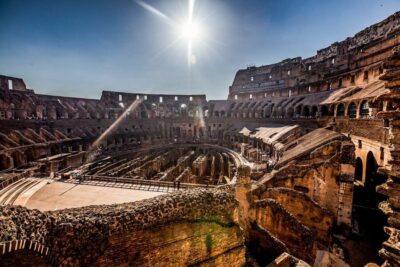
Colosseum: Underground and Ancient Rome Tour
Read our review →
Colosseum & Ancient Rome with Arena Floor Option I Max 6 People
Read our review →
Colosseum, Ancient Rome Tour or AudioGuided Tour
Read our review →
Colosseum Underground & Ancient Rome Guided Tour
Read our review →
Taormina: Ancient Theater Skip-the-Line Ticket & Audio Guide
Read our review →
Discover the Ancient Ruins of Pompeii: Day Trip from Rome
Read our review →