
Review · AMSTERDAM HISTORY TOURS
Amsterdam: Private Pedicab Historical Sightseeing Tour
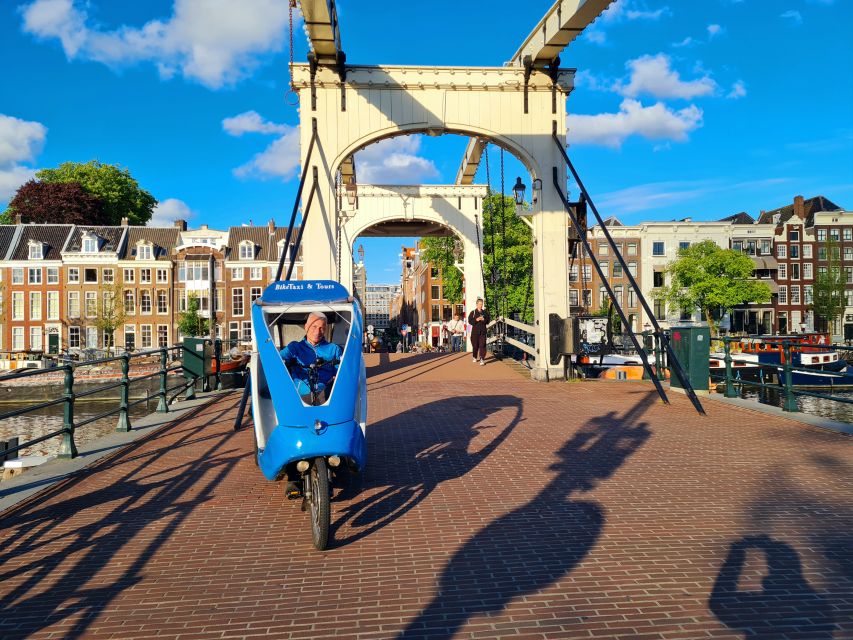
Amsterdam’s history comes into focus quickly from the seat of a pedicab. You move through the old center, canal ring, Jewish quarter, Chinatown, and Museumplein without spending two hours on foot, while a local guide explains what you are seeing. Bram de Haan is the named guide, and his use of old photographs and maps adds welcome context.
I like the easy access to narrow streets that cars cannot use, and I like the personal scale of a private tour. The main consideration is the price: at $230 for up to two people, it is good value for a pair who wants a private introduction, but expensive if you are comparing it with a shared walking tour. The combined passenger weight limit is 200 kilograms, and the activity is not suitable for anyone over 100 kilograms.
Key points at a glance

- Dam Square sets the story: Begin at the city’s central square, beside the Royal Palace, New Church, and National Monument.
- The pedicab saves your legs: You cover several historic districts in two hours with little walking.
- The Amstel provides the best photo stop: See the Skinny Bridge, seven bridges, houseboats, and the canalized river.
- Jewish Amsterdam receives serious attention: Visit the Great Synagogue, Portuguese Synagogue, Holocaust Names Monument, and former Sephardic homes.
- Bram adds visual context: Maps and photographs help explain how Amsterdam grew and changed.
- It suits a private pair best: Hotel pickup, a flexible finish, and room for questions make this more personal than a large group tour.
Why a pedicab works well in Amsterdam’s old center

Amsterdam is compact on a map, but its historic districts spread across canals, bridges, and streets where cars cannot always go. A pedicab gives you the useful middle ground between a walking tour and a full vehicle tour. You sit close to the street, see the buildings at a human scale, and let someone else handle the route.
This matters most if you have limited walking ability. Several people who took the tour were seniors, and the pedicab allowed them to see the main sights without turning the day into a test of endurance. You still need to get in and out at stops, but the two-hour ride greatly reduces the amount of walking required.
The ride is private for up to two people, which keeps the pace flexible. You can ask questions, pause for explanations, and request photographs without waiting for a large group. The tour also includes hotel pickup and drop-off, with a chance to choose another ending point in advance.
The tradeoff is space. This is a small pedicab, not a roomy sightseeing coach. The combined passenger weight must be no more than 200 kilograms, and the activity is not suitable for people over 100 kilograms. If you are close to either limit, check before booking rather than hoping the restriction will not matter.
More Private History Tours in Amsterdam
- Anne Frank and the Jewish History of Amsterdam Private Tour
★ 5.0 · 307 reviews - Private Boat Tour Amsterdam – 90 Min incl. welcome drink on historic saloon boat
★ 5.0 · 82 reviews - Amsterdam Private Historical Walking Tour
★ 5.0 · 75 reviews
Dam Square gives you Amsterdam’s opening chapter
The tour begins at Dam Square, the city’s main square and the place from which Amsterdam grew. It is a useful starting point because several major buildings sit close together: the Royal Palace, the New Church, and the National Monument.
You will hear how the square fits into the city’s early development before moving into the older streets. The setting is busy and central, but that is part of its value. You are not starting with an isolated monument. You are starting at Amsterdam’s civic heart, where royal power, religious life, and national memory share the same space.
The stop is more about orientation than a long museum visit. No entrance fees or interior visits are included, so think of this as an outdoor introduction. If you have only just arrived in Amsterdam, Dam Square helps you understand where the old center begins and how the rest of the route relates to it.
Zeedijk and Chinatown reveal the city’s layers
Next comes Zeedijk, a street that once formed part of the dike protecting the old city. That detail gives the street more meaning than its present-day shops and restaurants suggest. Amsterdam’s relationship with water is not a side story. It shaped the city’s defenses, neighborhoods, and growth.
You will see one of the oldest surviving cafés with its original interior. The tour does not include food or drinks, so this is an exterior sightseeing stop rather than a café break. Still, the old interior is a useful reminder that Amsterdam’s past survives in ordinary places, not only in grand museums.
A little farther along, you get a glimpse of Chinatown. The route does not promise a full food tour or extended exploration, but the brief visit adds another layer to the old center. In a short distance, you move from a former defensive dike to a historic café and then into one of the city’s most recognizable international districts.
New Market and Montelbaanstoren show Amsterdam’s defenses
New Market Square brings you to one of the old center’s most important buildings, a 15th-century city gate located in the middle of the square. The guide uses this stop to explain the square’s role and the city’s development.
This is one of the places where a local explanation helps. On your own, you can admire the gate, but you may not understand why it is there or how the square fits into Amsterdam’s former defenses. The tour keeps connecting buildings to the city’s growth instead of treating each sight as a separate photo stop.
A few minutes later, the pedicab reaches Montelbaanstoren. This old watch and defense tower formed part of Amsterdam’s expanded defensive line in the early 16th century. From here, you look over the Oude Waal, where houseboats sit in front of 17th-century canal houses.
That view combines several eras in one frame: medieval and early modern defense, floating homes, and the tall merchant houses that define Amsterdam’s canals. Bring a camera, but also listen to the explanation. The point is not simply to collect another tower photo. It is to see how protection, trade, water, and housing worked together.
More Private History Tours in the Netherlands
- Historic Amsterdam 2-Hour Private Tour with Local Guide
★ 4.9 · 53 reviews - Amsterdam: Private Anne Frank and Jewish History Tour
★ 5.0 · 26 reviews
The Jewish quarter asks for time and attention
The Jewish quarter is one of the most important sections of the route. You will see the Great Synagogue, described as the first synagogue Jewish people were permitted to build in Western Europe more than 350 years ago. Across the street is the Portuguese Synagogue.
The route then reaches the Holocaust Names Monument, made with 102,000 bricks bearing the names of Dutch Jewish victims of the Second World War. This is a serious stop, and it changes the tone of the tour. The guide’s historical explanation includes Amsterdam under the occupation of Hitler’s army, so you are not getting only a cheerful canal ride.
Across from the monument are 17th-century canal houses once inhabited by successful Sephardic Jewish immigrants involved in the diamond trade. That contrast is important. The neighborhood shows both the cultural and economic contributions of Jewish residents and the terrible destruction caused by the Holocaust.
You should allow yourself to pause mentally here. The pedicab keeps the route moving, but this is not a section to rush through while taking quick snapshots. If you prefer a tour focused only on architecture and light sightseeing, the Holocaust Names Monument may feel heavy. For most visitors seeking a fuller understanding of Amsterdam, it is one of the route’s most worthwhile parts.
The Amstel brings the best open views
The ride continues to the Hermitage, housed in a large 17th-century widow’s house that later became a museum. The building gives you another example of how Amsterdam reuses old structures for modern cultural purposes.
Then comes the Skinny Bridge, one of the city’s best-known bridges. From this point, you get a broad view over the canalized Amstel, Amsterdam’s main and widest canal. The bridge is especially attractive at night, when hundreds of light bulbs outline its narrow design, but the daytime stop still offers a strong view and a good place for photographs.
The sight of the Amstel is a useful change after the tighter old streets. You see the water as a broad urban route rather than as one more narrow canal. The view also helps explain Amsterdam’s name and development, since the city grew around the river and its connections.
If you want a particular photograph, say so. Stops are built into the route, and one past participant wished they had known they could get out briefly at certain locations for pictures. The practical lesson is simple: ask. The private format gives you more room to speak up than a large coach tour.
The 17th-century canal ring explains Amsterdam’s look
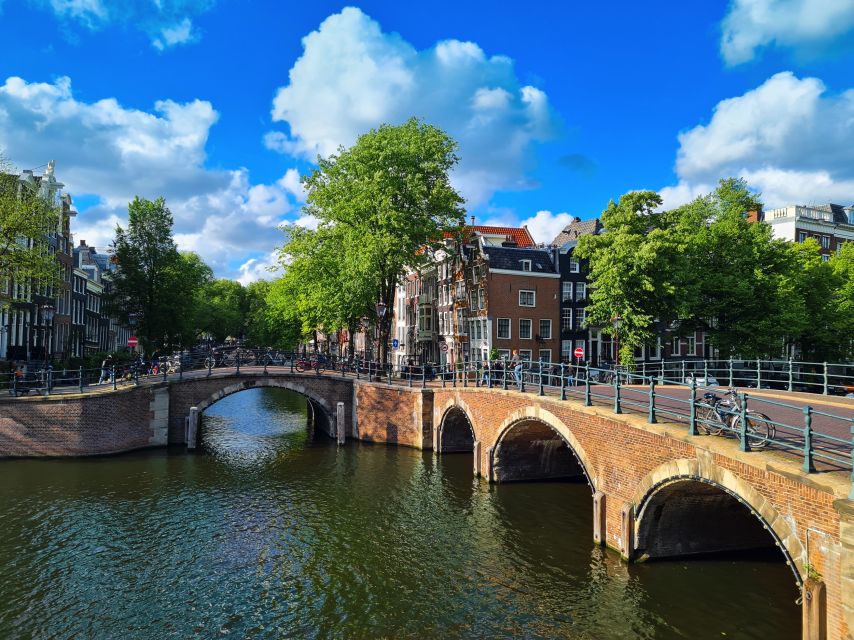
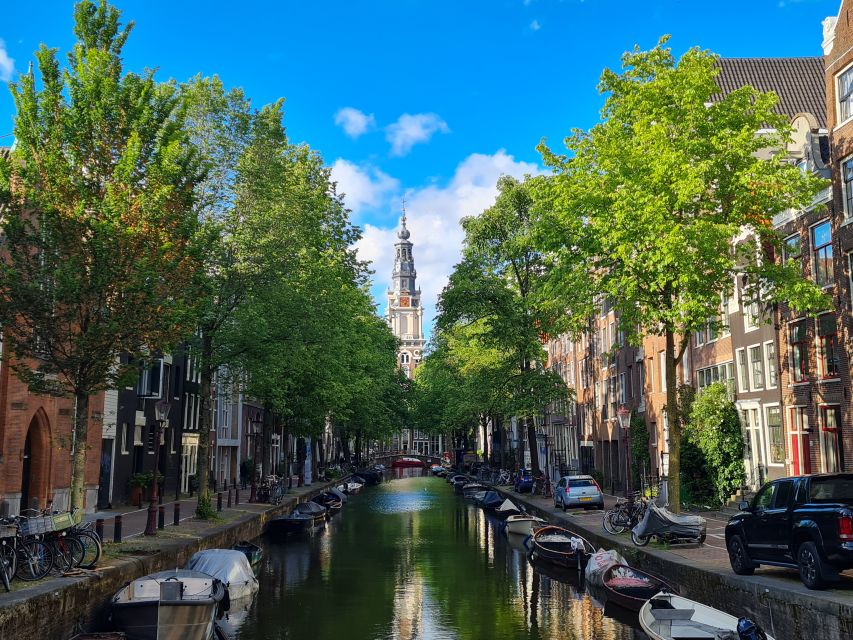
After the Amstel, the pedicab enters the canal district, the 17th-century neighborhood that curves around the old center in a series of half circles. This is the Amsterdam most people picture: rows of narrow canal houses, bridges, water, and streets following the curves of the historic plan.
The guide points out that the houses were built for successful merchants. They are not identical, although buildings from similar periods share certain features. You will learn to notice those patterns instead of seeing the canal ring as one long row of pretty façades.
That architectural explanation adds value to the ride. Amsterdam’s canal houses can blur together after a while, especially when you are trying to watch bikes, bridges, and traffic at the same time. A local guide can direct your eye toward details connected to the building period and the people who lived there.
The pedicab is particularly useful here because it can reach streets that cars cannot. You get a close view without committing to a long walk beside the canals. The compromise is that you will not have unlimited time at every bridge or house. This is an overview tour, not a specialist architecture walk.
Museumplein finishes the ride among major museums
The final planned stop is Museumplein, a large 19th-century green square surrounded by some of the Netherlands’ most important museums, including the Rijksmuseum and Van Gogh Museum. The pedicab passes through the Rijksmuseum tunnel before stopping in the middle of the square.
This is a smart ending point. After the cramped medieval streets and curving canals, Museumplein gives you open space and a clear sense of Amsterdam’s later growth. It also leaves you near two major museums if you want to continue sightseeing on your own.
The tour does not include admission to either museum, so plan separate time and tickets if you want to go inside. The two-hour schedule is designed to show you the setting, not replace a museum visit.
You can arrange a preferred final location before the tour. That makes Museumplein a useful endpoint, but it does not have to be the last word if your hotel or another part of the city suits your plans better.
Bram’s guiding style adds more than directions
The guide named for this experience is Bram de Haan, a native Amsterdammer who leads the tour in English, Dutch, or German. His role is more than pedaling and pointing. He explains how the city developed and uses photographs and maps to show how Amsterdam changed over time.
That visual material is especially useful at places where the modern street does not immediately reveal the past. A map can make the canal ring’s half-circle design clear. An old photograph can help you understand how a square, monument, or neighborhood looked before later changes.
Bram’s local perspective also gives the tour a personal feel. The strongest praise focuses on his warmth, preparation, historical explanations, and willingness to answer questions. One pair extended the experience from two hours to three, which suggests some flexibility may be possible, although the standard duration is two hours and any extension should be arranged directly.
The tour is not a scripted audio ride. If you like to ask why a building matters, how a district changed, or what you are looking at in an old photograph, this format should suit you well.
Price, comfort, and who gets the most value
At $230 per group of up to two, the tour costs more than a shared walking tour. The price makes more sense if you divide it between two people and place a high value on private guiding, hotel pickup, limited walking, and a route covering several districts.
I would especially consider it for a first visit, a short stay, or a pair with limited mobility. In two hours, you see the old center, Jewish quarter, Amstel, canal ring, and Museumplein without arranging several separate outings. You also get a local explanation rather than simply following a map.
The tour includes a blanket for cold weather, though you should still wear warm clothing. One person found the blanket useful on a cool, rainy day, while an earlier experience suggests it is wise not to rely on warmth alone. The pedicab is open to the conditions, so dress for the weather.
Food and drinks are not included. There is also no listed museum entry, so budget separately if you want to visit the Rijksmuseum, Van Gogh Museum, or another attraction after the ride.
Free cancellation is available up to 24 hours before the start for a full refund, and you can reserve now and pay later. Those policies are helpful when weather or arrival plans are uncertain.
Should you book this Amsterdam pedicab tour?
Book it if you want a private, low-walking introduction to Amsterdam that combines the major sights with serious historical context. It is especially well suited to two people, first-time visitors, older travelers, and anyone who prefers a local guide over a large group.
Think twice if you want long museum visits, a food-focused outing, or the lowest possible price. You will see many places, but mostly from the pedicab with short stops rather than extended exploration.
For the right pair, the value is clear: Bram’s explanations, hotel pickup, access to narrow streets, and a route that links Amsterdam’s medieval center, merchant canals, Jewish quarter, wartime memory, and museum district. Ask to stop for photographs, dress warmly, and confirm the weight requirement before booking.
FAQ
How long is the Amsterdam private pedicab tour?
The standard tour lasts two hours. An extension to three hours may be possible, but the listed duration is two hours.
How many people can join the private pedicab?
The price covers a private group of up to two people.
What is the passenger weight limit?
The maximum combined passenger weight is 200 kilograms. The activity is not suitable for anyone over 100 kilograms.
Where does the tour begin?
The sightseeing starts at Dam Square, in the heart of Amsterdam’s old center. Hotel pickup is included, and you should wait outside in front of your hotel.
Can I choose where the tour ends?
Yes. You can arrange a preferred finishing location in advance.
Which languages are available?
The live guide can conduct the tour in English, Dutch, or German.
Are food, drinks, and museum tickets included?
No. Food and drinks are not included, and the tour does not include admission to the Rijksmuseum, Van Gogh Museum, or other museums.
Newest history tours we have reviewed in Amsterdam
- Amsterdam: Jewish Quarter and History Guided Tour★ 4.7 · 210 reviews
- Skipping Lines & Sipping Beers: A History Tour of Amsterdam★ 5.0 · 22 reviews
- Amsterdam: Iconic Canals & Historic Sights Walking Tour★ 4.5 · 90 reviews
- Amsterdam Walking Tour:Anne Frank, History & Liberal Culture★ 5.0 · 18 reviews
- Amsterdam: Walking Tour of Historic Center★ 4.6 · 24 reviews
- Amsterdam: Luxury Canal Cruise with Historic VR Experience★ 4.7 · 31 reviews
- Amsterdam: Ghost Walking Tour and Dark History★ 4.8 · 118 reviews
- Amsterdam: Historic Boat Cruise with open bar and nibbles★ 4.9 · 31 reviews
Private History Tours, compared.
Private Guided Historic Electric Cart Tour of St. Augustine
Read our review →
Private Full-Day Tour of Historical Alexandria
Read our review →
Private Tour of the Historic City in a Ford T Car
Read our review →
Madrid Historical Tour with Local Guide in Eco Tuk Tuk Private
Read our review →
Private Biblical Tour Ancient Corinth & Isthmus Canal from Athens
Read our review →
Private Kathmandu Sightseeing Tour | UNESCO World Heritage sites
Read our review →
Historic Porto by Private Electric Tuk Tuk to Top Landmarks
Read our review →Browse the lists this tour appears in