
Review · FRANCE HISTORY TOURS
Toulouse Food & History Tour with a Chef (in English)
Toulouse’s best stories arrive with something to eat on this unusual food and history walk. Chef Alejandro ties each tasting to a place, from a sixteenth-century mansion to the Garonne riverfront, serving fresh food from a mobile cart as you move through the city.
I like the clever connection between local dishes and local stories, and I like the small-group feel, with a maximum listed as 10 in one part of the booking details and 14 in another. The main drawback is simple: you stand and walk for four hours, with no seating, so comfortable shoes and a reasonable level of fitness are essential.
Key points to know before booking
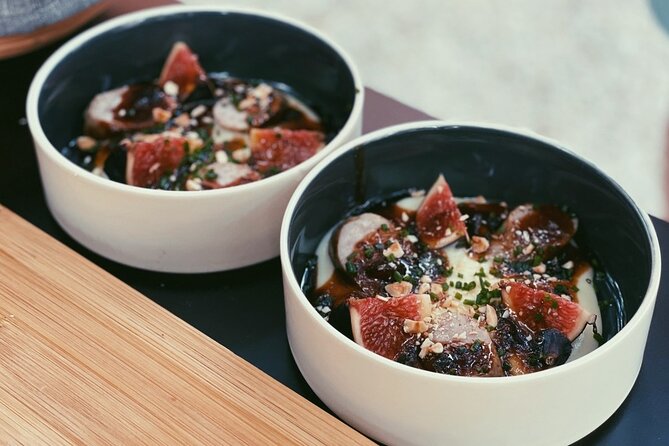
- Seven tastings form a seven-chapter tour: Sweet pastries, sausage, cheese, wine, charcuterie, and a traditional dessert are linked to Toulouse landmarks and local stories.
- Chef Alejandro cooks from a mobile cart: Much of the food is prepared in advance, then finished, plated, or presented along the route.
- The tour covers central Toulouse efficiently: You visit Hôtel d’Assézat, the Garonne, Place Saint-Georges, Marché Victor Hugo, Saint-Sernin, and Place du Capitole.
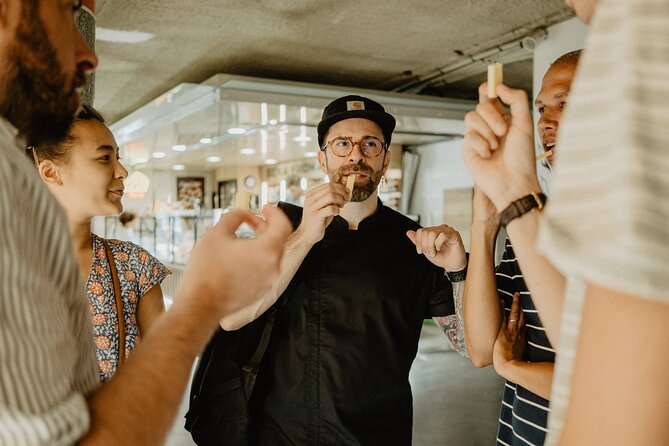
- The history is story-led rather than date-heavy: Expect tales of fires, executions, religious conflict, architecture, and aerospace.
- Come ready to stand: There is no seating during the approximately four-hour walk.
- The $133.02 price buys more than snacks: You are paying for a chef, seven tastings, a guided city walk, and useful food advice for the rest of your stay.
Why this Toulouse tour feels different
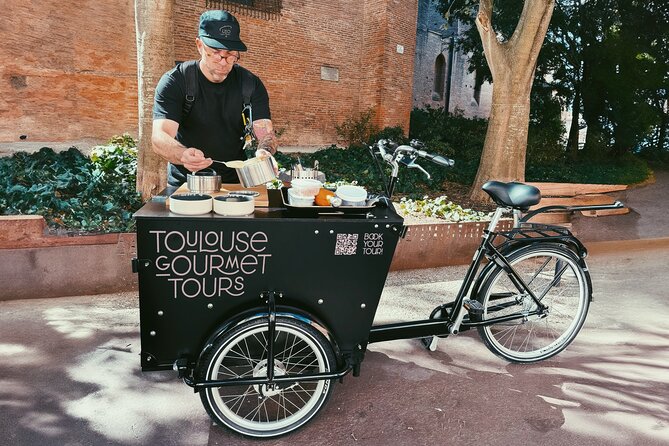
Most city food walks take you from shop to shop, with a bite here and a sample there. This one uses the city itself as the dining room. Alejandro carries a cart, stops at notable places, and prepares or plates food while explaining why that dish belongs in that setting.
That format gives the tour a clear shape. You are not simply hearing a history talk and then stopping for unrelated snacks. A pastry opens the story, a regional sausage becomes the centerpiece of a later stop, and cheese and wine arrive with an explanation of Toulouse’s market culture.
The tour is offered in English and begins at 10:00 a.m. at Fondation Bemberg, inside the Hôtel d’Assézat area. It lasts about four hours and finishes at Basilique Saint-Sernin, a short walk from Place du Capitole. That morning timing works well if you want to use the afternoon for museums, shopping, or a longer lunch.
I also like the follow-up help built into the experience. Alejandro has sent guests notes, photos, market suggestions, food shop ideas, restaurant recommendations, and answers to questions during their stay. That can add real value in a city where the best meal of your trip may depend on knowing which local specialties to seek out.
More History Tours in France:
- Paris: Louvre Museum Entry with History of Mona Lisa
★ 3.9 · 2,823 reviews - Paris: Dark History and Ghostly Guided Walking Tour
★ 4.7 · 1,000 reviews - Vieux Lyon Cultural & Historical Walking Guided Tour (English)
★ 5.0 · 942 reviews
Hôtel d’Assézat and Toulouse’s grand private mansions
The first stop is Fondation Bemberg, located at the Hôtel d’Assézat. The focus is not just the building itself, but the network of grand private mansions found around Toulouse.
You learn how wealthy families made their money in the sixteenth century and how that wealth paid for such imposing homes. It is a useful introduction to the city because Toulouse’s architecture makes more sense once you understand who had the money to build it.
The first tasting is the city’s most iconic baked good. One detailed account identifies the opening pastry as a chocolatine, a classic local term that adds a small but enjoyable regional touch. Starting with a pastry also sets the pace nicely: you begin with something light before moving toward savory food later in the walk.
You have about 30 minutes here. Since admission to the stop is listed as free, the value comes from Alejandro’s interpretation, the food, and the setting rather than from an included museum entry.
The Garonne, the great fire, and an old pâtisserie
At Quai de la Daurade, the tour turns toward the Garonne River. The view gives you a break from narrow streets and offers a natural place to discuss the great fire of Toulouse, which burned 85 percent of the city in the fifteenth century.
That event helps explain why Toulouse looks the way it does. A major fire is not just a dramatic story. It changes building materials, street patterns, and the way a city protects itself in the future. Here, the past is tied directly to the architecture around you.
The sweet bite at this stop comes from the town’s oldest pâtisserie. You should expect another small portion rather than a full dessert course. The food is meant to keep the story moving, not fill you up at the halfway point.
This stop also shows the strength of the tour’s format. You are standing beside the river, looking at the city while eating something linked to Toulouse’s food culture. That is more memorable than hearing the same facts in a classroom or from a guidebook.
Tour de Serta and the oldest timber-frame house
The next stop introduces the Tour de Serta, described as the oldest timber-frame house in Toulouse, dating from 1533. This is a short stop, but it adds variety to the route.
After a grand mansion and a riverfront story, you get a closer look at an older, more practical form of urban building. The contrast helps you read the city as a collection of different eras rather than one uniform historic center.
No separate tasting is specified for this stop, so think of it as one of the tour’s architectural pauses. The food is not constant, and that is probably wise. Seven tastings over four hours is already generous, and breaks for buildings and stories keep the experience from becoming a moving meal with no sense of place.
Same streets, a different century:
- Bordeaux: Historic Center & Chartrons District Bike Tour
★ 4.8 · 709 reviews - From Strasbourg: Best Of Alsace Historical Day Trip
★ 4.7 · 633 reviews - Notre Dame Cathedral: Exterior Guided Tour & Unscheduled Access
★ 4.5 · 409 reviews - Strasbourg: Guided Historical Neighborhoods Walking Tour
★ 4.9 · 275 reviews
Place Saint-Georges and the Toulouse sausage course
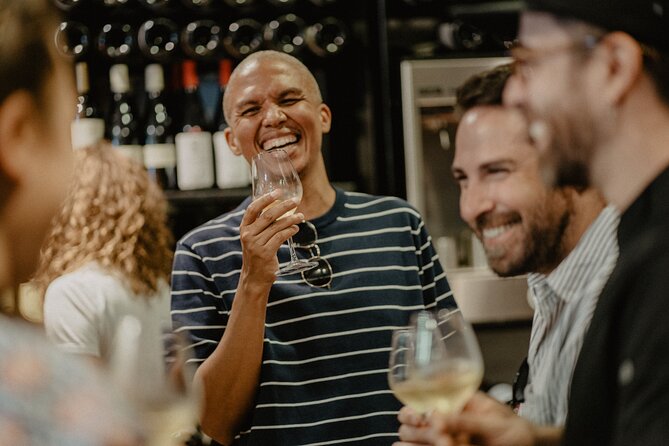
At Place Saint-Georges, Alejandro tells the story of a wrongful execution in the eighteenth century and explains how that event influenced the country’s political future after the Revolution.
It is a heavier topic, and the pairing with the main savory course gives this part of the tour extra weight. You receive a dish made with la véritable saucisse de Toulouse, the region’s signature sausage.
This is likely the most substantial tasting of the morning. If you want to understand a place through food, sausage is a useful entry point because it reflects local habits, ingredients, and pride without needing a formal restaurant meal.
The stop lasts about 30 minutes. You will still be eating on your feet, though, so do not expect a seated plate of food with table service. Alejandro’s cart is part of the charm, but it also means the meal is designed for tasting rather than lingering.
Marché Victor Hugo and a serious cheese-and-wine pairing
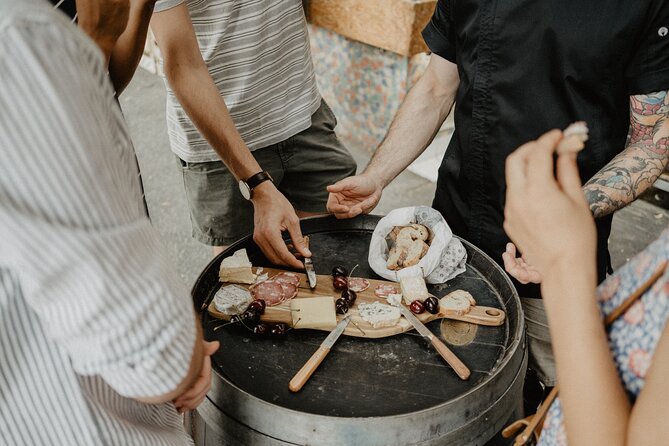
Marché Victor Hugo brings the tour into Toulouse’s market story. The square has changed dramatically over time, moving from a medieval rampart to an art-nouveau market and later to a concrete car park. That sequence is a good reminder that historic cities are constantly rebuilt, reused, and argued over.
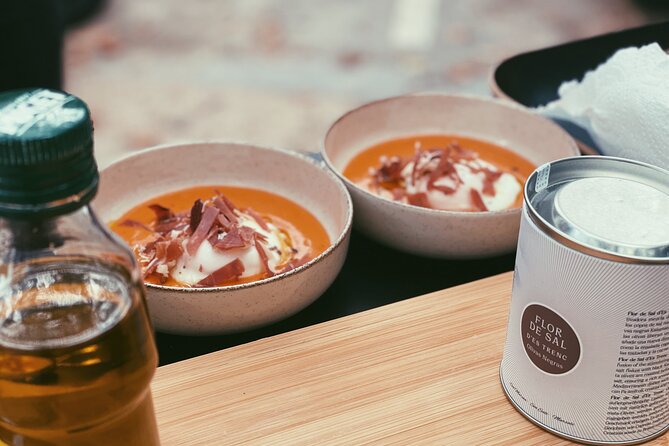
This is where the tour offers its cheese and wine pairing. The emphasis is on artisanal and very local cheeses, matched with wine from the area. Unlike much of the food, which is prepared beforehand and carried along, this pairing is presented as the tasting that happens with the most direct market connection.
You should alert the operator at least 24 hours ahead if you have food allergies or do not drink alcohol. That matters especially here, since both cheese and wine are central to the course. The published information does not provide substitutions, so advance notice is the sensible approach.
For many people, this may be the most useful stop for the rest of the trip. A market gives you clues about what to buy, what to order, and how local food fits into daily life. Even if you do not return to Marché Victor Hugo, the pairing can help you recognize the kinds of products worth seeking in Toulouse shops and restaurants.
Saint-Sernin and a dessert with an ancient recipe
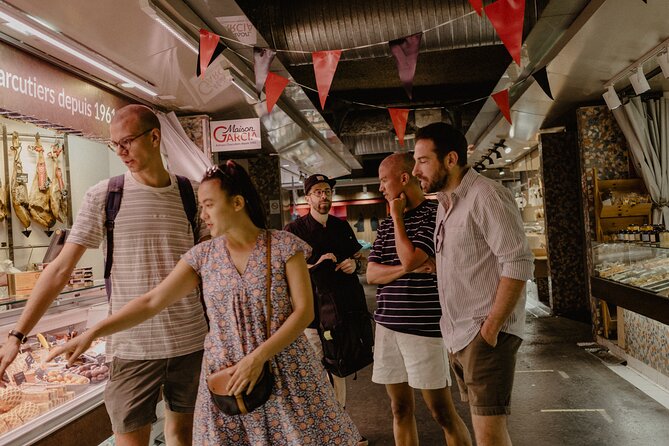
At Basilique Saint-Sernin, the subject shifts to the first Christian of Toulouse, who fought against the Roman Empire. The church provides a fitting setting for a story about belief, conflict, and the city’s early religious identity.
The dessert here is described as Toulouse’s most famous, with a recipe more than 2,000 years old. That claim gives the final sweet course a strong sense of place and time. You are not simply ending with cake. You are tasting a recipe presented as part of the city’s ancient food story.
Saint-Sernin is also a practical endpoint. The tour finishes here, with Place du Capitole about a five-minute walk away. If you have more sightseeing planned, you are already in a useful part of central Toulouse rather than being left far outside the main area.
The basilica stop also helps the tour build toward a clear ending. The food becomes a kind of closing chapter, while the church provides the visual finish. It is a more satisfying conclusion than ending beside an ordinary street corner.
Place du Capitole, aviation, and local charcuterie

Place du Capitole brings the tour into modern Toulouse. Here, Alejandro explains how the city became Europe’s aerospace center and the headquarters of Airbus.
That subject widens the tour beyond old buildings and traditional recipes. Toulouse is not only about mansions, churches, pastries, and market stalls. Its present-day identity is tied to aviation and industry, and the tour makes room for that part of the city.
The final tasting is the area’s most typical charcuterie product. It gives you one more savory bite and reinforces the idea that food can explain a city’s economy, traditions, and regional identity.
The supplied route lists both Place du Capitole and Saint-Sernin among the final stops, while the stated endpoint is Saint-Sernin. Since the two are only about five minutes apart on foot, this should not cause a major planning problem, but I would confirm the exact final position when booking if you have a tight afternoon schedule.
What the food service is really like
Alejandro is a trained chef, but this is not a cooking class. You will not spend the morning preparing a full meal yourself. Instead, he prepares food in advance, carries it on the tour, and finishes or plates it at stops along the way.
That distinction matters. The experience is closer to a moving tasting menu than to a restaurant meal. One account specifically notes that most food is prepared in advance, with the cheese and wine handled differently. You should expect thoughtful presentation and fresh service, but not a kitchen demonstration at every landmark.
The seven tastings include sweet and savory items, with pastries, sausage, cheese, wine, charcuterie, and the traditional dessert all represented. The portions are intended to be enjoyed across four hours, so you may still want a proper lunch afterward.
The chef’s mobile cart is one of the tour’s most memorable details. It gives the experience a playful, handmade feel and lets Alejandro serve food directly at the places connected to his stories. It also means you should dress for walking rather than for a formal meal.
Price, group size, and physical demands
At $133.02 per person, this is not a budget walking tour. The price makes more sense if you value the combination of a professional guide, chef-prepared tastings, seven food stops, and practical recommendations for the rest of your Toulouse stay.
Compared with paying separately for a standard walking tour and several small food samples, the package can be reasonable. It also saves you the work of finding local specialties on your own. Still, if your priority is a large lunch, restaurant seating, or a low-cost overview of the city, you may find the price harder to justify.
The tour requires moderate physical fitness. You will walk and stand throughout, with no seating. Wear comfortable shoes, avoid clothing that makes standing awkward, and keep your morning free of other time-sensitive plans.
The published details describe a small group, with one section listing a maximum of 10 people and another listing a maximum of 14. I would confirm the group size at booking, but either figure is far more manageable than a large coach-style outing.
The minimum booking is two people. Confirmation is provided at booking, and service animals are allowed. The activity requires good weather, and if poor weather or an unmet minimum causes cancellation, you are offered another date or a full refund.
Who will enjoy this tour most
I would choose this tour if you want your first morning in Toulouse to do several jobs at once. It gives you a city orientation, a food introduction, a set of local stories, and a list of ideas for later meals.
It suits curious eaters who like context with their food. You do not need to be a serious food expert, but you should enjoy trying regional specialties and listening to stories about architecture, politics, religion, and industry.
Families can also find plenty to enjoy, especially if everyone is comfortable walking and standing. The food breaks help keep the morning varied, and the guide’s storytelling style is described as humorous and engaging rather than formal or lecture-like.
I would be more cautious if you need regular seating, have mobility limits, or want a slow restaurant-style tasting. I would also contact the operator before booking if you have allergies, avoid alcohol, or need clear information about substitutions.
Should you book the Toulouse Food and History Tour?
I would book it early in a Toulouse visit, ideally on your first full day. The tour’s strongest feature is the way Alejandro connects food to specific streets, buildings, and events. You leave with more than a list of dishes. You have a better sense of what makes Toulouse Toulouse.
The $133.02 price is fair for a four-hour, chef-led experience with seven tastings, but only if you are happy eating on your feet and treating the food as a guided tasting rather than lunch. If that sounds like your kind of morning, this is a smart way to get your bearings and collect useful food leads for the rest of your stay.
FAQ
How long is the Toulouse Food and History Tour?
The tour lasts approximately four hours.
What time does the tour begin?
The tour starts at 10:00 a.m.
Where does the tour begin?
The meeting point is Fondation Bemberg at the Hôtel d’Assézat, Place d’Assezat, 31000 Toulouse.
Where does the tour end?
The stated endpoint is Basilique Saint-Sernin de Toulouse, at 7 Place Saint-Sernin. Place du Capitole is about a five-minute walk away.
Is the tour offered in English?
Yes. The experience is offered in English.
How many food tastings are included?
The tour includes seven tastings, including sweet and savory specialties, Toulouse sausage, cheese and wine, charcuterie, and a traditional local dessert.
Do I need to be physically fit?
You should have a moderate level of physical fitness. The tour involves walking and standing for the entire experience, and there is no seating.
Can I cancel for a full refund?
Yes. You can cancel at least 24 hours before the start time for a full refund. Changes or cancellations made less than 24 hours before the tour are not accepted for a refund.
Newest history tours we have reviewed in France
- Avignon: History and Legend Walking Tour★ 4.8 · 122 reviews
- Avignon: Private Walking Tour – Discover History & Heritage★ 4.3 · 45 reviews
- Avignon: Historic District Guided Food & Wine Walking Tour★ 4.8 · 84 reviews
- Arc de Triomphe Rooftop: Unveil History & Breathtaking Views★ 3.1 · 23 reviews
- Arles: Private Guide Tour – Explore History & Culture★ 4.3 · 22 reviews
- Aix-en-Provence: Between History and City Charm★ 4.9 · 30 reviews
- Private Half Day Historic Tour★ 5.0 · 58 reviews
- The History of Paris: Historical Le Marais Private Tour★ 4.5 · 47 reviews
France History Tours, compared.
Louvre Museum Entry with History of Mona Lisa
Read our review →

Vieux Lyon Cultural & Historical Walking Guided Tour (English)
Read our review →
Bordeaux: Historic Center & Chartrons District Bike Tour
Read our review →
From Strasbourg: Best Of Alsace Historical Day Trip
Read our review →
Notre Dame Cathedral: Exterior Guided Tour & Unscheduled Access
Read our review →
Strasbourg: Guided Historical Neighborhoods Walking Tour
Read our review →
Strasbourg on Foot: Historic Center and Petite France with a Local Guide
Read our review →Browse the lists this tour appears in